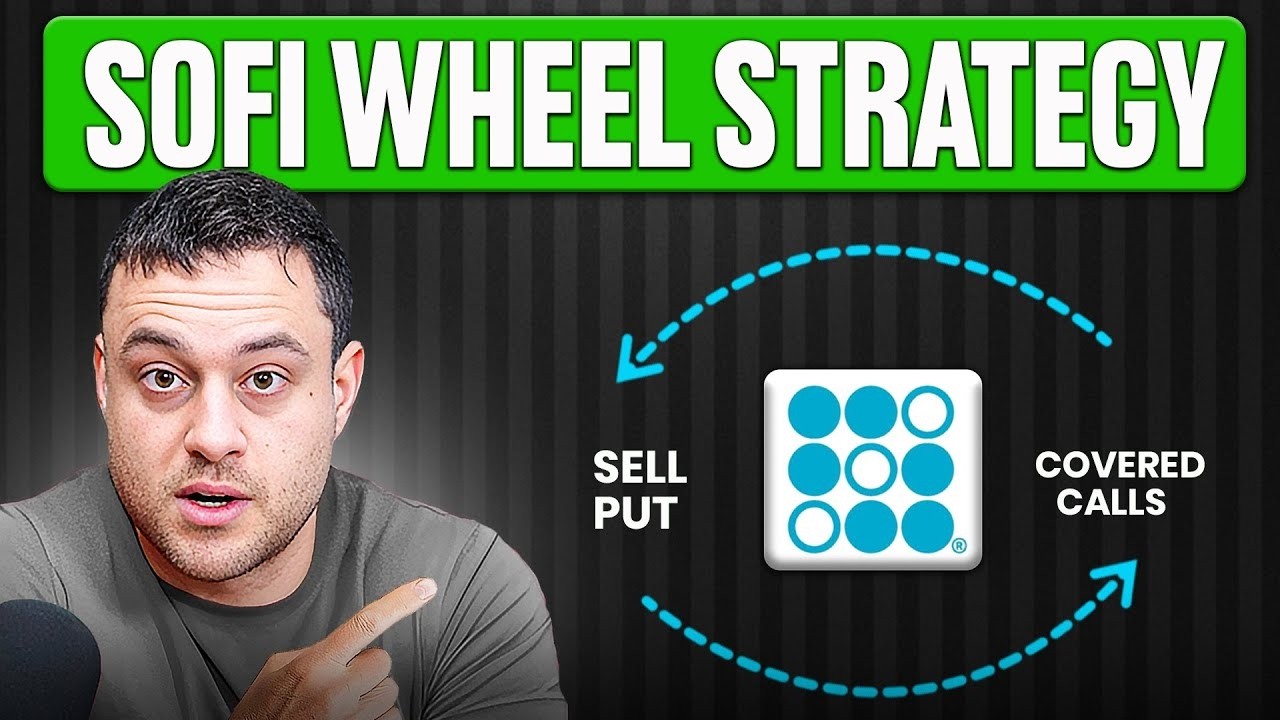
How to Make $10,000/mo Running The Wheel Strategy on SoFi
Now Playing
How to Make $10,000/mo Running The Wheel Strategy on SoFi
Transcript
499 segments
If you're looking to retire and create
income, you should look no further than
SoFi and the Wheel Strategy. I'm going
to talk about both of these. SoFi is a
high-quality company and the Wheel
Strategy is a highquality option trading
strategy that can generate income,
reduce your average cost of purchasing
stock, and make money from holding a
highquality stock. So that's why these
two things together are really good
strategy for creating monthly,
consistent, passive, and safe income. So
let's open up my portfolio right here.
All right, guys. So, take a look at
SoFi. SoFi is currently trading for $18
per share. I have 10,500 shares. My
average cost is $21.18
and I'm currently down on the stock.
That is the full transparency. However,
this does not factor in the wheel
strategy or how much money I have been
making. Literally hand overfist money on
SoFi. It has been ridiculous in terms of
premium collection. So, I want to look
at the technical analysis and show you
pretty much why this is the case. So
although SoFi stock, as you can see
here, it went from like $31 per share
and it fell down a lot. My average cost
again is $21 per share. And I do trade
this every single week in my Discord
community. Now, it has been so fantastic
for us investors despite really kind of
non-existent returns. These are
non-existent. This stock has done
absolutely nothing since March. I mean,
even February, this stock has only been
basically the same price at $19 and now
it's $18. So, it has actually lost $1.
However, because I'm running the wheel
strategy and I'm selling options, I
actually don't mind this. So, let me
show you. I'm going to go to trade SoFi
options and I'm going to go through step
by step and show you why this is such an
interesting play even though it's not
really moving that much. Okay? And I'll
discuss SoFi as a business as well. So,
we'll cover both the technicals and the
fundamentals in this video. But, let's
do a sell put because traditionally with
a wheel strategy, we are selling put
options with the goal of getting
assigned. And if we don't get assigned,
that's fine because we're collecting
premium along the way. So, let's do a
30-day out option, right? A monthly
option. And you can see here, SoFi is at
$18 per share. And if I go down a little
bit lower, and that's the whole point
whenever I sell a put option, my goal is
to go down lower. Even if I do at the
money here, which is $18 strike price,
you can see that the premium is $96. So
this is already very very advantageous
because at $18 if you subtract out the
premium that you collect your break even
is already around $17 per share. So if
SoFi does nothing where it falls $1,
literally doesn't even matter. I mean
you would get assigned at, you know, $18
per share. But if you collected a whole
dollar, your average cost is effectively
17. Okay. But what I'm going to do here
is I'm going to look at the 17 strike
price and I'm going to expand it right
now. So again, this is the first step of
the wheel strategy. The wheel strategy
is my favorite strategy. I've been using
for over a decade. It's just a whole
system and process that's very simple
even for someone who's just starting out
with option trading. This is a not that
expensive strategy because on SoFi,
look, $17 strike price, you're
effectively have to put up about 1,700
bucks roughly. Actually, a little bit
less when you calculate in the premium
that we collect here. But let's go ahead
and start off with the sell put and go
for the 17 here. You can see that the
premium here is $57 which is actually
very very attractive because I think 3%
of 1700 is going to be about $51. So
this is um over 3% in terms of premium
that I collect and this is premium
that's mine. This is premium that enters
my account right away. Okay, that
premium enters your account is still an
effective position in your account and
it is a unrealized gain. Okay, basically
so although it's cash in your account,
you still would have to buy this back to
actually realize the gain. But don't
really worry about that because the
whole strategy that I use with the wheel
is I'm not buying anything back. I'm
just collecting $57. I'm not managing.
Like literally, I am making this as
simple as possible. I work with so many
beginners and I don't want to over
complicate things. I want to make sure
that risk management is as good as
possible and the stocks that we're
selling puts on and running the wheel on
is stocks that we generally want to own.
So, it doesn't really matter if SoFi
were to go up or go sideways or even
come down. We're okay at $17 because
again, going back to the technical
analysis, not only is there like support
levels, but the stock is just going
sideways despite this being a really
strong company. I mean, their member
growth is very rapid. SoFi reached 14.7
million members in quarter 1, 2026, up
35% year-over-year, while adding a
record 1,55,000
million members during the quarter. That
is insane. Like where is a million
people coming from? Can you imagine how
much volume they are doing? And a large
member base gives SoFi more opportunity
to sell additional financial products
without acquiring a completely new
customer each time. So customers that
are acquired are using more SoFi
products. That's what I like about this
business. And when we see the stock here
at $18 per share, I firmly believe that
they have the strongest support of any
stock at around $17 per share because
their revenue is still growing very
quickly. It is ridiculous to see the
stock under $20 per share. I don't think
that's going to last because Q1 2026
their adjusted net revenue increase 41%
year-over-year to $1.09
billion. This is unusually strong growth
for a financial company that has already
reached Sofi scale. This is so unusual.
And what's even more meaningful is the
profitability. So generated $166.7
million of gap net income in Q1 and
report its 10th consecutive profitable
quarter. And every time they report,
literally this company doesn't really do
anything, which is super surprising
because, you know, we're going into
September right now. Basically September
1st on on Monday, right? And SoFi is
still under $20 per share. So when I'm
running the wheel strategy and I sell a
17 put, I hope I get it signed. like
literally sign me up. This is a 31 delta
right here. The implied volatility is
really good at at 49, which is
essentially 50. It's 49.9 is very
attractive. Any implied volatility
that's over 30 35 is already like pretty
good. Like that's medium. And then above
50 is high volatility here. So is like
basically right on that border, right?
They're seeing, you know, almost high
volatility. I'll say medium to high,
upper, medium, upper middle class,
whatever, however you want to put that.
So, this premium that I'm collecting
here is is very attractive. It's not
crazy attractive. Like, in my community,
I do I'm aiming for like 4% plus, and I
have many students that are exceeding
6%. That is something that's very
possible, especially in a bull market.
And when you're looking at stocks that
have more implied volatility for the
wheel strategy, it's a little bit more
of a lower return, lower risk strategy,
somewhere in the middle. And here, this
3% premium that I'm collecting, it's not
crazy, but it's very attractive because
this is a stock that I want to own. So,
I view this from the angle of I'm not
really losing even if SoFi goes down a
dollar. Now, if I wanted to like up my
premium, then I would just go right here
and then this would obviously be, you
know, very attractive. Exactly what I'm
targeting, which is the 4% plus. Like,
in my community, that's pretty much the
goal. I think that's what a lot of
people sign up for is well, first of
all, they want a coach that understands
risk management because the first and
most important thing is not losing
money. That's the most important thing.
It's all fun in games when we're all
making money when the market's up. But
it's protecting yourself on the
downside. So, first of all, I focus on
preserving wealth. That's super
important to me, especially with folks
that work so hard for their money. They
need to protect. But the second thing is
growth and an income. So, this is a
great growth and income strategy. As you
can see here, this is this is very
attractive. Now, okay, let's move on
into kind of like the next step here of
what I would do once I do get assigned.
So, again, let's say that we get
assigned at $18 per share. And again,
we're happy with that because, you know,
SoFi is a great business. Um, and one
thing more that I want to mention is the
banking charter gives SoFi a funding
advantage. That's something that I
really like about SoFi. It's like a
competitive advantage they have because
their deposits reached over 40 billion
and deposits represent more than 90% of
average liabilities during their last
quarter. So, management estimates that
deposit funding saved approximately $622
million in annualized interest expense
compared to, you know, with something
like warehouse funding, right? So, they
are able to fund themselves. They're so
self-sufficient. That's that's what I
was looking for. Self self-sufficient.
Okay. So, it's becoming much more than
just a lending company. They are, you
know, full financial services revenue
company which increased 41%
year-over-year and yeah, just super
strong in the feebased revenue which
creates another growth engine. I think
this is very diversified stock right
now. Let's go to sell call. Okay, let's
get rid of this 18 put and let's say
that we did um you know get assigned at
at 18, right? So, like what do we do
now? Well, let's go back here into
technical analysis. And by the way, what
we're looking at, I didn't really fully
explain myself, apologize, is this
moving average is a 50-day moving
average. It shows you pretty much where
the stock is trading at for the last 50
days on average. I'm going to kind of
zoom in here. U but you can see here
that it is right around 18. So the stock
is literally trading at its moving
average. It's trading in the tightest
range I've seen in a very long time and
really any stock. Such a tight range,
which again is good. So this tight range
indicates that likely SoFi is just going
to continue to trade sideways, right? If
it falls down, great. We will get a
signed on the put side. But let's say we
do get a sign that we are holding
shares. Okay, the wheel strategy, you
don't have to sell puts right away. You
can just start with covered calls if you
want. Although that would technically
not really be by definition the wheel,
but anyways, covered calls. Okay, we
would want to sell above the Ballinger
band. This black line here is the
bowlinger band. I use this all the time
in my coaching. I think it makes it
super simple for anyone that isn't an
expert just to understand where's
support and resistance, where is, you
know, the stock that they're looking at,
whether it's SoFi or anything else. What
is a support and resistance? And the
Bowlinger band gives you a range of
possibilities based off of, you know,
volatility and statistics. So, this
range right here is likely where SoFi
will be trading at in the next, you
know, foreseeable future, such as 20
days. This bowlinger band is a 20-day
period. So, look, the top is roughly 19,
right? 19 or 19 and change, right? So,
what would I do? Well, the stock is
unlikely to go above 19. So, what would
be logical to do would be to sell at 19.
So, you can see here how there's barely
any growth here. Let's say we're at 18.
Well, at 19, we're out. This covered
call would effectively put us out here,
right, at 19 because someone would
exercise and take our shares away.
That's fine. Like if the stock is going
sideways and it slightly goes up to 19
and I have to get rid of it. But I have
it at 18. I have to get rid of it at 19.
Great. That's a whole dollar or $100,
right? Per per contract. However, let's
also factor in the 73 cents here, which
is also the premium that we get
regardless of what happens. Like this is
why I love teaching this strategy so
much and why I optimize my student
portfolios to have typically 50% or more
of, you know, their overall portfolio in
something like the wheel strategy. It's
because it is in my opinion one of the
you know perfect balances of income and
growth. Yes, I have other growth
strategies and I cover on this channel.
I've been covering leaps a lot and I
have yeah 10x leaps group which is in
that group I'm aiming for, you know, I'm
aiming for everything I can get. I'm
aiming to swing for the fences because
LEAP options give me that huge leverage.
That's great. That's fun and I have that
in my portfolio, right? It's a higher
risk, higher reward strategy. But this
right here, I think you should not
overlook. Whether you're a beginner or
intermediate, something like a SoFi
that's going sideways could be extremely
attractive. $19 strike price plus 73,
that gets us to almost $20. And when you
factor that in, I mean, you can do the
math from $18 to 20 is actually very
attractive in one month. And if you can
repeat that, right, that's the hard
part. Can that be repeated month after
month? If so, I'm telling you that is
going to be beating the S&P. that's
going to be beating whatever YouTubers,
investors, hedge funds, people cannot do
that on a consistent basis. In fact,
most people cannot even beat the S&P
500. So, the fact that I have scaled my
portfolio and yeah, I've taken on some,
you know, additional risks outside of
the wheel strategy. Now, I've scaled my
portfolio from 100K to 700K back in 2021
using LEAPS. But then as I continue to
grow my portfolio, the wheel strategy,
which is what you're learning about
here, is what I have implemented more
and more of my capital into because the
predictable income is what I'm after. I
think that's what a lot of people want.
It's not, you know, it's not about
building the biggest assets. It's about
having enough income to live the life
that you want, right? So that is always
kind of the goal and the mindset shift
that I even work with students on
because they come in kind of with like,
you know, some people come in with a
toxic mindset and they've seen too much
content out there that's promising them
like a get-rich quick and they come in
with that mindset. I say, "Hey, no, no,
no, no. I don't believe in that. I
believe in getting rich slow." And when
I say slow, I mean not too slow, but you
know, enough time, years, years. We're
not talking about days. We're not
talking about weeks. We're talking about
years. Okay? So, if you can set up your
future in several years and not have to,
you know, be a slave at work or um you
know, not live the lifestyle and freedom
that you want, you're at a desk job or
you're even, you know, a high-end
profession, engineer, doctor, lawyer,
you're working like 40 hours a week, you
know, I don't know. Like, I'm not doing
that. I have freedom. It's because of
this. It's because of option trading.
And it took time to learn, but it's so
well worth it. And this wheel strategy
right here, $19 strike price on SoFi.
This is the exact type of trades that
I'm placing in my community every single
Monday. I want my students to understand
that you don't have to swing for the
fences to get attractive growth in the
portfolio. So yeah, this is SoFi and
this is the stock that I'm currently
running a good amount of my money. Let's
go back to my SoFi position. I want to
show you just how much I personally have
in SoFi so you can understand the type
of scale and risk management as well
because when you are running the wheel
strategy you don't want to over uh
leverage either because although so
looks attractive of course there's
volatility and the wheel strategy's
risks and dangers are that if the stock
crashes you know you're in trouble I
don't see that to be the case with soi
but again diversification is important
which is why this is 4% of my entire
portfolio but the good news is to finish
the wheel strategy and to get into like
the the full uh philosophy and knowledge
on running the wheel strategy. It's okay
to finish the life cycle selling a put a
covered call and then getting assigned
on the covered call. You essentially
will lose your shares at a higher cost
basis, right? So you have an average
cost of of 24 and then you get rid of it
at 26. That's cool. you made $2 per
share plus you got collect you collected
premium on the sell put side and like
basically step two and step three you
collected covered call income and then
you get out of the stock. So you've
you've made money three times. You made
money selling a put option. You've made
money doing the covered call and then
you made money on the capital gains
capital appreciation of having an
average cost of 24 and then selling the
stock at say 26. And if you're assigned
at expiration you go back to step number
one. You have finished the full life
cycle and then you start selling put
options yet again. You start all over
again. You rinse and repeat. Man, this
is a really powerful strategy. It gets
me excited even just to talk about it
because I think so many people can reach
retirement by running this simple
strategy. You don't have to recreate the
wheel or do any crazy strategies. In my
experience, I have been running the the
wheel strategy for basically almost, you
know, 10 years since I started trading
and learning and it has really helped me
personally achieve retirement as well as
other coaches in the program. Other
coaches are also sevenigure coaches and
we have all been using very simple
philosophy as I was a longtime coach
here. I have you know many years of
experience. The coaches that I work
with, they use a very similar strategy.
They learned from me, but then they
altered it into using the wheel strategy
and changing the delta a little bit,
looking at more innovative stocks. It's
really a flexible strategy, but this is
in my opinion the best blueprint that
you can have is pick a high quality
stock, SoFi, great company, and run the
wheel strategy by positioning yourself
to enter the stock for a discount,
selling covered calls to generate
income. And in terms of position sizing,
I would say that you're safe to
basically use 10% of your money in SoFi
or or or really you don't have to use
SoFi. This is an example. I personally
like the company a lot, but you can use
other companies whether it's maybe Tesla
or Nvidia or Palunteer or or other
stocks in your portfolio. Safe stocks
maybe have blue chip stocks, the the big
blue chip stocks and the S&P 500. Those
are great as well because they are
predictable. They're safe. And the wheel
strategy is a moderately bullish
strategy. So, a stock that has moderate
bullish activity that over the long term
goes up, the wheel strategy just helps
you acquire more shares of that company
and also helps you generate money and
consistent income on stocks that you
already have. So, if you're looking to
generate consistent income, use the
wheel strategy, subscribe to the
channel, and I'll catch you in the next
one.
Interactive Summary
Ask follow-up questions or revisit key timestamps.
This video presents the 'Wheel Strategy' as a consistent, income-generating method for investors, using SoFi as a primary example. The creator explains how to sell put options to collect premiums and potentially acquire stock at a discount, followed by selling covered calls once the stock is held, creating a repetitive cycle of income. The video highlights the importance of choosing high-quality companies, managing risk, and maintaining a long-term perspective to achieve financial independence.
Suggested questions
3 ready-made promptsRecently Distilled
Videos recently processed by our community