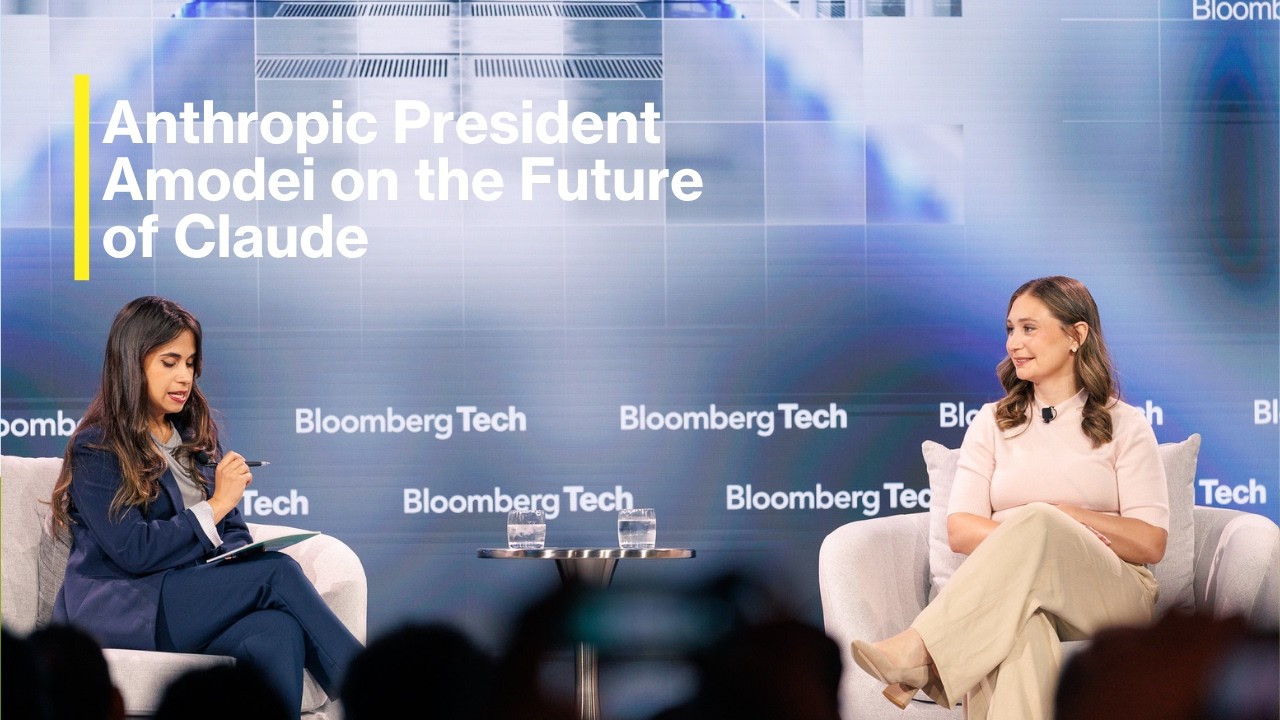
Anthropic President Amodei on the Future of Claude
Now Playing
Anthropic President Amodei on the Future of Claude
Transcript
363 segments
We were chatting about not so long ago when we first met and started covering
anthropic. Um, but for those who aren't familiar,
you and your brother Dario and a handful of other people left OpenAI to start
anthropic back in 2021. Now you employ thousands of employees,
many of them in a reporting chain. Up to you, um, in your role as
president. Uh, I'm curious, what is the difference
in the leadership style between you and Dario?
Well, first of all, thank you so much for having me.
It's great to be here today. And, you know, Dario and I really think
of how we sort of split duties was this incredible technical visionary.
I think, um, you know, years before I was this amazing idea that people were
excited about around the world, they had this really strong conviction that
artificial intelligence is going to be a big deal.
This is like early 20 tens. And I think Dario is constantly
reminding the company about the scale, the ambition, sort of where, um, the
technology itself is going. I think of my role much more as actually
running and managing the day to day of the organisation.
So I manage the executive team. We spend time making decisions about
customers, about our products. About the research and how that applies
to the people that are using, uh, artificial intelligence.
And I like to think that the two of us are a great balance.
Um, and I have to say, like, I don't know how one CEO just runs a company by
themselves. It seems like it's actually much easier
to do with two people, particularly when they know each other really well.
I remember, um, in one of our conversations earlier, are you telling
me that you and Dario rarely fight? And I'm curious how you manage.
What are what are some examples of places where maybe you have disagreed
and have been able to settle it in a healthy way with regard to the business?
Well, as someone who also has a brother, I know, you know, um.
You know, I think we've had, like, you know, a several decades to kind of
practice fighting and getting and still loving each other.
Right. So, um, as early as, like, why did you
take my toy? Um, can I have that back, please?
I think that has served us well. And being able to operate well together
in anthropic. I think what I would say is, you know,
we do disagree sometimes, but I think how you disagree really matters.
And I feel like there is always like, an incredible mutual respect between us.
So if we look at the same situation and we see something different,
I like to think that what our default is, is to be curious, right?
So I usually view it as like, oh, this felt like an obvious call to me.
Like, why do you see it that way? Because usually he'll have a piece of
information that I don't have or will have a different perspective.
And I would say about 80 to 90% of the time, what ends up happening is we meet
in the middle. And so we'll think like, oh, I think
this is the right thing to do. You think this is the right thing to do?
Actually, there's probably a third way to do this.
That's the combination of what we both think.
That's actually a little bit better. I think that's part of the strength of
having both of us, the ability to practice, um, looking at at situations
and decisions just from different points of view and perspective.
And I think it helps us make better decisions.
So two years ago, when you were, uh, sitting on the Bloomberg Tech stage with
Dario, anthropic was still very much the underdog in the competition against
OpenAI. And just in the race to AI generally.
Now it's in a very different position. No longer the underdog plot is a runaway
success, particularly among coders. Your company is projecting $47 billion
in annualized run rate revenue, and the company has eclipsed OpenAI's valuation
for the first time. Do you feel like you're definitively the
front runner right now, and how does that change your approach?
It is something that I think both Dario and I, you know, really hammer at
anthropic is that that is just completely the wrong way to think.
I think our view has always been, you know, this is really about how do we
show up every day for our customers? How do we stay humble and make sure that
we're really focused on the mission? Right.
The whole reason we started anthropic is we want to be able to build and develop
this technology in a way that is ethical, that's responsible, that's
fair. And I think it's really incumbent upon
everybody at the company, but especially leadership to say, you know, all of
these numbers, they're actually not the point, right.
We are really here to do a job. We're here to support the businesses
that rely on us every day. AI is increasingly a bigger part of
everybody's workflow. Their experience at the office, their
experience in their personal lives. That's a huge privilege and
responsibility. And so I think if anything, you know, we
work really hard every day to say, like, our job is to be the best version of of
who we can possibly be as a company every day.
That takes work, that takes humility, that takes time, that takes focus and
energy. I want to talk about the big news
earlier this week that anthropic has filed confidentially for an IPO.
Um, space acts also filed opening eyes expected to file anytime now.
How far back have you been planning to file?
And do you think that there's a race here to be first among the AI companies?
So, uh, yes. Correct me confidentially, you know,
filed our S-1. Um, and that gives us the option, uh,
you know, to potentially go public after the SEC review.
Unfortunately, that's all I can say about about anything IPO related.
I'm sure you understand. I mean, um, if we can just maybe level
up a little. What is the calculus for a kind of an AI
company generally to go public or not in this moment?
What are some of the pros and cons here? Because on the one hand, yes, you can
access more capital, um, if you're not a startup, but on the other, then you're
beholden to, you know, quarterly results, shareholder calls, etc..
So what are some of the pros and cons just generally for an AI startup, do you
think to go public in this moment? So I think, you know, at least speaking
for, you know, ourselves and I think I'd probably really for the eye industry
more broadly. It's a very capital intensive business
to to train AI models. I think that's something we've been, you
know, very open about from from day one. I don't think that's, you know, a
surprise in the industry. And I think this kind of concept of
like, how do you access the level of capital that you need to train these
models? Right.
It's a it's a really big kind of upfront cost to train the models and to sort of
inference on them. And I think that is, you know, my guess
is that, you know, over time, the sort of core set of companies that are
working to advance the frontier are just going to need access to capital.
And I think the public market is very well suited to that.
So there's obviously, of course, trade offs.
But my sense is there's just a fundamental structure of how training
and kind of serving these models for customers, um, works that it will
require that level of access. It's clear that many businesses can't
get enough of Claude, but at the same time, we are hearing about some
customers who are concerned about the pitfalls of so-called token maxing of,
you know, companies making leaderboards of who uses the most AI tokens for using
AI sake. Um, Uber's, uh, one of Uber's executives
talked about it getting harder to justify why spend if there isn't a clear
metrics backed ROI? Do you think there is truth?
The idea that some businesses may be overspending on AI tools in this early
experimental phase, and they may cut back as they move out of that phase?
So I think kind of two things. Two things are at once here.
I think, you know, I like that you said, you know, experimental because I think
the reality is it feels like these AI tools are so powerful and so capable,
which is true. And comparing them, you know,
particularly to, you know, even two years ago when I was, when I was on
stage at Bloomberg with Dario, um, I think the models have just come so far
in what they're able to do in the economic value that they provide.
But I actually think there's a lot more distance to go still for what the models
will be able to do, you know, to to four to 6 to 8 years in the future.
And I would suspect that we will see some,
you know, some, um, experimentation in different fields to understand how do
you kind of get the most value out of these models for what particular
workflows? I think the second thing that's true is,
you know, how businesses are choosing to use AI will change.
So the use cases today. Um, some of them, I expect will continue
to be kind of the the primary driver of, you know, efficiency or, um, creativity
or, you know, new approaches to doing things within businesses, whether that's
coding or, um, you know, financial services, legal, health care.
But I also think, um, and the, the industry as a whole, not just the er,
the eye industry, but really the business community gets, um, more
familiar with the tools we're all going to learn together.
Like, what is the best way to apply these tools that also supports
employees. And so I think today there's this
there's this feeling that it's like, oh, like I, you know, the leaderboards and
it's like, I have to use it and what do I even use it for?
And I think my hope is that over time, it'll be more incorporated into the day
to day of how humans do our work, how we communicate together, and that there
will actually be a lot more value realized in a way that that feels really
good to people. Does anthropic have a leaderboard
itself? We don't have a leaderboard, no.
Or at least not not in the way you've described.
We do track how much we're using cord internally and for what use cases,
because we really try to prototype all of the tools that we give to our
customers. And so all of the products that, you
know, you see, whether that's, you know, coupon code, core design, um, like all
of these are things that we actually built at Anthropic first because we
said, hey, this is a real need. We have.
Could Claude help us with this? And so I think it's important for us to
just have a kind of a metric for checking, like how are we using it and
how much are we using it. But there's not a like you must use I
and you must use it, and it's better if you use it or not.
What, um, type of job function outside of coding or research?
Uh, are using Claude most internally. The entire company uses Claude for, uh,
for topics large and small. Probably the second biggest I would
actually say is finance. Um, and so a lot of the kind of back end
financial planning analysis, uh, you know, like just number analysis.
I think Claude is really, really helpful, uh, at that.
But honestly, like, our people team built an incredible tool internally, um,
for how we do performance reviews that leverages Claude.
We're in the middle performance review season, I have to say, like, the
feedback from our team has been so positive.
Um, they're like, it just feels so much more fun to do this.
It's so much more interesting, interactive.
It's pulling in information about what I did over the course of the past six
months when I'm assessing myself, and I think that it really just speaks to the
generality of these tools, their ability to, I think, reach across the business
and, and just take a lot of information in and help you as an employee, be more
successful in your role. Dorian and Tropics leadership has been
vocal about the need for more compute. Um, your company recently made a major
deal with ex AI to lease compute. There are others.
OpenAI, uh, made a big splash sort of earlier on with securing huge data
center deals and spending, you know, up to a trillion on it, on, uh, on
infrastructure. Why did anthropic take a little bit of a
different approach? And in hindsight, do you think you
should have done more earlier on on the compute front?
We've talked publicly about this concept of sort of the cone of uncertainty
related to compute. And I think something that's important
to know is you the sort of structure of these deals is you have to commit to a
certain amount of compute, you know, reasonably far in advance.
And so I think anthropic view has always been we are we are wanting to, you know,
plan for the best outcome but not overextend ourselves such that we're
buying more compute than we could productively use.
It's really hard to predict that, you know, perfectly.
And I think we would much prefer to be on the side of having a little bit more,
um, demand for the product than we're able to serve, than the inverse where
you overshoot and then you're actually, like, not in a great situation because
you've bought something. You can't pay for it down the road.
It is really hard to get this right. I think the industry as a whole, uh, is
still grappling with how to kind of structure these deals, but I think my
sense is it's it's impossible to know what the future will look like.
On balance, I continue to think it's better to be fiscally responsible and
think, you know, carefully about how much you're going to buy, make sure that
you have the ability to actually use all of that compute in the future, and we'll
probably undershoot or overshoot at some point a little bit in the announcement
with SpaceX, anthropic expressed preliminary interest and using potential
data centers in space. Uh, what do you think about that?
Is that a reality? And how far out are we for that?
Um, I don't think that data centers in space are something that will be, uh,
will be on our to do list in 2027. Um, but I, you know, I will say AI is
the field that has surprised me the most.
It's probably surprised the world the most in terms of just what new things
are possible, are made possible by the advent of this technology.
So, um, no immediate, immediate plans for, uh, for working with astronauts to
to get Space center, uh, data centers going, but you never know.
A few months ago, anthropic had a very public battle with the Pentagon over
restrictions on its AI software. Are you more or less optimistic today
about finding a solution to that? Anthropic has been really leaned in from
day one and talked very publicly about our commitment to national security.
And we were the first company available, um, on the top secret cloud.
I think our commitment to, you know, these values and these principles are
also very, very old, right? It's sort of not not a new, not a new
thing for us. But I have to say, I've been very
impressed the degree to which we've been able to work productively, you know,
with the administration around a wide variety of topics.
And I think that's actually been the been the much bigger story over a long
period of time is our ability to to partner productively with government at
all kinds of, of levels. Because fundamentally, I think
artificial intelligence is and will be a geopolitical issue.
And in order to be an ethical and responsible lab, we need to work with
governments around the world, uh, in the US, but also in partner countries to
say, how can we how can we roll this technology out in a way that's safe, in
a way that's good for people, that's going to protect democracy?
Um, and so I do really feel optimistic about this in the long run.
Do you think other companies like OpenAI or Google have been able to negotiate
better deals with the government because of anthropic sticking to its position?
You know, I think every individual company is going to have their own
stance and sort of their own principles about like what what their red lines and
what their values are. And my sense is anthropic will always
be, you know, as open as we can be about what our principles and values are, why
we have those principles. But ultimately, I think it's important
that whatever those values are for you as a company, that you are true to them,
um, that you feel like you can explain them to employees and to the world more
broadly and fundamentally. You know, we can't really control what
what other businesses are going to do. I think anthropic role is to be the sort
of best version of itself. Again, to say, like, if we were the only
organization in this, you know, in this situation, how would we want to behave?
I think that's that's really the best way we've been able to navigate many
difficult decisions at the company over over the years.
I think philanthropy seems to be a big part of anthropic culture.
I know you and many anthropic co-founders have pledged to give away
half of your equities and 80% or, sorry, 80% of your equity.
I'm curious, would you be in support of something like the proposed billionaire
tax ballot in California that would impose a one time tax on individuals
whose net worth exceeds 1 billion? So anthropic has, I think, again, like
pretty publicly talked about the fact that we think AI is going to create a
huge amount of wealth. We're already seeing that.
And I think we've been pretty open about this idea that that should be
redistributed in some fashion, both the pledge and then a lot of sort of views
of anthropic when we're talking about, you know, potential for labor
displacement, are really grounded on this belief that if we don't take
intentional actions, I, like many technologies, will probably widen the
the gap of inequality and disparity. That's not what we want to see.
So I think there are a lot of interesting suggestions kind of floating
around for for how to approach that. Of course, the part we can control is,
you know, what do we as a company and as individuals, as co-founders sort of
choose to do with, you know, any, you know, economic benefits that we get from
I but I think this is a really big and important question that actually goes
beyond the walls of any individual company.
There's a lot of potential upside with AI to cure disease or lower the cost of
consumer goods, but also real fears that, you know, Dario is validated,
saying last year that I could potentially wipe out half of all white
collar work. Do you agree with that?
And and if so, what's the solution? Is it something like, um more taxes?
We talked about basic income job retraining and how do you pay for all of
that. Sorry, I think I is We're already seeing
the ways that it's disruptive. I don't necessarily think we know the
future. So exactly what the type of disruption
that might happen. Um, you know, a year or three years or
five years from now is unknown. I do think it's important for companies
to be open about and study what we're seeing today, which is part of why we
publish or societal impacts research. We say, hey, here is how people are are
using AI. Is it displacing jobs?
Is it supplementing jobs? What we found so far is that in 2025 and
2026, replacement is a tiny, tiny, tiny fraction of what AI is doing.
And really where where we see that is mostly in jobs that are overseas and
mostly in customer support. And so these are jobs that are sort of
already being automated by more traditional ML, you know, non generative
AI systems. Could that change in the future?
Absolutely. And I think we're a little bit unusual
in the sense that we talk about it a lot.
We say, hey, this might happen. But I think there is this just broader,
again, sort of societal challenge. AI is going to be able to do so many
productive things that humans can do today.
What does that mean for how we find meaning, how we earn income, how we
relate to one another? And again, I think the default will be
to treat it like past technologies and say, okay, we're going to integrate this
into existing workflows. And that's sort of the end of the story.
I personally believe there's a real opportunity here for us to say, how do
we accelerate and sort of accentuate the parts of doing work and finding meaning
that only humans can do. And this very fundamental belief that
humans like to spend time with other humans.
We like to create things together. We like to relate to one another.
Um, sometimes we like to disagree with each other, and I don't think I will
fundamentally take that away from us. But we have to figure out how we apply
that within the existing economic infrastructure so that people can still
find meaning in their work. And so that people have a way to earn a
livelihood. Again, I think there can be a lot of
different ways to structure that. But I think this is an important moment
for us generally as a society to say, like, what are the lives that we want
humans to be able to live and how do we work closer towards that future?
Two months ago, anthropic unveiled, uh, and restricted access to mythos, uh,
your most powerful model, right? Citing significant concerns about its
potential, um, to wreak havoc on critical software, uh, by spotting and
exploiting security vulnerabilities. Now, anthropic plans to release these
mythos level AI models more widely. Can you help us understand what's
changed in the past few months? Are you confident that these models are
different now in any meaningful way from the version, or are they safer?
This is a great question. We actually, on Tuesday just expanded
the set of customers that have access to to mythos.
I think it's about an additional 150 organizations around the world in 15
different countries. And really, our approach to mythos has
always been, this is a there's a time component to it.
So we released it, you know, initially to Cyber Defenders.
So some non-profit groups, some governments, some organizations that are
critical infrastructure for protecting, uh, you know, against potential cyber
attacks. And what we found is just like an any
kind of security vulnerability situation, you have to give the
defenders a head start. The technology AI models are going to
keep advancing. If it's not us, you know, one day
releasing a mythos level model, another AI company will.
But it actually matters who you give access to first and how long they have
to patch some of the vulnerabilities that mythos was, was capable of, of
revealing. And so we're taking this this very
cautious, very tiered approach, which I know in some ways is frustrating because
people really want access to the model. But I think, again, as a company that's
founded on these principles of being ethical, being responsible.
We felt it was important to give access to the organizations that were capable
of really helping us defend against some of these risks, and then slowly widening
that circle to more and more critical infrastructure until eventually we feel
it's safe to release it more widely. So far, anthropic has been very focused
on enterprise, even in how you're talking about that roll out.
But could we see a push into consumer this year?
So we do have a consumer product. Uh, it's it's I and um, you know, I
think we have always really from, from day one felt that, you know, enterprise
and business is the best kind of spiritual fit for anthropic in our and
our values. I think this focus on trust, on
responsibility, reliability, uh, transparency.
These are just so baked into the DNA of anthropic, the company.
Um, and I think, you know, we have a, you know, increasingly growing consumer
base. It mostly looks like, you know,
professionals and individuals that are using AI for productive uses.
So it doesn't necessarily have to be, you know, work.
Sometimes it is, but it's often for, you know, advancing your own skills and
knowledge, whether that's in a hobby or helping.
Um, you know, I'm a mom helping me, like, organize applications for
preschool when my son was younger. I mean, corn is so powerful.
And being able to just help abstract away some of the administrative duties
of just being a person. But I think the difference to us in our
consumer product, maybe compared to competitors, is we're not it's not an
entertainment tool. We're not using it for people to sort of
have fun and have it be this like it can be fun to use it, but it's really for
kind of productive activities, whether those are at work or at home.
And I think I believe that is going to continue to be, you know, a reasonably
large number of people that wants to use that that product and service, even
though enterprise is our primary focus.
Interactive Summary
Ask follow-up questions or revisit key timestamps.
This interview features the president of Anthropic discussing the company's leadership structure, its philosophy on AI development, and its approach to growth and safety. She explains the collaborative dynamic with her brother, CEO Dario Amodei, the company's focus on responsible AI deployment, and its cautious strategy regarding compute resources and model releases. The conversation also touches on the potential societal impacts of AI, including job displacement and the need for ethical wealth distribution.
Suggested questions
5 ready-made promptsRecently Distilled
Videos recently processed by our community