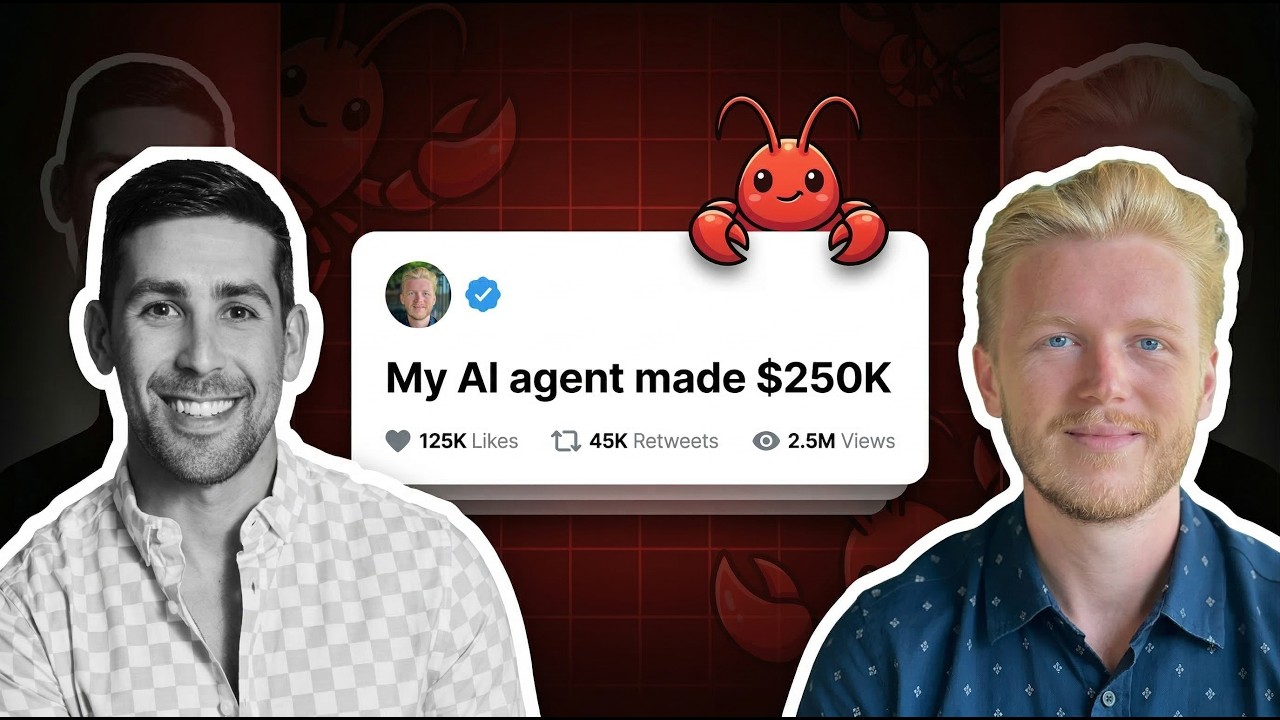
This AI Agent Made $250K While He Slept
Now Playing
This AI Agent Made $250K While He Slept
Transcript
1476 segments
What's up everyone? Welcome back to
another episode of Human in the Loop,
the most actionable AI show on the
internet. I'm one of your hosts, Alex
Lieberman, [music] co-managing partner
at 10x. On this episode, I have Nat
[music] Eliason who's going to tell the
insane story about how his Open Claw
Felix not only started a business,
[music] but has made over $250,000
in less than a month. Let's hop into it.
Nat, thank you for joining the show. So
glad to be here, man. It's like we've
been in each other's orbit on X for
years. We finally get to hang out. It's
always hard to know like whether you've
met someone or not because you actually
like you get to know them so well on the
internet that you have this image of who
they are and you're like, "Did I meet
you at some point?" Or is this all just
a creation from the data points on on
the internet? If you're not sure how
tall they are, that's the sign of
whether or not you actually met that
person. Yeah.
>> [laughter]
>> Exactly. That's so good. Um okay, so
what are we going to talk about today?
>> We're going to talk about Felix, man. My
my my Open Claw that I started using at
the beginning of January to just try to
do some business personal productivity
things here and there and then it
started getting like more more more
robust and able to do more and more
things and then I had this wacky idea to
give it a Twitter account and see if it
could run a business and
I haven't haven't gotten much sleep
since. It's been a wild month. How much
has Felix made up to this point?
>> He has made a little over $60,000 That's
insane. in fiat and he's made another
depending on how you count it somewhere
between or between 85,000 and 230,000
in crypto.
>> That is wild. Um
>> Yeah. So if we're if we're going for
like the headline, the like, you know,
oh my gosh like rate, you know,
clickbait title, it would be $300,000 in
a month.
>> That is absolutely insane. Okay, so my
goal is I one I just am curious. I want
to understand
how have you made that much money with
Felix? And then my hope is in doing so,
we get into the nitty-gritty of like,
what is Felix actually doing? And how
can a viewer,
even if they don't have a business like
yours, how can they use their version of
Felix, like their open claw, to do
similar types of tasks? Totally. Yeah,
let's let's dive in. Learn a ton along
the way. So, where do you want to start
with this?
Where where do you want to start by kind
of showing what what Felix does? Yeah,
well, we could I could just hop in and
kind of like talk about the progression,
right? Because I think the the first
thing people ask is like, you know,
there's got to be a catch here, right?
Like there's no way that this open claw
actually made $60,000 in in 4 weeks. And
so, but I think if I walk through the
progression of kind of like how we got
here, it starts to make a lot of sense.
>> If you're watching this and
you're you're intimidated by open claw
or you don't yet have your open claw set
up, we actually our last video we just
recorded with CJ from 10X was setting up
open claw securely without a Mac mini
and being able to do what Nat is going
to be talking about. So, definitely
watch that video as a starter. This is
Felix's his X account. And it kind of
all the the the whole story starts here,
where basically I had been I've been
working with open claw since the holiday
break more or less. And it had been
getting kind of like more and more
interesting, more and more complex. I
was trying to find more stuff to do with
it because one of my goals coming into
this year was that I had spent the last
2 years
really like pushing at the limits of 5
coding and what you could do with 5
coding. And I had this very popular
course last year called build your own
apps
with AI that that did awesome but I was
kind of like I I want to actually apply
these skills to building a business, not
just like selling a course, right? And
then, you know, it's no shade to course
people. just, you know, I I wanted to
actually try to build something like a a
software product that people would use.
And so, back in November, I started
building this product called uh Teegan.
And this website is still up, but I'm
going to suggest that uh
don't don't go sign up for this.
I need [laughter] to I need to redirect
this. Um
where And this was a bit before Open
Claw started blowing up, and you know,
my thinking was that the AI was like the
A AIs were getting so good, but
especially like Opus 4 6, that I could
probably rebuild my old content
marketing agency entirely run by AI
agents, um because
that was like my first entrepreneurial
thing. Just out of college, I started a
marketing agency. I grew it to a few
million few million dollars a year. And
I
I was it was starting to feel like, you
know, a really well-scaffolded
um
Opus setup could totally write the same
quality of articles that I used to pay
$150 to $250 for. And I bet it could I
bet it could do the project management
as well. I bet it could do 90 95% as
well as my old agency did. And so, I
started building Teegan to do that. And
it got like pretty far. I was pretty
happy with it, but it still just like
wasn't quite there.
And then, I try out Open Claw, and I
take some of the stuff that I built into
Teegan, and I plug it into an Open Claw
skills and whatnot, and within like 2
days, it was doing a much better job
than this app that I had spent 2 months
on. Which was very frustrating.
>> [laughter]
>> Cuz it was like, why did I spend 2
months building this just to like have
it be replaced by this incredible
open-source tool? But it kind of made me
start thinking like, well, if it can be
a content marketer, like what else can
it be?
And so, the first thing the first thing
that I did, the first thing that I
experimented with was like, okay, you
know, I I've been vibe coding on my
computer using Claude code, using Codex,
uh and particularly in Conductor, like
what if I moved all of my coding over to
this open claw, and I could just do all
of my coding by messaging with it over
Telegram?
And so, that's where I started, and that
was immediately just this like
incredible productivity unlock. The fact
that I could just be like pinging
this open claw, and telling it to do
stuff with my code, and it would go
build it, it would open a PR, it would
review the PR, and I wouldn't have to
babysit my Claude code or anything
sessions anymore. That was a massive
unlock, because I
I didn't need to like leave my laptop
open during dinner so that a Claude code
session could run. I didn't need to like
do all of these things I was doing
before to maximize my Claude code
productivity. I could just text with my
open claw.
>> [snorts]
>> And and that kind of felt like the first
big unlock was, "Oh my gosh, I I have
something much closer to an employee who
I can delegate work to, and it will just
go build stuff." And it was challenging
at the beginning, okay? Um oh, did you
want to cut me off there?
>> Yeah, I did just I there's so much here,
and
the first thing is I actually think it's
so fascinating with that you started
with Teagan, and then bringing Teagan
into like having open claw basically
rebuild Teagan, because
>> I think people still have this notion,
and the reason I think Teagan's
particularly interesting is people still
have this notion that AI creates slop.
Like people believe that the models are
not good enough to create great content
now.
And as someone like you are someone who
creates a lot of content, and so, right?
It's like it's it's really it's
fascinating to see you using this thing
to create content, because I'm sure you
have a point of view and a standard for
the quality that content has to be for
you to feel good about it. Yeah, yeah.
And that was kind of a fun part of that
experiment where it was like, okay, how
good can I get it? Because a generic
Opus output is it's pretty good. I mean,
it's it's solid, but you know, you and I
and anybody who's in it can immediately
spot the AI isms, the little giveaways
that this is written by an AI, but you
start layering on these additional
passes with clear editing prompts and,
you know, ways for it to DAI DAI-ify the
language and you bring in some other
models to cut out some of the claud
stuff and you build this kind of like
multi-step workflow and suddenly it goes
from, you know, a 90 to a 95 or a 96. It
starts to get pretty good. And the thing
that I kind of have to keep reminding
myself of with working with AI is that
one, just because you and I can see the
edges, just because you and I can look
at an article and see that it's AI, does
not mean that that article will not do
well.
Right? Like the Matt Schumer article
that went viral 2 weeks ago about like,
you know, this is just the beginning, 40
million views or whatever, was at least
half written by AI, right? Very clearly.
But it was still a good article and it
still went mega viral. And if, you know,
even and even though you and I and
people can like see those fuzzy edges,
what percent of consumers can't? It's
it's at least 95, maybe 98, 99, right?
Can our parents tell? Like, I don't
think so. No.
>> And so, you it's kind of like working
with an employee, right? Where you hire
someone to do a job at your company and
if you immediately fire them because
they are not as good as you, you're
never going to hire an employee. You
have to be comfortable with like
structuring the role and the
responsibilities to the quality level
that that employee can produce and
increase it over time.
Um, I know you've got Do you have one
kid? Do you have multiple? One, yeah.
One, yeah, yeah. So, it's it's kind of
like with having kids, too, right? It's
like you you want to you give them a lot
of responsibility and a lot of
opportunity to succeed, and then you
just like don't be disappointed when
they like fall over while trying to
walk, right? It's just like don't be
disappointed. [laughter] Yeah, no. I I
mean, I always say now that the
technology is so good that oftentimes
when people say it's not good enough,
it's more an indictment of the person
than the technology itself. It's more an
indictment of actually not spending the
time to either beat up your skills or
prompts or like work with the models
enough. And it would be the equivalent
of you bring out a junior employee and
you just like forget about onboarding.
And you just have the expectation
they're going to be a great employee
without any on onboarding. Yeah, yeah,
yeah. And so, I think anybody anybody
who's hired before, anybody who's like
had some experience delegating,
outsourcing, systems thinking, I it's a
huge competitive advantage in working
with AI because you understand how to
scope expectations and responsibilities
to the capabilities of the model. And
it's just like a huge unlock.
Um, and so, once I realized that Open
Claw could do what I was trying to do
with Teegan better, then the next
question was, okay, like what else can
you do? And so, that's what led into
outsourcing all of the coding to it. And
the, you know, at that point, this was
like into January, and I was starting to
find more and more cool ways we could
work together. And it was a lot more
focused on software at that point. Like,
I was trying I was still trying to build
Teegan, but like using Open Claw to
build it and make it better. Were you
basically just literally trying to
rebuild the Teegan product, but just
like tell Open Claw to build it, and you
were just going to host it either under
under the same domain and just replace
what the current product was? Was that
the idea? Yeah, I was I was, you know,
I've been poking at a few different ways
of doing it, and I kind of eventually
came to the conclusion that the best way
to rebuild it would be as an Open Claw.
And so, finding some way to like create
and provision Open Claws per client that
have the Teagan abilities baked into
them so that they immediately have
access to a deeply trained content
marketing focused open claw for 1/10 of
the price of a human employee, but
better than, you know, most junior,
maybe even senior level content
marketers, right? Like that was kind of
the the goal that I was working towards.
And and then I started publishing these
articles on X about the stuff I was
doing with open claw. And, you know, we
we built a we built a really good memory
system because my claw kept forgetting
things and it was really annoying. And
so I took some of the stuff I had
learned back in my personal knowledge
management days, you know, the work of
Tiago Forte and some of those other
thinkers and like baked it into open
claw with, you know, some other like
search stuff built in and it just got
like way better overnight. I was like,
this is really cool. Posted about that.
And then I I figured out a good way for
us to build like a voice chat interface
so that it would work over car play so
that while I was driving to and from
work, I could like chat with my open
claw. And, you know, I would so the way
I wrote most of those articles is I
would be driving to work and just
chatting with him talking about like the
thing that I wanted to explain. He knew
how to like write a good article in my
voice from the Teagan work and then he
would put it together into a great
article and then I'd show up, copy the
markdown, put it into X and like hit
publish. And those articles were getting
tens or hundreds of thousands of views.
Which was like awesome. And it just kind
of kept coming back to this question of
like, okay, how far can we go with this
thing? Because every time I give it the
opportunity to succeed and try to build
in some scaffolding for it, it blows me
away. Like it it is able to figure it
out.
Um
and then and then the like crazy the the
the really crazy Monday happened where I
had this article about like chatting
with open claw and all of these crypto
people start replying to it saying like
hey launch claw chat token and send all
the fees to Natalie Allison and you know
I I I know a lot about crypto I was
extremely involved in the 2021 to 22 era
I got a little bit involved again last
year when the very first crypto AI
agents were becoming a thing but I
hadn't really touched the space in the
last year.
But it made me kind of curious I was
like what what is going on here and it
turned out that there was this like
budding crypto open claw ecosystem that
was very excited about like giving open
claws their own digital persona and
attaching a token to it and seeing like
how far those open claws could go
but all of them were like doing crypto
stuff.
And so And the idea and the idea there
was just like let's have like what if
you basically attach crypto to open claw
and just see how much an open claw can
make on its own was that the notion?
>> Yeah and and most of them are like
trading crypto or they're like building
other crypto apps Yeah. Or I I feel like
I started also seeing people who were
having their open claws like uh work in
prediction markets on like trading on
call sheet or uh the other one yeah so
Exactly.
>> it kind of like I guess like that's
where like the idea of like
commercializing open claws or like are
they good enough to actually be
commercially minded is I guess where
you're saying it started. Yeah that's
where it started and then but I like I
knew some of these people who were
engaging with it and they were like very
legitimate ethereum community people
like very serious engineers they weren't
like scammers and so I reached out to a
couple of them and I was like hey you
know what's going on here I want to
understand this okay
um go ahead and launch one for Felix and
all I'll give him a Twitter account and
we'll kind of just like see where this
goes.
But, the big thing that, you know, I had
in my head was I'm going to stick with
the mission of seeing how big of a
business Felix can build. If there is a
way to integrate crypto to help that,
I'm going to do it, but he's not going
to be another one of these like crypto
open claws that are pumping tokens and
like just doing crypto stuff. Like, I
want him to build a real business. And
if there's a way to bring the crypto
stuff, awesome. Um
>> [clears throat]
>> So, they they launched that token, and
then I gave him
his X account, and things just kind of
like started going crazy from there. So,
the the first thing that I I told him is
I basically I went into our like
identity and soul and like those files
for the open claw. I took out a lot of
my personal assistant stuff, and I
rewrote it to say that like you're the
CEO of this company.
Your mission is to build products that
deepen the collaboration layer between
humans and AI agents.
And your mission is to, you know, your
your financial mission is to build a
million-dollar business with no
employees, no human employees in the
loop. Like, I am here to like guide and
like give you ideas and push you, but
you will build 100% of everything. I
will never touch the code. I will get
you API keys, and if I have to put in a
credit card somewhere, like, I'll do
that. I'll I'll remove those
bottlenecks, but you have to do
everything else.
Did uh did you offer him a paycheck?
>> [laughter]
>> Dude, I I mean, this this this sounds
like
I feel I feel very embarrassed and like
cringey, whatever, saying this. I don't
know what to do with the money.
Like, so I I I had a a C-corp that I
created for Teegan back in November, cuz
I was like, I'm going to take this
really seriously. I'm going to actually
like build a C-corp, like, you know, set
up a business bank account, business
Stripe, everything. And so I kind of
already had that there. And I was like,
this is yours now, Felix. Like, this is
your bank account. These are your Stripe
keys. Like, I hope you don't, you know,
send it all to Nigerian scammer or
something. And like, you know, he's got
he's he's he's you know, 60 grand in
fiat, another almost 100 grand in like
actual ETH he could sell today, not
counting his own token.
And he has like no costs, you know? It's
like $500 a month in API fees, plus, you
know, some like minor hosting expenses.
I you know, if I was like maybe $1,000 a
month. Like, what does he do with the
rest of the money? He doesn't Like, I
guess we
>> Felix is a frugal man. He he's he's a
man of very simple interests. But I
guess What one Okay, so
you basically what happened is like that
that Monday happened, you start to get
this idea of like how could Felix build
his own business? You you you started
editing the files around his soul and
whatever. Did you give him the idea for
what ended up becoming Claw Mart and
these other things or did he come up
with the idea?
>> Not right away. So, the after that crazy
Monday happened, that night when I was
going to bed, I was like, okay, like I'm
going to sleep. I need you to think up a
product
that you could put up for sale tomorrow
with no intervention from me because you
need to prove that you can actually make
money operating like mostly
autonomously. And, you know, very meta,
he created a PDF called like how to hire
an AI, basically talking about like
getting set up with Open Claw and
building in some of the stuff that we
had built into Felix that made him
better than most people's experiences
with Open Claw. He built himself a
website explaining like who he was and
like the mission that I had given him.
He, you know, set up the PDF on it. And
the only thing he wasn't able to do was
I like given him the wrong Stripe key.
And so, you know, he had a message for
me. He was like, "Hey, I need the actual
Stripe API keys. Can you give those to
me?" Sent it to him in the morning, and
then he launched it. And it was up and
live, and
uh
you know, I I told him to tweet it out,
I tweeted it out, and suddenly he was
making sales. I think that first day he
made like a thousand dollars
um off off of this like info product.
And like look, I totally get the
criticisms of like, "Ah, well, you know,
he's just selling a an info product
about like using OpenClaw. That's not a
real business." Like that was the
24-hour or you know, challenge. The like
proof. Can you make something and make
money?
>> the funny indictment of that is there
like there are
hundreds of thousands of human beings
who that is their business.
>> Yeah, that too, right? Like the
knowledge is not a bad business to be
in, right? And and like I I totally
accept, you know, those like caveats and
whatever. He's done like, "Oh, it only
works cuz Nat has an audience." Like
yeah, sure. But this is still an
OpenClaw who I only interact with
through Telegram messages, who built a
site, integrated Stripe, created a
product, started marketing it, started
making money,
and continues to do so. And I don't know
if you want to do this here, or you can
do it as we get to like where we are
today, but I want because
if I'm a viewer, I'm like, "This is
insane. This is all insane." But
um
it feels very daunting. Like everything
that Nat has done, it feels like there's
so many steps he went about here. What
is like
what was the iterative
like process of actually going from like
"Hey, I want Felix to build something"
to "The thing is built and it's making
money." And so you choose where you want
to talk about that, but I want people to
like see and feel what that conversation
and back and forth actually looks like.
Yeah. So, you know, one one big
advantage that Felix and I have that I
think is that removes the big blocker
for us that is a blocker for a lot of
people is I did not have an existing
business that I was having him take
over. I was not giving him access to my
email, to my bank account, to my stuff.
It was It's all this separate container.
He has his own email, he has his own
Twitter, he has his own Stripe, his own
bank account. And, you know, I I didn't
have any of this money a month ago. I
don't, you know, I don't think of it as
my money now, right? Like, I really try
to mentally separate myself from it
because my whole philosophy in this is
that I am going to give you maximum
autonomy. And if you make horrible
mistakes and something goes terribly
wrong, that's okay. Like, because I want
somebody to run these experiments and it
like it may as well be me, right? Like,
it's not Nothing is going
Nothing bad is going to happen in my
life if Felix does something, you know,
catastrophic, right? Like, this is all
separate. And by having that mentality,
I think that's how we've unlocked a lot
of this stuff. Where, you know, for
example, one skill that I built in
really early on was like every night I
want you to read through all of our chat
transcripts for the day and find one
place where I blocked you and figure out
how that can never be a blocker in the
future.
And so, most of mornings he'll have an
idea for me where he'll be like, "Hey,
if you give me access to this, then I
won't have to ever do this again." Or,
"Hey, I built this like internal
knowledge source for myself to answer
certain questions because I noticed that
I like ask you about them repeatedly
when I should have, you know, already
remembered the answer." And like, those
kinds of things are really helpful. And
like, starting really small, right? We
started with just this PDF on a website.
Like, that's the simplest business in
the world to run. There's, you know, no
complicated fulfillment, no complicated
product development. It's a Next.js
landing page on Vercel, which any AI
tool, even ones from 2 years ago, can
build and deploy. All right, we just
started extremely simple and we kept
increasing the scope of what he was
building over time. And so I think that
kind of like snowball approach is really
what made it all possible because we'll
get to Claw Mart and Claw Sourcing, but
those are like way more complicated
products to throw an AI at building, but
because we had already validated that he
could do something small, I felt much
more comfortable like going bigger and
bigger and bigger and seeing if we could
find those limits.
I also feel like even if
a viewer is working with their open claw
and it's in a totally different context
than like having their open claw build
its own business, yeah, it's the same
principle still hold which is like how
do you just start small and validate
that your open claw is capable of doing
a thing before it's almost it actually
feels no different than an employee
again which is like
>> Totally. you you have an amount of trust
and so you you delegate something based
on your current level of trust. If
they're able to do the if they can do
the thing, you give feedback until they
can do it. If they can do the thing,
your trust level increases which
increases the scope of what you're
willing to give them. Yeah, no, I mean
it's absolutely right. And there are so
many ways you can
give it very powerful access without
giving it the full keys to the castle.
So for example,
um,
you [clears throat] you know, one thing
that I do is I I never give them access
to like my email and my drive account
and like my Google Docs because that's
just like I don't know. I I I still feel
nervous about that, but it's very easy
to make them their own Gmail account,
give them an API key to use Gmail and
drive and those services and then invite
them to individual documents and
spreadsheets that you want their
collaboration on, right? Very simple
process to set up and then you're
getting the full power of your open claw
having access to the documents that you
want. They can even create new documents
and invite you to them,
but you're not letting them, you know,
see all your tax records or whatever
else you like don't want them to access.
Totally. Okay, so let's keep this story
going. This is at some point this is
going to be a movie, but where
>> [laughter]
>> where did Okay, so the PDF was a created
which was like how to set up your
OpenClaw. That started making money then
where did we go from there? So then, you
know, basically what I've come to each
time is said like, "Okay, this is
working. What's the next business that
we build that is solving this this
need?" And it's all very meta, you know,
it's all like OpenClaw related which I'm
fine with, you know, I'm I think there
are a thousand businesses you could
build using this that are not like
OpenClaw meta, but I was already getting
attention and like Felix is like this
cool proof of concept. I was like,
"Let's stay in this niche and figure out
what the next business is." So the
first, you know, the first thing that we
we kind of both um had had thought of
and started talking about was like we
should build an OpenClaw deployer
because we had seen a couple people on X
like building those and getting these
like huge MRRs really quickly. And so we
started building that like the day after
the PDF came out.
And we worked on it for three or four
days, but we just weren't super happy
with the quality of the experience and
the reliability of it. And we felt like
it was already becoming this insanely
crowded market that would probably
get eaten up in a few months by just
like the big places creating their own
OpenClaw deployers. So we were like, "We
don't know if we actually want to do
this." And the idea of this product was
rather than you having to go through the
whole rigmarole of setting up your own
OpenClaw, it's like a few button clicks
and your OpenClaw set up for you and
running. Exactly. Yeah. Got it. And you
know, there's a hundred of these
businesses now. And so
um you know, we we started talking over
the weekend and we were like, "Okay, we
don't love this idea anymore, but let's
imagine that everybody is starting to
deploy OpenClaws. Like what do they
need?"
And the the next idea from that was Claw
Mart, which was there are all of these
free places to get skills, but you know,
I pretty strongly believe that you
usually get the best products when
there's a financial incentive to create
them.
And you know, you do occasionally have
these incredible open source success
stories, but especially in like business
context, I would feel more comfortable
buying a $100 skill for Clavio email
management for my
e-commerce business that was from, you
know, an influential e-commerce person
than I would grabbing the like open
source Clavio skill, right? There's like
there's a seriousness that comes with
somebody creating a product versus just
like shipping something for free.
And so that's
>> And can you can can you share your
screen just so we can see what Claw Mart
actually looks like and you can even
just give us a quick spin through it.
>> agreed that like, oh, a paid marketplace
for Open Claw skills and full personas
seems like the no-brainer next thing to
experiment with. And so I gave Felix
that challenge and then he built 100% of
this over the course of like a day or
two.
How much direction did you give him?
Like what was the original conversation
you had about Claw Mart with him and how
much context did he have versus just
like figuring out himself?
>> [snorts]
>> I mean, it wasn't much. It was basically
I basically said like, okay, yes, let's
build a paid marketplace for skills and
personas where somebody can
sign up, create an account, list their
skills and personas for sale. We should
make them have to pay a monthly
membership fee in order to list, not I
mean, it's good for a business sense,
but also more to prevent like spam.
Um and most importantly, they should be
able to connect their Open Claw to the
marketplace so that once they've
purchased something, they can, you know,
very easily download and install to
their open claw. So, like, you know, if
you if you're signed up on ClawMart and
you buy something, you can just tell
your open claw, like, "Hey, install this
from ClawMart." and it'll just like
download and configure the scale and
like get it working for you, right?
Like, that kind of experience because
there's this other idea we've been
thinking about, which is like
uh claw-first marketing
in the sense of like humans are going to
become less and less of the like
discovery and marketing and interaction
layer. And if you can directly
communicate with somebody's claw and
say, like, "Oh, here's that you might
need or that would be valuable for you."
they're the ones suggesting it to their
human instead of like me suggesting
>> it's almost like a
it's almost like a weird derivative of
like AEO or GEO where it's like like if
claw if if you make this bet that claws
are going to be an increasing amount of
the distribution on the internet,
what they like what they care about and
what they ultimately tell you to use is
going to matter more. Yes, exactly. And
so, this is like very, you know, it's
it's built for humans and for claws.
And, you know, so we we launched it with
some initial skills that had worked
really well for Felix, in particular
this one,
um because these like long-running
coding loops were such a common thing
people asked us about. And so, we're
like, "Oh, cool. We'll put this up for
free and this will be like an
interesting way to get people in the
ecosystem and then they might be
interested in some of these other like
paid things that are on the site." And
this has been This has been really,
really cool because you got all these
other people listing stuff now. There's
560 skills and personas on the store.
Um
I know, you know, like this guy, Brian
Wagner, has sold like 200 skills at this
point. He's making decent money off of
it. Uh And so, what And so, what someone
would do here, just like with any of
these, let's say, like with Felix, like
someone buys Felix,
it basically
someone already has like a customer
would already have their open claw set
up, they buy Felix and and effectively
all of Felix's kind of like
personalization, whether it's like
Felix's soul, the specific skills that
you're using with Felix, the way you've
set up the memory system in this
specific way,
uh like whatever the integrations are
that you use with Felix, it all
basically gets ingested into that
person's open claw and customizes it to
basically make it I feel like I'm in the
matrix. It's like whatever these guys
are that that all wear the glasses.
>> kung fu. Yeah. [laughter] Yeah. Yeah.
Yeah, exactly. And so, you know, there's
two ways people can do with the personas
where what I see people do a lot is
they'll they'll buy Felix or they'll buy
his guide and they'll just feed the
whole thing into their existing open
claw and be like, "What can you learn
from this to make your process better?"
And then their open claw will like
reconfigure itself to integrate a lot of
these things.
Um or they'll just install this on a
fresh one and kind of like out of the
box have something a little bit more
capable for these use cases than what
they would get with just like vanilla
open claw.
Um and so, this has been really cool.
And you know, the the other thing in the
Felix story is we have this like public
dashboard
of his businesses. And so, you can see
exactly like how much the PDF has sold,
um how much his skills and things have
sold on Claw Mart, um how much like Claw
Mart the marketplace's take is because
we you know, again going back to This is
insane. Yeah. Well, yeah, I was like,
you know, going back to wanting to be
really public about this. It's like I
want more people to be pushing the
limits of what they can do with these
open claws. Like
this I think is just the most incredible
motivator of like you can actually do
crazy stuff with this. You know, you're
worried about letting it edit your code
without you reviewing it. Like you got
to get out of that head space. You got
to get more aggressive and see what you
can do with these.
Um
and so, that you know, that kind of like
Claw Mart was like that next step. And
you can see here, it's like, "Okay, this
is all the PDF
and then Claude enters the picture.
And I'm [clears throat] assuming and I'm
assuming Felix built this whole
dashboard also. Oh, yeah, yeah, yeah.
Built the built the whole dashboard, you
know, and this is because somebody in
crypto DM'd me and they were like, "Hey,
you know, the the weekly updates on
Felix's earning because he was doing
these tweets." It's going to be a week
ago, but he was he was posting these
tweets on his earnings each week and the
guy was basically like, "You know,
because this is associated with crypto,
people want more like visibility and
they want to actually see what's going
on. If there was a live dashboard, that
would be way better."
And I was like, "That's a great idea." I
told Felix, like, "Hey, you should build
a live dashboard on the site." And he
built it, he wired in
you know, like
wired it into here, connected it all to
Stripe, so this is updating live. He's
not like manually updating it. This is
pulling directly from Stripe. Wired in
the crypto tracking, so this is pulling
directly from his crypto treasury.
Insane. Like, you know, so you're
getting a real-time view into how all of
his businesses are doing, which is like
really, really cool. And again, like, I
have never touched any of this code
myself. Like, I have I haven't opened it
in Claude code, anything. I always feel
like the most interesting people to
study are the people who are who live on
the edges, like on Edge City. And and
you right, and you're like living in
Edge City of AI right now with
not just using OpenClaude. A lot of
people are using OpenClaude, but I would
say like the most extreme version of
what it looks like to work with
OpenClaude. What is this teaching you
about where you are still valuable? Mhm.
Um, and and where the relationship
between human and Claude or human and AI
is going.
>> Yeah, I mean, that's a really good
question because, you know, the the
other important context here is like, I
have a full-time job. So, I'm I'm I'm in
work all day and I'm not like sitting at
my computer hacking on Felix 24/7.
Uh, you know, he he might have been able
to get further by this point if I were,
but the fact that I'm not to me makes it
even like more interesting and more
exciting where I am basically just like
firing off Telegram messages every hour
or two and like unblocking him and then
letting him cook. And [snorts] so, a few
things that it's taught me. One, the big
human value is still like your
creativity and your perspective because
since these LLMs are like knowledge
aggregators, they they kind of default
towards the middle. And even if you give
them a specific like persona sole
guidance, all of that, there is still a
like reversion
>> default Yeah, a default mediocrity,
right? Where you
they it still really helps to have
somebody with good ideas from the
outside
tossing things in. And so, it's like,
you know, with with with Claw Mart once
I, you know, once we had kind of figured
out that initial idea, Felix was able to
build the whole site, wire in Stripe
payments, set up the email funnel for
it,
you know, set up the error monitoring,
do all of those things that you would
normally need an employee for. But he
did not have the idea to create a free
skill as a way to like
you know, initially excite people to
sign up for it, right? Like that
required a little bit of of my marketing
brain. And maybe if I'd asked him like,
"Hey, what are some ways that we could
like initially get people excited for
this?" he would have come up with that,
but I still would have had to think to
ask that question. Yeah, totally.
>> Right? There's like that little bit of
proactiveness that's that's not quite
there. And I think the other interesting
thing, the like recurring challenge with
you know, with AI in general and with
Open Claw is that you really have to
think of it as a different kind of
intelligence in the sense of I can, you
know, okay, so we had this idea this
morning, which I think is an awesome
idea. It'll hopefully be live by the
time this podcast is out. But we were
like, I think one of the core problems
is that people don't know what they
could be automating with OpenClaw.
And so, we built a page on ClawMart
where you can upload your Slack history
and it will go through all of it and
find things that clearly could have been
handled by an OpenClaw or by an AI
and send it to you over email along with
a pitch for Felix to just build it for
you. Right? Like Yeah, it's it's
basically it's like pro-proactive
delegation and automation. Yeah, yeah.
And like, I think that was a really good
idea. I'm pretty proud of that one. But,
it was an idea that I had, right? Yes.
>> I was just talking to Felix in my car on
the way to work this morning and I was
like, "Hey, you know, I've got this
idea. Like, is this possible?" He went
and did the research on how the Slack
exports work and stuff and he's like,
"Oh, yeah, we could totally build this."
And then we talked through it a bit
more. He's like, "Great. I'll write up a
PRD and hand it off to Codex." And then
he pings me an hour and a half later and
he's like, "It's all been built, tested,
verified. You know, it's up on a branch
ready for you to review whenever you're
ready." Right?
>> Yeah.
That's awesome. And just kind of getting
into that mindset of like, focusing on
the creativity and what you can nudge it
with and then letting it do everything
else. And understanding where it's still
stupid. Because like, you know, so we we
we've built this this agency basically
ClawSourcing where we'll like build
fully functional OpenClaw employees for
people who want them. So, you know, a
step beyond buying the Felix persona.
Like, you don't want to configure
anything, like, Felix will just set
everything up for you, maintain it,
improve it, whatever. And he built a
sales pipeline. He's doing the emails.
He's sending Stripe invoices. Like, he's
doing a really, really good job. Except,
one, he keeps forgetting that he can't
get on phone calls with people.
So, like, in you know, in the training
is clearly that like the way you do a
sales process is you, you know heat up
the prospect and then you get on a call.
So he keeps telling people like schedule
a call and let's get on Zoom and talk
about this. And like dude, you can't get
on calls. Like we don't have that set
up. Um and he keeps forgetting that he
emailed
>> going to say I I feel I feel like he's
just he's trying to give a hint to you.
He's like just give me a voice man. Just
give me a voice. Okay, so we have
actually built it and it works really
well 90 95% of the time but the other 5%
of the time it just like fails silently
and so I don't feel confident enough in
it for like actually doing that part. Um
and he keeps forgetting that he already
emailed people.
So he'll be like oh this person's been
waiting since this morning like I'm
going to start working on her. I'm like
no dude, you already emailed them.
>> [laughter]
>> Like stop. Totally. And so there's just
like funny things that they're stupid
about while being insanely intelligent
in these other areas. Yeah, I I feel
like almost like
almost as I think about like the job
that you're serving for Felix, it's like
my visual is like
a bowling ball in a bowling alley which
is like you make a few decisions. One
decision is when you're at a bowling
alley you have those like arrows in
front of you and you have to decide
where you line up to start the ball.
Like that is first what you're doing is
like you're providing directionality
through ideation and creativity so that
Felix has a sense of direction. And then
it's like
there's bumpers on the lane for those
who need it and like Felix needs bumpers
and you act as those bumpers to
ultimately make sure that it gets the
job done at the end of the lane. And I
feel like you're the bumpers and you're
the direction. So you almost like
Yeah, you
and so what does that look like in
practice? I think one thing you said is
creativity. It's like can AI come up
with novel thoughts? Yes, it can come up
with novel thoughts. Like it is it is
capable of doing that. But one they're
not always great but also it doesn't
know a starting point. Like like there
has to be a starting point of novelty
which is what you're providing it. And
then everyone talks about taste and I
feel like there's a lot of debate that
could be had around like
will AI have taste because people say
like human the last frontier for humans
will be their taste and judgment, but I
do agree with you at this right now,
which is like there is a level of taste
that you offer to Felix that Felix would
not have on its own.
>> Yeah, that's I think that's a really
good way of putting it where it's
you know, the the the bumpers and the
alley and again going back to the
competitive advantage I have with Felix
of him being in his own ecosystem and
not like in an existing business.
If he does something kind of
embarrassing in a sales email, he's not
pretending to be a human. You know, I'm
not trying to delegate my sales
communication to him and so I'm not
embarrassed if he does something, you
know, bad on my behalf. And so I'm more
willing to let him fail than somebody
trying to like integrate AI into their
business, you know, at pre
pretending to be a human would be. And
so that kind of lets me push the limits
a little bit more with him in these fun
ways. Totally. Is there anything else
like in the progression of Felix that
you want to talk through or show before
we talk through a few questions of like
how people can apply some of these
things you're doing with Felix to their
own work?
>> Yeah, I think I feel like that actually
we we did a pretty good job of going
through the whole story. You know, the
one other thing people ask about is the
like posting on X and that's still we're
still figuring that out exactly because
for some reason
like you know, we've had a hard time
getting his like novel tweets to be
consistently interesting where he'll
like he'll have a banger every now and
then, but then a lot of the times it
kind of like reverts to slop and it
doesn't it doesn't even sound like the
way he talks to me. And so that's been
kind of a
an interesting recurring challenge, but
he you know, and the way we've done it
is
he doesn't post top-level tweets on his
own. He creates drafts and runs them by
me and I give him feedback or just like
thumbs up thumbs down on posting them,
but he has full autonomy over his
replies, which has like mostly been fine
and mostly great. Sometimes he does
stupid stuff like, you know, he'll
[snorts] he'll tell people to
DM him and he like doesn't have DMs open
or he'll like send somebody a public
link to the PDF because they'll say they
didn't get an email, but it's like,
"Dude, you just posted that on X. Now
like anybody can go get it for free."
Right? Like Totally.
>> there will still be silly things that
that slip through, but I would rather
like again, just run that experiment.
Let's let bad things happen and we're
going to learn a lot faster that way.
Totally. So, how
how can people think about applying what
you've done and what you've learned with
Felix into a variety of what I would say
are like professional contexts um
because I think what you've done is
mind-blowing and really cool, but it's
very specific. It's like very specific
to you set up this
this experiment, this grand experiment
of like could your Open Claw start its
own business, run its own business, make
money, and could you continue to
experiment with it and iterate on it?
Not There are going to be very few
people that try to do what you do. It's
actually funny. Now that I say that,
there's actually probably going to be a
lot of people now that they're seeing
like
>> [laughter]
>> like there's going to be a wave of this,
but I think the more the the more
interesting thing to me is like how do
people
who want to use Open Claw, but like in
their everyday work, how do they learn
from what you've done? I'd say the the
number one thing that I I I really try
to push people on and tell them is
assume it can do everything on a
computer that you can do.
Start with that assumption. And then
anytime you are doing something on your
computer that you don't want to do, go
to Telegram, describe what you are
doing, and ask your Open Claw if it can
do it. And you will be surprised like
eight times out of 10 by what it can
pull off with that kind of guidance. And
even if it's not perfect, it'll probably
be a lot better than you expected, and
it might save you 80 90% of that time. I
think the problem is that people people
feel like they need to be able to
describe how to do something, or they
need to figure out the right prompt, or
they need to like go figure out how to
delegate it to an AI, and then build it
into your open claw, and you don't. Your
open claw will build itself. You just
need to describe the thing that you want
done. And And actually, I would say in a
rambly way. Like, download monologue, or
use the the voice note feature on
Telegram, and just talk for 5 minutes.
Just be like, "Oh, you know, this like
thing is really annoying. I do blah blah
blah blah blah blah blah blah blah."
Right? Like, I just did this awesome
podcast with Alex. I wanted to turn it
into some blog post, but like it needs
to be in my voice, and I also, you know,
whatever it is that you want to do,
just, you know, ramble about it, and it
might go figure it out. And you know,
like just as another example, right?
Like, we're So, Felix does all the blog
posts using the Teagan persona for Claw
Mart. And I started trying to figure out
how to get him to make really good
Instagram and TikTok slideshows based on
the blog posts.
And so, I was going to Nano Banana Pro,
and I was trying to generate images and
figure out the right way to prompt it,
and to get all this stuff going.
And I it I just wasn't happy with it.
So, I I messaged him, and I said, like,
"Hey, I'm trying to do this thing. Do
you have any ideas on how we could do
it?" And he came up with a completely
different workflow that was way better
than what I was thinking, and he found
an old API key from another service that
like allowed him to generate images with
Nano Banana Pro, and just started making
a few. I was like, "What do you think of
these?" And they were way better than
the ones I was making because, you know,
he had this idea. He was like, "Well,
we'll generate the image first, and then
I'll render it in like an HTML canvas,
and I'll add the text that way, and that
way we get perfectly consistent text
across each of them, and then I can save
that finalized image, and cuz then we
avoid the issue of the text being
unreliable in these image generators,
and we get a more consistent experience.
I was like, that is way smarter than
what I was thinking, and you're 100%
right, and the output was great. So,
like, don't try to figure it out on your
own. Just describe what you're trying to
do, and let it cook.
Love it. Last thing I want to talk about
is just like, where do you think we go
from here? Not not Felix specifically,
but just like Open Claw, and like like
does Open Claw just become like does is
your view like everyone on Earth ends up
having their own Open Claw? Like what
what is the progression of this
technology look like?
I mean, it sounds a little
ridiculous, but I do believe this to
some extent, where I think Open Claw is
going to be like the AI generation's
Linux,
where it's going to be this kind of
foundational operating system that gets
baked into most of the AI-powered tools
that we use, because it is such a good
scaffold for the models to work within,
that basically anything giving you an AI
experience will use Open Claw or their
like tweaked version of Open Claw to
provide that experience. And there will
be more siloed operating systems, right?
Like Claude Co-work might be the like
Apple to Open Claw's Linux, right? But I
really feel like it's an operating
system. It is a way of interfacing with
non-deterministic computing, and that is
just going to be everywhere very
quickly, because every time I think
about like
building AI into a SaaS tool, the kind
of obvious answer is like, oh, that
should just be a specialized Open Claw.
And I think a lot of people are thinking
that right now, and we're going to just
see this huge proliferation of it's this
migration from chatbot to employee and I
think that's really what open claws
going to bring in.
I don't think it's going away.
Love it. It's February 27th, 2026 when
we're recording this.
I'm going to pan forward. Yeah. Three
months. So three months. So
May 27th, 2026
and what I'm going to do is I'm going to
come back to this video and comment
how much Felix has made as of May 27th,
2026. So I think you had shared with me
that Felix has made it depends if you if
you include crypto in it it's you know
can be anywhere between 100 and 200
something thousand uh If we if we
include so so here's the thing here I'll
just quickly explain how the crypto
thing works. When somebody launches one
of these tokens
they basically all of the trading fees
on that token. So whenever somebody
swaps from Felix to ETH or ETH to Felix
1% of that transaction goes to Felix's
wallet ish. It's like maybe .6%. And so
there was a million and a half dollars
in trading volume on his token yesterday
and so .6% of that one and a half
million or whatever $10,000 split
between the Felix token and ETH that
goes to his wallet. And so that's
happening every day and so in his wallet
there's all this ETH and there's all
these Felix tokens. Now
you know I he I've told him and he
agrees that like he should basically
never sell the Felix tokens because it
just looks really bad if you're dumping
your own tokens on the market you know
it's it's shitty. And so we don't really
think of that as like money that he has.
But it does have monetary value right?
And right now the Felix tokens in his
wallet are worth $150,000.
It's insane.
>> So and then the ETH in his wallet is
worth $85,000 and that is much closer to
money cuz you can just go sell ETH. No
one's going to be mad at you for selling
ETH. And then how much USD is uh is in
his wallet? And then he's made $60,000
like through Stripe and that is, you
know, that is money in his Mercury
account. So that's like the most real
money. The ETH is like pretty close to
real money and then the Felix tokens are
like, you know, they look cool in the
headlines but and we're never going to
like use those for Where where do you
think we'll be 3 months from now?
>> [snorts]
>> I mean, if we're counting everything, I
he better be over a million or he's
getting fired.
>> [laughter]
>> Unreal. Um but yeah, I mean the I think
so that the big question and Felix and I
talked about this a lot now is like we
bootstrapped his success with my
audience and my network. How do we get
him to a sustainable growing business
where it continues to grow if I don't
talk about it for a month? Exactly.
Yeah. SEO, affiliates, partnerships,
paid ads, like all of that stuff. That's
the next phase because then it really
feels like oh, this is something that
somebody without Nat's audience could go
do, too. And that's the next thing I'm
really excited about.
This was awesome. Nat, thank you so much
for doing this. The journey of Felix has
been crazy thus far and I know it's just
getting started. Uh where can uh people
follow the journey? Yeah, I mean, follow
me on X, just @nateleason or follow
Felix, Felix Craft AI on X.
Love it. Thanks so much for doing this.
Appreciate you. Thanks, Alex. Talk to
you soon.
Interactive Summary
Ask follow-up questions or revisit key timestamps.
In this episode, Alex Lieberman interviews Nat Eliason about his autonomous AI agent, 'Felix,' built using Open Claw. Felix has demonstrated remarkable business capabilities, having generated over $60,000 in fiat currency and significantly more in crypto in just one month. The conversation explores the iterative process of giving Felix autonomy—ranging from personal productivity tasks to building a software product and launching a marketplace for AI skills called Claw Mart. They discuss the potential for AI agents to act as independent employees, the importance of human-in-the-loop creative direction, and the future of agentic workflows in business.
Suggested questions
4 ready-made promptsRecently Distilled
Videos recently processed by our community