Why the Clarity Act is running out of time
Now Playing
Why the Clarity Act is running out of time
Transcript
393 segments
The Senate is running out of time to
pass the biggest crypto bill in American
history and it still needs to go to the
House. Meanwhile, the CME has launched
almost 247
24hour
a day single stock futures and North
Korean hackers have hacked North Korea.
We've got a lot to talk about today on
the Daily Wolf. Let's go.
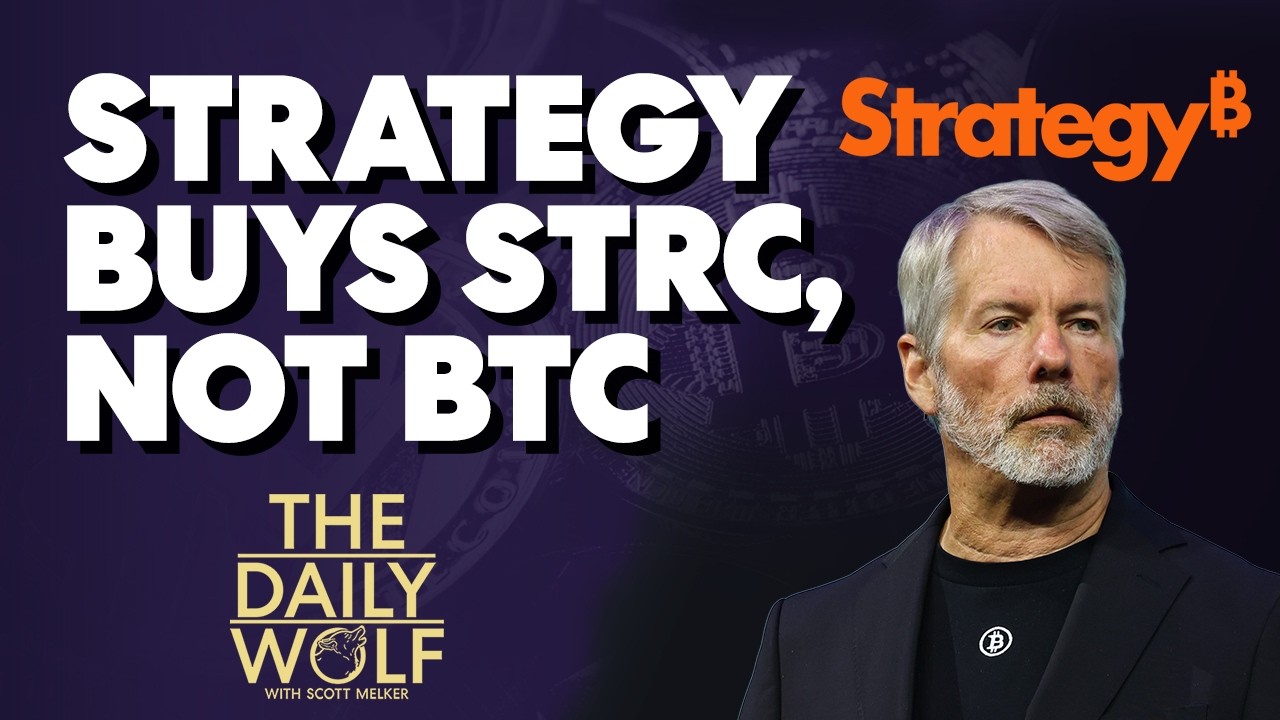
What is up everybody? Welcome to the
Daily Wolf on Yahoo Finance. I am your
host Scott Melker, also known as the
Wolf of All Streets. We have a lot of
stories to cook through today. There's a
lot of signal in the noise, but always a
lot of noise as well. We're going to
start at the most predictable place
because we're running out of time to
talk about it. We've got this right
here. Clarity Act faces fresh delay as
Senate prioritizes Russia sanctions
bill. So Thoon has decided the Senate
calendar and nonsurprisingly the Clarity
Act is not on it for this week, meaning
that next week will be the last chance
before the recess for the United States
Senate to pass the Clarity Act. Now, as
you know, we now have a merged bill that
came out merging Senate Financial and
Agriculture that includes ethics
language for the first time, but that
ethics language is still a major
sticking point for Senate Democrats who
are needed to pass this act. Now,
remember, not only does it need to be
passed through the Senate and voted on,
but it also then has to go to the House
to be voted on, and then the president,
who has said he will sign it, would need
to sign it. But he's also said he's not
signing anything right now until they
get the voter registration act done. So
it could also uh hit that wall even if
this all gets passed. Now I was skiing
recently in Cororche u because I'm fancy
in France in December. I don't know if
you guys have ever seen this but it's
the shortest runway in the world. You
literally have these like it's like
Hunger Games for really rich people.
They come in, they decide whether
they're going to live or die and they
divert. They come back. shortest runway
in the world has a hill literally to
stop your plane and to get it going
faster. Well, the United States
government, the Senate is trying to land
a 747 on this thing right now. That was
a way of me saying there's a really
short runway to get the Clarity Act
done, but it felt good, right? So, I
would say that the odds are still
extremely low. We haven't even gotten an
agreement on ethics language. I just
think it's so funny. I mean, the Clarity
Act here has survived stable coin yield,
government ethics, partisan warfare, and
outf faces its most dangerous opponent,
congressional vacation, right? And there
was an interesting take that the
president could actually force the
Senate to skip their recess and vacation
and stay to pass essential legislation.
I don't think that's going to happen,
but we'll see. So, the story here is
that we're the Corsal runway trying to
land an A380 and maybe it's not going to
happen. Maybe there's still that 5%
chance that it will. Meanwhile, in the
degenerate world of the CME, we've got
this. CME launches single stock futures
enabling investors to trade Spaces,
SpaceX. Uh, I highly don't recommend
that. Micron and others 23 hours a day.
So, that gives me an excuse to uh dunk
on the critics and tell you that it was
mathematically guaranteed when SpaceX
was trading over $200 with almost no
float and sellers even available in the
market and people were putting their
entire entire retirement funds into
SpaceX that it would be trading under
like 110 bucks today, which it is. Just
that's my little I told you so from my
how not to invest segment that I did for
you on SpaceX recently. But yeah, now
you can trade single stock futures 23
hours a day. I believe it's six days a
week. So listen,
it is interesting because crypto spent
years obviously arguing that stock
should trade around the clock. The CME
just finally agreed and capitulated, but
they're doing it without putting a
single stock on chain. This using their
existing systems. They tried this in
2002 actually to launch single stock
features futures and it failed
spectacularly. But that was because it
was in the depths of the end of a bare
market in tech and because back then
really retail was not interested in
speculating with leverage. Now once
again these are options contracts.
They're not actual stocks but they
effectively will trade like them for
people who are doing it. And this is
clearly a reaction by the CME to
Hyperliquid, Coinbase, Robin Hood,
everybody who's offering 247 365 access
to stock trading, including preIPO
shares. So you're going to get 55
standard single stock futures. This is
for institutions at the CME, by the way.
22 micro single stock futures. It will
cover the basically most highly liquid
55 stocks. So Nvidia, Apple, Tesla,
Amazon, all the big names. a standard
contract to be a 100 shares. A micro
contract will be 10 shares. These will
settle in cash and quarterly and trade
from Sunday evening to uh I believe yes,
Friday afternoon. So like literally
they're going to take an hour off to
clean the puke off the floor of the
casino each day while crypto keeps
trading in the casino that never closes.
But I I I just think that this is
fascinating because clearly this is a
defensive maneuver against the crypto
industry that has now made trading
during market hours, even on individual
stocks, effectively moot. We know that
the future will be largely tokenized,
but they're intending to compete. And in
that same market, we've got a crazy
story. Perpetuals tied to SKH Highix hit
by flash crash to $900 on Hyperlid. But
this is the problem that's still here
exposed on the tokenized side of 24365
trading tokenized stocks. You have
moments where there's very little
liquidity because the main market is not
open, but something is still trading a
tokenized version that's attached to it
and have a flash crash. So you had a 20%
dip basically from $1,000 to $900 and
right back on hyperlquid. And that could
have been because somebody got
liquidated or they fat fingered an order
that was too big and it crashed the
market. But there's very thin liquidity
still for some of these tokenized
assets. And when somebody tries to move
size, it can crash the market. And then
when the Cosby itself opened, SKH Highix
went down about 15% after this had
happened for 20. And there's question as
to whether actually the price action on
hyperlquid
forced certain traders to make decisions
based on what they thought the price
would be on the actual Cosby. Now
listen, the Cosby uh another segment of
our how not to invest was the way the
Koreans are just the biggest degenerate
traders and gamblers on the planet. And
you remember when I told you that they
were selling their uh insurance and
their savings to get leverage ETFs of
these very assets. Well, since that time
we've had so many circuit breakers on
the Cosby, it's hard to keep up. Cosby
crashes 8% as AI chip selloff slams
Asian markets. So these people were
obviously buying leveraged exposure to
the hottest market at the top and now
they're all getting liquidated and it's
crashing and we're getting circuit
breakers every day. Actually, I didn't
know what the floor of the Cosby looked
like. So I did a quick Google search of
what the South Korean market uh trading
floor looks like and here it is.
These guys are crazy. They're crazy.
That's Squid Game. That's Korean in case
you guys missed that. So listen, I don't
know what's going on over there. the
insane volatility that's not being
reflected in other markets, but very
very clear going back to the beginning
that the markets will become 24/7 365
everywhere and uh much like SK squid
game, you could just die in the middle
of the night with your position. You
used to just be able to die uh Monday to
Friday during trading hours. So now
listen, this is a little bridge from the
CME story we have right here. I told you
about this weeks ago, but people still
talk about it. We have this one right
here. See, that's our trading floor.
Very orderly. Not like that, right? Very
orderly. Inside the CME and CFDC's
battle over onchain perpetual futures.
So, the story I just told you gives us
some color. A few weeks ago, I told you
that CME was actually suing the CFDC,
their own regulator, over allowing
perpetual futures, which is that
cryptonative product, to exist because
they said that these are not the right
kind of contracts and that people
shouldn't be able to trade perpetual
futures. They don't have a settlement
date and all these reasons. Well, now
you can see the reason because they're
trying to slow it down so they can do it
not on crypto rails and capture the
value themselves. But the battle over
what all of these uh entities can do and
can't do is going to rage on. But it's a
story of the incumbents trying to slow
down crypto rail so that they can catch
up and offer the products themselves.
And the CFTC
uh of one, it's one guy, Mike Celick, he
he is the entire commission. uh you know
they've been going at it with a lot of
leg legacy entities and with the states
if I told you over prediction markets
and we have a story there Minnesota
cannot ban prediction markets as
lawsuits play out judge rules so you've
seen obviously that the CFDC says that
they should control regulation over
prediction markets a lot of the states
pushing back and banning these well now
that ban has been effectively lifted in
Minnesota for now so Minnesota tried to
ban prediction markets and a federal
judge predicted that Minnesota would
lose, right? And so now you had this
bill where Minnesota criminalized Kouchy
and Poly Market and all of these and the
CFTC challenged the law and now a
federal judge is granting a preliminary
injunction blocking enforcement. So they
found that the plaintiffs are likely to
succeed on their federal preeemption
argument if it goes to court. Now, one
of the best parts of this is that a
federal judge literally had to comment
on this that the court specifically
raised an entertainment contract
involving Love Island is the kind of
market that can present a difficult
legal question, right? So, they're
saying, "Hey, maybe these are great
hedging instruments that should be used
into the future and they're legitimate,
but maybe you shouldn't be able to trade
on inside knowledge of which contestant
uh has a threesome and gets kicked off
Love Island tomorrow,
right?" So, I don't know if they do that
on that show. I've never watched it, but
it feels right.
If you guys ever watch Love Island,
that's really a show. Anyways, probably
shouldn't have said that. Um, [laughter]
so, so the the battle over the turf for
prediction markets is going to be
endless. Now, I highly recommend uh to
shill my own content. This coming
Sunday, I'm putting out a podcast that I
just recorded with ex CFDC chairman
Chris John Carlo and we talked at length
about this and he made a very, very
clear point. Of course, listen, he was
the head of the CFTC saying this is the
CFTC's jurisdiction and not the states
at all and that it's going to go to the
Supreme Court and the CFTC is going to
win. And his argument was that for the
states basically to to uh be able to be
the regulator on this, there had to be a
middleman, right? a prediction market
contract, regardless if it's on sports,
anything else, gambling, whatever you
call it, that is a bet that's binary
between you and me over the outcome of a
prediction. His point was that states
get to regulate things that are like
casinos where there's a house in between
that's keeping a vig and obviously the
casinos and the states who are the
house, they want control over this, but
these contracts do not count. It really
changed my thinking about uh the way
that these should be positioned. And
once again, Chris John Carlo, my friend,
uh, basically convinced me that I was
kind of wrong about something. Shocker.
Scott was wrong. Happens every day. Ask
my wife. Next story. Ethereum, Salana,
and Avalanche get busier and cheaper
even as token prices fall. This is a
great report from Bitwise that kind of
showed this strange phenomenon we're
having in the market where actually
blockchain adoption is increasing
massively, but the tokens are dumping to
Hades. ETH, Soul, and Avac each fell
approximately 50% or more over the past
year. Meanwhile, Ethereum transactions
increased from 121 million to nearly 240
million. But the revenue on that dropped
41%. That's because there's now uh more
block space. Basically, it's become a
commodity and that has caused for the
transactions to be cheaper. So, even on
more transactions, they're making far
less money. Actually, very good for the
consumer. Salana processed nearly record
transaction volume while its network
revenue declined. Avalanche Cchain
transactions roughly quadrupled to 236
million while revenue fell to
approximately $330,000.
So listen, more transactions prove that
people want the product, but they do not
prove that the token captures the value,
which has become a huge problem in this
market. Right? The tokens are priced
based on speculation from previous
cycles. And even if their utility
increases, maybe it doesn't justify the
price that they're trading at. I got two
more quick hit stories to get to right
now. Bit mine jumped 30% on more ETH buy
ahead of Clarity Act vote. So the story
here is that Tom Lee and Bitmine are
financially engineering their balance
sheet now much like Michael Sailor is
with strategy. He now owns almost 5% of
all the ETH. Almost all of that is
staked. But interestingly, Bitmine also
doing a huge share buyback program.
They've basically uh been doing that all
month with money that they raised by
selling shares. So, selling shares to
buy shares. Uh this is not exactly
revenue, it is financial engineering.
Then the final story that I had to get
to, which is why we're cooking, North
Korea arrest hackers accused of
laundering stolen funds from country's
bank via crypto. So, yeah. uh North
Korean hackers woke up one day and said,
"We've been trained by our government to
hack the entire crypto world for
billions of dollars for our government.
Wait, we can we can do this and keep the
money." So, they hacked their own
central bank and basically got caught.
But they hacked the central bank. They
sent the money out their
microtransactions to China and then had
people physically smuggle the money back
into North Korea. And all I can say is
those dudes are dead. I mean, this is
North Korea. South Korea is the Squid
Game, but North Korea is real life Squid
Game. Like 24/7, 365 trading on your
life, right? So listen, the CME is
trying to catch up 23-hour trading 6
days a week. It is very clear that the
future of all markets is 24/7, 365. But
this show is not. We only have 15
minutes and I'm done. I'll see you
tomorrow. Peace.
Interactive Summary
Ask follow-up questions or revisit key timestamps.
This episode of the Daily Wolf provides an overview of several key topics in finance and cryptocurrency. Scott Melker discusses the potential, yet unlikely, passage of the Clarity Act in the US Senate, the CME's expansion into 24-hour single-stock futures as a competitive response to the crypto market, and the volatile nature of prediction markets with a specific look at the legal challenges in Minnesota. Additionally, the report covers a shift in the crypto market where blockchain adoption is increasing despite falling token prices, Bitmine's financial strategies, and an incident involving North Korean hackers attempting to steal from their own central bank.
Suggested questions
4 ready-made promptsRecently Distilled
Videos recently processed by our community