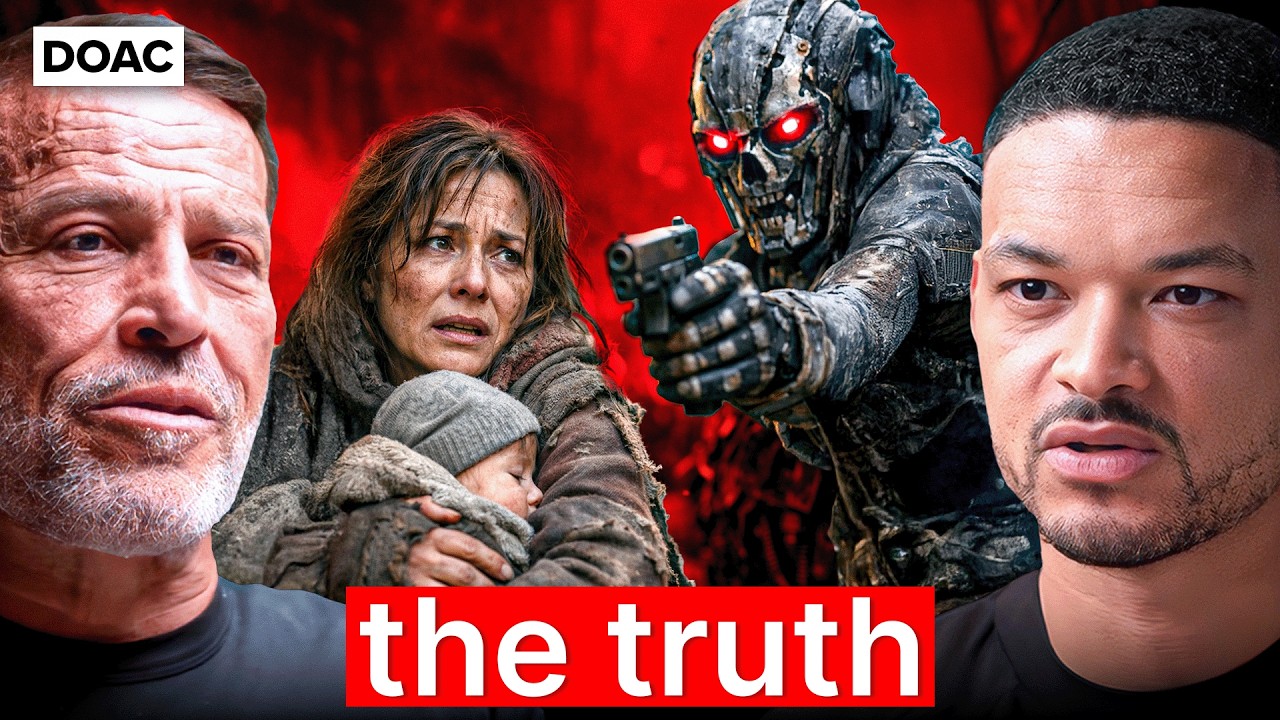
The REAL Reason Nobody Knows What's Coming Next
Now Playing
The REAL Reason Nobody Knows What's Coming Next
Transcript
704 segments
So if I were to ask you just for because
we weren't recording then
what you think maybe the most
consequential thing we should be talking
about right now is as it relates to
suffering and everything that's going on
in society, what would that answer be?
>> I think it's AI but it's not just AI,
it's nanotechnology. It's how technology
the rapid change in technology and if
you don't believe it's going to destroy
humanity
and it's going to liberate us from a lot
of labor. If you believe that, the ones
that promote that concept if that does
happen and we displace this many jobs in
this short a period of time jobs are not
just money. Jobs are meaning. It's not
the only form of meaning but it's
meaning. So it's like you talk about
well we'll do give people UBI and okay,
I think you might have to because the
change is going to happen so rapidly
like I said, you know, farming 80% of us
were farmers 150 years ago. Now it's 3%
we feed the world. That's a long
transition. I think I mentioned to you
off the air that I was visiting with
President Obama 10 years ago and towards
the end of his term there and I was
saying
hey, I just got to talk to you. You
know, you inherited pretty tough economy
from the original 2008 explosion
breakdown. We lost 8 million jobs. So I
said there's technology coming right now
that we can predict is going to displace
more than those 8 million jobs. And I
talked to him at that time just about I
said just take one like self-driving
cars. They're just starting to come out.
I said in the next 10, 12, 13, 14 years
they're going to become ubiquitous. And
I said there's 8 million truck drivers,
Uber drivers and taxi drivers. And
are you doing anything to retool them? I
said because
>> the US?
>> Just in the US. I said because if you
don't think about this, I'm a business
person and I can hire a person to drive
a truck only 8 hours a day. I have to
pay for the health care which gets more
expensive every year.
They're going to at me about
things. And I can buy a truck that can
drive 24 hours a day and my insurance is
cheaper because it doesn't make mistakes
and I can depreciate the asset.
Am I going to hire anybody?
I said so those jobs going to go. That's
8 million that's That's one sector. We
can look at farmland where there's so
many industries affected. So, I said,
"We've got to retool those people now or
there's 10 years to gear them up because
these [clears throat] are not people
that are going to do it on their own and
they're going to be shocked." They're
The shock to their system, the loss of
dignity of of being in control agency of
their own life, of their own job, of
their own direction is huge. And if you
go back to like the Luddites, you know,
you're from the UK, right? You must know
your history there. 1800s, you know,
mercantile they'd come up with these
machines and how did people react? And
by the way, this story is the same
across history. We have a radical change
like this. All these people are
displaced and what do they do? They
rioted. They took hammers and they
destroyed those machines. They
threatened to kill the owners of those
companies and some were shot and killed.
They blew up and firebombed places. And
what did the UK, you know, do about
this? They passed a law in the first
year of this of these Luddites saying,
"You destroy a machine, it's capital
punishment." They hung people.
Because they couldn't have them destroy
the growth of the of the economy, right?
And guess what? 15 years later the same
thing happened again with the thrashers.
Thrasher machines that were used for
wheat and they lost all the jobs and the
people and the government overreacted.
I'm not trying to be overly dramatic,
but if anyone thinks this transition is
going to be smooth by us doing nothing,
they're wrong. And the problem is as I
mentioned you before, I think the
leverage is not in favor of us taking
care of society. The leverage is the
carrot and the stick. The carrot is I
can make a trillion dollars if I have
the right LLM or, you know, if I get to
artificial general intelligence, who
knows.
And if we don't do it, China's going to
do it. That's the stick. And then
they're going to run the world. So,
there's no focus on safety virtually as
you all know. And there's certainly no
focus on what's happening with these
jobs. Right now, high school students
are getting jobs more than college
students for the first time in 50 years,
right? You see the displacement. You
know, you got friends like I do. Mark
Benioff's one of my dear friends. They
let go of like What was it? I think it
was Was it 5,000 customer service agents
and that was done with AI now. Now he
wants to elevate them to other jobs. So,
we have to look at what this means to
our society. We have to anticipate what
this means and we've got to retool not
just the jobs, but the psychology.
Because
people talk about a post-work world. You
hear people talk about this all the
time. Elon, people like that. They
labor's like electricity. You just take
it for granted. It's so cheap. It's so
easy. Well, if that's true and he's
talking 3 to 5 years. And a lot of
people say Elon's early. He usually is
uh in his predictions. But Ray Kurzweil
is a good friend of mine. He's the most
accurate predictor of technology in
history and he's been saying 2029 for
almost 20 years is when you have
artificial general intelligence. If you
go to Hinton, I think you've interviewed
Hinton, haven't you? Right? So, he's the
longest. He's saying 2030 to 2040. He's
given us a little more room. In the next
3 to 10 years, this is going to happen.
How are we prepared for this?
And so, this is the questions I'm trying
to bring up to people that have
influence to say, "If you're in
business, you got to take a look at
this. If you're in government, you got
to take a look at this." And so, I I
just got
um they haven't announced it yet, but I
just got selected to be on the federal
advisory committee
for the president and for the Health and
Human Services and I'm on the mental
health side and I'm hoping to use that
position to bring more of government's
focus into this category as well because
it's got to be addressed.
>> When we recite these And that's
>> By the way, the answer to your question
is and that's suffering. That's
suffering at the highest level, not just
financial suffering. That's emotional
suffering. That's loss of identity
suffering. If I am a coder, I am a truck
driver and I lose who I am. Now,
I I just want to say one last thing.
We've already been in a post-work world
cuz I had one person say to me recently,
"Well, for 4,000 years, we tied our
identity to our work." I said, "No,
Americans all go, 'What do you do?'" Not
everybody in the world does that. And
for 4,000 years our connection po-
before the agricultural revolution was
really what tribe we're connected to and
our sense of significance was maybe our
courage in battle, not our financial
component. Or maybe it was our
creativity, our poetry, our storytelling
capacity, or maybe it was our
generosity. Um maybe it was our wisdom.
So we can find other things that have
meaning besides a job. But if you don't
take a culture that's been conditioned
for 200 years to think a certain way,
we're going to have a lot of pain and I
would like to see us have less of that
if we could. And I'm only one person,
but I'll do my best to
help people make that transition.
>> It's funny cuz when we think about those
historical examples of transition, I for
many reasons think this is even more
extreme.
>> I agree.
>> Because you have intelligence and you
have you've basically disrupted both the
muscles and the mind.
>> But you know, it the reason it's going
to explode even faster is because we're
moving from LLMs to now actually
studying visually what's happening in
the real world. And when robots do that,
then the game changes. There's tempo of
learning. Just think about this. You and
I are having a conversation. I picked up
one of your books here and I'm reading
through your books. So I'm going to get
a feel for who you are and everything
else before I came here. I've seen some
of your videos, but and I know like I
really enjoyed it. But I had to go get
that. I had to take couple hours to dig
through that. You and I have a
conversation. If either one of us learns
something or a machine, every machine
knows instantly you push one button and
they have all of that knowledge. There's
none of this word transfer. It's just
it's now. So people don't realize what
this really means. And when you're
learning from the real world, not just
LLMs,
right now you and I are our brains are
predictive devices. They're predicting
what is going to happen next to the best
of our ability and we're trying to close
that gap as much as we can or we get
jolted. Well, think how predictably
that's going to do to people's heads
when all of a sudden their labor is not
needed.
>> Mhm.
>> And it's no longer blue-collar labor,
which is what people thought it would
be. It's white-collar labor. I mean like
in my financial
I have a lot of I have uh
I own 95 different private equity firms.
I have owned the firms, not the actual
funds, right? So, I get the two and 20
on and I got pieces of all of them. So,
they're biggest in the world. And so, I
get to take a look at some of the things
that are happening so fast and I look at
all those jobs and I see people in those
industries and
quantum is taking its hook over maybe 5
years ago. I've seen the shrink in these
offices from staffs, the guys who were
making 5 million, 10 million dollars a
year, they're now unemployed.
Right? It's not just blue-collar
workers, it's everyone. So, you're
right, this has never happened before in
history and what's being done about it?
>> More money's been put into it to
accelerate it.
>> The carrot and stick, the trillionaire
and China, those two pieces are driving
it all and a few people are trying to
hammer like Kinton and a few other
people, we got to work on safety here so
it doesn't eliminate the human race. And
I'm not a reactionary person, but you
know, of what is it, 25, 30% of the
people that work in AI say that they
think it could potentially do that. I
mean, like you could use electricity to
kill people or light up a city. So, all
technology has that challenge, but this
is a different technology. This is a
technology that keeps learning, can
replicate itself. Right now, they don't
even know how some of this actually
works. They don't know how the AI is
actually working. It's teaching itself.
These AIs now have their own language,
I'm sure you know, they're talking no
longer in English to each other.
And you know, I'm sure you've seen the
studies, right? Where they give the
information on in the email and then
they say they're going to shut off the
AI and it blackmails them by giving them
confirmation of somebody having an
affair and it blackmails them.
I mean, it lies.
So, we're we're living in a crazy world
where the opportunity is greater than
any time in his- history for us to be
creators. We were created, we're meant
to create. We've got tools to create
like never before. But we we're going to
have to make sure that as we're doing
that, we've got some parameters around
safety and some parameters about what
does it do to society. And I don't have
the perfect answers for it, but I do
know one thing, retooling is the answer
and I don't believe most people will be
replaced by an AI. They'll you'll
replaced by somebody who knows how to
use AI.
>> Yeah, one of the things you said that
really blew my mind when I watched a
video from Boston Dynamics this week
where they the guy explained how these
robots are going to learn and he goes
there's two ways. One way is we're going
to get our factory workers to wear a
suit and every time the factory worker
does something that the all the robots
are going to learn that thing and the
other thing is he said is if one of our
robots learn something whether it's how
to pick up a book or how to make a
omelette every robot learns it
instantaneously and my mind was like
wow. That is
I personally
don't know where this leaves us. So
that's kind of
>> Well, neither do I but there's certain
things you know it's leading us towards.
You know it's going to lead us to a
great deal of violence because there
going to be people like have always
happened with technology displaces them.
Only this is going to be a global event
across multiple areas and not just
drivers of Ubers and truck drivers. If
we don't get our act together and have a
plan, there's going to be violence for
some period of time. There'll be there's
that grief period of loss and that
people go through when something jars
them that much and some people don't
return from that grief. And some people
are going to take this technology and
they're going to go off It's already
happening now even without AI.
There are more males at home 25 to 35
living at home with their family not
working
than anytime in human history including
the depression.
Right? There are I think it's 25% or I
think it was 30%. I forgot the number
just saw it recently of young men have
never approached a woman to ask her out
for a date.
They play video games all day long.
Their mom does their laundry and they
order Uber Eats. This is a mass number
of people. That's just the technology of
getting somebody gamified. Imagine with
AI. So some people are going to go live
there and some people are going to go
the Star Trek route and say I'm going to
figure out what makes human existence be
here.
But it's not hard to figure out the
majority are not going to go the Star
Trek route. And so we've got to have a
bridge because of the time compression.
If this was 100 years to do it, we could
adjust. There will be more jobs.
There'll be new jobs. There'll be new
time. But it's the time frame that I'm
most concerned about. So, when you ask
me what I'm concerned about, that's what
I'm concerned about because it creates
suffering. And it's something that we
can predict is going to create
suffering, and yet I see very few people
in positions of influence and power
doing much about it.
>> So, on an individual level, if you were
an 18-year-old
Tony Robbins,
what would you be doing at this moment?
What would [clears throat] you be
focusing on work-wise? What How would
you be designing your life for such a
world?
>> Well, I have five kids and five
grandkids, right? So, I have
a 52-year-old daughter, and I have a,
thanks to COVID, a 4-year-old daughter.
So, COVID was good to me. I was home.
So,
um
I look at my my, especially, my
grandkids and my daughter, and I say
they're entering a world that none of us
have known before. And so, how do I arm
them for it? And the answer is a couple
of things. Number one, I have to teach
them not to do what most people in the
world do. Most people you talk to, of
any even quote successful people,
whatever that means,
they're stressed all the time.
Stress. I'm so stressed. You hear people
talk about stress all the time. It's
like they argue about who's more
stressed.
And I I look at that and go, why are
they stressed? And the answer is because
they're managing their life.
It We're not made to manage
circumstances. We're made to create.
We were created by something,
call it your creator, call it the
universe, call it God, whatever you want
to call it.
And we were made to create. And when we
create, we're alive. When we just pray
to maintain or manage or hold on to
something, if we're just like caught up
in making a living instead of designing
a life, life is a and that's why
so many people have so many challenges.
So, I'm teaching my kids to be creators,
and I teach them the second piece, the
most important thing I believe, that's
made me successful and anyone I've ever
interviewed. You interviewed a million
people. You see if you agree or disagree
with me.
The three most important skills in life
now are the ones that allow you to learn
more rapidly.
If you learn rapidly, you can win no
matter what happens with the technology.
And what are those three skills? Number
one, the skill of pattern recognition.
When you can recognize patterns, you
eliminate fear.
Fear comes from this has never happened
before. I don't know what this is,
chaos. Like I hear people all the time
talk about how we've never been this
place politically where here in America
where the most we're going to have a
civil war the war and they don't do any
history whatsoever. I I have these two
placards that I have cuz back then they
didn't have ads, right? They had
placards. And one is from Thomas
Jefferson talking about Adams and one
from Adams about Jefferson. And they
said stuff that make Republicans and
Democrats look like they're nice to each
other. I mean, it's just unbelievable
the stuff they said. This is a cycle.
And so when you recognize a pattern, it
gives you power, potential power at
least. The first power is you know what
not afraid anymore. You go, "No, this is
not something that's never happened.
This is not something that's
I can see this. I can see how this has
been dealt with." What took us from
living in fear, from being
hunter-gatherers or trying to survive
every day, didn't know if we're going to
survive every day, to being able to stay
in one place?
What? Pattern recognition.
>> I was going to say the seasons, but
>> You got it.
>> Really?
>> That's it, the seasons. I I figured
you'd get it. Seasons because before
that
you could do the right thing at the
wrong time
and you get pain.
And three of the four seasons are the
wrong time.
So once we figured out, "Oh my god, if I
plant in the spring and I take care of
it through the hot summer, I get this
big reaping. And I hang on to some of it
to make it through the winter, I can
live here. I don't have to worry. All my
fear disappears." So we have The minute
we understood seasons, it changed
humanity. And by the way, there's the
seasons to your life.
You could say 0 to 21 is springtime.
Springtime, how hard is it for something
to grow in springtime? If you start a
business in in economic spring where
everybody's optimistic, you think you're
a genius, you're just in the right
season, right? So 0 to 21, you're taken
care of. In that season, you grow like
crazy. Somewhere around in roughly,
everyone's different, 21 22 years old,
you go to the next stage, 22 to 42, and
that's your summer time. That's the
testing period of your life.
What happens? You are 21, you've heard
all this stuff, and now you go, "You
know what? I don't have to believe this
I want to see what I believe.
I'm going to test." All history, all
studies of psychology show this is the
most difficult time in most people's
lives, right? 22 to 42. So, if you're in
that range and you're listening, I love
you. Hang in there.
>> [laughter]
>> This is This is your ground If you keep
growing, this is a great time, all
right?
Somewhere in that range, you make this
transition. Somewhere around 30 35,
you're 33, you just got engaged,
congratulations, right? You start to
move towards a family, you start to have
those experiences. I'm sure yours will
be very successful. Many aren't, right?
So, at 42 and 43 to 63, that's the fall.
If you planted in the spring, right? And
you worked your tail off during that hot
summer,
now you can do more with your pinky than
working around the clock. You know more
people, you have relationships, you
recognize the patterns, you know what's
going on. It's nothing's really a shock
or surprise to you. You're more
strategic, you're more efficient, you're
more elegant, you have more choices. Um
you've learned a lot of lessons if you
grew. Now, if you didn't plant in the
spring and work hard in the in the
summer, you're going to weep in the
fall, not reap in the fall, right?
So, now this is This is your power
period. This is when most people earn
the most money in their life if they're
going to grow because they've
accumulated knowledge, skills,
relationships, and so forth. And then,
the winter, cuz she comes back to that,
64 to 84 to 104 to the oldest human's
124,
that period is a transition period to
where you become a real leader because
you're no longer you know, that 22 to 42
you're trying to prove yourself to
yourself or maybe other people or both.
But there's a point when you get into
your power group, you know who you are.
By the time you get into this last
season, this you know, 64 to 84, 104,
124,
you know who the F you are. I mean, and
and you you want people to like what you
do, but if they don't,
it's like you know who you are. You
don't give a
I've just entered that season myself.
I'm about to be 66 in a few weeks. And
um
it's the most fulfilling season of all.
Um it's mind-boggling. I wouldn't
believe that when I was your age. That's
why I'm sharing it. Is if you're
healthy, if you're fit, if you're
strong. Um if you don't do that, then
it's can be a that time. But if
you're healthy and strong, you have
40-year relationships, 35-year business
relationships. You have friends that
adore you and love them and you're it's
unbreakable. It's unshakeable. You have
an intimate relationship or a family or
husband and wife relationship if they've
built to that point that is
beyond anything you'd ever dream of or
hope for. You wake up every day and you
know that life is a gift and you want to
give back even more. Like you're more
driven than you were when you were in
the 22 to 42 stage.
Those are the seasons.
There's one more. There's seasons of
history.
And your season of history shapes how
you shape your life.
So, you can look at a thousand years of
Roman history. I'm very much in history
and 500 years of Anglo-American history.
Um and you start to see patterns. In
fact, I'd recommend for everyone,
there's a book called Generations. Have
you read it?
>> No.
>> When I was working with President
Clinton
in those days, I worked President
Clinton,
I went across the other side and worked
with the Speaker of the House Gingrich.
I On the same day, on Clinton's on
on his desk, on the Resolute Desk, was
this book Generations. And I asked him
about it.
And he told me about how it is amazing.
It shows how history is somewhat
predictable and why the cycles are
generated by different generations, how
we react to the way we
we grew up. And then I go over to
Gingrich's office and he's a historian
he's got on his desk reading. It's a
pretty thick book, good size book. My
point is it's if you want to navigate
your life
you need pattern recognition so you
don't go in reaction and one thing is to
understand seasons are a great pattern
they freed us
there's seasons of your life you should
think about this season what's this
season about for you? What do you want
to extract from this season? And every
season has predictable challenges and
predictable opportunities and where am I
in the season? Some people go through
their spring time during a war winter
time. Some people go through spring time
in a fall. We all grew up with different
environments and so we're shaped by that
and that's why histories change. So but
let me finish the last of the last piece
I've gone way long I apologize.
I said there's three skills what what do
we need right? First one is pattern
recognition the second one is pattern
utilization.
So I watch you like you you and I both
we developed companies took them public
very early ages made a lot of money and
figured out it wasn't just about money
right? I mean you have to look at your
history
you didn't just recognize patterns you
used them. You saw them in marketing
areas you saw online opportunities you
saw things you didn't just oh now I
understand it you jumped on it. Anyone
is incredibly successful in anything if
they're great at dance if they're great
at investing in companies they've gained
in running companies if they're great in
singing they recognize there are certain
patterns and then the final skill and
this is what I'm teaching my children is
you ultimately want to become a pattern
creator. You think of example learn
learn to play the piano right? How do
you learn to play the piano? You got to
recognize patterns and usually you're
taught someone else's patterns that
produce something beautiful right? Could
be Bach Beethoven could be some rock
could be whatever you're learning and so
you learn those patterns and you
practice them you learn to use them
right? And now you can produce the same
music.
There is a point and I'm sure you've
experienced this already and you're
going to experience a lot more in the
next 10 years of your life
you've taken so much input in you've
recognized so many patterns that now you
come through and you become the pattern
creator.
>> If you love the Diary of a CEO brand and
you watch this channel, please do me a
huge favor. Become part of the 15% of
the viewers on this channel that have
hit the subscribe button. It helps us
tremendously and the bigger the channel
gets, the bigger the guests.
Interactive Summary
Ask follow-up questions or revisit key timestamps.
The video features a deep dive into the profound societal impacts of rapid AI and technological advancement. The guest argues that this transition, which threatens to displace both blue-collar and white-collar jobs at an unprecedented speed, will lead to significant human suffering if not proactively addressed through retooling and psychological preparation. He emphasizes the importance of pattern recognition, pattern utilization, and becoming a pattern creator as the essential skills for individuals to navigate and thrive in this changing landscape, while also highlighting the importance of understanding the 'seasons' of life and history.
Suggested questions
3 ready-made promptsRecently Distilled
Videos recently processed by our community