Lauren Tan - SpaceXAI engineer
Now Playing
Lauren Tan - SpaceXAI engineer
Transcript
1400 segments
Um, personally I think that uh the best
use of you of AI is really as like a
like a pair like someone you're pair
programming with and not someone as not
not a not a tool to just replace the act
of writing code or worse outsourcing
your thinking.
And I think there's a tendency like, you
know, because AI is so exciting, you
want to put AI everywhere and be seen as
someone who's very, you know, um, what
do you call it? Like, uh, on the ball, I
guess, with with AI. Uh, that you feel
this pressure of like, you know, I'm
just going to I got to increase my
productivity. I got to ship like 100 PRs
this week and barely understand what I'm
doing and, you know, vive code my way to
a million ARR or whatever.
Um but I think you know um one of the
things that I've personally seen is that
although when I use AI I save some time
you know writing the code I actually
find myself spending more time reviewing
what the AI did and like correcting it.
So, you know, like I've I've tried the
the thing that a lot of people say like,
you know, you uh instead of prompting an
AI to just build the feature outright,
you sort of get it to uh build a spec
for you first, then you review that
spec, and then you do this whole thing,
then it's like,
>> uh, okay. So, I assume you can see my
screen.
>> Yes. Yeah, we're good. [clears throat]
So yeah, today yeah I think I think the
big theme for me as I've been using
agents to write code and I'm sure a lot
of you have had the same experience as
well is how do you trust it? You know
especially if you are an engineer that's
been writing code for a very long time.
You have a lot of opinions and lessons
that you've learned about doing good
engineering. And when you see agents
just, you know, winging it and, you
know, guessing, hallucinating,
uh, you know, confidently stating that
they found the smoking gun, uh, for the
hundth time, uh, but it's actually not
the real problem. You lose a lot of
trust. And when you lose when you don't
have much trust [clears throat] in your
agents, I feel like you you really can't
get the most out of them. And for me,
the parallel is like with management. Uh
so if I'm an a manager an engineering
manager of a team and I have a bunch of
you know I have a team of engineers uh
on my team and I don't trust them then
the mode of operation I'm going to be in
is going to be like micromanagement
right I'll have to spend a lot of time
looking over my reports shoulders and
checking that they're doing their work
well you know that they're not shipping
bugs to production
and so I drew this chart because uh it's
It's not it's not a very scientific
chart but like this is how I imagine
myself and my journey through using
agents. So you know like fast forward or
back forward uh or fast back uh fast
backwards like a year or so when you
know nobody was or not many people were
using agents to code. Uh I think you
uh you know get into this mode where you
are
in very heavily in the loop with one or
several like a handful of agents and you
find yourself just constantly fig uh you
know trying to understand what your
agents are doing uh and you're very very
in loop. You're watching every single
output. you are sitting there prompting
um and you really can't parallelize
beyond that because you don't again you
don't have that trust right you can't go
to a 100 agents uh like spawn 100 agents
when you don't even trust the output of
one agent
so over the past 5 months I feel like
I've really been able to uh like ascend
this trust curve and now I'm at the
point where uh I actually have this
sounds kind of scary to say And it it
makes me sound like a slop artist, but I
I promise I'm not. But I actually have
my agents now um autoemerging PRs for
me. Uh which is like a wild thing to
say, but um like I woke up today and
there were like 20 PRs landed and I just
reviewed them on main like they were
already landed and they were good. Uh so
how did I get to that point is basically
what I wanted to talk about today.
Uh and again like yeah feel free to jump
in if you have questions. colon. Um but
uh oh yeah, of course I got to show this
this chart. [laughter]
Uh where uh
no do not trust to someone requested to
control my computer. Uh I probably won't
do that. Uh but yeah, so this chart I
think I I'm I'm sharing this chart not
to kind of like flex but to kind of show
like the journey like so you can see
like the curve like it sort of like
inversely matches the contributions I've
been able to land at cursor. So I joined
five months ago and five months ago like
I you know my first month I was like not
very productive because I was obvious
you know I was learning the codebase
didn't know what the heck was going on
and as I got more confident in in my
agents uh I've really been able to kind
of ramp up my productivity uh and again
like yeah like last month I shipped a
thousand PRs which is ridiculous. Uh,
and then this month we're only on the
12th. I'm already at like almost 800 PRs
landed. Uh, so the velocity is
definitely high and you you I'm sure a
lot of you will definitely be
questioning like how how much of this
code is actually good. Um, and I think
yeah, like that's definitely fair to
question.
Um but uh yeah, I think I think if you
set up your agents well, you can
definitely get to a very similar level.
Um and so I'm going to talk about how we
do that.
Uh so for me I think I'm curious like I
guess call in your experience as well
but uh for me I think the most important
skill that you should have in your
toolbox when you work with agents is
verification. Uh and by verification I
mean the ability for an agent to
actually run the code uh or take CPU
traces or heap snapshots or uh you know
open an iOS simulator whatever you know
however your application is exposed to
your users. It can do the same thing and
uh run it for real and actually test and
verify it don't work because that's the
thing that really closes the loop. uh it
doesn't guarantee your agent writes good
code uh but it allows them to at least
write correct code uh which is a big a
really big step forward for being able
to trust your agents. Um
I will I can share one example that we
have uh within cursor. Uh
oops
where let me open this
let's make this uh make full screen.
There you go.
Uh so for the for cursor's agent window
uh so this is actually an interesting
story but uh when I joined cursor five
months ago uh they're actually uh well I
was supposed to join a different team I
was supposed to join like the cloud
agents team uh but then since I have a
lot of experience working on react and
agents window is a react application uh
I was
uh I was asked to basically help out
with the agent window work. Uh but um
there wasn't really a lot of like skills
to help me. So I just found myself that
okay uh agents window is going to launch
in like week right we have a really
tight deadline and um there was uh you
know I was just sitting there like okay
I'm going to open up the performant the
the chrome dev tools and just like take
a trace look at it myself and try to
make sense of this flame graph. And keep
in mind I was just like in my first week
so I had no idea what I was looking at.
No idea where you know I mean I had some
idea but you know the code base was
completely fresh to me. Uh and I
realized like my agent had no idea
either you know like I would take a
screenshot of the tree I would download
trades I would send it to it and it be
like yeah it kind of looks like this you
know uh and it would like confidently
state like it's this thing and then I
try to fix that and turns out that's not
the actual thing.
So this was very very slow process and
if you've ever done any like performance
work yourself or you know just even
development with an agent where you
don't have a verification skill you are
the verifier right you you're the
bottleneck you you you tell your agent
to do something and then it goes off and
write some code then you open up your
you know local dev build and then you
start to say oh you know doesn't work
then you got to copy paste screen uh you
know screenshots or console errors or
whatever uh and then your agent like
slowly kind of like uh you know works
with that and then tries to understand
it and um fix the thing but then you're
constantly just in the loop and and
being a bottleneck. So there's really no
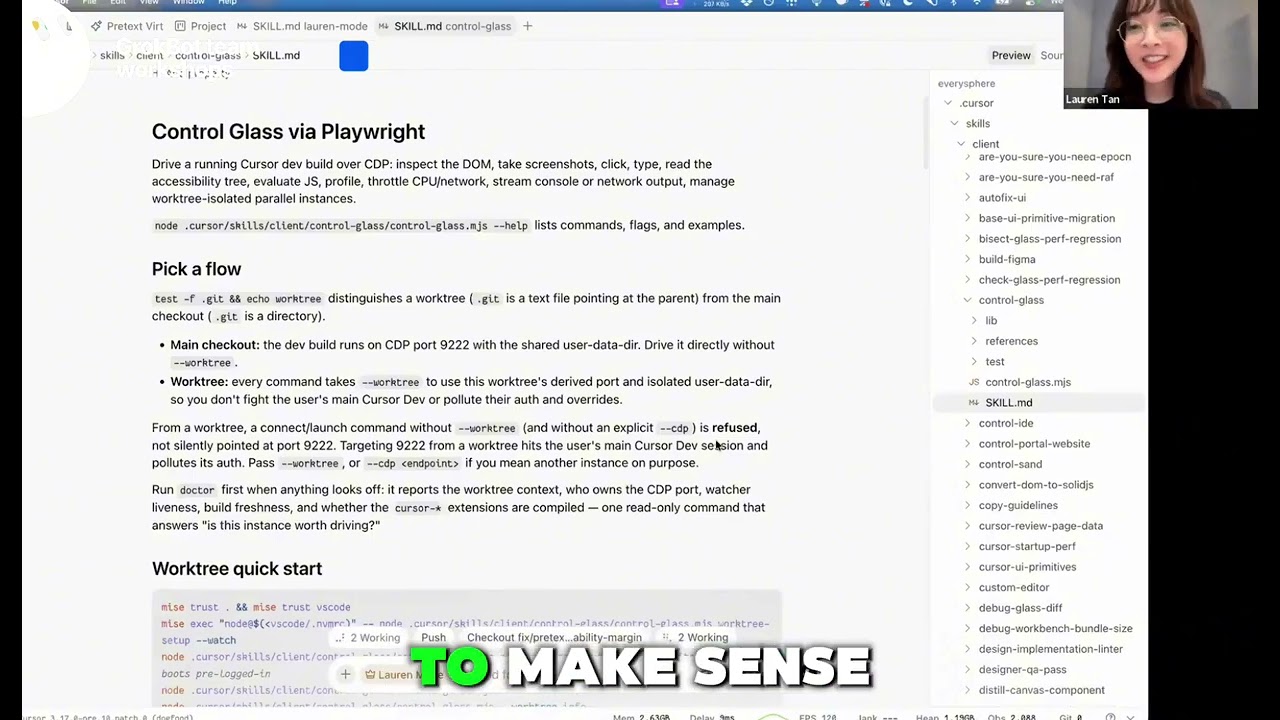
way to parallelize. So the control glass
skill is like one of the first skills I
built uh for cursor. Uh and glass by the
way is the code name for agents window
that we use internally but it's just
cursor I guess. Um, and so this skill uh
is I guess the the the code itself is
not super interesting. Your agent can
very easily make one for you. Uh where
if if you're building an electron app or
a web app or even iOS uh applications,
uh you can teach your agent how to use
like the Chrome DevTools protocol or
through uh Apple has some utilities as
well for running the simulator and
taking traces and controlling
programmatic control as well. Uh so
that's really useful. Uh but one thing I
want to talk about is uh the
this thing
uh where is the read me? Uh so this
skill comes with this very unique
feature called or not feature uh unique
file called a feature map. And so the
story then is like I built this skill
and so now the agent was able to uh
actually run the agent window and take
traces and whatnot. Uh but it had no
idea what what the agent's window was.
So um you know like someone would say
like oh the the left sidebar is like
laggy or something like that or you know
the right side the the PR tab is not
working and the agent would just be like
kind of flailing around. it would spend
a lot of time trying to like look up the
code and you know where is this feature?
How do I actually get to it on the UI
which made it basically completely
useless. Uh you know like we would I
would run this skill locally and you
know it would spawn a dev build uh but
then it just be turnurning like I just
try to click here. It wouldn't know how
to get to things um and it was just an
awful experience. Uh so who's putting
arrows on my screen? Um, so, uh, yeah,
this this feature map has been really
useful, uh, because it teaches the agent
how to get to all of the features that
you have. Um, and in PAC, the plugin
that I I've made, uh, if you search for
PAC cursor on Google, you you'll find
it. Uh, but there is a create
verification skill in that plugin where
it actually helps you set up something
like this for yourself. Um, including
the feature map. So it will actually
explore the code and build up this
initial feature map that tells your
agent how to get to all of the different
features that you have. Uh and this is
extremely powerful because now like you
have these user reports that come in uh
you you can actually map even like a
vague report or even a screenshot. So we
have this uh internally at cursor where
uh we have a slack channel with you know
lots of people giving us feedback on the
agents window and rockbot and whatnot.
Uh, and often times the report is very
bad, like very low quality, like someone
just put very often we get like a
screenshot like and then someone just
says question mark question mark
question mark like what is this?
[laughter] And you know like the without
this your agent is like I have no clue,
right? But with a feature map like this,
it has a lot more context and
understanding of how to actually
navigate how to get to all of the
different features. Uh so like you know
example like I guess like the sidebar
like what is the sidebar uh you know
like all the different sub features that
are present in it um like from the user
point of view here's where to how do I
get to it all the different keyboard
shortcuts
uh even like the the what do you call it
the DOM elements or yeah like the
attributes that you use for selecting
things through the CDP uh are all there.
So uh again yeah this is like really
really powerful uh for for agents
>> uh and piece stack ships uh that create
verification skill but also a maintain
verification skill uh so you can keep
this up to date.
>> Cool. Yeah, I was just going to ask how
you created that. So do you mind sharing
a little bit more about um that that
process in the context of Pstack and
maybe just what Pstack is for the folks
who aren't familiar?
Yeah. So, Pstack is pretty interesting
because uh well, first of all, the name
is kind of goofy. Like the P the P in P
stack is like potato potato stack
because I um so uh uh there's a pretty
uh famous person Gary Tan who is the CEO
of Y Combinator and he's come up with
this plugin called GStack uh Gary Stack
and uh funnily enough we share the last
name. We have no relations. Uh, but I
thought it would be funny to kind of,
you know, poke fun at Gary and make
Pstack my version of of of his plug-in.
Uh, but kind of tailor it to my own set
of p engineering practices.
Uh, but I honestly actually never set
out to build PAC. Uh, it just started
with a bunch of skills, right? Like I
started with that control glass skill
and then I started with another skill
like called how which I also noticed
through like observing agents. Um so
like you know in the early days of me
you know trying to climb this ladder I
was like super in the loop and I was
basically nitpicking my agents to an
extreme degree. I was like I would tell
it um you know this feature has stopped
working. Here's a bug report like why
isn't it working?
And very often the agent would just like
confidently state like, "Oh, it has to
be this, right? It has to be this
thing." And I noticed like when I looked
at the actual tool calls, I noticed it
wasn't actually reading the code that I
thought should be affected. And that
made me just extremely suspicious. And
at that point, I was like, I'm not going
to I can't trust any this agent anymore
cuz it's just it's just completely
hallucinating. And I think
I think it's very easy to just, you
know, like build up that distrust and
not and kind of feel helpless like, you
know, you don't know how to help your
agents succeed. But like again, I think
the the the management analogy is super
helpful because like imagine if you were
a manager of an engineering team and you
had an engineer on your team who was a
really good coder, no business context
whatsoever. you know they they just you
just hired them and they they onboarded
you know like 5 seconds ago. Uh and so
how do you actually teach that person to
be effective? So how you do that is
through a skill. uh skill being just you
know it's just markdown right but you
know it encodes a lot of information
instructions a lot of uh you can really
draw out a lot of intelligence from an
agent by well some people on Twitter
call it like you know pull the agent to
a different latent space which is kind
of like a fancy way of just saying like
since uh you LLMs are sort of like they
predict the next token uh when you give
it some high quality tokens uh to begin
with then you know it it can kind of
pattern match on like a higher space
that's you know smarter.
Um so that's like a very interesting
model there. But yeah I built PAC very
very incrementally. Uh so uh started
with just really observing how agents
you know all the fail different failure
modes of of that agents were having and
every time I saw that I just okay I'm
just going to make that a skill right
like stop hallucinating actually go and
search up look up the code use a lot of
sub agents uh and yeah stop guessing
>> yeah that makes sense one one kind of
followup question here both from myself
and from a bunch of people in the chat
so
>> I guess it's two two parts So one is
like how do you maintain these skills?
So like the product changes over time.
Obviously there's a lot of people who
are shipping against the codebase. So
how do these skills get maintained? Uh
and then second to that is like how do
you know when your verification is is
good enough? Uh like and you know you
can trust that the ver verification
loops that you've built are going to I
guess you trust that the outputs uh when
they're done.
>> Uh yeah maybe I'll talk about um I think
somewhat related. Maybe I'll start with
this one first. So like how do I
maintain these skills?
So um if you're not familiar with this
concept, an eval is essentially like a
way to uh well I think the mental model
I have is like it's like a unit test for
an agent. Um and uh you can actually
make your own eval. You don't need like
a special framework for them. You can
build you can you can build one
depending on like you know how
scientific and how rigorous you want to
be. Uh, my screen is red.
>> Yeah, there's a little button. Um,
sorry. Do
>> you mind like disabling the drawing or
something? I I can't see my screen.
>> Yeah, sorry. If you guys could not draw
on the screen, that'd be great. But, um,
there's a little button in the
>> Is that a troll?
>> Yeah, the little drop down.
>> Um, how do I clear?
>> Yeah, you got it. Perfect.
>> Yeah. Yeah, evals are a way to unit test
your skills basically. And actually in
Pstack, we ship uh under potato mode
there's a playbook if you search for it
called eval playbook. Um and it's uh
uh it's like not it's actually pretty
pretty rigorous the way it's done. Uh
but um essentially what I do is I spawn
a lot of different sub agents. I have
like my main coordinator agent uh come
up with a rubric for uh what I want the
skill to do. Um and then it spawns all
these sub agents and it it creates
individual directories for them uh which
are cleverly named to not let the sub
agent know that it's being evaluated
because uh agents can actually tell and
when they do they change their behavior.
Uh, but it does a bunch of stuff like
that to um essentially yeah like test
whether or not the skill I'm making or
changing is actually doing what I think
it does. Um, and one of the really nice
things about cursor is that we are we we
support so many different models. So you
can actually eval your skill across all
sorts of different models. Um, and you
know get a sense of how well it performs
across that different matrix. um
especially for the models that you use.
Uh so I do this a lot. Every time I I
modify a skill, I will run one of these
uh like the Ebal playbook uh and make
sure that you know it's actually leading
to a result I want. Uh but I will say
like maintaining skills is actually
pretty hard. Uh it requires I think a
lot of taste and observation. So you
kind of need to be very good at being a
backseat driver. You know what I mean?
Like if you do pair if you ever done
pair programming for example uh and you
watch a coworker code and you just like
you you could probably do this better
you know you could do you know like why
did you not do this right you you ask a
lot of questions to your coworker and
it's kind of a similar thing here you
like you don't want to just be a passive
observer of your agent you want to be
very in the driver seat in the initial
stages when you're building up your own
set of skills uh you know obviously you
can use something like PAC but if you're
building your own set of skills it's
very I think you opening up the all the
tool calls and like reading the code and
reading all the to uh the agent behavior
and their thinking blocks is a really
great way to see where they they fail,
right? like what what you know where are
they being done and then you can go and
build a skill for that and then with
verification how you trust it is it's I
think it's also a very similar iteration
loop uh where you know like I actually
did the same process for verifying the
verification skill where I actually get
um so one thing that's interesting about
eval is that you can sort of hill climb
them meaning that uh your eval can
produce a score right uh a score that
you can get your coordinator to produce
uh but also comp uh you can have a judge
agent of a different model to uh kind of
cross reference and make sure that the
first model is not being biased, right?
The model that's judging all of the sub
aents that are running the thing. Uh but
you can also like hill climb. So meaning
that you can you can use like /loop in
cursor and you can say okay keep looping
on this eval right until everything is
10 out of 10 as an example. Uh and I did
the same the basically the same approach
with the control skill. And so I kind of
it was very it was very hands-off
actually. Uh so you know I uh I kind of
built I built that skill that way like
the CLI and that skill. Um and over time
it's gotten really good. Uh but yeah, it
was definitely not super smooth at the
beginning. It required a lot of
iteration and I think there's an analogy
here for me which is um well I make this
analogy later in a different slide on my
drawing here. Uh but I think of it like
uh you know as a as a engineer now
you're sort of more like you uh like
maybe a manager or the analogy I like is
like you're like a a chef in a
restaurant. uh you know, you're the head
chef. Uh you're not cooking all the food
yourself anymore. You have a team of
cooks, right? You have line cooks, you
have a sue chef, you have, you know, all
these different stations.
Um and it's your job to really design
the environment. You know, you you're in
charge of setting up the kitchen. You're
in charge of, you know, like giving
tasks to different people. So,
um yeah, it's a very interesting way of
working. Uh but yeah, that's that's how
I've basically built uh these
verification skills.
>> Yeah, just just one fault there on like
to go try to go one layer deeper. So are
you let's say we wanted to build um an
eval or a skill for for something and we
wanted to kind of get better on its own
which is is what I think you're
suggesting. Uh are you doing that in
like a work tree kind of isolated with
like the sub aents and and then the
reviewer agent and and all that? Is it
happening like in some type of cloud
hosted environment? like what's the the
more the practical steps if I wanted to
go do this uh and like set up a
verification system for something? What
would I what would I do or where would I
start?
>> Um I think that uh the best place to
start is local because you can observe
you can definitely observe what your
agents are doing. So, uh, if you're
building a verification skill for
yourself, uh, I would definitely start
local and just have your agent bring up
the application, whether it's like a CLI
or, uh, desktop app or whatever. And so,
you can actually observe, right? You can
see how the agent is interacting with
the the application. You can see it, you
know, how it calls like the different
APIs that that allow it to interact with
the uh the application.
Um but uh for me personally uh I have
basically been kind of all in mostly all
in on cloud agents because they're
extremely powerful. Uh and the really
powerful thing about cursor is the the
cloud agents actually where if you spend
a little bit of time setting up your
environment
these control skills these verification
skills pay a huge amount of dividends
because it's not just something that
makes you as a single engineer better.
It actually levels up your whole team uh
and even your whole company because uh
you can actually start thinking about
cloud agents. You can start thinking
about automations that automatically do
things like uh I I get I kind of talk
about this a bit later but I'll just
kind of get into it. Uh where where you
know for example like I talk a lot about
this agent we have called Benny, right?
who who uh you know takes all of the bug
reports that we get and it automatically
goes off in the cloud, opens up a cloud
uh it's you know its desktop. It runs
cursor in its own computer and it uses
the same control skills to interact with
the application and try to reproduce the
bug uh or the user report, right? And
this is so so powerful because at once I
can immediately I I get so much
information from this automatically like
here in this example you can see that uh
the Benny actually reproduced the bug uh
but it's already fixed on main. So it
actually confirms that we fixed this
problem already and all I need to do is
just release another build of of cursor.
Uh so that's like huge information there
that I didn't have to go off and sit
with an agent you know and spend an hour
trying to figure like is this fixed?
this is not fixed. So you you you gain
back so much time. Uh but you know
everybody on my team benefits from this.
Everybody in the company benefits from
this. Uh so definitely think that uh you
know keeping these uh using cloud agents
is super powerful. Uh but yeah it's like
a journey. You have to trust it first
right before you you get to this point.
And that's it goes back to what I was
saying here where you know it's very
hard. It's it's almost impossible. And I
would definitely encourage you not to
try to jump from, you know, like if
you're still in this zone, you don't
want to jump to like I'm going to spawn
hundred of thous or thousands of cloud
agents right now because you're just
going to waste a lot of tokens. Um and
it's going to be extremely expensive.
>> Yeah. So just to kind of recap so far,
basically the if we wanted to go on the
journey that you've kind of gone on, it
would be to start with verification,
building some some skills and some some
ways of determining that the agents are
producing at least like correct code.
Whether like you said, whether it's good
code or not is maybe a separate
question, but like it's it's technically
solving the problem by looking at, you
know, stack traces, looking at, you
know, the the actual behavior in the app
and so on. Um, and then once we trust it
locally, then we can start to think
about scaling into the cloud and running
more agents that are picking up signals
I guess on their own, right? So whether
that's like a bug report that comes in
or something, they can go and pick it up
and solve the problem and give us back a
PR. And then maybe the last step is like
automerging the PRs, which uh is where
you're at, [laughter] maybe not where
everyone is at.
>> Um, and then reviewing the one main, but
um, is that is that about right?
>> Yeah, exactly. I think yeah, that's why
I drew this this uh this curve, right?
because that this this basically
describes my journey of you know when I
started barely could use a couple agents
and I was just observing every single
thing. I think there's really no
shortcut for going from here to there
because this is really about your
personal level of trust in agents,
right? Um obviously, you know, as a as
an engineer, you don't want to just slop
code into production. So, how do you
actually build up that trust? Takes um a
lot of uh I guess taste and judgment. Um
but uh you know, like I think plugins
like Pstack definitely kind of help you
uh get up to speed much quicker. Uh and
so I guess it's like if you trust me and
you trust PAC then in by extension you
can maybe trust your agents but if you
don't trust me and I I definitely would
not encourage people to blindly trust me
uh uh you know if you build up your own
set of skills that you can obviously you
know take a look at PAC and kind of fork
it make it your own improve the skills
definitely encourage that uh but for me
it's really all about it just keeps
coming back to trust you know every one
of us here in this chat have a different
standard for engineering. Uh and there
are different things that are important
for us in our codebase and uh when you
are able to encode all of that into
skills and you can verify that your
agent is actually doing them that allows
you to really kind of ascend this curve
and um uh you know start automating
things. Uh there's another piece I
wanted to talk about um if there's more.
>> Yeah, go for it. I I'll pick up more
questions as I go. Yeah, I think there's
a third part to this which I haven't
talked about yet which is kind of an
interesting one which is like
refactoring and rewriting. Like one of
the uh I guess most controversial one of
the most controversial topics in the
industry I think is like should you
rewrite your app or not? Um because I
think engineers are very prone to this
where especially when you join a company
you come in and you see like the code
base and you're like oh man this is
like who wrote this code you know it's
terrible I want to rewrite the whole
thing is a very common inclination and I
think a lot of you know before agents um
and I guess arguably even now people
will definitely discourage you from re
rewriting stuff but I'm actually here to
make a case for why you might want to
consider it.
Um because
I think it really depends. Uh you know
uh brownfield applications I think are
actually in a pretty good spot
especially if they're set up well
already. Uh and like recently I've been
talking to some people but uh you know I
I was just observing I I just noticed
this parallel which is that a lot of big
tech company problems are now
everybody's problems. Um, and the big
tech company problem, you know, like
when I was working at Meta, like we had
this giant monor repo, we had like, I
don't know, tens of thousands of
engineers just, you know, like banging
on their keyboards and and shipping
code. And
a lot of really great engineers at Meta.
Uh, but, uh, I'll say like, you know,
you'll be surprised that the code
quality is actually not that good. Um,
and so I often joke that like, you know,
before AI slop, we had human slop. Um
and so uh you know I think a lot of big
tech infra like uh like what Meta has or
Google you know you know really big tech
companies are actually designed for that
where you you're sort of like you're
catering to the the you know like uh
this sounds so bad to say but like the
the least capable engineer on your team
right you build you build frameworks you
build conventions you build guard rails
you know you restrict credentials so
that you know your intern doesn't wipe
your production database Um
there's uh you know if you have that
level of infra already I think your
agents can actually already do a very
solid job right because they have the
the guard rails are already in place for
agents to not cause havoc or not cause
too much havoc uh in your codebase. Um
and you can always add more you know
guard rails. Uh but I think like green
field applications especially are you
know like the brand new applications are
like the biggest risk in my opinion. Uh
and also the greatest opportunity
because you know if you vibe code a
project uh a prototype um like we did
for Grockbot you know Grockbot was spun
up very very very quickly. Um and if you
if you haven't heard of of Grockbot it's
like our a new application we just
launched yesterday. Uh it's it's really
cool. uh lets you orchestrate your
create like individual agents that have
their own identity and you can kind of
orchestrate them. It's super cool.
Definitely check it out. U but yeah,
that was it's like a very it was a very
green field application like most
prototypes are so like vibe coded very
quickly. Humans were not reading the
code at all. And uh I had this tweet
recently uh where I said something about
organic architecture. Um
maybe I'll find it. Uh but the idea is
that uh when you have a completely vibe
coded application, you essentially have
no guard rails whatsoever. So uh your
agents
when you give them a task, they will
just solve it in whatever method is the
most convenient. And over time you get
into this uh situation where you have a
codebase that is spiraling out of
control because you don't understand it.
uh your agents understand it I guess in
a way but like they've built something
that is you know optimized for short for
shortcuts uh and uh you know it will you
will suffer you'll have a lot of of
issues with that application
uh so I think starting your codebase
with uh like very strong constraints is
very much needed uh because like when
you have a codebase that you can trust
right when you have guardrails that
actually help you uh uh help your agents
write good code. You can get into the
you know like into this part of the
curve where I I where like I I said you
know I woke up today and I had like 20
PRs merged u by my agents and that's
because I invested a lot a lot of time
uh over 600 PRs I I I calculated
yesterday uh when I refactored all of
Grockbot to this new architecture that
I've been building. Um,
and yeah, I've gotten to a point where I
I don't really look I really don't look
at the code anymore. And um, I say that
not just, you know, to sell you tokens,
but because I, you know, it it it took a
lot of work to get to that point. I
spent a lot of tokens to get the
codebase to this point where I no longer
have to look at it. Uh, but I'm very
excited because, you know, of the
potential where, you know, it's not just
this doesn't just benefit me. It
benefits everyone contributing to
Grockbot and it also empowers you know
designers and product managers and you
know pe uh even GTM people to add
features to Grockbot and I don't have to
worry you know I don't have to to wake
up at night in in the middle of the
night and worry like oh someone's
just merged a perf regression right I
have a ton of constraints and CI like
it's actually very annoying to write
code in in graph web but like agents
absorb all of that annoyance
Um but yeah, I'm happy to talk about
what exactly that is. Um
>> yeah, I think one question um
>> yeah,
>> before we get into the this part here is
just around that element of like what
your your your CI looks like or maybe
some of the constraints and then also
like the average PR size. I saw a
question about that earlier just to give
people you know kind of a a glance. It
doesn't have to be like mathematically
average but just uh you know like what
generally the size of the a PR is. um if
it's only a couple lines of code or you
know um yeah
>> um
I think it depends uh let me
>> I'm trying to do this in a way where I'm
not going to like
>> you yeah you don't have to share the
actual number like an actual average
>> I think this is fine
>> benchmark
>> but like we have so okay this is not
that interesting but uh well fun fact is
that virtualization in grockbot and in
uh cursor is actually powered by uh
Pretext uh which is a sort of new
library that someone's built. Um that's
really interesting. You should you
should check it out, but that's not
really that important. Uh I think the
average PR size I actually don't know. I
I don't know if I want to click on
these. Uh I probably can, but I would
say like they can range anywhere from a
few hundred lines or 50 lines to like a
thousand depending on what the thing is
doing. Uh, so like here I'm actually
like deleting a bunch of files. So I
expect that it's just like mostly
deletion. Uh, but yeah, it kind of
varies.
>> There's no like Yeah,
>> there's no like hard cap or hard limit.
Are they're all like 50 line PR?
>> There's no hard cap. Yeah, there's
definitely no hard cap, but I I do
encourage my agents to split up their
work into multiple PRs. Uh I do that
mostly because uh I like I like the idea
of the I guess maybe this is much harder
to do now as in the world of agents and
you have like so many commits but I like
the idea that you know the git history
is a very rich source of context. Uh,
and I like the I like each PR to sort of
atomically describe what that small
piece of thing is doing, which also
makes it easier for me to revert changes
and like figure out, you know, oh, I
shipped a bug and it's just it's here,
right? It's not in this 40,000 line PR
where you who knows what landed in
there.
Uh, but I don't have a hard cap on PR
size.
>> Cool. And then um yeah, also quick
question on like CI. So again, you don't
have to go into like uh the screen share
of like your CI does, but just generally
would you describe what the CI kind of
looks like uh or how strict it is?
>> Uh yeah. So uh well specifically for
Grockbot. So Dune is the is the sort of
cheeky code code name for the
architecture that we've built for
Grockbot. Um the CI looks pretty
annoying because there's checks for
everything. So like literally I have um
uh well if you've written any react for
example you know you know that one of
the biggest foot guns in react is use
effect. Uh so in
uh Dune and in graphbot we've banned use
effect. So Dune is just you can the the
mental model of what Dune is uh you can
kind of think of it as like Nex.js JS
for uh electron apps and it's designed
for agents to write uh and it's like
custom for you know our agent powered
applications. Um so the CI checks are
very like specific to that like you know
don't use use effect it's it's it's
banned like CI will fail uh and yell at
you. We have like some of the more
interesting ones that people might raise
eyebrows is like I actually ban code
comments as well uh which is very
interesting. Uh, but I've noticed that
99% of the time agents just write code
comments that kind of describe some
historical thing that is actually
totally irrelevant to the code. Um, like
it will often say like, you know, oh,
Lauren said you should never do this and
it's now in in a code comment. I'm like,
what? Like why? What? That was I didn't
say that as like a durable, you know,
global rule. I just meant like your this
PR sucks and you should change that
part.
agents don't really understand us that
well surprisingly uh and or they kind of
assume too much and they kind of do
things in like very stupid ways. So like
yeah we just ban everything everything
you can imagine like the agents are bad
at we ban. Uh so one example that we
actually suffer a lot in the agents
window is we have uh you know you if
you've used the agents window you've
definitely seen performance issues and
you know we're constantly trying to fix
them. Uh but it's like a it's a never-
ending struggle because there's so many
pull requests that get merged. Every any
one of them could just regress
performance or stability or reliability.
Uh you know the agents window doesn't
have this architecture yet. I plan to do
bring this learning back there and kind
of refactor everything there. uh but uh
it just regresses super often uh because
uh there's just one example is like we
have very poor um isolation between
processes. So like on you know on on
Electron you have a renderer thread that
renders your UI but you also have like a
main thread that you can run other code
that you know doesn't need to block the
renderer.
Um, but we do a poor job of separating
those things and so often times you just
accidentally have code that gets pulled
into running on the renderer thread and
then all of a sudden you're competing
with the the renderer that you know that
has a very if you want like 60 fps you
have to every frame that gets drawn has
to be done in 16 milliseconds. So very
very small you know deadline per frame
uh if you want you know a very smooth
product. Uh and when you start building
bringing in accidentally bringing in you
know things that are like very
computationally heavy or they have a lot
of IO uh then you just get into like a
lot of jank your FPS really drops. You
start uh you know losing frames. You get
long tasks that take more than 16
milliseconds and you just get this
really choppy experience.
So all of those patterns that we've
learned basically building electron apps
we've encoded into this framework and it
becomes like a hard failure. So I
literally in in grabbot we literally
have a directory called electron main
electron renderer and we have a import
uh CI guess where we actually check the
dependency graph to make sure you're not
accidentally importing code from one
directory to another. Uh so that's
enforced by CI um as well as bug bots uh
which is our which cursors um like code
review tool that runs on CI uh you know
in our agents MD it's everywhere like so
I I I I um I have this thing here where
I I talk about like um you know like
there are multiple layers I think for
building a good codebase. Uh obviously
the codebase is one where uh if you have
an architecture like this where it's
extremely strict uh you know the the the
way to build features is very
conventional that's like the strongest
strongest level of enforcement because
agents just love to copy existing
patterns. So uh one example of this in
Rockbot is like we have this these
concepts called like a feature and we
have entry points and transcript cards
like oh you know the cards that you see
in the chat these are all like like
nouns I guess in in the framework and so
there's a very conventional way of
creating them and so like a feature is
all in in a single directory as an
example and so all of the code that
contributes to that feature lives in one
directory so it's all collocated in one
place makes It's super easy. You know,
agents don't have to like uh grap around
and try to figure out like where all the
things are. It just looks at the feature
and like, oh, okay, I'm working on the
onboarding feature in Grockbot. Uh, I'm
just going to work in this directory.
And for 80% of the work, it's mostly
just very encapsulated there.
[clears throat] But, uh, like it's like
very it's like designed again for you
know like the dumbest agent like you
don't have to think, right? the the the
one of the key principles I have for
this framework is like the shortest the
shortest path is the best path.
So uh because that plays exactly to how
agents love to write code is like they
like to take shortcuts really you know
they they'll find the quickest way to
solve the problem. So why not make that
the best way to solve the problem? Uh so
I I probably won't get into all the
specific details. Um and uh the the this
framework is really more of a collection
of ideas and principles rather than
something that will open source. Uh you
can you can you know screenshot this I
guess if you want and uh tell your agent
to uh do some build build something like
this for you too.
Um yeah, but it's really all about the
layers uh you know like the the codebase
is one part with features uh and
directories and you know import or
blocking import dependencies uh that
shouldn't be imported uh but and and it
all enforces that and static analysis.
So like uh there's CI checks, we have a
lot of lints for bad patterns that we
observe. uh compiler diagnostics
uh there's also rules and bugbot which
are um I think like three four five are
more soft right these two actually make
make CI red right so that you know
there's a hard constraint where the
agent can't just write crappy code
for rules and skills and bogbot your
agents can still forget right you can
still or it may not always consistently
apply them So, I like to layer them, but
I don't I don't like to rely on them as
the only source of enforcement because
it's very very soft, right? And if you
if you only have rules and bug bar and
skills and a style guide for your code,
you will it's only a matter of time
before your codebase looks like complete
trash. I'm sorry to say that, but uh I
definitely recommend yeah like you know
investing in you know things that can be
hard and forced, right? And this is why
you know maybe uh the choice of text
stack that you use is also very
important. Um like I think for example
Rust is sort of making you know it's
like getting super popular again. Uh
because the compiler is so strict right
the compiler enforces so many different
things. you know, there's a borrow
checker that you have to appease and if
as long as you make sure your agents
don't write unsafe code blocks, uh you
can more or less feel somewhat confident
that if the code compiles, it's probably
works and it's good. Uh but you see, it
gives you that level of trust and
confidence that you as a human engineer
no longer need to go and check it
yourself. you know, you you rely on code
and static analysis to actually make
that uh a lot smoother. Um, and I I
guess the worst part, the worst place to
be in is if you are stuck in code review
land where you actually enforce all of
the constraints, the invariance in your
codebase by literally the human person
saying, you know, reading the code and
like, okay, you should not do this,
right? Every time you have to do that,
you should consider that as a code
smell, like a anti- pattern and you
should say, "Okay, instead of me
commenting on the PR, how do I turn this
into a hard rule, right? How do I turn
this into a lint rule? How do I turn
this into a CI failure? Or how do I even
categorically eliminate this problem uh
entirely?" Uh I I can talk about another
migration I've done, but I'll probably
pause here.
>> Sure.
>> Yeah. I feel like that's that's where I
am to be honest. is is what you're
describing right now, which is that like
I don't have all of these rules. So, I
have some things to go do after this
session in terms of being able to scale
my agents. I'm I'm definitely on like
the uh you know, maybe a couple of
parallel ones locally stage. So, like
two to three locally, and I'm sure most
people here are on the same. So, uh
yeah, I know we only couple minutes
left. Lauren, was there anything else
that you wanted to to highlight?
Obviously, there's lots of questions, so
I can grab more, but I want to give you
a few minutes if there's anything else
you want to talk Well, I think I've been
yapping for quite a lot, so I'm maybe
let's just do questions.
>> Okay, cool. Uh, one question that had uh
a couple of uh came up a couple times
was just around like token usage.
>> So, the the question is like is is what
you're describing a realistic thing for
people who are on, you know, uh a normal
set of token usage. They don't have, you
know, basically unlimited tokens uh to
work with.
>> I think that's a really good point. I
mean like obviously you know I work at a
AI lab where we have unlimited tokens.
So uh I definitely cannot
say that you know this is something
everyone should do in the exact same way
that I did it. I think it's possible to
get to this point without you know
breaking the bank.
But you know if you're like an
engineering leader or you know you're
you have a startup that you lead um I
think to me it's a question of ROI. Um,
and it's like, uh, yes, you spend a lot
of money on tokens in the upfront stage,
you know, like refactoring a codebase is
going to take a lot of tokens. Uh,
adding all these things uh, is going to
take a bunch of tokens. But if we're
heading to a world where agents are
writing all the code and, you know, you
want to be very lean, right? You don't
want to have to hire, you don't want to
be, you don't want to become like meta,
right? Like I mean like in terms of you
don't want to become a 10,000 person
engineering org because I mean that's a
cool problem to have but also you have
so much overhead. There's like planning
you know like you it's it's a personally
I I wouldn't uh it it's not super fun
but um I think you want to stay very
nimble right and you want to you want to
be like agents are all about allowing
you to do things that you couldn't do
before. That's really to me like the
value of agents, you know? It's not just
storing tokens on every single little
thing, but um to me like the thing I
couldn't do before is like enforce this
level of constraints in a codebase by
myself, right? Like I'm just a single
person, you know? Uh it would have taken
me years to build this framework uh and
do all the refactoring and test
everything myself and verify, you know,
like run imagine if there it was just
me, right? you know in in pre- agent era
just like running you know by it would
take me so long right and my salary is
pretty high right like so you know the
the question I think an engineering
leader might have is just then you know
like what is there's a trade-off of do
you hire someone to do this or do you
spend the tokens to set up a code base
so that even the the most naive right
the dumbest agents can do a good job and
when you actually get to this point like
even agents that are not you know fable
size do an excellent job of writing code
and this pays a lot of dividends as well
for me personally where I've empowered
not just myself but again like PMS
designers engineers who are not familiar
with Grockbot to just contribute in a
way that is sustainable
so I think yeah it's definitely like a
trade-off for sure you know like nothing
is like free for sure uh and tokens are
pretty expensive Uh but oh actually uh I
I I don't know how many of you have seen
this but we actually announced Grock 4.6
today. So very exciting finally out. Um
so yeah, GRO 4.6 would be like a great
it was very very smart. Uh it's really
good on the on the benchmarks. Uh and
it's the same the tokens uh well uh I
hopefully I'm not saying this
incorrectly, but uh I believe the cost
per token is the same as 4.5. So you're
actually getting more intelligence for
the same cost. Uh I think this is an
area that cursor tries to cursor and
SpaceX AI try to really optimize for
like that heredto frontier of you know
cost versus intelligence. Uh you know we
don't necessarily want to build the
biggest model ever because that is
extremely expensive to run. It's really
about like how do you find that sweet
spot right? you don't you don't need a
giant model, but it's just super smart,
right? And it's not very expensive for
inference.
Uh but um yeah, I think to kind of round
it up, um I think it's like a it's it's
there's a if you do your own analysis, I
feel like it's pretty positive. It it'll
be pretty positive that the ROI you get
from investing in stuff like this uh
just empowers not just yourself, but
your whole team to be so much more
productive, right? Like imagine if you
have an army of engineers like me who
are shipping so much improvements and
and bug fixes uh you know every day,
right? Like that is pretty exciting.
>> Cool. Uh one last question before we
wrap up. This one is for the people in
product on the on the call.
>> So let's say we do have an army of
engineers who are shipping like Lauren.
I'm just curious like how is the product
team or other functions of your company
keeping up given that like if you're
shipping so quickly, have are they using
AI more to do their jobs? Like as much
as you can speak to that obviously you
don't have like you're not in that role
but just curious about how that works.
>> Um I think this is where grathbot has
been actually exceedingly powerful. uh
where so before graphbot like you know
uh obviously cursor only had cursor like
we only had agents window we had a CLI
we had an IDE and these are really like
power user tools right like de they're
designed for developers so it's very
very developer centric you can do
knowledge work in them but it like the
UI is not really optimized for that so
we actually didn't really have uh well I
think like a lot of people like you know
GTM product like they might have use
cursor uh to do their work but it
definitely wasn't like a delightful
experience for them. Um I think now with
grabbot
uh it's become Grockbot is basically
like the kusher moment for people who
are not in tech in my opinion like it's
like it's like a very very accessible
way to use agents in a very comfortable
very familiar interface. It looks like
iMessage. Um, and it's very fun to, you
know, you can give your agent a fun
name. Uh, you can have you can kind of
do orchestration with in a very like
natural way where you can sort of, you
know, each agent's like a person, right?
Now, you got a team of agents like
working on you have one one agent per
account that you manage as an example.
Or if you're a PM, you have, you know,
you can have an agent that summarizes
all the work that Lauren did last night
and then now you know what I did, right?
So I think our PMs are leveraging that a
lot and they're shipping code too. Uh so
you know like often times they will just
say oh here's a bug I fixed it can you
look at it and then I'll go review it
and actually it's just perfect. I'm like
okay stamp. Uh so uh that I think that
shows that you know the the Dune
architecture is holding up right the all
the the really strict constraints allow
people who are not experts in
engineering to contribute at a high
level. Uh so I'm I feel like I'm already
seeing that pay off a lot where uh you
know designers and PMs are just able to
to to ship features directly. Um and
that just makes the Grockbot team super
fast, right? Where we can ship so
quickly. Um and we have a lot planned.
So, I'm very excited uh to, you know, uh
to to ship more ship more
Interactive Summary
Ask follow-up questions or revisit key timestamps.
The video features a discussion about the effective use of AI agents in software engineering. The speaker, an engineer at Cursor, shares his journey from being heavily 'in the loop' with AI to achieving a high level of automated productivity. He emphasizes that the key to scaling AI-assisted development is building trust through verification, establishing strict architectural constraints, and treating AI agents like a managed engineering team rather than just a coding tool. He also discusses his internal tools (Pstack/Grockbot) and explains why enforcing rigorous code standards and automated checks is essential for maintaining a high-quality codebase when using AI.
Suggested questions
3 ready-made promptsRecently Distilled
Videos recently processed by our community