Pare de vender agentes de IA, venda sistemas de IA para empresas
Now Playing
Pare de vender agentes de IA, venda sistemas de IA para empresas
Transcript
291 segments
In this video, I’m going to show you
why it makes much more sense to sell AI
systems to companies than simply
selling an AI agent. I’ll explain
what an AI system actually is, okay?
And what makes a company want to pay
for this type of system, and how you
can structure this kind of solution
without having to start everything from
scratch for every new client. But now,
let's move to the first topic of the
video, where I’ll explain why selling
just an AI agent is becoming
increasingly difficult. Because when
you have or sell an AI agent as an
offer, if your main offer is an AI
agent, I’m sorry to say, but that
type of offer is getting weaker and
weaker today. Because nowadays, guys,
there are already ready-made tools,
cheap options, and increasingly
accessible solutions out there. So, if
you tell a business owner, "Hey, I sell
an AI agent for WhatsApp," it creates
little perceived value and puts you in
direct comparison with any other person
or tool that does something kind of
similar. So, the AI agent will continue
to be useful—it will become more
useful over time—but it works better
as a piece within a system, a larger
solution, you see? So when your sales
argument stops being the agent and
starts being what? The system that
solves a real problem for the company,
your offer becomes much clearer, much
harder to compare, and much more
connected to the result the client
wants to buy, okay? So, the first topic
I wanted to bring to you is this:
selling an AI agent is getting harder
and harder for you to do. And what is
the shift that I want to discuss with
you here? The shift from an AI agent to
an AI system. Basically, this type of
change happens because the system makes
the solution much more complete and
easier for the business owner to
visualize. So instead of seeing just an
AI agent responding to messages, they
can actually see the entire operation
taking place. And when I say "they," I
really mean the business owner, the
entrepreneur. So they start to see the
lead being assisted, they also see the
lead being registered in the CRM, they
can see the lead moving through the
stages, scheduling an appointment, and
generating data on a dashboard. So,
guys, this really helps make what
you're offering tangible, because the
client can see the solution actually
working within their company. And the
AI agent will continue to handle the
delivery part, but now it will be
connected to a larger structure, which
improves the perceived value and also
enhances your offer and the delivery
itself. I’ll give you an example of
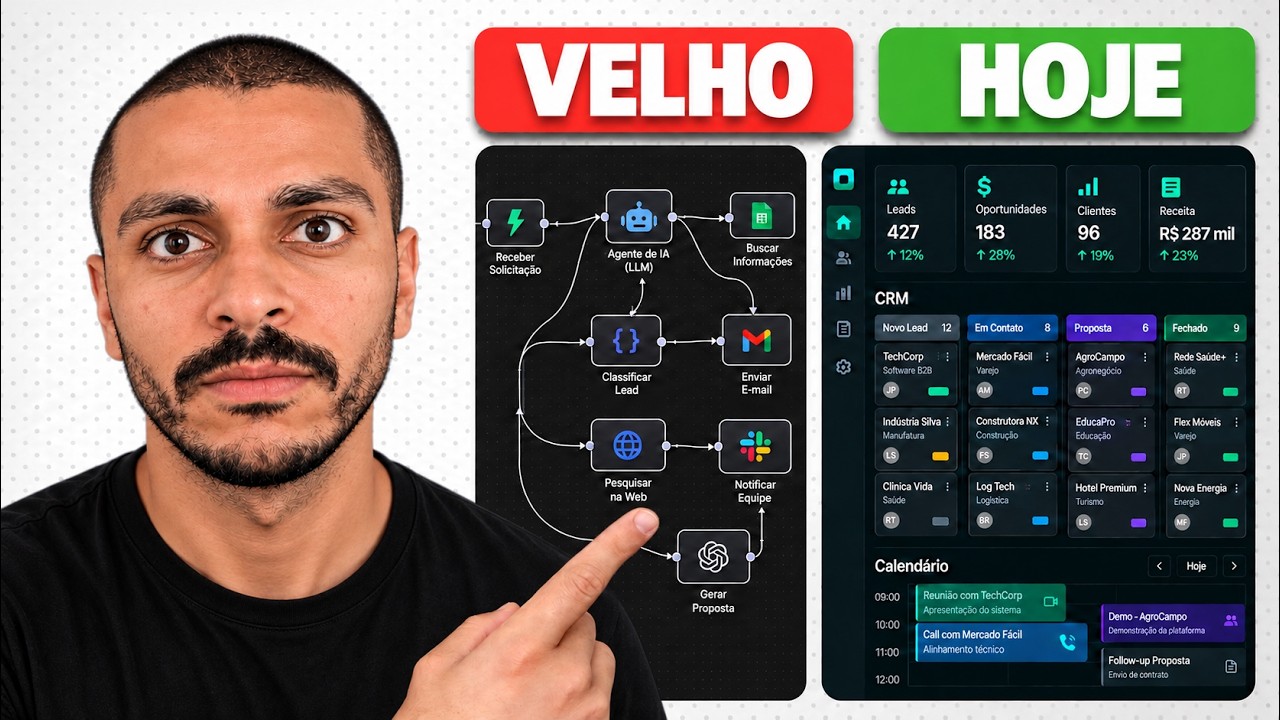
an AI system here. Look at this. This
is a type of AI system that has
dashboards, a CRM, a Kanban board, and
a section for conversations. In other
words, everyone who contacts this
company via WhatsApp will appear here,
and guess what? The AI agent? It's
already plugged into this type of
system. So, everyone who gets in touch
with this company, the AI agent will
respond to them in a humanized way, 24
hours a day. The AI agent will change
the status of these Kanban cards
automatically. It will also register
leads and clients here automatically as
well. And the best part, this type of
system already has a calendar. So, the
company basically doesn't need to pay
for any other tools; everything will be
connected in one single platform. The
company's management, the customer
service management, for example, will
all be unified in one place, okay? So
this is one type of system that I want
to share with you. Want to see another
type? Look at this one. This one is for
a law firm, a legal office. And it has
the same thing: it has a dashboard, a
CRM, conversations here as well, and
the lawyers 'calendars, and so on.
There’s the section for clients,
lawyers, practice areas, where you
register services and everything else.
And the AI agent knows everything
that’s here. So it knows the services
, it knows the company data, and so on.
So you see, it's no longer just about
selling an AI agent, but a system, an
ecosystem already integrated, where the
AI agent is just one piece of this
system. So you can see that your offer
becomes much stronger. But it’s no
use going out there and creating
systems blindly. Why? Because you need
to understand that you must create
systems that companies will actually
want to buy from you, okay? So, just
because you turned your delivery into a
system doesn't mean the company will
want to buy that system, right? The
system must truly solve a problem that
actually matters to that business,
something that is causing the company
to lose money, waste too much time, or
let opportunities slip away. That is
how the business owner, the
entrepreneur, will perceive the value
of the solution. Before you think about
what the system will have inside, you
need to understand which problem it
will solve, how much that problem
weighs on the company's operations, and
why it is worth investing to fix it. So
, let me give you some examples of
systems. Let’s look at a customer
service and sales system. This system
can receive leads via WhatsApp, handle
the service, log everything in a CRM,
track every opportunity, and perform
follow-ups until the lead buys or moves
to the next stage. Basically, this is
that type of system. Obviously, it has
more features, right? It has scheduling
and such, but it’s plugged into an AI
agent that handles follow-ups and
everything else, okay? Along with
important metrics for the company, so
the business owner can make the best
decisions possible. Another type of
system is a scheduling system, for
example, that organizes appointments,
allows booking or rescheduling, and
sends confirmations and reminders to
reduce what? No-shows, cancellations,
and manual team work. Where is this
type of system very welcome? In clinics
, right? Where the no-show rate is high
, depending on the clinic type,
especially those that don't charge when
booking the appointment, where the
person only pays on the day, for
example. Another type of system is for
Google reviews, which identifies
customers who have visited the company,
sends review requests at the right time
, tracks who replied, organizes the
history, and helps that local business
have a continuous process to generate
what? And manage new reviews. So this
type of solution is very good for local
businesses that rely on Google reviews
and need more of them. So you can
implement this type of system in
companies as well. So, notice that in
these three types of systems here, the
company isn't buying a system just
because it has many features. No,
that's not it. They are paying for this
type of system, they want to buy it
because there is a real operational
problem that this structure helps solve
. So, take an example of these types of
systems here, look. This one, for
example, is for a real estate agency.
Actually, this one even comes with a
website. Along with the site, there is
a system already plugged in where the
real estate owner can register the
properties themselves. With all the
properties registered, they can already
, look, automatically appear here. So
you can see that it's a strategic
system that really solves a real
problem for the company. So that is
what makes companies buy this type of
system. And now I want to bring up a
problem that practically every company
understands and has, which is what? The
problem of customer service.
Practically every company has this kind
of problem, and almost all of them
understand it. So let's go. Basically,
guys, every company receives contacts
from interested people, often via
WhatsApp, but they aren't always able
to respond quickly, maintain a good
standard of service, overcome
objections, follow up, and track each
opportunity to the end, right? So, when
this fails, the company doesn't just
lose messages, it can lose sales that
were already very close to happening.
That's why customer service is such an
interesting opportunity here. Well, why
? Because there is an easy problem
there. "Easy" in quotes for you to see,
for the business owner to realize they
really have a problem and several steps
that can be connected within what?
Within a single system. So, when I
bring this type of solution here, the
main problem it solves is the customer
service part, the delay in response,
the follow-up, the organization, having
a real place to organize the service,
to highlight who the leads are, who the
customers are, who buys more, which
professional is getting more
appointments, which service is being
bought more, which is bringing more
return to the company, and so on. This
is organization, this is management. So
, we tackle the customer service side
here, which is one of the main problems
. And so, what do I want to bring to
you here? That you don't need to build
this type of system here, look, from
scratch. You don't need to build this
here from scratch. Why do I say that?
Because today you can have a standard
structure with the main parts already
connected. And then you adapt this base
to different niches, processes, and
needs. So you have a standard, a
standard system, which you can adapt
for a law firm, or maybe for a real
estate agency, or maybe for any other
type of niche. And this way, each new
client starts from a much more advanced
point, without you having to repeat all
the technical work from the previous
project. And that is exactly the
business logic that is the "Nucleo".
For those who don't know, the Nucleo is
a kind of matrix system, which is
basically this right here: a matrix
system where you already have a working
base that includes an AI agent for
WhatsApp, follow-up, CRM, Kanban,
scheduling, a dashboard, and everything
else. So, if you want to know more
about the Nucleo and how you can get
access to this type of system, I’ll
leave the link below. Remember, the
Nucleo is there in the GitHub
repository. You can download this
repository and you can modify this
entire system. Notice that the system
is already created, it's already there,
but if you want to add other features,
add an official API, or add any other
type of functionality, you can do it
with this system. So, you see that you
don't need to start from scratch.
There's already a system here, ready to
go, already plugged into an AI agent, a
dashboard, a CRM, and a conversation
module where the company's own
secretary can reply right from here; it
even has its own scheduling part. So,
you can take the Nucleo, which is this
type of system, and turn it into a law
firm system, or even a real estate
system, or for other niches as well. So
if you want to know more about the
Nucleo, or if you want to download it
already, I’ll leave the link below
for you to learn more. So that's it,
another strategic video from the
channel is appearing right here,
straight to the point, and it's
definitely worth watching.
Interactive Summary
Ask follow-up questions or revisit key timestamps.
This video argues that selling standalone AI agents is becoming less effective due to market saturation. Instead, it advocates for selling comprehensive AI systems that solve specific, high-impact business problems. These systems integrate AI agents with CRM tools, dashboards, and scheduling capabilities to provide tangible value to entrepreneurs. The author also introduces the concept of using a 'base system' or matrix, such as the Nucleo, to avoid building every project from scratch, allowing for scalable and efficient delivery across different business niches.
Suggested questions
3 ready-made promptsRecently Distilled
Videos recently processed by our community