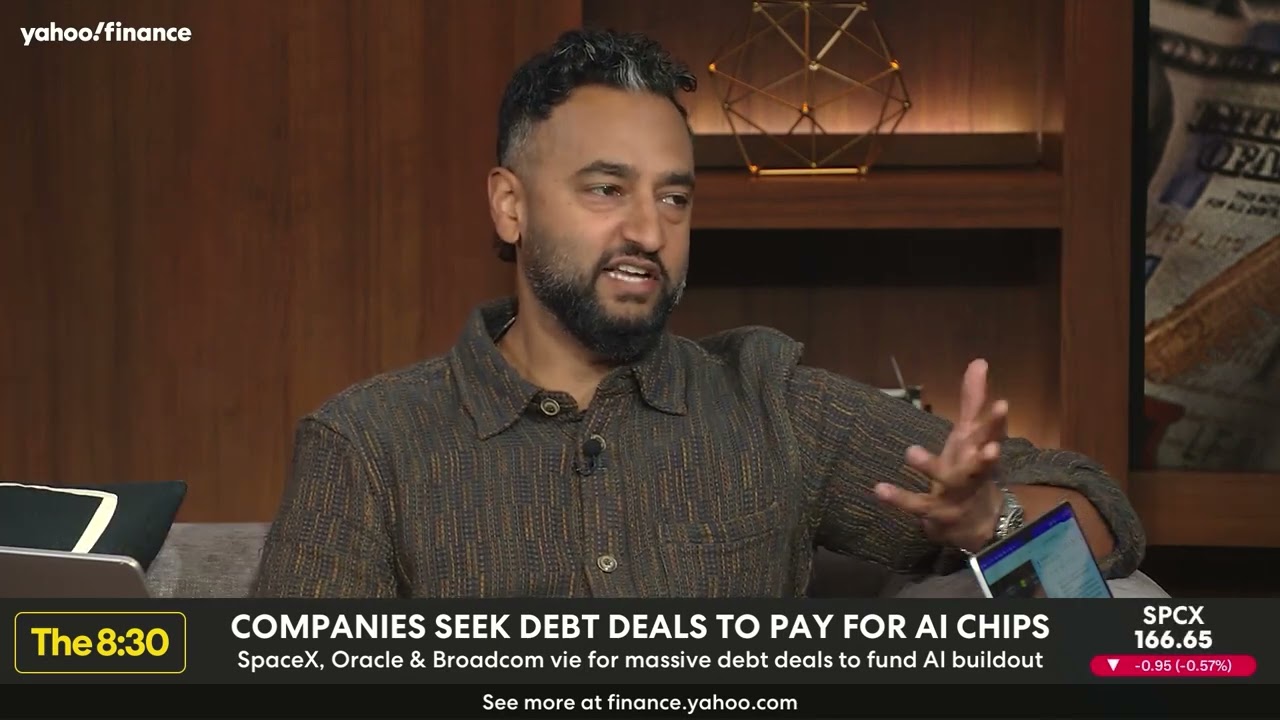
Market Hang (12:30–1:30 p.m. ET)
Now Playing
Market Hang (12:30–1:30 p.m. ET)
Transcript
1731 segments
Hey, welcome to the market hang. I'm
Dandy Franchesco. We got a full house
today. We got Gus and Mark in studio,
Nancy and David remote. So, a bunch of
really smart good investors and me. So,
this will be great. Um, but let's start
with obviously the market. Uh, you know,
S&P nearing records, NASDAQ up super
high, yields finally coming back a
little bit. Um, but still this question
of, you know, are we close to this edge?
Should we be nervous or not? And um
Mark, I want to start with you. Uh you
had an interesting blog or a newsletter
the other day where you had the great
line, the stock market is wearing
noiseancelling headphones, which I just
love. And for the record, always go
transparency mode. Never go full noise
cancelling. It's very dangerous out
there, people. But I'd love for you to
kind of expand a little bit on that and
uh what you're seeing in the market and
what the the risk that the rest of us
maybe aren't.
>> Yeah. I mean, I think that's the
challenge of the day for all of us,
right? So, we've all been trained over
the years to worry about yields going up
and up and up and up. And they weren't
going up and up and up over the years.
And then 2022 happened, 2023 happened,
and we all learned that when yields go
up, sometimes stocks go down. And so,
both bonds and stocks can go down at the
same time. So, we're at this crazy crazy
situation where we see these yields
right on the longer end of the yield
curve that we haven't seen since 2002.
And some people that are probably
watching us right now weren't even
involved in the market at the time.
>> Weren't even alive. Maybe
>> weren't even alive. I was there. Um so,
you know, that is the big challenge. So,
the question is is, you know, we see uh
stocks, as you said, all-time highs. Um
and of course, these super high bond
yields. Question is is, you know, when
is the stock market going to realize
that or is the stock market going to
realize? One of the two has got to be
right. It's usually the bond market that
usually wins out
>> always. But so far that's the big
question right now. And so right now not
all stocks,
>> some stocks, right? That's the that's
the big challenge here. It's not all
stocks. The indexes are doing well.
>> Sure. So
>> right now the
>> I think that's where you got it wrong
though. Like everyone says that it's the
equity market guys versus the bond
market guys and it's always like, "Oh
yeah, the bond guys are the smartest
guys in the room." I had equities here,
so I take umbrage at that. But I think
the equity guys have been right over the
past few years. All right. I just think
that the bond market and the equity
market, they're just focusing on two
completely different things. They're not
conflicting at all. I think the equity
markets, they're focusing more on
profitability and overall economic
growth, while the bond market, it's kind
of changed its focus from monetary to
fiscal policy. And you've seen the term
premium go up to about 70 to 80 basis
points right now. So, I don't think
they're saying something different.
They're just focusing something
completely opposite. Well, David, I'm
glad you chimed in here because I wanted
to pull up a a tweet from it's a little
ways back, but it sounds like you're
kind of still holding the same position,
which is you said in an interview, you
know, the biggest risk investors have
right now is not being risky enough,
right? You can see it right there. You
know, kind of risk on. Is that I know
that was, you know, back September 15th,
so obviously things have changed a
little bit in the past almost month, but
is that still the position? It's it's
time to be risk no matter what.
>> Yeah, my position has not changed
whatsoever. I mean, that's a question
we're getting a ton right now. Like,
hey, should we start to own more fixed
income than equities? And I I think that
is the absolute wrong decision because
when you live in kind of the fiscal
backdrop that we have when you're, you
know, printing money, running a 6%
deficit as a percentage of GDP, when you
have the debt problem that you have
right now, like if you own just fixed
income, you're just losing money safely.
I mean, there's so much debasement of
your capital. Even with nominal rates at
5%, if you look at tips, they're closer
to 2.7%. I think the inflation rate on
that number is much higher. I think
you're just kind of setting yourself up
for mediocrity moving forward if you
continue to own fixed coupon payment
vehicles. And that's why I think, you
know, the only game in town continues to
be stocks.
>> Yeah. I mean, you see the big board
here. Lot lot of big numbers, lot of
green. But Gus, Nancy, I'd love to bring
you in here. What kind of side do you
fall on?
>> Well, I think you have to look at why
rates are going higher. You had a supply
shock, right? oil's gone higher that
maybe comes to a head say 6 12 months
whatever it is you end up having no
strong growth and that's something else
that you have to look at right so you
have strong growth um also we just
talked about the oil you talk about you
know underlying inflation I'm looking at
labor kind of holding in we're looking
at you know the price of housing which
has kind of stayed also you know based
in a level that doesn't look like it's
inflationary and then the third thing is
you're looking at goods inflation and
that's where part of the problem is and
I think the interest rate increase that
we have is something that isn't going to
affect all of the investment that's
being made in AI that's already from
free cash flow coming from maybe a lot
of the hyperscalers and some borrowing
so we're in a position where if I look
at that it's not inflation debasement
you know like it was in the 70s or early
80s as I remember um but you're looking
at an environment where interest rates
are up but markets are growing pretty
substantially and they're moving higher
we started the year at around 320 and in
terms of what earnings are going to be
>> or you know and now we're we're
somewhere in that 260 270 and next year
we're looking at 420,
>> right?
>> So yeah, we're discounting that.
>> Nancy, what about you? Where do you come
in on this?
>> Yeah. So, um I'm I'm just going to say
ditto [laughter]
and then add some color. Um well, first
of all, stocks are cheaper now than they
were at the beginning of the year. Uh so
so that's important. We've seen multiple
compression. uh we're expected to see
somewhere between 30 32 33% earnings
growth in Q3. Uh and and and that's
going to be looking backwards. So what
we're going to be focused on is
guidance. But I think importantly I I
was managing I may be the oldest person
in the group but I was managing money in
the '9s. Uh we had higher interest rates
tenure was between 5 and 8% that
coexisted quite nicely with robust stock
returns. It matters why and how quickly
yields rise. And I think for me it looks
to me like a return on capital trades.
So if I can borrow at five five and a
half% and I can uh get a return of 20, I
should be doing that as a corporate CEO
all day long. Uh and and so for me rates
are um I mean I don't want to sound even
older than I am, but they are
normalizing. My first mortgage was 12
a.5% so we sort of cut our teeth on
higher interest rates. I don't think the
problem with mortgage rates is that
they're at seven plus percent. It's that
they've they're being compared to 2 and
3%. But if you step back and say, is
this a reasonable um amount to pay for
debt? I would argue the answer is yes.
And I think that's why stocks continue
to drive higher. And if you just look
since the Fed hiked rates, best
performing group is technology. Yeah. uh
counterintuitive because I don't think
the economy is slowing, but I think it's
part of um I still want to own earnings
growers even in a growing environment.
So, uh we're bullish. We've been um
we've been right, thank goodness, but uh
it it's been it was a challenging
summer. Yeah, let's just
>> Nancy, you bring up such a good point
with the rates because as someone that
bought a house uh a little over a year
ago, right, having to stomach, you know,
you know, at that time we got a little
over 6%. It sucks, right, when your
friends are like, "I'm on two and a
half. I'm on three and a half." But it's
kind of one of those things like it's
old the you ever seen this show,
Forgetting Sarah Marshall, like it's
over. Find a new show. Like those days
are gone. And I and I do agree that we
need to understand the context of like
just because what once was doesn't mean
what will be. Um so I I think that is
good. Now obviously the big thing coming
down the pipe is earnings. That's kind
of been the big bell weather for the
stock market. Does anyone you know the
what's what is that the one thing that
could slow it down and and you Nancy you
talked about projections that's going to
be the big focus. What's the the the red
flag that people are nervous about as
these companies start reporting?
>> I think the outlook
>> it's margins I think. Oh sorry I thought
that was me. Margin
>> margin. Okay.
>> Um you you saw the micro report uh 80
you know they're only going to generate
86% margins and the market was
horrified. So, I I think that's going to
be where the critical focus is going to
be. We're near um I we're at highs for
operating margins. So, um we'll be
watching that as well, but I I think the
market needs to sit back and and as Mark
might say, put the noise cancelling
headphones on because an 86% margin for
micron is is it's it's tolerable for me
as an investor.
>> Sure, Gus.
>> Ditto ditto on that. But the other
thing, right [laughter] back at you,
Nancy, the the other thing I wanted to
say is it's going to be the conference
calls
>> because you're hearing about in Texas
[clears throat]
and in Virginia the two biggest areas
for data centers, you know, some
slowdown potentially, but you also have
in Texas, I know they're going through
audits in terms of energy usage. So, are
you going to get allocated? Are you
going to have some sort of a delay? Are
things going to back up at all? And that
puts a question mark into the AI trade
which then flows down into industrials
and some other players that might not,
you know, have the computing power or
things that they need to in institute AI
in the fast way that they're expecting
to.
>> Sure. David, anything? Gus market. I got
I got one. You know Gus Mark and N like
debunk my theory here because you know I
was just talking about some clients the
other day and obviously we're going to
see some type of growth slowdown. And to
NY's point we've seen overall valuations
of the market go down from 22 times to
start the year to 19 times to start the
year. I think everyone wants to say it's
like rates that is bringing valuation
down. I think it's the index becoming
more you know asset heavy and less free
cash flow centric. So if we know you
know if growth is going to come down or
we just see the hyperscalers start to
grow less I think everyone thinks that
the market is going to fall apart. But I
would actually disagree and this might
be a hot take. I think that valuation
has already come down enough that if you
see the hyperscalers you know spend less
on capex their overall free cash flow is
going to go you know higher which while
earnings may hurt earn earnings may hurt
overall return I think pro I think
overall valuation can actually go higher
and I think that can really insulate the
market if hypers scale or capex does
slow down
>> but will it slow down right I mean you
know muse just came out and talked about
charm and all these other things that
they're coming out it seems like the the
the status quo has been plowing more and
more money in. It doesn't feel like
there's going to be a pullback because
it's this frantic race that if if I pull
back that means I'm going to lose that
much more in this race, right?
>> I don't um here. Sure. Um Mark, why
don't you, you know, um chime in here as
far as kind of where your position is.
>> Yeah. First, I feel like I have to sort
of
>> I have to remind Yeah. Like, okay. No,
no, I'm not throwing cold water. I just
made have to make myself clear. Uh I'm
very constructive on equities, okay?
because you know I came out of the I
came hot out of the gate with the bonds.
Okay, I'm just saying I am watching
rates very very closely. Rates I do
believe we have to watch we do have to
watch interest rates, right? So I do
believe the earnings growth at least for
the next 12 to 18 months is going to
continue. Of course it'll be bumpy. We
too just like uh just like Nancy, we're
watching uh margins uh very very
closely. That might be some of the early
sort of signs that things are getting
tough. Look, even if things are bad,
they're still so much better than they
have been historically. There are still
great thesis to own most of these,
especially in the tech sector, uh,
specifically in the AI ecosystem. The
the fundamentals are really, really
strong in terms of valuations, etc.
However, again, I hate to be that, you
know, that guy. A lot of these
hyperscalers and a lot of these
companies are relying more and more on
debt. Okay? Um, you can't just turn that
spigot off. They're all needing that
capital right now. Um, and by the way,
oh, we're talking about debt, okay? That
means if yields are going up, that debt
is becoming a little bit more expensive.
I'm not saying it's going to crash the
party, uh, and everything's going to
repric and it's going to be bad. It's
just something that we have to watch
carefully, right? They don't exist, both
of them, in separate, uh, in separate
categories, right? You say you're an
equity guy, I'm an equity guy. Um, but
that said, you know, equity guys have to
see what's happening over the nerds on
the bond desk. And so, you know, I
learned early on to pay attention to
what the bond guys are up to. And then I
learned that, oh, they're the guys at
the repo desk that sit like in the
basement with the stock loan guys.
That's where you really find out what's
going on. Um, and so, you know, it's
just all about sort of these things
which were, I think, for many years kind
of detached. They're just becoming more
and more attached. And so, like I said,
I don't think the bond market's going to
crash the equity market. Uh, but it's
definitely something we got to watch,
right? So, I mean, it's definitely it's
got its finger on the pulse of a lot of
what's going on in the economy right
now. I think a lot of the economic data
that we're seeing, which is a little bit
backward looking, is not really very
helpful in looking, you know, the macro
data, not very helpful in looking at
stocks at this point. We're looking
very, very closely at stocks. But there
is a point there is a point where you
know if if this things start to happen
with consumption uh with all these other
areas that kind of we all laugh at now
right because stocks just keep going up
and up and up and up and you know look
um again you know you could have been
you could I don't want to make fun of
equity people
>> but you know you made fun enough about
people I think we can get
>> I you know I know a lot of fantastic you
know equity people who just you know
bought equities what everyone was buying
and did very very well. You know, bond
people, it's much more difficult, right?
Right. Because there's so many
challenges in making money with bonds.
Um that
>> Go ahead, Nancy.
>> Well, I'm I was just going to jump in
and I I wanted to get them
[clears throat] going. [laughter]
>> Got you. Got you. Pulled them in the
bait. You grab the bait.
>> Bonds and equities. So, I'm not just
single-minded. And I think there's this
notion that if you're bullish, you're
not as smart as the bears because the
bears can tell you everything that's
wrong. I I can tell you too. Um I I
refer to our head bond trader as the as
the worry wart. I mean he he can tell
you everything that po that can possibly
go wrong. But that's not how markets
trade. And so I think what's different
now and it hasn't been easy, Mark. I
mean this year's been a slog. And I
think you know you can say well yeah the
indices are up but below the surface
most stocks are are down. And so I I
think what you have to do when you're
thinking about it is is there
skepticism? There is a lot of
skepticism. That's good for the
sustainability of a bull market. We had
zero skepticism in the '9s and it was
just euphoria all the time. So I I know
what you're saying. It the party will
end. Growth will decelerate at some
point, but if you're three years early
or two years early on that bet, you
leave a lot of your clients money on the
table. So the dance is you got to keep
keep in the game and figure out how to
rotate.
>> Yeah, Nancy, you're so right because
even if you're right, you can still be
wrong if you don't capture all of those
gains. It's and and to your point on
the, you know, the bomb people being
super smart, it is easy to if you
continually just call the end of the
world and the end of the world never
comes, people kind of forget about the
one time it hits, you're like, "Oh,
well, the guy hit it, so perfect." You
know, so I I definitely see your your
point. Uh sorry, it looked like you
wanted to
>> can only end once, though. But hey Dan,
I think I think Mark gave the the the
Yahoo headline quote of the day there.
Bond guys, they're nerds and he's 100%
>> guys. We're crushing our [laughter] bond
audience right now.
>> So if we look at if we look at the
banks, they're going to be reporting in
another week and you're going to get,
you know, an outlook. So what's
happening in terms of net interest
margin? Bad debt. And I think that's
going to look okay. The question is
going to be six and 12 months from now
because you ended up having a lot of
software that ended up getting put on
the books in terms of loans that have to
be re-uped and they were done at much
lower prices. You're talking about
housing and your friends at 3%. Well,
you also have companies that have that
same situation.
>> Sure. Sure. And well, sorry. Go ahead.
Yeah.
>> No, just the outlooks that we're going
to get from the banks, they're great
barometers for the economy. So, where do
they see things? So, you're going to get
an answer really quickly in terms of
where the positioning should be.
>> Yes. I will also say though there is the
whole private credit world right which
is that's what we won't get the view of
and that's where you know maybe the
>> well you will tangentially you got 250
billion that was put into software
during 2001 2002
>> right
>> so that has to come up for uh you know
for refinancing
>> that's a that's [clears throat] a
valuation problem there not not a debt
problem there on that side of the
>> Sure yeah and and tech debt as a
percentage of the total debt outstanding
is like 8% u so I think yes they've been
issuing a lot of debt, but there's 38%
of the S&P plus or minus. Um, so, so I
think we have to keep that in mind. And
then also remembering that some of
that's dry powder for buybacks.
>> Uh, and and that that's important
because that puts a floor under the
market as well. So, there's an
insatiable uh in the shadow banking
system as it's called, there's an
insatiable demand for corporate debt uh
and and in particular technology debt.
So the private pension plans, the uh I'm
sorry, the insurance companies, the
state-run pension plans, they can't get
enough. I love it because they're like
low risk, but they leverage all the
debt. So
>> I want to throw
>> Would any of you guys on this call
though say that the private credit side
of things is going to be the one thing
that's going to make this house of cards
collapse right now?
>> I don't think so at this point. I think
you got time if you know to see how
things play out and you're going to
start getting revenue coming through,
right? because a lot of the AI that's
being that was put in place a year ago,
year and a half ago are starting to see
revenues being generated whether it's
anthropic in their um you know in their
10Q or I'm sorry their K's um saying you
know we're looking at I think two
billion uh in terms of revenues that are
coming through. So you know there is a
time uh as time goes on we're going to
start seeing cash flows and and monies
come in to pay down that debt and expand
what they're doing currently. I think
with the uh David to your point about
the private credit what maybe worries me
or gets me a little nervous is you know
a couple years ago when obviously rates
spike it becomes the very hot thing on
Wall Street right priv everyone wants to
get in private credit it's the hottest
job to get into um so you know sure
those those top tier right debt that
kind of lands in private credit I think
that will ultimately be fine but like as
you kind of go down the totem pole and
more and more people want to get
involved where does that debt land
what's the underwriting process you know
I mean what was it Jamie Diamond
famously called it the cockroaches,
right? So, so when does that come to
fruition and how have those cockroaches
been nesting and and how big does that
get? Maybe it's only a small pile of it
and it's something that the market can
absorb or maybe it's a lot bigger. I
mean, the big issue with private credit
is that it's private and to NY's point,
it's shadow, so we don't really have a
full sense of it, but that's where I I
get a little bit uneasy.
>> Yeah, it's just a black box at 2. That's
why people are afraid, but you know,
it's still just a $2.2 two trillion
dollar industry. So it's not huge in in
the grand scheme of things. And
obviously the software is going to be
where the quoteunquote problem children
are going to be. Not on the top end,
especially like the more vertically
integrated companies, it's might be down
the wrongs, but if you look at I think
Goldman stats put this statistic out
there. It's like of all those loans on
PC for software companies like the loan
to value on those loans is like 30 or
40%. So I think that's just what
everyone's expected to be. I don't think
it it's going to be a problem actually
at all. moving forward in the future
because the interest coverage ratios
they have on there is like two 3x. So
it's more of the valuation problem than
the the debt repayment problem.
>> Right. Mark riding in my seat. I'm
riding in my seat. You know I keep
getting sucked back into that vortex of
I don't want to be the fixed income guy.
I don't want to be that guy. I want to
join the bandwag. I am long all these
stocks that everyone else is long. I
love this stuff. Let your real colors
fly. I have been pedal to the metal. I
have been pedal to the metal and just to
be clear, I'm not saying the world is
coming to an end tomorrow. Look, we get
paid to make investments, right? That
that's what we do. Um, and you know,
look on Wall Street and I've been doing
this for a minute. Um, you know, you
learn early on that, you know, you take
advantage of an opportunity investment,
you do it until you can't do it anymore,
right? And that investment right now is
very real and really, really good. It's
really solid. The thesis on a lot of
these stocks that we all own probably
sitting here today is super strong. I've
never seen such a strong environment as
I'm seeing today. I like to tell people
it's like this. You know, you look out,
you're on the at the beach or on the
lake at Lake Tahoe and you look out on
the water, although you don't have this
problem in lakes, but on the beach we
have this problem. You look out the
beautiful you see a beautiful blue sea
>> and some people they just jump right
into the water and they swim because
it's beautiful. other people like me,
the what is it? The worry wart bond guy.
I know that there's sharks under that
water and I have to know because that's
who I am. What sharks are lurking under
the water. I still swim. I still swim.
I'm not saying don't go and swim, but
I'm telling you that there are sharks
and I like to know what's out there. How
big are they? How many teeth do they
have? You know, how do I avoid them?
That's really it. Okay, so I made that
clear. Yeah. Now, let me just say with
regard to, you know, I don't think it's
prudent to ignore that fixed income and
bonds and borrowing and debt, um, we
can't ignore that even companies that
historically would not use that part of
their balance sheet to raise money are
doing it, right? Companies that don't
necessarily need to, but they are using
fixed income to finance data center
buildouts prudently, right? Because that
you learn that in corporate finance.
That's how you raise money to do those
types of projects, project finance.
However, it's getting to the point where
some of these companies which we are
investing in to plow money into R&D,
they're spending a lot of money on
building infrastructure. They're
starting to look like utilities. We're
treating them like they're innovators,
but they're starting to their balance
sheets are starting to look more and
more like traditional utilities, right?
And so that said, again, I'm not calling
an end to the party or anything like
that, but I'm saying that if the places
that I'm looking to see where there
might be a problem coming, I'm thinking
if it's going to start to fall apart,
it's going to start with the fixed
income side. You're going to start to
see some problems and then once the
oxygen leaves the room, um and and then
then there's investor sentiment that
will play a big factor into it. That's
not going to affect their ability to
make money.
>> Yeah. But it's [clears throat] not like
you can just turn these facilities off
overnight. You still have to pay those
bonds back.
>> I'm I'm waiting for David to come in
with stats about shark attacks now. They
only happen like once every
>> They don't have sharks in Lake Tahoe, do
they? No sharks in Lake Tahoe.
>> Just I'm going to I'm a big newsletter
writer.
>> Huh?
>> I'm a newsletter writer just like you,
Mark. And my newsletter theme over the
past quarter was Dolly Parton. And she
has all these like Dollyisms. And one of
them was like, if you want the rainbow,
you got to put up with the rain. So, I
think we recognize that there's a ton of
rain. I don't think we're going to see
the cracks on the fixed income market
first. What I would actually look for on
the equity side of things, I think there
needs to be a bifurcation on the AI
winners because there's so many
perceived AI winners on the equity side,
specifically on in the small cap
universe, that don't that are that
basically the non-earners out there. uh
they have in financial technical terms a
crap ton of debt on their balance sheets
and I think you're going to see cracks
in that area of the market first and you
haven't seen that just yet.
>> So I think go ahead spread
>> go ahead.
>> I was just going to say wouldn't it it
it really hasn't shown up in spreads.
>> Um and I think that's something that we
all look at uh as a as an indicator. It
always has historically right.
>> So I mean it that's not to say it can't
and I I think we actually all agree. Um,
it's it's just been enjoyable to watch
Mark squirm. [laughter]
>> Mark, I'm going to put the one I want I
want to hear from everybody here quick
about their take, but Mark, I'm going to
start with you. We do at Business
Insider, we do a quarterly thing where
to invest $10,000 right now. Mark was
nice enough to participate. Next time,
we're going to get all four of you
involved. But, uh, Mark, again, I don't
need to I don't need to paint more of a
picture, but something in the article.
So, where if you had $10,000 right now,
where would you invest it? So, okay. I
You caught me at a very weak point.
[laughter] All right. And And I'm
squirming right now, Nancy. I am.
>> What's the end of Fight Club? You caught
me at a very interesting point in my
life. You call Mark at a very
interesting point in his life.
>> They did. Uh, you know, I was watching
yields, you know, longer yields going up
and up and up, and I'm like, "Okay, you
know, look, maybe it's prudent to like
put a little bit of fixed income in a
portfolio of $10,000, right?" Um, you
know, I'm still I I still tilted heavy
into AI. I still I still like the S&P,
right? I still like these types of
things. So, but I thought maybe a little
prudent to buy a little bit of of uh
fixed income here at these levels, but
not a small allocation. And um just to
be fair, and I did say, and I'm going to
be honest, right, you could check me on
this, right? I did say, let's put a
little bit in bills, right? Tea bills.
But why? I put them there because if the
market pulls back, I want to have some
dry powder. And I think that's a great
place to put your money right now. You
could just take it out. The yields on
the on, you know, on this uh year and
under paper are very attractive. And
again, it's the nicest way. You know,
you you never got paid this much to hold
cash. I'm not saying go to cash,
>> but I'm saying that this is an
opportunity to buy the pullbacks. We've
been buying all the dips,
>> right?
>> So, that's really why I did to protect
myself.
>> All right. All right. You're off,
>> but you could kill me for the bonds.
>> Plus, what about you? Where do you come
out on $10,000? Where are you investing
right now? I think you want to look
where choke points are for AI and you
want to invest in those areas as well as
the leaders in AI. So those are part of
it and you end up having companies that
have been investing in this and are
starting to see the benefits whether
it's banks from looking at industrial
companies I have an energy company
that's supplying 5 gawatts of energy to
to behind the meter they call it types
of companies. So you can't get power the
guys in Texas we're talking about now
all of a sudden you flip a switch 18
months you're able to get you know your
power plant going. So, okay,
>> those are the things.
>> Choke points. Got it. Nancy, what about
you?
>> Uh, $10,000. Huh.
>> Yes.
>> Yeah. I think I would um I' I'd put it
in the cues for now. Um I I just think
you get broad diversification. Uh you
don't get all the choke points, but you
get most of the names that are going to
succeed. And I think I didn't know what
the time horizon was, but if it's fourth
quarter, that's where I'd put it.
>> Okay. And then David, what about you?
Where are you landing? I'm going 99%
beta between the S&P 500 and the Q's,
but you know, Mark said he wanted dried
powder in case the market pulled back.
I'd rather on that last 1% in long
volatility in low delta put options. So,
you know, he basically puts guard rails
on the portfolio. If you get a pullback
in the market, you know, you can
capitalize on the gains from the put
that have that be the dry capital to go
out there and buy the dip.
>> Gotcha. All right. So, we're talking a
lot about AI and let's kind of bring in
some of the pricing pressure that we're
seeing. And so there was a report about
Microsoft slashing its internal cloud
spending. Um you know that also came a
couple weeks ago when chat when openi
announced chat GBT's uh premier tier
subscription is going up. We also just
broadly have anthropic and openai
looking to go public right they want to
get their financials in order. So I
think we're seeing some of the AI
companies right increase some of their
subscription models. Maybe some of the
users pulling back in some areas. So I
wonder, you know, I've used this term in
in my own newsletter, chatbot monogamy,
right? This idea of um from the AI
companies, they want to go deeper with a
client, whether it's an enterprise or a
person, right? Muse wants everything.
They want all of your details. Um and
then from a user perspective, is it
really realistic for me to manage a
bunch of different subscriptions? We
were talking before um with some of the
producers about streaming, right? Like I
can only have so many streamers. Do you
do you see that as a realistic future
now that people are going to start pull
back and there's going to be winners and
losers and how does that impact all
these companies? Mark, you're shaking
your head.
>> Yeah, totally. Um, this brings up such
an interesting point, right? Because um,
you know, these companies, and I dare
say this, it it hurt it gets me nervous
to even say it. You know, these
companies where they are right now,
they're starting to look to me like
commodities in a weird sort of way,
right? Because at some point, yeah,
there are notable differences and we all
know the notable differences between the
different models that are out there, but
at the end of the day, they're all going
to serve some sort of a function and
companies or individual users are going
to be able to select their favorite
based on price, based on all these types
of things. You see them now, they're
talking about price. They can't, it's
going to be very difficult to continue
to exist as a differentiator, right? And
at some point, uh, even sort of the
users, the corporate users, the B2B
users are going to be like, "Oh, we're
just going to go for the one that makes
the most fiscal sense." It's going to
be, uh, it's going to be a CFO decision.
It's not going to be the nerds making
the decision, saying, "Oh, no, no, no.
This one here is, you know, is smarter
at this or smarter at that." Yeah,
there'll be nuances, but, you know,
we've seen this happen in technology
before. It's going to be very hard to
continue to differentiate. Now people
below that level below the the providers
themselves I'm talking about the open
AIs and the anthropics right those guys
will still be able to differentiate
themselves better chips you know better
power cheap you know all that kind of
stuff that's all sort of organizing
right now but the people that we're
expecting the most from in the next year
as these two companies the big ones go
public you're going to that's going to
be the question we're going to have to
ask ourselves is this some sort of a
sustainable
moat that they're building that's going
to make this one the winner. That's not
going to ultimately put price pressure
on companies that have very very high
costs to produce their products,
>> right?
>> I'm going to take it from the other
side. You have power users. They're
maybe five uh you know 10% maybe of all
of the AI users. Now, those guys are
going to probably look for what's the
best utilization? How do I get these
models to work the best? How am I making
more profit in terms of my company? Then
you have the guys kind of middle in the
the the we'll call it the entry level.
They're looking at, you know, um what
goes into this recipe and obviously
that's going to be more of a
costconscious thing more so than anybody
else probably. Um and then you do have
the CFOs that are probably going to get
involved with the power users over time,
but I think you're going to draw down
the pricing of this uh in terms of like
any other model. Um and you know you're
going to have lower and lower costs who
gets more utilization and those are the
people that you're going to look to is
probably going to be the winners.
>> David, you look like you want to
>> It's 100 Yeah, it's 100% kind of a
commodity side of things. Obviously like
the Muse news, you know, not being on
the enterprise side of things is
interesting, but like can you blame
Daario for coming out and you know
giving all this fear porn out there to
try to people make people afraid of AI?
Like
>> oh I love that
>> he knows what his mode is and it's going
to be on the regulation side of things.
So, I'd be doing exactly what Dario was
saying before, but I mean, we're just
seeing Jeban's paradox really play out
in real time. I mean, you have cheaper
tokens, far more tokens, bigger total
bills, but like every time the price
drops, usage is going to explode higher.
And I think that's what continues to
make me very bullish about the entire
space, even if it is commoditized.
>> Do you think, and N, I'd love to get
your take, too, but David, do you think
that the other foot will eventually
drop? What I always think about, I'm a
millennial, right? And I was raised on
the millennial subsidy, right? We had
Door Dash and we had all these great
apps that gave us super low prices
because they wanted growth, growth,
growth. And then all of a sudden, I look
at my Uber Eats and I'm like, wait,
there's this fee and this fee and this
fee and my Door Dash and and my gym
subscription is this and all of a sudden
it spikes up. So do you think there's a
little bit of like draw up it down, get
the usage in and then as we right when
we get addicted then the price spikes?
>> Yeah, I mean that's likely going to
happen. I mean, we kind of had this
exact same thing happen during Google. I
mean, people can now look stuff up. I
mean, that was kind of the narrative
around Google to, you know, try to bring
down overall costs. I mean, now you can
just look stuff up even more faster and
efficiently. So, I I definitely think
it's going to happen. I don't know, you
know, Dan, I don't know if I'm a
millennial not. I lived 23 days in the
80s. Drug, sex, rock and roll. I don't
remember any of it. Um, [laughter] but
you know, I'm unfortunately I have not
been able to look at my uh my Uber Eats
build, but I definitely probably have
those uh piles of fees stacking up where
I need to utilize Muse. [laughter]
>> Yeah, I mean I haven't jumped into the
Muse, but sorry, Nancy, I want to bring
you in as well. What where do you fall
on all this? [snorts]
>> Um, I don't know. I'm back on sex,
drugs, and rock and roll. [laughter] Um,
what what were we talking about? Um I I
think I think you watch what the the
smart leaders are doing and what what we
heard from uh Jensen Wong about I don't
know maybe it was six months three
months ago was that they Nvidia was
pivoting away from the large language
models which is not to say they're not
still dumping chips in the to the LLMs
but they were focusing on industry and
they were focusing on sovereigns and I
think that's where we're going to start
to see bifurcation like and by the way
one of the big winners is probably going
to be Microsoft. Not the best product,
certainly not. Um, but embedded in the
enterprise. And so, you know, go back to
when I was growing up and it was the
question was, do you want to own a Sony
Betamax uh player or a VHS player? Sony
was superior, but VHS stole stole the
brand. And so, we ended up with an
inferior technology. Um, but because it
was it was omnipresent. And so I think
you're going to start to see changes.
And I think that's what Daario's worried
about. Uh and Sam Alman as well. You
don't pull an IPO or push an IPO uh
because you're you're optimistic about
about the future. You you pull back and
try to recalibrate. And last thing I'll
say is this whole
nonsense about the end of humanity. Um
[clears throat] it and please regulate
us. We can't help ourselves. Oh, by the
way, we just released a new model. Um,
but I behind the scenes while this was
all going on. But just remember, it
wasn't that long ago that Mark
Zuckerberg was like, "I'm sorry, did we
censor? Please regulate me." So, I think
it's an old playbook for Silicon Valley.
>> Also interesting that Mark is on the
other side. He's not the one. You know,
it's cuz he learned his lesson. But
David, I got a Dolly Parton quote for
you for your next newsletter. It costs a
lot of money to look this cheap. Um, so,
you know, just, you know, there
something for for your next newsletter.
But no, Nancy, I I totally agree with
you about I I think I've kind of I've
written about this a lot. The whole oh
regulate us. I think it's far too
convenient. You have the rise of openw
weight models which are a real risk to
the business model for open AI and
anthropic. You also have other players
kind of coming in whether it's the big
guys like Google and Gemini continues to
kind of make progress there. Um and I
think also it's an easy scapegoat for oh
we can't release our new product not
because maybe it's not as good as we
thought maybe not. No, it's because the
regulators like we the fate guys, the
fate of humanity is at hand here. So we
for for everyone's sake, we need to hold
back. I think it's far far far too
convenient that all of this is is coming
down. And the other thing I I really
question is, you know, when they say
they want to be regulated, how much do
they really mean that? You know, how
much do they really want the government
getting in their models, getting in
their source code? Like these are
trillion dollar companies. There's so
much valuable IP. I read a story the
other day about at Meta the people who
are working on their top AI models. They
don't even have them on the internal org
chart. These are like the, you know,
another millennial. These are like the
unspeakables in Harry Potter. Like
you're not even allowed to look at these
people. You can't know who they are, you
know. So if that's the secrecy that they
have around this thing, they also at the
same time want to turn over to the
federal government. I I don't I don't
necessarily um buy all that.
>> Sorry. Go ahead.
>> And and the federal government, they
can't regulate anything including crypto
or the internet.
>> Track is not great. track record is not
great.
>> I'm going to play play on that with
Dolly Parton and Nancy. I mean the
government only works 9 to5 [laughter]
AI 24/7.
>> Um I want to talk about Gus. You
mentioned choke points. So we had an
interesting deal today. Google with
constellation, right? Nuclear power. Now
I'll be upfront with my bias. I come
from a nuclear power power family. My
dad was a nuclear engineer. So I've been
I have lots of propaganda of of nuclear
power, but I can be unbiased in that. I
think it's a really interesting deal.
But I think it's also interesting for
the markets because um you know nuclear
power had an interesting run last year.
This year not doing that great but we
are seeing this deal done. What's the
disconnect between it seems like the the
way forward with um AI and the way to
power it is probably going to be nuclear
power but the markets aren't necessarily
recognized that is that because the
value's already been built in or what's
what's your take on that?
>> In constellations uh example I think
part of it has been because they had
five approvals for plants that they
could put down. So they're past the
approval process, right?
>> So they can get to market quicker than
anybody else. And that's why I think it
was discounted
>> already into the pricing. Um when I look
overseas, I mean it's been used in
France for uh years. You know, it can be
used here. Uh you end up coming out with
a model that is our biggest problem is
we haven't built these plants. There was
one built down in Georgia. It was
supposed to take three years. I think it
took seven.
>> Takes a while,
>> right? So you have to have that muscle
memory. So I think that this is actually
the way to go and you'll probably see
the government get involved after the
election trying to get it, you know,
push start this to get more nuclear
plants going because it's one of the
fastest ways that you can actually get a
lot of power.
>> Sure.
>> And push it out safely and it's also
clean,
>> right? Which is it's just as again as a
child of nuclear power hearing about
it's you know our governor at the time
was not a big fan of hearing this is not
clean, this is bad. Now it's the clean
nuclear it's clean. It's just it's all
it's an upside down world. But um I
don't know if anyone else has thoughts
on on the nuclear push in power or no um
or sorry Nancy
>> I'll just say one thing I I thought I
wanted to be a nuclear power activist
after uh the China syndrome uh which you
probably none of you remember but it it
came out Jane Fonda so I mean who didn't
want to be Jane Fonda at that age so it
was it was a nuclear power meltdown and
then and 12 days later we had the three
mile island meltdown and here's here's a
fun fact no one died But we shut down
all the nuclear power regulators and we
poisoned the earth if you're following
with the climate people for 40 years uh
using fossil fuels all the way all the
while yelling at the fossil fuel
companies. So I I think it's awesome
that we're finally back there. Um I I I
grew up in an age where you hid under
your desk duck and cover nuclear bomb.
Um and I was always curious how that was
going to protect me, but you know we
obeyed. Yeah. and um desks were sick.
Yeah. Yeah. They made desks really well
back then, [laughter]
>> but I do think it's I do think it's
awesome. And we have a a strategy we run
that is invested in all the technologies
we think are going to change. It's a
thematic portfolio. So, highly volatile.
I'm not hawking it here. I'm just saying
we're in the names. Uh we we we like the
space and I think uh I think it's going
to really change the way the things
we're talking about.
>> Sure. I'll I'll just say not an
investment advisor. don't hold any of
the fancy certifications you have. I
think one interesting thing to look at
is people who handle the nuclear waste,
right? That's always been a big problem.
We were supposed to have Yucka Mountain
in Nevada. Never fell apart. Now, as we
have more of this nuclear power, we're
going to have more of these radioactive
rods that are going to be created as a,
you know, as a byproduct of this. We're
going to have to put it somewhere. They
can't keep out on site. So, I don't
know. Just one to look out for. Again,
not a financial adviser, but just my
thought. Um let's uh let's talk a little
bit about AI adoption, right? Because we
talked a little bit about Muse now. And
one interesting thing, we had a story um
a CEO told us how actually Muse is
driving him away from Amazon purchases
and boosting Shopify. And the the
backstory here is that Amazon has
blocked Muse, right? It's considered a
competitor. So Muse is not playing and
there is a big relationship with
Spotify. Um, again, it's just one
example, but I'm curious if if this is
the start of maybe bigger things as more
and more people leverage Muse and and
shopping is a big piece of the puzzle
here. What do we think there?
>> I mean, is that going to be a worry for
the overall market? I mean, let's just
say that happens. All right. You know,
uh, the corporations, maybe they spend
less. Well, you know what? That boosts
profit margins. What's the one thing
that markets love to see? Increasing
margins. Or if they take it somewhere
else, you know what? All right, maybe
we're spending less here. We trim the
fat to save money, but we're probably
going to spend it somewhere else, which
then encouraers, you know, some type of
other revenue growth. So, I I don't see
it being a a bearish aspect whatsoever.
It's just a better stewardship of
capital.
>> Sure. Is anyone here on the Muse game
yet?
>> No.
>> No. No buyins. All right. What about
Instinct? Instinct. No. So, you guys are
not involved on the You guys aren't No
one's in on the AI agents yet.
>> What's What's holding you back?
Mine's not on the consumer side of
whatever. Like I'm not worried about the
agents. Like everyone's worried like,
"Oh, they're going to steal my data." My
data has already been stolen probably
[laughter] a million times and it's
going to continue to be stolen. But I
definitely need to get on the train,
Dan.
>> Yeah, I I I fall in the same boat as
you. I get an email, I think once a
month, saying that all my details are on
the dark web. So, there's a lot of Dandy
Franchescos out there. Nancy, sorry. It
looks like you were going to say
something there. Oh, I was just going to
say I have two millennials that in my
household and I'm I'm just waiting for
them to come home Christmas and get me
set up on Muse. I mean, I I love the
idea of it because it solves problems.
Um, but I I as I used to tell my
students, I don't I don't have to know
how to use technology. It was my
generation that invented it. So,
>> I love it. You heard it here first.
Thanksgiving break, look for the spike
in Muse downloads and Instinct downloads
[laughter] because all the kids come
home and say, "Mom, dad, you got to get
on this." Uh, Mark Gus, what about you?
You guys not interested in the AI agent?
Is there a specific reason or just
haven't got around to it or
>> I just haven't got I think it's an
amazing thing. I mean, it's an amazing
technology. I've been embracing
technology from, you know, back in the
day when we invented the wheel. Uh,
probably before Nancy got into the I've
been around for a minute. Uh, but yeah,
[laughter] no, I've always been very
close to the tech and and I just haven't
had a chance. I think it makes a lot of
sense. I mean, we I definitely use
agents, but I use them like what would
be considered the oldfashioned way now,
right? through the the LLM, through the
other services, uh, versus having it
right there on a cute little app. But I
think it's a great thing. I mean, it's a
tool, right? It's again, this whole
question of is it going to end the
world? I remember when we talked about,
well, Nancy, of course, will remember
this, right? When the when we had when
when they first came out with
spreadsheets, right? Everyone thought,
oh my god, it's going to end the entire
accounting profession. It, you know,
everyone's going to lose jobs. There's
going to be massive unemployment, right?
But it's it actually had the opposite
effect, right? I mean we became the most
productive country in the world on the
backs of those technology tools right
>> sure enhanced it started
>> consult this is just we're going to see
this is just really the you know two and
3.0 of that, right? So, it's happening
right now. Um, you know, obviously all
these questions about
>> all these questions that people are
worried about about their their identity
and all that stuff. This stuff all
existed before. There are always
nefarious people out there that are
going to do the wrong thing. Look,
kitchen knives, they could be really
great tools if you're trying to cut
salad, but you can also kill someone
with a kitchen knife or in the hands of
somebody who's not dey, you can hurt
yourself with it. I'll I will I'll jump
on the aging myself trend. And I
remember when buying stuff on the
internet was like people would kind of
look at you like you put your credit
card on the internet like my I think it
was I think it was until 2010 my mom was
willing to uh to jump on that train. So
I I definitely appreciate that. I think
the flip side uh Andre Horowitz had an
interesting um report about the most
used apps. I think we could put up here
users for Gen Z. Um so these are the top
consumer AI apps by monthly revenue. Um
so sorry this is active users right so
chatgbt cap cut which I know I use is
like for Tik Tok cutting uh Gemini
another chatbot there canva and AI
gallery I think making your Instagram's
pretty um and then if you go to revenue
um which I think we also have that chart
so interesting that OpenAI the top but
then anthropic jumps up which that
caught out to me I think uh Claude was
maybe seven as far as users but
interesting that open eye and anthropic
are one and two as far as revenue um but
yeah I don't know if anything stands out
to anyone there. Higsfield I think is on
the the AI um you know movie side of
things. Um so yeah it's just you know
Jenz is always willing to really um jump
in. I know we talked a lot about AI so
maybe we could pivot here to the wider
economy right because there's a lot of
other companies out there
>> [snorts]
>> um and with earnings season what sectors
are we expecting or hoping some
outperformance from? Uh Mark
>> jump in. Yeah. So we talked a little bit
about banks before. Um um you know I I
love that banks come first, right? Um
not because I love banks or anything
like that, but no because you know again
you mentioned earlier that they give I
look at them more for a read on what's
going on in the broader economy, right?
Every single one of those banks is kind
of unique in the in the clients that
they serve, right? So you get to hear
something interesting from each one of
those. And you mentioned the credit
issue. So for me in the last um again
because I am Dr. doom. Um I'm always
looking for when's that next crack going
to come, right? Um and so look, I I
think all of us are, but you guys
probably have gone away from that. You
know, I'm waiting for that consumer to
break. All right? And that consumer is
not breaking. And every single quarter,
I'm like, the consumer is going to break
this quarter. Consumer is going to break
this quarter. And consumers just keep
spending. And I love to hear the banks
talk about, you know, their credit cards
and things like that. And every quarter
it's like, oh, our defaults are lower.
And I'm like, wait, when is it gonna
finally break? But I'm gonna Here's my
thing, right? This quarter, I'm gonna be
looking for something different. Here's
your doom quote of the day.
>> As if I haven't already rolled 10 of
them here. Um, you know, I'm going to
start to look at how their higherend
customers are are doing with their
credit right now, right? Because I know
there's the wealth effect and I know but
a lot of the wealthier the top part of
the K uh has been really supporting
consumption a lot, right? Um, and I can
say though that the top end of the K is
where the problems might start, right?
Because if you start to look at any
labor problems that we're having right
now, if you looked at Friday's numbers,
last Friday's numbers, you start to see
the numbers start to look worse for
white collar people, right? Because of
AI, right? Because we are all being
replaced by AI or they're basically
tamping down hiring, right? So through
natural attrition basically there's a
lot of pressure on the top end. Okay.
And so you are going to start there is a
there is a point where people even
wealthy people are going to start to
pull back and we have seen it. We've
heard it from Walmart before that
they're getting some wealthier they're
getting more wealthier customers that
are coming to shop in their store. You
see it at Costco. You you see it uh at
all these places now where people are
trading now. Higherend customers clients
are now starting to trade down. So, I
want to hear what what they're going to
say about them. That to me is what I'm
listening for. Of course, I'm looking
for private credit and all that
[clears throat] other stuff, but what's
the consumer up there?
>> So, some of the other things that we
look at, there are companies that
actually have August quarter ends and
they reported actually pretty good
numbers. Yeah.
>> So, you have that. The second thing is I
always look at TSA. So, if I'm looking
at that's probably if you're taking a
flight, it's because you have excess
cash. Yeah.
>> Right. And those are at record numbers.
>> Yeah.
>> And we're also looking at Nancy had
mentioned it before. or if we're looking
at some sort of spread widenings and
things like that, we're not seeing
credit so far. And then on the flip
side, usually earnings, you end up
having analysts bring numbers down and
then you beat it. But for three quarters
in a row, we're actually increasing
numbers going into quarter end. So right
now things look okay. Now the outlooks
are the things that we're looking at and
you know what are they going to tell us?
Are they going to pull back numbers? Are
analysts going to get more concerned?
And is it going to break the difference
between the winners and losers or just
start to do that at this I mean, well,
banks had a fantastic quarter last
quarter, right? So, the question is is
can they keep it up, right?
>> Will they be able to have those fees
that they had last quarter?
>> Looks like bonuses are going to be big
now, too. I saw a report.
>> I just think if anything is, you know,
that's that that's the one sector that I
think can can provide the most amount of
let's call it queasiness, right? Cuz,
you know, it can go either way because
they they were just so good last quarter
and the expectations right now are so
high. Um, so you know, for me, you know,
obviously that can set the tone for what
what follows.
>> David, what are you looking at?
>> That's I mean that's why Brian Moahan's
comments are really the only comments I
want to look at during uh bank earning
season. It's actually not JB Diamond. I
think he's been wrong a lot here lately.
Like let's go back to the 1957 novel
novel by Ein Randall talk. It's called
Atlas Shrugged. All right. You know, we
know that the consumer drives like 70%
of the GDP spend here in the United
States. Like, and if the consumer ever
shrugs, that's what's going to create a
problem for the economy. But we always
want to talk about that K-shaped
economy. You know, the top part's doing
great, the bottom part's doing terrible.
But I I actually don't agree with that
at all. If you go back to pre-COVID,
like the top 1% has grown its net wealth
by 108%. If you go to the bottom 50%,
they've grown their net wealth by 129%.
Obviously, it's off a much smaller base,
but obviously if you look at the top
cohorts, and I know Mark, you made a
great point that, you know, if we're
going to see some spending slow, it
might be on the top end. I fully
disagree with that because if you look
at who owns stocks, who looks own homes,
like that's what's driven the majority
of the net wealth over the last 10
years, and that just continues to
skyrocket. And, you know, I don't like
quoting Buffett. I think he's over
pontificated. But if if consumers have
the money in their pocket, they're
they're going to spend it. They're not
going to let a bul burn a hole in their
pocket.
>> That's not Dolly Parton. [laughter]
>> Taking shots
>> all over all over the board, guys.
>> I love it. Taking shots of Jamie
Diamond, Warren Buffett, and physically
showing the Atlas shrug. Nancy, what
about you? What's uh what's what are you
looking at on the for earnings? [snorts]
>> Um well, I I think I said it. I think
we're we're focused on margins and
guidance because um I I do think um God
bless America, the consumer is going to
continue to spend. Uh even if you look
at energy costs, I mean they were higher
a few years back. Uh and so I don't
think um I don't think energy costs are
going to derail the consumer. It h they
haven't yet. Uh and and the if you look
at the lower end of the income cohort,
that's actually been the group that has
enjoyed the highest level of salary
increases. So to Dave's point, but um
that said, uh they matter a lot and um
so we'll be we'll be paying attention.
Uh, but I I want to see some activity in
the IP IPO market uh get restarted. I
think that'll help the banks that we
own, which are Goldman and JP Morgan.
Um, Meg, just in general, I hope you
cannot hear my dog barking.
>> No, you're fine. [laughter]
>> Okay.
>> Are there bears around? Are there bears?
>> Are there bears around? Is it protect?
Do you [laughter] need to Do you need to
go?
>> I'm not a bear. I'm not a bear.
>> Please, please.
>> I'm a bull.
>> It's afraid of Mark.
>> He's [laughter] He's reacting to Mark.
Um yeah no so so anyway I think I've
said it but yeah we're going to be and
and also the spread of AI across sectors
that has been our investing theme for
the last four years old economy
companies that are um pivoting to the
new technologies we started with
digitization remember that one nobody
could say it before 8:00 in the morning
but um and so we're we're watching that
across you know multiple sectors
>> so we've done a lot of you know
nostalgia here which is very timely
because the nostalgia economy is
growing. Um, there's a story recently
about how CD sales are booming. Um,
which is fascinating. So, I'd love to
hear from all of you if there's a '90s
trend that you don't want to make a
comeback. Before we do that, I have a
great business idea. For any of the Gen
Z, only Gen Z viewers, I will offer you
12 CDs for a penny, and you just have to
send me your credit card details. There
might be some further, you know,
charging, but don't worry about that.
Just send them. And for the people who
are confused, I'm talking about Columbia
House. You might remember there was a
famous subscription service in the back
of the magazines. You got 12 CDs for a
penny and then every CD after that was
like $45 and they wouldn't stop coming
unless you sent your firstborn. They
actually just shut down I saw in
September. So it's very Yeah. F which is
crazy that it lasted till 2026. Um but
uh nostalgia. Gus, let's start with you.
What's What trend would you not like to
see make a comeback?
>> Mullets. [laughter]
Well, look, Andrew Wang, you know, the
the the Facebook guy. Um,
>> I don't feel like I can weigh in on the
mullet thing. I'm just saying. And I'm
thinking maybe not you either, but you
know, [laughter]
>> Mark, what?
>> I'd love to see a mullet come back,
personally.
>> What would you not like to see come
back?
>> Oh. Oh, boy. I love the '9s, man. So, I
I can't say that there's anything I
didn't like. I think all of us are now
grasping for that time where we had our
feet at least one toe on the ground, but
right now everything's moving so fast. I
think that's why you're seeing that. But
I will say that if people are grasping
for those comfort things, those things
are not as easily disrupted as maybe
everything else in our lives which
operate on a you know millisecond to
millisecond basis where you actually had
to listen to a tape all the way through
and if you were lucky enough it
automatically turned over. You didn't
have to pull it out of the machine and
put it back in.
>> David, what about you? I hopefully you
remember the '90s as opposed to the 80s.
What's one thing you'd like to uh
[laughter]
>> I love mullets. I go to like 10 NASCAR
races a year. I may own Jorts. So, don't
leave the leave those. You can maybe
take like Frosted Tips, but I I wouldn't
bring [laughter] back uh Beanie Babies.
Okay. I feel like that's very
reminiscent of what we saw in like 2021
and 22 and2 with the I don't know what
those monkeys were called or the meme
stocks, the gamification of the market.
I feel like that early entrance was a
Beanie Baby. So, don't don't bring back.
>> I love that. Nancy, real quick. What
would you like to bring back from the
90s or not?
>> I have quick I'm a portfolio manager, so
I'm going to answer a different
question. I have a great CD story in
Europe in Budapest. This guy comes over
to the table. He's playing and I just
like wanted him to leave. So, I bought
his CD. Okay.
>> And I got home and I was like, "How do I
play this thing? I don't have a CD. Not
one in my car. Not one in Yeah.
>> All right. Well, listen, this has been
great. Thanks so much for being here and
uh we'll see you next time on the Market
Hang."
>> Thank you.
>> Thank you. Yeah. That was great, guys.
Great job.
Hey, thanks everyone.
[music]
[music]
>> [music]
[music]
[music]
[music]
[music]
>> Heat. Heat.
[music]
[music]
Hey,
hey, hey.
Down.
[music]
Down.
>> [music]
[music]
>> Down.
Down.
[music]
>> [music]
[music]
[music]
[music]
[music]
[music]
[music]
[music]
[music]
>> Hey, [music]
hey, hey.
Interactive Summary
Ask follow-up questions or revisit key timestamps.
This episode of the Market Hang features an expert panel discussing the current state of the stock market, focusing on the dichotomy between high equity valuations and rising bond yields. The investors debate the impact of fiscal versus monetary policy, the sustainability of AI-driven growth, and concerns regarding corporate debt and margins. The discussion also touches on the potential risks of private credit, the commoditization of AI models, and the panel's investment strategies for a hypothetical $10,000.
Suggested questions
3 ready-made promptsRecently Distilled
Videos recently processed by our community