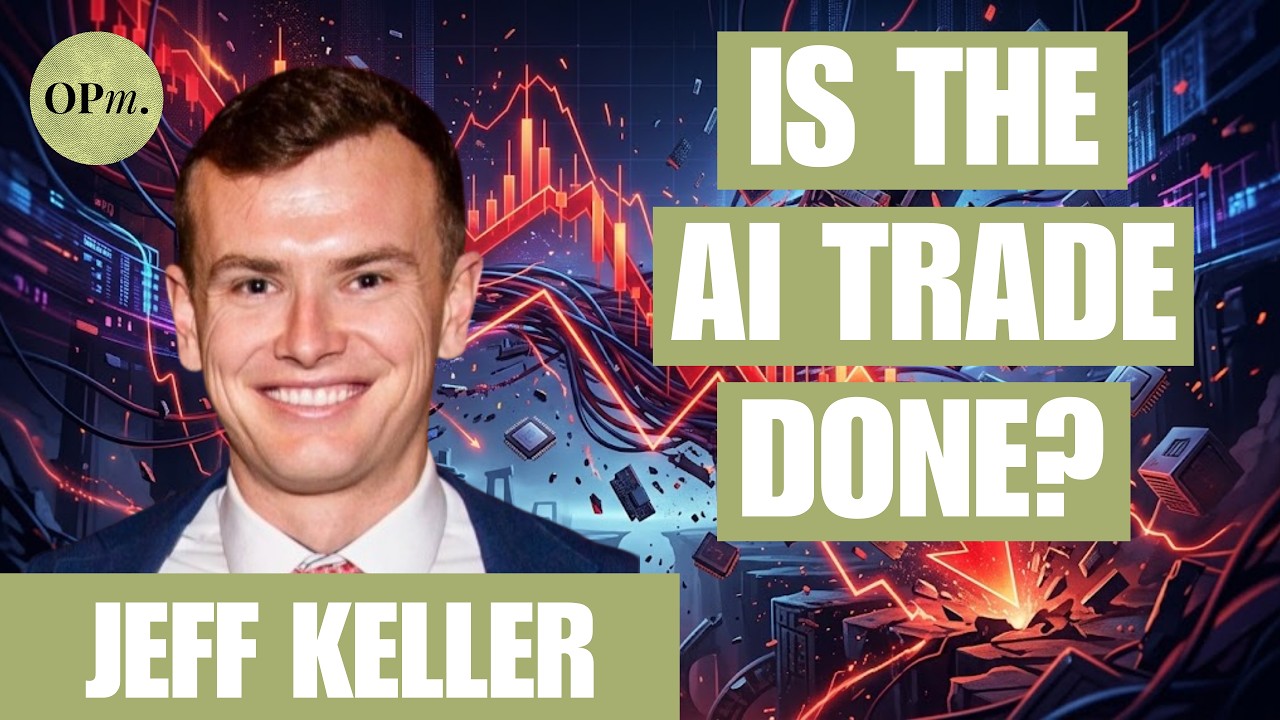
Is the AI Trade Over? (Why July Wasn’t a Blowoff Top) | Jeff Keller
Now Playing
Is the AI Trade Over? (Why July Wasn’t a Blowoff Top) | Jeff Keller
Transcript
1803 segments
In this market, long-term uncertainty is
so high that anything with short-term
certainty is trading at a huge premium.
Whenever you get heavy retail
involvement in any trade, uh that
usually
in my experience has meant that the
clock is ticking for the end of that
trade. There's been a maybe a disconnect
between the financial analysis of this
and the religious analysis that maybe
comes from the West Coast. There's going
to be a lot of pain, I think, if this
ever rolls over. And um uh I I just
don't think it's yet. Welcome to Other
People's Money. I'm Maxi and I'm joined
today by Jeff Keller, founder and
portfolio manager of Capeite Partners, a
technology sector focused hedge fund
that he's been running since 2021. Jeff,
thank you so much for joining me today.
>> Hey, thanks for having me, Max. Big fan
of yours. So glad to be here.
>> I I'm a fan of yours. I've been really
enjoying following along with Capeite
and everything that you've been doing.
There were a lot of tech focused hedge
funds that were birthed in 2021. a lot
of them sort of rode the the tech sector
up and then they rode it down in 2022.
And so I think, you know, just seeing
how well you navigated 2022 and the the
undulations that we've had in the tech
sector has been something that's been a
pleasure to watch and observe from the
outside. That's why I wanted to bring
you on today because it does feel like
since the start of Q3, we have had a bit
of shift. I actually ran the numbers as
of yesterday's close. Uh so since the
start of Q3 software and services are up
20%. Technology hardware and equipment
are basically flat but if you go down to
semiconductors and semiconductor
equipment we're down 7 and a half% to
start the quarter. Clearly a massive
divergence from what we saw to start
2026. So what are you seeing and maybe a
little bit about your background to give
us the perspective that you're coming at
from the tech sector.
>> My background is a little more
operational. Um, so I spent some time
actually working at Salesforce and
MongoDB. So a bit of a software
background and I think that maybe
orients me a little more towards the big
themes, a longer term horizon. Um, uh,
you know, looking for extreme
dislocations of markets. I think you had
in the beginning of this year an extreme
dislocation actually where the war in
Iran was distracting everyone from what
was just massively inlecting adoption of
AI. And that's been a longunning story,
but you really had the takeoff moment in
Q1. And you know, obvious Q2 was, you
know, I don't know that it was the
blowoff top for this trend, but you had
100% gain in socks. You had retail get
heavily involved. And so it's not
surprising that that trend has chopped
around a bit. And obviously, we had
situational awareness and deleveraging
in Korea. So I think some of this
volatility is, you know, it's certainly
obvious in hindsight. It's to be
expected. I think we're still moving
upwards on an S-curve with regards to AI
adoption. And you know, the bulls would
say, hey, Apple services is still
growing double digits today. Google
search is still growing double digits
today. Meta is growing in the 20s. And
so, um, you know, you could have 10 to
15 years of double- digit growth for
some of these AI labs. And, and, uh,
that'll lift all boats. So, I think the
volatility is to be expected. I think
software was thrown out with the
bathwater, obviously, and so some of
that bounce makes sense. But, you know,
if you zoom out, I don't think that late
June was the end of this mega trend. I
think this is just kind of normal
volatility. And so within software
obviously there was the big disruption
narrative and it's hard to say whether
that narrative has been disproven. I
mean if you take like the analog of
newspapers and how much the the market
was able to sus out the the pain the
newspapers were going to go through
before it actually showed up into
earnings. So if you are in the
disruption of software camp, um it's
really easy to to point to examples like
that and say, "Yeah, software looks
strong now. We we really haven't seen
the disruption, but but the results have
been extremely strong." And so when you
look at this rally, is it the market
saying that software actually isn't as
much at risk as maybe we felt at the
beginning of the year, or is it more
technical in nature? Because software
shorts were paired with a lot of these
AI longs. As much as the big
deleveraging event has happened,
degrossing is still happening across the
whole hedge fund complex.
>> It's been, you know, entertaining to see
socks and IGV basically have a negative
one correlation. Um, that does suggest
that there's there's clearly a technical
element to this that, you know, some bad
news for AI leads into it and service
now and and Salesforce stocks to go up
several percent. So that's an odd
dynamic. I think you split software kind
of into application software on the one
hand and sort of infra and cyber on the
other. Um you know I think the
application software obviously is still
under question. I think a lot of what
we've seen so far is just a
recalibration from that sector trading
at a premium to the rest of the market
um being double digit growth for a
decade now being maybe low double digit
or high single digit in some cases. And
once you get into that five to 15%
growth area, you know, it's really hard
to to to trade on revenue multiples and
non-GAAP EPS and and uh it's really hard
to dream the dream. So I think with um
you know the Salesforce workday,
obviously we've seen an acquisition
potentially of workday, but um I think
the initial sort of crash was kind of
coming back down to earth and it wasn't
actually pricing that AI was going to
disrupt the entire business. It was just
these are low to moderate growers with a
little bit left tail risk. So I I I
think that was somewhat rational.
They've bounced a little makes sense,
but you've really seen the balance in
cyber and infra. And I think part of
that is, you know, anything usage based,
any anything with the ability to
accelerate. I think in this market,
long-term uncertainty is is so high that
anything with short-term certainty is
trading at a huge premium. And so people
know that cyber numbers are going to be
good because people are rushing to to
build up their defenses with these new
AI threats. people know that infra can
accelerate because you see more software
adoption in general. You see, you know,
at least some portion flow into existing
tools. Uh you know, I I I don't want to
say I'm I'm bearish on that yet, but uh
those multiples have come a long way. Um
you're paying sort of 25 30 times
revenue for for large companies. Uh I
think that the the success rate on those
is paying up there is low. Obviously,
the next couple quarters are going to be
good. Um but you know, cyber is also not
immune from disruption threats. It's a
new paradigm. Uh, you know, you talk to
folks at some of the AI labs and they
think cyber is very much something that
they will disrupt as well. So, I think
that's TBD. I think it's a lot of uh
momentum and they're going to beat for a
little bit has driven them up. But, but
I think that's, you know, it's it's a
lofty territory that they're in more so
than AI, frankly. I'd argue that the
real AI winners are Crowd Strike and and
and some like that rather than maybe
some of the semis.
>> So, so within the the infrastructure, I
mean, what are you talking about? Can
you give me some examples of
infrastructure and why those names
haven't been under the same pressure as
application?
>> Yeah, I mean you look at a company like
MongoDB where I used to work so you know
I'm biased but um AI is clearly leading
to a proliferation of software. people
are creating either, you know, vibecoded
apps or they're just able to develop
more efficiently within large
organizations. And you know, every
software application has a database line
underneath it. A and and so when you
have an explosion of your end market,
that's going to lead to an explosion in
database software. And there's a
question of how are these databases
being selected? It's no longer human.
It's now, you know, various large
language models. So it's not clear how
the shift uh the mix shift works but I
think the the view is a rising tide may
lift that boat. You know that's an
example of Um obviously you know
you've seen some pick up with like CDNs
or the fastleys and and aim basically
anything that can deliver computing
resources that's driven on more compute
flows through to their numbers. I think
that they've seen some uplift and so
things that are usage based um certainly
in the short term you can see a pretty
quick spike. I think the long-term still
more under question but I think I think
infra there's a higher chance of beating
than there is in a Salesforce or you
know Wix or something that's a little
bit less likely to really blow up
numbers in the short term.
>> It sounds like you're not concerned so
much with market share, right? Like a
lot of times with these more mature
sectors, it's all about like who's
winning within the sector. And do you
think that within tech it it's less
about those types of bets and more about
where is the pie growing? Like is this a
relative a relative betting market where
you're really trying to pick winners
between these competitors or are you
just trying to see like where where is
the the wind at their backs? You know,
ultimately the work that I think one has
to do is bottoms up and company driven
and who the winners are. But I think in
technology a lot more money gets made
being in the correct major theme than it
does picking sort of within those
themes. You know, if you were 10 years
ago aware that cloud software was taking
share and there was a big migration to
the cloud, you know, certainly there
were certain names that were better to
buy, but for a while there it was more
importantly to be in the sector. Um, I
think that's what we've seen with AI and
you start to get dispersion, but early
on I think it's it's much more thematic.
It's much more sector driven and over
time as as the, you know, open-ended
growth story slows down, then it starts
to be about more dispersion. I think we
actually have a little bit of that with
AI where I mean it's still a pretty
open-ended growth story, but you've had
huge p the numbers now are sort of GDP
scale and so I think you're starting to
see a lot more dispersion where it does
matter who has more sustainability
rather than just this rising tide in the
short term is going to lift everyone.
>> Well, let's talk about that dispersion a
little bit. I'm sure obviously you have
this software background, but if you're
a tech focused investor, you've probably
have some exposure to some of these AI
themes. I mean post shakeout with what
you have seen from the market where do
you think investors should be within the
big AI trades I mean I also ran the
numbers on just the the uh S&P 11
sectors and you know technology uh came
in third. The only things that were
worse were industrials and utilities
which were really thrown into the AI
trade. So, you know, that has been the
lagard coming out of uh the bounce in
the market. So, where do you think if
people still want to be exposed to AI,
they should be looking?
>> I guess I'll start maybe with a
negative. I think one risk is to always
extrapolate a very short-term dynamic. I
think you're seeing a little bit of that
with, you know, the pricing of compute,
certainly maybe with Neoclouds.
Obviously, Elon is entering that space.
So, I do think that I think there's a
little bit of a risk that, you know,
this very short-term extremely high
price of compute is Elon might ex might
move us quicker to the glut. Um, so I
think that extrapolating that is a risk.
Um, you know, the other thing is it's
funny that of all these various, you
know, whether they're bottlenecks or or
semiconductor companies, they trade on
the same factor and they trade on
basically hyperscaler capex and the ARR
of the labs. like they they they need
the same underlying drivers and they
trade at hugely different multiples and
I think Gavin Baker's made this point
which makes sense. You know I actually
um you've got a lot of sort of behind
the meter you've got some some services
companies that are trading at pretty
high multiples on outyear numbers and
then frankly you have things like Nvidia
and Micron and the well well-known names
that are really not extrapolating. In
fact, they're telling you we're at peak.
And so, you know, maybe it's a little
contrarian, but I I I think it's likely
that the low multiple names across the
AI trade in general are going to do
better, even if they're at different
cycles of earnings growth. But it's all
driven by the same factor. There's
little micro cycles within each. But,
you know, I I I think that a lot of the
semis are not extrapolating as much as
some of the kind of more creative
whether it's behind the meter, some
services, highly cyclical businesses, uh
kind of hidden AI winners that people
have piled into. Those I think are
pricing in a rosier future than actually
a lot of semis.
>> And you know valuation is so different
as you said across this like how are you
thinking about what is or isn't cheap?
How far out are you looking that you
feel confident on earnings? Are you
valuing these things off of 27 28 um and
then you know between software hardware
right you're just talking about very
different multiples. How are you
thinking about valuation across tech
right now?
>> It's a good question. I mean, it's funny
to think about how many people, myself
included, you know, we'll talk about
four or five year projections and you
think back four or five years ago and
just completely different things we were
talking about five years ago is NFTTS
and spaxs and the metaverse and um and
AI was was was not on the radar. I think
there's a big risk with valuation. Um
I'm contradicting myself a little bit
earlier, but where a lot of these are
highly cyclical businesses, they're
obviously trading at maybe it's not peak
earnings, but massively inflated
earnings. You have a new profile
investor, you have a lot more growth
investors and tech investors. And so um
you know, multiple can be dangerous.
Even though I think that the multiple
there's some that have there's extreme
dispersion and there's some that are
very cheap. Um just relying on multiple
can be very dangerous because there's
high cyclicality here that a lot of tech
investors are not used to. But I think,
you know, if you have good visibility
into three years, you know, beyond that
is just hard to forecast in technology.
Again, you look back to five years ago,
very hard to very hard to predict what
we're doing now. And so, I think
there's, you know, if you've got
threeear visibility into into stocks and
valuation, you can do well. I think
there's a very high premium on one to
two quarters. I think that, you know,
that's a different game that I try to
play, but it's generally a two to
threeyear, you know, through cycle
earnings multiple with decent downside
protection.
>> Okay. But as as you said earlier, you
think there is a premium on that
certainty right now in in the coming
quarters. So as a portfolio manager, how
are you sort of bridging the fact that
you like to take a bit more of a
long-term view with knowing that the
market is really rewarding short-term
certainty and short-term growth.
>> That's the beauty of the long short
model is you can obviously you can bet
on both sides of the book. You can try
to isolate some of these factors. I
think that, you know, maybe it's
anecdotal, but I think that the time
horizons of people that I talked to is
probably shorter than I can remember.
Again, I haven't been doing this for 20
years, but, you know, I've never heard
sort of more conversations about what's
the catalyst path and, you know, who's
going to beat sellside consensus
numbers. And, you know, whenever you see
people that are that short term, I think
you can you can take a look a little bit
longer. I think it's, you know, it's
never as easy as simply this company's
going to beat earnings for the next
quarter, even though it works like that
sometimes. I think there's got to be a
longer thesis. So, you know, shorting is
a dangerous game. Um, you've got to have
awareness of of how far, you know, how
much people can extrapolate how juicy
some of these near-term imbalances can
get. But I think if you have, you know,
a couple a year or two of of horizon,
then you can sort of look at these and
say, "Okay, where are people
extrapolating and where can I sit and
wait?" And I think that's a pretty good
opportunity.
>> So, you're talking about that earnings
feedback loop, right? One of the other
interesting factors from earlier this
year that it felt different to me was
you had a feedback mechanism with a lot
of these partnerships deals. There were
catalysts really outside of earnings.
You know, one semiconductor company
would would make a deal with Nvidia and
the stock would would rip 10 20%. We're
still seeing those big sorts of deals,
right? somebody would announce, you
know, a huge bond offering to to fund
capex or or or some other sort of
buildout and,
you know, the the presumed receivers of
that of that capital would rally. We're
still seeing those sorts of
announcements, but we're not seeing that
feedback loop in terms of the market's
reaction. I mean, what is that telling
you that this feedback loop has really
dampened its effect? There's certainly a
lot more sobriety in the trade. I think
there's a lot of 1990s parallels.
Obviously, I was not investing at the
time, but it's funny to even compare it
to 2021. You know, the euphoria was
multiples higher in 2021 than it is now,
which is interesting because I think we
have a much more bankable long-term
technology trend. So, I think the
sobriety in a way is encouraging. I
think to your point about the lower
reactions to some of these
announcements, I think that there's a
lot of announcements where the economics
are unclear, especially think about with
data centers. You know, this company is
leasing from that company. You know, we
don't know who's on the hook for extra
costs. We don't know what happens if
there's a delay. And and so we've gone
through this phase where any association
with a year ago's OpenAI this first half
of this year, any associate association
with anthropic was gold. And I think
there's definitely a lot more scrutiny
to say, are you actually going to be
generating sustainable long-term profits
from this? Um I think you've seen that
with, you know, the crypto miners um
converting to data centers. Euphoria has
totally come off there because I think
there's concerns. So um
>> but now Bitcoin but now Bitcoin's
ripping and they're ripping along with
it, too. So they they get the best of
both worlds.
>> Yeah, exactly. They they they might have
to shut down the the data centers and
and uh go back to Bitcoin mining. No, I
think um I think you're right that there
there there's more sobriety. I I think
it's another point where it's actually
makes me a little more bullish. You'd
rather be in an environment where you
have to sit and earn the returns than
one where you get stocks moving 20 30%
on on press releases. So I think that
you know I think it's better to have a
longer slower cycle especially as a sort
of a manager of investments because it's
much easier to stay with things that
compound over time than it is with
stocks that go up 20 50% on press
releases. I I think it's also giving an
interesting picture into some of the
newer holders of these names, right? Um,
you know, if you go type in a ticker on
X, your favorite tech uh ticker that
just had one of these big announcements
and the stock hasn't moved, you're going
to see a lot of commentary from retail
sort of like cheering on the deal,
right? cheering on that deal and
wondering why why am I not getting the
20% pop that I got when this type of
deal was announced three to six months
ago. And so I I'm just wondering what
how you're thinking about the the holder
bases and the way things the the new
participants who have been coming into
this trade. One of the things you want
to be cautious of is whenever whenever
you get heavy retail involvement in any
trade that usually
in my experience has meant that the
clock is ticking for the end of that
trade. Now I'm not saying that I think
the AI trade is over but but you know
you saw it with you saw it with gold and
silver in the beginning of this year.
You've obviously seen it with crypto.
We saw it at one point with software
certainly in 2020 and 2021 when people
would be launching you know paid
newsletters writing about um MongoDB and
Elastic and and and all these companies
were it was it was you know um
>> Fastly
>> Fastly. Exactly. Yeah. Yeah. And so I I
think there's there's reason to be
cautious there. I think for sure that
you have these you know boring hardware
companies for 10 years that are now all
the rage among retail investors. I think
that's that's certainly dangerous. The
flip side is again this I think has a
lot more legs. It's got a lot more of an
open-ended growth story. You know, one
thing I've learned is shorting an
open-ended growth story can be deadly
because there's no catalyst. There's no
end to the story. You know, you might
get a data point that's helpful in your
direction being negative, but it's
really hard to put a nail in the coffin
on an open-ended growth story. And, you
know, AI is a good open-ended growth
story. I think it's a real one. um you
might have some hiccups, but in general
adoption is moving up the S-curve. We're
capex is going up. I think that's the
case for a number of years. And so I
think that's what differentiates this.
It makes me feel that, you know, this is
not uh this is not a 2022 environment.
It's not like June was the blowoff top
and we're going to be, you know,
semiconductors are going to be bleeding
for years. I think that this couple
months is a little bit more of an
information vacuum. People are latching
on to every ARR leak of anthropic or
open AI. I think that'll get clearer
when they become public. Um I I think I
think it's good. I think it's good to
clean out some of the leverage. I think
it's healthy in general. You know, I
don't know that we're going to rip to
alltime highs, but I certainly, you
know, I like short selling. I'm not
piling into shorting AI here.
>> We've made a few analogies back to 21.
You just talked about 22. You know, we
had this huge deleveraging event around
situational awareness in 21. it was
Archagos and it was a lot of the the
Kathy Wood arc names. To compare those
stocks and their businesses to what
we're seeing from AI is completely
disingenuous. So, let me just start by
saying the fundamental case for these AI
stocks compared to the speculative case
that was being made for a lot of those
names in 2021 is completely different.
With that being said, the market loves
to extract as much pain as it possibly
can. And that deleveraging event in 21
really did mark the top of the arc
names. The market continued to power
higher until inflation concerns really
started to take everything down besides
energy in 2022 and and we had that
rising rate environment. And so I just
wonder how you think about just the
technical factors that we're talking
about here and that you know as strong
as the open-ended case is that we could
still see a scenario where the market
moves higher a lot of these other themes
like software that are continuing to
have strong earnings. I mean so many
sectors are starting to participate in
the bull market. um like is there just a
little bit more pain to come for the
tourist semiconductor investor before we
start to see the market turn back to the
fundamentals?
>> I I think the 2021 analogy is
interesting. I might quibble with it in
a few a few areas. I think you're right
that it was sort of blowoff top retail
involvement and it took a while to get
through that pain. There's a lot of you
know ironic similarities to just
incredibly leveraged hedge funds driving
up a few of these stocks. I think you
know even in 2021 stocks like Tesla
software eventually kind of hit their
peak in late 21. So they they recovered
the the quoteunquote real businesses did
okay even if the spaxs and the GameStops
and and and whatever may have been sort
of cratered around uh Q1 of 21 as you
mentioned. So I ultimately I I do think
it was inflation higher rates that did a
lot of the damage in 2022 for the real
businesses and and we were coming from I
think arguably more indefensible
multiples back then 50 times revenue on
software when clearly software had gone
through a pandemic pull forward for for
you know cloud adoption. Um AI today
obviously there's some pull forward. I
think there's more legs to it. I think
the multiples are actually more
reasonable. Um, and so I think that
there's interesting analogies. I don't
think that this trade will break until
you start to see adoption slowing. I
think right now the reason the market
kind of gets nervous about ARR metrics
or whatever is that's the best indicator
we have is anthropic arai
open source whatever it may be. But as
long as in general the complex is seeing
more adoption, which it is right now and
it's explosive, um, you know, I I don't
think you want to short them. And are
they going to rip again? unclear, but I
think there's still a lot of open-ended
growth in this story. And so that's
where it's different, I think, than 21.
>> Now, it's another one of those sort of
rhyming but not matching perfectly.
Obviously, there is some debate about if
and when the Fed might hike rates. We're
probably going to get something, you
know, in the next few months, whether
it's the next meeting or not. The market
is pricing that in, you know, with near
certainty, but that by the end of of 26,
we're going to get something. But it's
not going to look like 22, right? We're
not going to come off the zero bound up
to the level of interest rates that we
saw. I mean, that was obviously a huge,
huge hiking cycle, but we're seeing
fiscal concerns come into play and
arguably those real businesses that were
hurt by rising interest rates are more
rate sensitive now than they were then.
We're we're seeing a lot of this
spending funded via the credit markets
to the point that that they've even
commented that it's crowding out the
Treasury market, the biggest market in
the world. And so I just wonder how you
feel about the rising long-end bond
yields and that you everybody seems
really focused on whether the Fed is
going to hike, but the market is
pushing, you know, financial tightening
much more so than than monetary policy
is. And do you have concern about the
ability for these companies to continue
to raise if we have rates at this level
at the long end of the curve?
>> It's definitely a concern. Far far
greater minds than than me have spent a
lot of time trying to, you know, figure
out which way the bond market's going to
go. So, I won't forecast what's going to
happen to rates. You know, certainly we
we've seen a number of kind of these
bond freakouts and rates go up and then
they come back down. Who knows if this
time's different. It's certainly
possible that two months from now, you
know, the 10 year is down 30 or 40 basis
points for whatever reason and you know,
we have less capital concerns than we do
right now. But for sure, when you look
at it now, I mean, this is a it's a
capital crunch in the sense that you're
talking about hundreds of billions,
pretty soon near trillions of what used
to be buybacks now actually going away
and also requiring debt issuance. You
know, my view is I I understand it's a
concern. This is a more dangerous way to
finance this buildout. I'm not that
worried about it, frankly. You know,
especially after the anthropic IPO,
these major the labs and and SpaceX and
Google will have raised about $500
billion year to date. And the markets
are fine. A lot more in debt as well, or
maybe not more, but a lot of debt as
well. And markets are broadly okay. I
think the cash these companies are still
growing top lines.
double digits, 20s for some. Frankly, I
think there's probably more cost base
they could take out if it ever got so
bad. You know, these are companies that
employ tens of thousands of people. They
did it in 2022. So, I think that there's
still enough room to fund the buildout.
I think capital markets are more
volatile and subject to euphoria and
fear. So, you don't want to go through
periods of the markets shutting down,
but I think they've generally been open.
The market's taken in stride so far. And
the other thing is the way that these
people that the Silicon Valley leaders
think about this is they view this as
existential. This is essentially the
greatest race of their career. This is
the pinnacle. You see Sergey and Larry
coming back to Google to work on this.
You see Elon basically pivoting all of
his attention to building data centers.
Um, you know, this is the big one. And
if they need to borrow at 150 bips
higher than they thought they did, and
it ends up in aggregate being whatever
that math is, big dollars, 1020 billion
dollars more a year, I don't think
that's going to slow them down. I think
there's been a maybe a disconnect
between the financial analysis of this
and the religious analysis that maybe
comes from the West Coast. And you know,
I grew up on the West Coast, so I like
to think I can do a little both. But,
you know, I don't think they're slowing
down. I think the credit markets might
try to slow them slow them down. But
unless we see yields really blowing out,
I think there'll be enough money to fund
it for a couple years. And if they're
wrong and you know the ROI never
materializes, we'll have a problem. But
I think their bet is in a couple years
it'll be obvious that this is a
transformative technology and so you
know a few extra bips of borrowing cost
is not going to slow us down.
>> Now what do you think about you know
obviously we we saw Google report its
first negative free cash flow quarter.
like is that coming for the rest of the
hyperscalers and and how do you think
markets are going to think about you
know the MAG 7 and the the the
hyperscaler names that you know have
they were the market leaders they are
definitively not the market leaders
right now like is that trade of just buy
the the big meggaap tech companies do
you think that's over um not to say that
they won't keep up with the market but
but that it's not going to be the the
easy trade to outperformance.
>> I think so. I mean, you know, I own some
of them. The stocks, I think, are
reasonably cheap. I think it's just a
very different profile than it was over
the number of years. You know, Amazon,
you can check me on this, but is
probably up something like 10x since
2016 or 2017. I mean, you made extreme
returns in owning the most well-known
companies in the world. Can you still
make 15 to 20% a year or or or whatever
it may be from here? Absolutely. But I
do think you're right that the profile
of return that people associate with
these companies I I think is is probably
behind us. I think also you know the
hyperscaler model which drove a lot of
the performance of the Mac 7. I mean
obviously not Apple and and not Meta but
but the other three were a lot of it was
cloud business. You know that market is
dramatically changed from basically
three vendors with you know thousands of
customers to now there's probably nine
or 10 scaled providers of of compute.
You include Oracle and SpaceX and and
and the labs who are procuring directly
and the Neoclouds and Core Core Weave
and Nebus at least. So you have a market
that went from maybe three to 10. They
still have scale advantages, but you
have fewer customers. So I understand
why those stocks are not trading at
higher multiples given their growth. Um
I think there's a lot more uncertainty.
there's more competition and you've got
a little bit of the law of large numbers
here just where you're talking about
again GDP level market caps and profits
and whatever. So to be able to get you
know two five 10x returns on those I
think that was a golden period over the
last 5 to seven years but I I think
you're right that that's over but
doesn't mean they can't still be good
riskrewards. It's just a different
profile. Now, I just pulled up Google's,
you know, adjusted free cash flow
estimates, you know, and looking at
annual numbers here, and it's like 27,
so it's like 18.8 billion in free cash
flow and then 28.5 positive free cash
flow in 28. I mean, does that presuppose
like too much certainty on the return on
this capex? Like, do you think that the
path to return on the spend is that
clear? in that immediate or are these
firms really betting on five 10 years
out that that growth that we said is is
really hard to predict it is I mean I
think there's a lot of focus on what's
the ROIC of this investment and there
there's obviously many opinions you know
the way I think about it is you know
it's almost like buying an option you
know it is existential if you don't play
this game and it wipes out your business
so you have to play so it's a defensive
option number one number two it's an
offensive option because you see it in
the cloud numbers. There's other other
ways that you can generate new products.
I mean there there's just sort of this
open-ended upside that maybe if we
become the leading provider of of
compute then whatever it may be there's
open-ended upside. So, it's really an
optionality thing. And I think the way
they've talked, I think Microsoft talked
about this in the latest call, maybe it
was one of the other hypers, but you
know, you can structure this where
you're buying powered, you're buying
powered shells, you're not filling it
with the chips yet. You're essentially
buying a couple years of optionality
where if you need to, you can ramp up a
lot of capacity really quickly. So, that
all makes sense to buy that option. Now,
if the ROI on that option is low but
positive, I think that's still a good
investment for them. You know, people
think about this as a concrete. You put
$1,000 into the ground, what are you
getting out of it? I think of it as you
got to put $1,000 into the ground
because if you don't, you might lose
your whole business. You got to put it
in because it might be this open-ended
upside. And I don't know if it's going
to pay you back 15. And frankly, I'm
okay actually. Shareholders might not
like it, but it's rational to do it even
at lower returns because the alternative
is is too risky. So, I think that has a
couple implications. One is we don't
know what the ROIC is, but I think
they're going to keep spending because
of this need to accumulate options.
Number two, it might not be great for
shareholders because if the ROIC is only
like four or 5%, that's not great. It's
kind of a waste of capital, but it's not
it's not incinerating capital. Um, but I
think the main takeaway is they're going
to keep spending because the risks to
stopping, I think, are much greater than
the optionality you buy by at least
continuing to stay in the game. So, I
think it's very hard to pin down the
ROIC. I think it's pretty good, you
know, which you can calculate in a
number of different ways, either through
numbers right now or just sort of
anecdotally about the profits that that
are flowing through the chain. Um, but I
think it's actually more driven by
basically the need to maintain
optionality than it is near-term ROI.
Going back to what you said about the
market is really rewarding short-term
certainty right now, you could argue
that the reason that the hyperscalers
have not participated is the uncertainty
around that ROIC. When I look at
estimates at least for, you know,
Google's free cash flows, you know, it
says to me that the the confidence
people have in those those free cash
flows turning around in 2028 seems to me
that that
they're willing to at least with a range
of outcomes say, "Hey, we're going to
start to get some return on this spend
two years out from now." But what if
2027 comes around and we're not getting
that visibility into 28 into this ROIC?
And it's not that it's negative. It's
not that it's going to be overwhelmingly
positive. We just don't really know yet
what the the return is going to be. Do
you think that that uncertainty is going
to cause continued problems for the
hyperscalers?
>> Yeah, I think it's a good question. I
think there is a world where to the
point earlier, you know, this used to be
a three horse business and now it's it's
eight, nine or 10. Um, you know, the ROI
where the profits flow in this chain is
not clear. you have anthropic and open
AAI building a lot of their own power
and data centers not enough but but
they're they're moving that direction so
I think that is why you know I remember
two years ago everyone was praying that
AWS would grow like 18%. And it's now
growing 40s and stocks incrementally
higher but not materially so given sort
of what we would have thought about a
40% growth two years ago. So I do think
that there is a decent amount of
queasiness on the ROI. I think there's
also queasiness on the sustainability of
growth because it's so concentrated in
customers. Um, so you've seen it where
meta meta is kind of on the ropes with
it. Um, I think the market and I think a
lot of people say the hyperscaler ROI is
still positive and Andy Jasse laid out
well and I think people are on board
with that for now, but you're right that
that can change quickly. I think
sometimes we overestimate how sensitive
these execs are to the stock price. Um,
again to the point of religious zeal,
like certainly they don't want their
stock price going down, but you know, it
it took a long time before in 2022
before Meta Meta started making cuts and
and that sort of thing. So, I think it's
got to be could they go down 10 20% and
everyone thinks it's a bare market for
sure. I don't know that that would cause
them to flinch. And is it going to is is
the ROI so bad that the stock would go
down more than that? I I don't think so.
I struggle to see the the stock market
forcing them to stop capex because in my
view the ROIC is good enough that the
stocks will never get so cheap that they
change course. But uh that is the
question.
>> I mean Zuck is a different animal when
it comes to his ability to withstand the
the share price pain. But I I do want to
open up the the can on Meta a little
bit. I mean there are so many bare
arguments for Meta. There was at the
point when they were sort of saying like
we're we're building out all of this
compute capacity. We're buying it up,
but we're not going to sell it. It it's
for our own uses. And they were really
being punished for that when they sort
of indicated that if they had overbought
that they would sell it out. The market
really rewarded them. And it has
perplexed me and it might go to the
short- termism that that you we're
seeing in markets, but I'm like if Mark
Zuckerberg can't figure out what to do
with the compute that seems to me to be
just like a bare case for AI technology
in general. I mean, what do you think
about this this bare argument for for
meta that they haven't defined so much
what all of this compute is going to be
used for?
>> I do think it would be a little
shortsighted of them to rent out the
excess compute. I think the reason they
made this messaging is they want the
market to give them rope and so they
need to signal like look we understand
your concerns and we will stop or re
release the capacity we have if need be.
Now if you do one of these threemonth
contracts you can earn a couple billion
dollars in profits and that would be
helpful to Meta but it's much more about
the signaling to investors than people
on a trillion dollar plus company
getting excited about you know one year
supply demand on a portion of your
capacity. So, I don't think it's going
to move the needle for the business. I
think it's more almost telling
investors, look, we get it and we will
stop if need be. We will release our
capacity if need be. Um, I I I might
disagree a little bit that, you know,
Meta, they've had a lot of internal
dynamics, hiring a new team. You know,
they were originally open source focus.
They've bounced around a lot. I think in
general, there's always winners and
losers within the AI uh the foundational
models. I think as long as the aggregate
is making progress, that's more relevant
to the broader AI trade. I think that's
still the case. I think meta has, you
know, more of its issues. I think
Zuckerberg, you know, there's a great
quote in in Sebastian Malby's book on on
Demisabus about basically him asking
Zuckerberg about AI as well as various
other tech trends. And Zuckerberg was
equally enthusiastic about AI and crypto
and and NFTTS and all this stuff. and
Zuckerberg far richer than I am, far
more successful, but he has a tendency
to, you know, go big on tech trends that
it's not really obvious that he needs to
do that for the core business. I think
as a shareholder, you have to be you
have to believe in him for that. I think
that's just a tough that's a it's a it's
a more binary question as a shareholder.
It's it's not it's not one I can
underwrite. Um, and so but I also don't
think that their troubles are
necessarily reflective of broader AI
troubles. Well, to me, I'm just saying
like it's funny the people who are super
bullish on AI, right? But then they're
bearish on Meta because Meta doesn't
have a plan. I'm like, well, there
really isn't a plan at the corporate
level for a lot of companies. And if you
talk to the teams that are sort of
trying out AI, I mean, it's difficult.
It's difficult to to go to senior
management and say, "Yeah, we want to
bring on this technology that the bull
case is we all get fired, right?" like
the the actual adoption at the corporate
level, how that's going to look is still
a huge concern. And so I just don't see
how you could hold both views in your
head at the same time that you're like,
I'm super bullish on AI. It's going to
change the way that that we work.
Compute is going to be the new oil, but
at the same time, like Zuck is
overbuilding or over, you know, like
>> it's a good point. Um, I think that is
Zuckerberg's view as well, which is
basically, you know, hey, we're
believers in AI. We're building this
compute. Don't worry about it because we
can we can sub lease it. We can do
whatever we need to do. Again, to the
point about sort of acquiring
optionality. It's not totally irrational
for them to do. I actually think it's
actually quite rational. They're the
biggest spender. They're relatively the
biggest spender. They get the most
questions. But, um, I understand his
concept of like this is existential to
my business. It might be huge upside.
It's not obvious yet. I need to keep
playing the game and I need my investors
to give me rope. And so I need to tell
those investors, look, I'm I'm playing
this game and I will back off if need
to, but I'm not backing off yet. I think
that's actually a rational strategy even
though public markets will whip your
stock around.
>> Well, I I want to shift a little bit
from from the analysis of of the facts
right now to to what it means for for
you as an investor, as a portfolio
manager. So, you know, you have the
ability to go long and short. What does
the the book look like right now? I know
that you are very focused on the micro
and the individual companies. We have to
stay away from that a little bit, but in
terms of the the places where you're
you're carrying a bit more exposure to
these themes and the places where you're
you're sort of betting against them.
>> You want to be in the big themes. I
think I have a little of a contrarian
streak. You know, there's a lot of
headwinds about um the politics around
data centers. I think in general that is
an overstated concern. I understand why
there's concern. I understand why these
people are upset about data centers
midterms are coming around. I think
there's, you know, there's a lot of
stocks that are basically implying that
data center starts are going to be
challenged. Whether that's labor,
whether that's some of these some of the
sites that that are actually applying
for power. I think that that is
unlikely. I think that's probably short
term. I think that you look past the
midterms, whether certain states are
going to sort of put moratoriums in
place or not, they're I think they're
going to get built. we've seen various
technology moral panics over time and
usually the market is strong enough. So
I think that's one area where I'm
looking at things that are uh uh pricing
in a deceleration and data center
starts. I think there's actually some
legs there. Um you know I I I'm always
wary of extrapolation. I think you know
anywhere that there's high near-term
certainty I'm I'm looking a little more
contrarian and saying you know
eventually you come on the back slope of
those of those little mini cycles and
extrapolations. So I think data center
starts look good. I think there's a lot
of idiosyncratic growth stories that
have been kind of left for dead. You
know, things like e-commerce, some
recent IPOs. I mean, nobody's talking
about those anymore. It's all I
software. Is software dead? Is it not?
So, I think that there are kind of some
independent stories, growth oriented,
stand on their own legs that are that
are pretty compelling because, you know,
they used to be bit up to high multiples
and I think they're not as attractive
given there's other exciting areas.
>> Now, you know, a bit about just your
philosophy on the portfolio, right? So
you said you want to have these themes.
Your long short, right? Long short means
a lot of different things. It can mean
anything from like market neutral to
there are people out there who are
running essentially like 100% net long
calling themselves long short and it's
really more of a an enhanced long
portfolio. What does it look like for
you? What are your typical nets and and
how much can that swing around because I
think it can help us understand how you
feel about the environment. I refer to
the fund as long biased which I count as
having sort of more than 50% net
exposure can obviously be higher than
that as well. You know I think that
there's so much money one of the more
sort of common market debates these days
is uh is the influence of of pod shops
and momentum shops or whatever it is. I
there's clearly a lot of money that is
market neutral that is relative
valuation focused. I think that there's
uh a lot of opportunity and not being
constrained in that way. I like being
long biased because markets go up over
time. Capturing beta, you don't want to
get paid for it, but you want to be able
to capture it for your investors. So, I
think that a long bias model with more
duration that is not subject to, you
know, having to be perfectly factor
balanced is a is a pretty attractive
model. I think it's probably always been
the case, but when you have more and
more money that's that's got to be, you
know, quarter to quarter that's got to
be factor balanced or factor aware or
has to de delever at the wrong time,
maybe it was July or whatever it may be.
I think that the kind of old school
longshore model is probably in for a
renaissance. Um I I think that there,
you know, there's reasons why it's tough
to do that business. Uh people don't
want to pay for it. You know, people
want either a cheap long only or a high
fee um market neutral shop. And so I
think that creates an opportunity where
kind of the old school stock picking um
can actually outperform.
>> I alluded to it a little bit like you
did very very well in 22. So many tech
investors got so excited in 2021 and and
got carried out, you know, rode their
names down all the way. Some of them
have very publicly come back from the
ashes and, you know, legendary comebacks
and and hats off to them. Um but but
many people didn't. For every for every
uh Cliff Sawson who who made it out and
back, there was somebody else who got
carried out um probably times three. And
so I'm just interested in like are you
ever going like fully net short and what
does it the environment have to look
like for you to get that bearish on tech
and and and and what would you want to
see from the current environment to to
really start to make you concerned?
because despite the uncertainty, you're
still pretty bullish on this trend.
>> It's unlikely I would ever get net
short. You know, I think I think late
2021 was a once in 10 or 15 year
environment where you had basically all
the factors of incredible government
support, significant retail involvement,
clear cyclicality
with with COVID and and and pandemic
beneficiaries in secular industries. So,
you had just you a lot of reasons to be
incrementally bearish. Uh I think that
multitude of factors rarely exists. I
think markets move faster now. So it's
very possible that we get one more
regularly. Now I think the AI trade
eventually has those ingredients. You
know huge huge change in underlying
business activity to do this AI uh
buildout. A lot of investor enthusiasm.
People are talking about you know
obviously curing cancer and and money
will be obsolete and and and whatever it
may be and a lot of cyclicality in in an
investor base that's used to secular
growth. So the ingredients are there. Um
I think the things that are most
important are number one uh basically
the the lab ARS. In other words, the
adoption the S-curve which I don't think
there's any crack in there yet. Number
two is the capex. You know there's
concerns it's not going to grow at the
rates it has forever but um you know if
it levels off at pretty high rates a lot
of these stocks will do well and and
right now it seems like growth is is
still strong. capital markets are still,
you know, they're tightening, but still
provided hundreds of billions of dollars
this year for infrastructure. So, I'm
not worried about the capital markets
stopping it. And then the third thing
that's that's relevant is, you know, the
price of compute basically. And I think
that will signal if we're in an
overbuild, which which would be
problematic. So, I don't think we're
there. I think the AR is strong. I think
the capex is strong. And the price of
compute, the time it takes to build data
centers is not suggesting we're at a
glut yet, even though Elon might might
move that a lot. So, those are the
things I'm looking at. I don't see it
yet, but I do think that if and when
this cracks, you know, it would be
helpful to have a short selling skill
because there's a lot of people in
highly cyclical businesses trading peak
on peak and even probably some stocks
that I own. So, there's going to be a
lot of pain, I think, if this ever rolls
over. And I I just don't think it's yet.
>> The thing that has me most concerned is
is actually somewhat the AI tools that
that are available to a lot of investors
and the echo chamber. And look, whether
it's financial Twitter now X or it was
the chat rooms back in the 90s where
people were sharing stocks with each
other, you now have like a true echo
chamber where you're talking to an AI
chatbot. And there is so much happening
at the technology level. And so people
are doing a lot of fundamental work, a
lot of work trying to understand the the
differences between these companies and
where they sit in the supply chain. And
it's really easy to have a strong almost
feels like bulletproof fundamental
thesis and you can take that and you can
put it into an LLM and you can say sense
check this and they can go you know Jeff
that is a really smart thesis but
sometimes like the market doesn't really
care about that like it it feels good
the fundamental focus that people have
right now but it the market doesn't
always care.
>> I think you're right. I mean, the amount
of AI generated content that I've seen,
whether it's, you know, in sellside
research or or substacks or even just
investor chatter is surprising to me
because, you know, the whole job is you
got to come up with your own thoughts.
And I think that it's very easy to get
standard consensus thoughts, but I'm not
really sure those are those are of
value. And so, I think AI is great for
ramping up. It's great for facts and
figures, but you know, I I agree with
you that it can create an echo chamber.
I mean, I think there's also a huge
behavioral opportunity in fund
management. I mean, you just think
about, you know, think about how
addicted we all are to our phones. Think
about how quickly these narratives spin
up in politics or stocks or whatever it
may be. Um, think about everyone's
attention spans. So, I do think that I
don't think AI helps with any of that. I
think AI probably enables a lot of
shortcuts. It enables a lot more
confidence. I think that it's going to
create a lot more behavioral
inefficiency. I heard on another podcast
that somebody was saying, you know, I
think that if AI gets advanced, it's
basically going to remove kind of fear
and greed from markets because, you
know, the AIs don't suffer from fear and
greed. They can be sort of perfectly
rational. And I basically completely
disagree. Like I think that um I think
you're going to get faster narrative
cycles. I think you're going to get more
crowded narrative cycles. I think that's
in addition to the phones and terminally
online nature of our society. So I think
that there's a an emerging behavioral
inefficiency. I think markets probably
getting less efficient over time and I
don't think AI really helps with that.
Actually, I think it might for
quantitative models, but I think it's
much less likely to lead to inefficiency
and more likely to lead to
overconfidence.
>> Yeah, you're saying to efficiency, you
said not to lead to inefficiency. More
likely to lead to inefficiency than
efficiency.
>> Yeah, that yes, thanks for catching
that.
>> I just wanted to clarify. But uh to your
point about the speed and I mean it's
something that right like the faction
you talk about being factor aware and
you're like there's a there's an
advantage for fund managers you don't
have to be overly factor aware but it
does seem like it is a requirement to at
least know what your factors are. That
doesn't mean you know you can you can
believe it's an advantage for you as a
portfolio manager to knowingly take on
more factor exposure than somebody whose
job it is is to minimize that factor
exposure as much as possible. But it
doesn't mean you can't be unaware of the
factor exposures that you have. And I I
think the speed at which things are
being bucketed, factorized, and ceasing
to be idiosyncratic company level alpha
and becoming a bucket or a theme or a
trend is is happening extremely fast. I
mean, how do you as somebody who likes
to underwrite but do bottom up work kind
of sense check yourself and make sure
that you're not letting the strong
fundamentals that you're seeing cloud
the fact that it's part of a theme that
is extremely hot right now and that
means a lot of the money that's coming
in is is not doing the work that you're
doing.
>> I think you certainly have to be aware.
I think it's you know I I I've spent a
lot more time in the last year or two
trying to be aware of factor uh
exposures. It's not even something I
was, you know, paying attention to
probably four years ago. So, I don't
know if that's just my awareness or the
markets are changing. Um, you know, I
think it's ultimately a time horizon
question and I think it's it's an LP
management question. You know, if if um
there's certainly a you know, there's a
standard in the business that you sort
of report monthly results and monthly
results is completely insignificant in
the scale of time. quarters are probably
insignificant and so it's kind of just a
a you know a noise generator especially
given how much factors move you know if
you were a software investor you know
you had LPs saying what what's what's
wrong with your your process why are we
losing so much money and the reality was
it might have been that AI funds were
levering up and you know shorting
software and and driving negative
momentum into your stock and it's a it
was a two-month thing and those stocks
have roundt tripped over four months so
I think you have to be factor aware I
think you got to manage your LPS I think
you need to make sure that if you're if
you're making factor bets or you have
sector bets or whatever that you're very
well aware of that and that you're
conscious about that. But I also think
it creates a longerterm opportunity
where you can say look clearly momentum
is having whatever it is one of its
worst five day stretches in in 20 years.
Okay, let's let's take a look at that.
One of the things I like to go to is
extremes. You know, when you have a wash
out in a sector, you have people saying
something's uninvestable. you have, hey,
this is the largest, you know, hedge
fund shorting day that we've seen in in
seven years. Okay, pay attention to
that. Those are the types of signals
that I think give a lot more
opportunity. It seems like a new world.
I'm sure there's always been parts of
that. I certainly wasn't paying
attention to it as much as I am now. So,
>> and so, you know, what did you do?
Obviously, we all had to go through
that, right? in July. I doubt there's
anybody listening to this podcast who
didn't have at least one AI stock in
their portfolio that was going down
every day despite really no news about
that particular company. I mean, you as
a as a professional investor when that's
happening to you, what are you doing to
sort of like sense check your book?
because I I don't think July is going to
be the last time in this cycle that
something like that is happening and and
you we're all left, you know, wondering
like what why is this happening,
>> right? Yeah. I mean, there there's kind
of a life cycle of at first you think,
oh, this is great. My stock's down. I
can buy more. And then there's a second
where you start to get a little worried.
And then there's a third where you say,
okay, there's maybe bigger factors at
play. And that's kind of when I think
people started hearing about the margin
calls and situational awareness and it
made a little more sense. An example
there is a lot of their pain was
concentrated in Asia, especially Korea.
Um, you saw some notable percentage of
of the Korean population getting margin
calls. Who knows if that's kind of
rumor, but you you saw a lot of margin
calls, a lot of leverage in Korea, huge
deleveraging. Um, that's something that
that perks my ears up. you have huge
hedge fund deleveraging, huge retail
deleveraging in a secular trend that I
actually think is is still going pretty
well for the basically two large
companies in that country. So that's one
where once once you sort of have all the
pieces in place and you can see what's
going on, you say, "Look, I want to be a
buyer when people are getting margin
called and liquidated." So that's one
where maybe I think the picture is
improved. Um but but otherwise, you
know, it's it can be hard to sus out
what whether it's fundamentals or
technicals. So, I think you have to
really see a lot of signals like I think
we saw in Korea to say, "Okay, this is
maybe just even from a short-term
trading perspective, a much more
attractive proposition."
>> And is that the type of thing where you
are keeping some level of cash on the
sidelines for these events where you're
willing to flex up your leverage a
little bit when you have that confidence
as a portfolio manager? Like, how do you
like to maintain the ability to step in
when you have that level of confidence?
Yeah, I mean I think I've talked about
optionality before, but I think
optionality is generally one of the most
important things when when managing a
portfolio and that can be cash, that can
be lower gross exposure, but being able
to move such that you're not the one
deleveraging or maxed out when there's
an opportunity. I think that's
especially more so in these markets
where it seems like there's again these
sort of three, you know, three standard
deviation events or once in once in a
20-year event seem to be happening every
several months. I like to run with a
little bit more flexibility. I like to
be able to step in once there's a little
more pain. I'd say in general, my time
horizon is a little longer. I'm trying
not to trade too much. I'm trying to
wait until something hits me in the
face. I think we had a little bit of
that in July uh with with sort of as I
mentioned, but it's hard to say. And I
think that uh uh you know, there's a
graveyard of folks that try to trade
short-term moves. So, that's why I'm I'm
really trying to see something that's
three standard deviations, four standard
deviations really stands out to me. and
then you can move and keeping that
optionality open, you know, uh this job
it's like we we all spend all of our
days looking at models and companies and
reading and all this stuff. Um but you
make your money on one or two good ideas
a year, a couple big ideas every couple
years. And so making sure you have the
optionality for that, I think is more
paramount than, you know, making sure
you've got, you know, great stocks maxed
out at all times.
>> Yeah. I mean, and look, obviously the V
has come down quite a bit, but I just
like pulled up like EWY and Socks V. I
mean, they're realizing
uh 73 V and EWY the one month look back
and and socks is 55, you know, they
peaked out at like 185. It's like how
much leverage do you need for sectors
that are realizing that level of
volatility?
>> Right. Right. Yeah. I'd say in general I
I've learned that I comparatively I run
with very low leverage. I didn't realize
some of these folks are running with as
much. I agree with you because I think
you know leverage is a great way to
reduce optionality. I I I think it's
interesting the realiz I mean usually
one of the most basic indicators you can
see for how markets are feeling is just
the VIX and you can tell how much people
are panicking and and paying for
protection. This market has been
different because there's such
dispersion within sectors and even
within stocks that you know the markets
are very tranquil. The headline indices
are very tranquil and you're actually
seeing these incredible ball spikes and
in in certain sectors or to your point
EWI or stocks which you know it's like a
duck kicking below a surface but if you
go below the surface this year's had a
lot of volatility and a lot of rotations
and a lot of opportunity to be nimble at
extremes. You know, my guess is frankly
it's it seems like one of those trends
that's going to increase. It seems like
there's probably only sort of shorter
time horizons, more uncertainty, more
money flowing into, you know, less
fundamental strategies. So, my guess is
that that will increase and sort of the
behavioral advantages will increase.
>> Well, look, I I want to talk about
what's what's coming up next and and
close out. We've got um pretty much with
the exception of Nvidia at the time that
we record this, they haven't reported.
I'm not going to ask you for any
predictions on Nvidia earnings or
anything like that, but we're kind of
through the meat of earnings season by
and large. We have a little bit of Fed
uncertainty, geopolitical uncertainty
that people are concerned about,
obviously what's happening in the bond
market, but what are the factors that
you're going to be paying most attention
to, you know, as we close out 2026?
>> Yeah, I mean, I think we'll get the
anthropic S1 probably, it sounds like
next week or or the week after. Um, I
think that's going to be, you know, I
don't know that we'll get a ton of new
information that we don't really already
know. We might get a little more
precision, but my guess is the numbers
are broadly leaked, but I think that
those companies coming public will be
hugely helpful and that we just have
metrics and we're not sort of guessing
and and trying to hear third-hand. But I
I think the most important things are,
especially for the AI trade, it's a it's
ARR of the labs and open source, some
form of adoption of AR. Number two, it's
capex, which, you know, seems pretty
locked to be strong for 27 and people
start looking at 28. Uh, but but you
know, I think if anything, people are
feeling better about the hyperscalers
than they were in the first half. So,
that seems to be strong. And then number
three is probably the forward prices of
compute, which very tight right now,
probably tight for a while. Uh, I I
think if if if you're going to see an
overbuild in data centers, you'll see it
there. Those three I think I think are,
you know, broadly strong right now. You
know, what will what will the stocks do?
It would not surprise me if we chop
around for a while. I think you had a
lot of retail enthusiasm, a lot of
investor enthusiasm in June. Usually,
you don't see those things rip back to
new highs. I think that we're sort of
waiting for the next breakthrough or
acceleration. It wouldn't surprise me if
we get one. I don't know what it is, but
there's recursive self-improvement is
kind of floating out there. So, we could
have some technology breakthroughs that
get people excited again, but it would
not surprise me if we chop for a bit.
But, I think having the labs public will
help with some of this narrative
volatility. Uh, so I'm excited for that.
One follow-up question to that before I
let you go. Do you think that there will
be any sort of like capital vacuum that
comes from that? We saw it with space,
right? Again, not quite the same
fundamental business quality that we're
talking about in many of these AI themes
that people are investing in where
there's already like strong earnings,
but you know, you had all these also
rans in space really have the win taken
out of their sales. they had been doing
incredibly well and the second people
could buy SpaceX, they sold a lot of
those other space names to go put it
into SpaceX. You know, we don't have a
pure play lab, right? Like anthropic.
Obviously, if you're buying Google,
you're getting the whole Google
business. If you're buying these
semiconductor companies, yes, it's
directly tied to to the AI theme, but
you don't have really AI AI model
exposure available on the public markets
in a pure play. I mean, do you have any
concerns about certain pockets of the AI
trade having a SpaceX effect?
>> I think it's possible. I I don't I don't
have a ton of concern. You know, I think
that, you know, equity issuance is a
huge signal for kind of euphoria and and
and blowoff tops. I think it is
different when the equity issuance is
into kind of more real businesses. Now,
I would certainly quibble with the
SpaceX valuation, but in general, these
are these are not dollars going into I'm
trying to think of some of the
highlights from from Spaxs or whatever
it is. So, I I think that equity
issuance into realistic businesses at
realistic prices is less capital sucking
than you know, we need to put $10
billion into Nickeola or whatever we
were doing back in 2021. So, I think
there's some worry. you know, the space
stocks, they they sort of they were at
they they doubled and then got cut in
half. So, they're kind of back to where
they were. Could the AI stocks run up
into the anthropic IPO and then come
back down for sure, but I I think that,
you know, the the euphoria and the
optimism and the positioning has kind of
cleaned out in the semi-rade. I don't
know that means it's going to rip, but I
I think that I think the market's ready
to digest, you know, anthropic, and I
think it'll want lab exposure. Frankly,
I think I think it's going to trade in
at a crazy price. You know, I'm not
saying I'll buy it, but I I think that
there's going to be a lot of enthusiasm
for it.
>> All right. Well, Jeeoff, we will leave
it right there. Where can people find
you out on the internet these days?
>> Uh, I'm on Twitter, Jeff Keller1. Um,
and then always on email, JeffLlight.co.
I didn't pay for the com, so it's just
the do.co.
>> Nobody's paying for the com anymore. All
right, Jeff. Thank you so much. We'll do
it again soon.
>> Great. Thanks, Max. Appreciate it.
Interactive Summary
Ask follow-up questions or revisit key timestamps.
This episode of Other People's Money features Jeff Keller, founder and portfolio manager of Capeite Partners, discussing the current landscape of the technology sector, specifically focusing on the AI trade. Jeff highlights the normalization of market volatility following the extreme exuberance observed earlier in the year. He discusses the divergence between AI infrastructure and application software, the importance of distinguishing between thematic sector growth and stock picking, and his perspective on the sustainability of massive capital expenditures by hyperscalers. Jeff also touches upon the behavioral inefficiencies in markets, exacerbated by AI-driven content, and why he remains long-biased despite technical headwinds and valuation concerns.
Suggested questions
4 ready-made promptsRecently Distilled
Videos recently processed by our community