OpenAI IPO Delay Report, King Reveals Tax Bill, Naples Powers Italy Growth | Bloomberg Daybreak:...
Now Playing
OpenAI IPO Delay Report, King Reveals Tax Bill, Naples Powers Italy Growth | Bloomberg Daybreak:...
Transcript
408 segments
Bloomberg Audio Studios podcasts radio
news.
This is the Bloomberg daybure podcast.
Good morning. It's Friday the 26th of
June. I'm Caroline Hipka in London.
Coming up today, tech stocks tumble as
open AI reportedly delays its IPO and
Apple hikes prices on rising chip costs
just as AI demand begins to justify its
massive expense. The tech sector in
Naples helps to lead a regional revival
that could be a gamecher for Italy and
beyond. Plus, his majesty's royal
contribution. King Charles and Prince
William disclosed the tax they paid HMRC
for the first time in modern history.
Let's start with a roundup of our top
stories. Stocks are falling as a
sell-off in Apple shares and reporting
that open AI may delay its IPO rattle
confidence in artificial intelligence
bets. South Korea's tech heavy Cosby has
tumbled 8% triggering a 20inut trading
halt as Asian markets slumped to a
2-week low. In Tokyo, SoftBank shares
have plunged 13% after the New York
Times reported that the chat GPT maker
Open AI is leaning towards delaying its
planned listing until next year.
According to the paper, bankers advising
the startup believe that recent
volatility in tech stocks along with the
performance of SpaceX shares following
its record IPO could dampen retail
investor appetite for the offering.
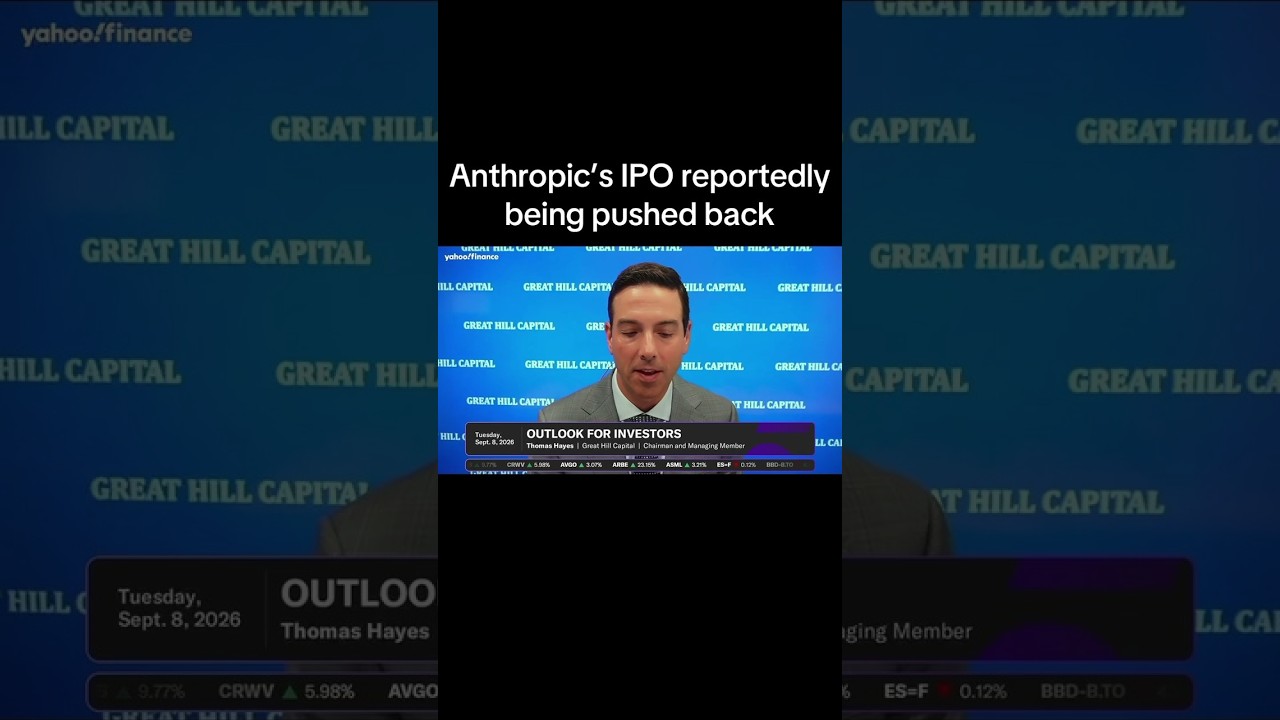
Blind's remain bossic says that waiting
may be the smart move if the company
wants to maximize its value.
>> SpaceX, Anthropic, Open AI, there were
supposed to be the holy trinity of IPOs
this year. Three AI companies all
potentially coming out of the gate with
trillion dollar valuations. We got
SpaceX, Anthropicus filed
confidentially, and the best we know,
they still plan to move forward. Open
AAI also making that confidential
filing. But this New York Times report
suggesting that there have been some
discussions with Sam Alman who leads
this company where basically the
advisers said that if you go out of the
gate now, you're not going to have that
$1 trillion valuation.
>> Bloomberg's remain bustic there after
open AI's latest funding round earlier
this year gave it a valuation of 852
billion.
Well, that reporting on the chat GPT
maker came shortly after Apple announced
price hikes for Macs, iPads, and home
devices. The iPhone maker stock fell
more than 6% in US trading as the
company sought to offset rising costs
caused by unprecedented global demand
for memory chips. 248 Ventures chief
investment stratey strategist Lindseay
Bell believes the move is a sign that AI
stocks may have peaked. I think that the
Apple's stock price reaction is sending
a signal that the rest of the market
might not have gotten today. And to me,
it says this could be the first sign
that the AI bubble could potentially be
starting to deflate. And I don't say
that lightly. I say that in a market
that we've been in that rewards margin
expansion and at the very worst margin
maintenance.
>> Lindsy Bell speaking there as shares of
Apple's Asian suppliers also fell
sharply following the news. A ship has
been hit by an unidentified projectile
in the straight of Hormuz. The container
ship Ever Lovely was struck while it was
sailing along a recommended route.
According to its Taiwanese operator,
Bloomberg TV's Middle East correspondent
Abir Abu Omar says that it's the first
reported attack since the interim US
Iran peace deal came into force. Now,
there are some reports that suggest that
the Iranian army through those
projectiles. The US side says it's too
early to tell, so it's it's not really
clear yet who the culprit in this attack
is, but the latest reporting suggests
that it's the IRGC. Abir Abu Omar added
that oil prices which had earlier
returned to pre-war levels turned higher
on the news. Brent crude touched session
highs close to $76 a barrel after the
attack. They have since declined.
Emergency services in Venezuela are
still searching for victims after two
earthquakes struck the country earlier
this week. Rescue teams in the coastal
city of Katia Lamar are looking for
those trapped by several collapsed
buildings after residents compiled lists
of missing people on social media. Luis
Pache from the Red Cross says that their
work is more than just getting people to
safety.
>> They're going to have psychosocial
needs. They're going to have physical
health requirements. And so we're
setting up stations. We've already
ordered a mobile health facility. We've
already unlocked 2 million of our own
funds to deliver to the Venezuela Red
Cross um so that they can continue to
perform these services and so we're
we're moving.
>> That was the Red Crosses Lois Patche who
is speaking there. The total death toll
from the incident has risen to 235
people but thousands more injured
according to the country's health
minister. A volunteer-run database now
lists 11,278
people missing in the coastal city state
of La Guerra. Here in the UK, King
Charles III has revealed his personal
tax bill in a move to increase
transparency around the British
monarchy. Bloomberg Adabio has the
story. The king of England voluntarily
paid 12.9 million in tax last year,
whilst his son, Prince William, paid7.76
million. The figures were revealed in
statements from Buckingham and
Kensington Palace released yesterday for
the first time ever. The unprecedented
window into the finances of the British
monarchy come at a time of increasing
scrutiny. Earlier in June, a report from
the National Audit Office showed that
the disgraced former Prince Andrew
Mountbatter Windsor received private
income by subleting three cottages on
the royal estate where he lived. The
king's assets range from castles to
riverbeds, placing him among the world's
wealthiest people. In London, Tiwa
Alabio, Bloomberg Radio. The heat wave
searing much of Europe is officially the
most severe ever recorded in the region
with intensely high temperatures pushing
politicians to call for action. Now,
researchers at World Weather Attribution
found that temperatures were between 5
and 12° C above seasonal averages in
France, Germany, Italy, Spain, and
southern England. The UK's Green Party
leader, Zack Palanski, has told
Bloomberg Radio that laws need to catch
up with the reality of climate change.
>> It's not just infrastructure. We should
have a maximum workplace temperature.
It's outrageous that we have uh lowest
workplace temperature where you can't
work in the cold, but we don't have that
for heat. Businesses, schools, we will
have to be flexible. And this won't
always be a popular message. People
don't like change.
>> But if we don't change, we're not going
to survive. And it's as stark as that.
As the um environmental office puts it,
we need to adapt or die. Zach Palansky,
who was joined by members of a UK
Parliament environment committee, who
wrote to the government asking for its
views on how to adapt to overheating.
The extreme temperatures have been
deadly and are forecast to continue
today before easing over the weekend.
So, those are our top stories for you
this morning. In a moment, we're going
to bring you more on artificial
intelligence reaching an important
tipping point that could justify the
data center spending splurge. Plus,
Italy stark north south divide may be
shifting thanks to Naples. But before
that, something else has caught my
attention this morning. Are you jetting
off anywhere? To eat the airline food or
not eat the airline food, Bimbo Business
Week has been to one of the biggest
airline catering sites in the world.
This is a sprawling food factory outside
of Hong Kong where they make those
little plastic trays or the plates of
food. If you're in first class, good for
you. In terms of what they have been
reporting about, I just think that it's
an extraordinary story because as we
think about the AI roll out around
automation, around kind of the modern
economy, basically this whole business
is still massively labor intensive,
physically demanding, repetitive work.
catering workers are among the lowest
paid employees across aviation. A lot of
workers um can't endure the shifts and
there's a huge kind of attrition rate
around 50% in some countries in terms of
annual uh you know staff attrition. 5
billion people bought a pl boarded a
plane last year. Um so it's kind of a
huge deal and a massive industry.
Ultimately what is underneath the silver
foil is all down to airline budgets of
course but there is some fine dining
that has crept into uh meals even at
30,000 ft. So I just think it's a really
interesting and important sort of story
that actually even as we think about
automation and jobs may be being
massively altered due to AI manual labor
in some industries is just still really
big. Have a look at Bloomberg Business
Week uh this week to read that story
around uh the airline industry. Open AAI
is reportedly holding off on its IPO
while Apple is hiking prices, both of
which are tied to the story of AI and
whether the massive costs of investment
will be worth it. A new report from
research firm Exponential View shows
that revenue from artificial
intelligence has now surpassed
depreciation costs. Our global business
reporter Jacob Reid has been writing
about this and he joins us now. Jacob,
good morning. So, as we think about AI,
this is a really important story. This
idea of depreciation, why is that so
important when it comes to working out
whether AI is going to be worth it?
>> Yes, depreciation is like an AI, you
know, in anything. If you buy a car new
from a showroom after you've driven it
around for a couple of years, it's going
to have lost a fair chunk of its value.
Or the same as your new iPhone and you
go and trade it in a few years later and
hey presto, it's not worth what it once
was. It's exactly the same for
artificial intelligence chips. You know,
we hear the news year after year of
these chips getting faster and more
efficient, and that means last year's
chips are worth less. Now why this
really matters for the accounting is
that these big firms Google, Microsoft,
Meta, they need to say in their in their
accounting, how many years are our chips
going to depreciate and they've actually
got a fair bit of leeway to say that and
it's it's really hard to know because
chat GPT is only 3 years old and it's
saying we think our chips are going to
last four, five or six years but it has
a massive impact on, you know, how how
many write downs, how much loss they
have to put on now, how how their profit
and loss looks. And also, some of these
firms, they're borrowing as collateral
against their chips, which may or may
not be worth what they say they are. It
it really caught my attention because
you might know the big shot that that
fantastic film and Michael Bry has said,
or this is potentially one of the
biggest ways people are fiddling the
numbers. So plenty of people would
disagree with him but it's an active
question.
>> Yeah, absolutely. I think that's really
important as we try to understand you
know the cost benefit um and the
accounting around AI but how did
exponential view sort of calculate all
of this and you talk in your reporting
about AI at a tipping point.
>> Yeah. So they they what they did was
pretty snazzy. Um, first of the kind
really because we know quite a lot about
the supply side of the AI industry. You
know, these these so-called
hyperscalers, they they give us figures
about how much they're spending on chips
and data centers. But OpenAI, Anthropic,
they're still private companies and even
even Google and Meta that are public
companies. They don't really break it
down into that much detail how much
demand is there for their AI products.
So what this report did was was was try
and track that demand from the bottom
up. They looked at over a thousand
companies. They scoured, you know,
company filings, executive statements,
press reporting, that sort of thing to
build this really big model. And as you
say the result from that was saying we
maybe reached a tipping point where
global AI revenue and that that excludes
China for now but global AI revenue has
overtaken is outpacing those
depreciation costs and it's not a done
thing that that will continue right
depreciation costs will keep on going up
as that capital expenditure uh keeps on
going up but symbolically it feels kind
of important. Yeah, absolutely. And a
really really interesting uh analysis of
the landscape when it comes to AI.
Jacob, thank you so much for being with
us. That is our global business
reporter, Jacob Reed. Thank you for your
time. Stay with us. More from Bloomberg
Daybre coming up after this.
To Italy now, where Naples is leading a
regional revival in the south of the
country that could be a gamecher for
Italians, but also for Europe. Joining
us now, Allesandra Miglatio in Rome.
Bloomberg Western Europe economy
reporter, Allesandra, good to speak to
you. Italy is Europe's third biggest
economy, but the north south divide, the
industrial and wealth gap has been so
deep. How is that changing now? It's um
well, we've crushed some numbers and we
were surprised to see that it it really
seem there's something is happening. I
mean, of course, the south remains
problematic as far as unemployment, as
far as demographics. The the population
is not comparable to the industrialized
north, but um we saw that southern Italy
is growing 07% compared to both Italy
and northern Italy, for example, growing
05 and Campa, the region where Naples is
located, is growing, grew in 2025 09%.
That's quite something, you know,
compared to a 05 for the country. And
that's just 2025. But then what we saw
when we looked further back is that it's
not a one-off. Um if you go from 2019 to
2024, you see that the south has grown
7.7% and the rest of the country just
5.8. So what are we seeing? It's it's a
matter of pace. It's not that the south
is richer than the north. The north
remains extremely rich. It's just that
when you see an area that has had so
much trouble and has been so far behind
and it starts finally growing, then you
know the pace will obviously be much
faster. We see that with developing
nations. But what I think really struck
us was that it's not just a one-year
thing. We see a trend. Something is
moving in the south and the economy
really is it seems to be picking up and
it seems to be concentrating around a
few cities. So certainly Naples body in
the east and then Katana in Sicily.
>> Yeah, I think it's really fascinating
reporting. I wanted to highlight it to
our listeners because I was amazed to
read in your story that the Naples
region is second to Milan for startup
businesses which is um you know very
interesting and that a lot of this has
been done by using European money and so
you know powered by EU funds maybe there
are lessons across Europe for all of
this in terms of how to build economic
dynamism.
>> Thanks for listening to Bloomberg
Daybreak Europe. If you're enjoying the
podcast, give us a follow, leave a
rating or review, and maybe send it to
that one friend or colleague who's
always trying to keep up with the news.
And if one podcast a day isn't enough
for you, you can also listen to us live
every weekday from 6:00 a.m. in London
on DAB radio, on TuneIn, and on the
Bloomberg Business app.
>> Or if you've got a smart speaker nearby,
just say, "Play Bloomberg Radio.
Interactive Summary
Ask follow-up questions or revisit key timestamps.
This episode of the Bloomberg Daybreak podcast covers several key business and economic updates, including a slump in tech stocks due to news surrounding Apple and OpenAI, a security incident involving a container ship in the Strait of Hormuz, and an unprecedented disclosure of tax payments by King Charles III and Prince William. Additionally, the show explores how Italy's southern region is experiencing a notable economic revival and discusses a report regarding the financial tipping point for AI investments.
Suggested questions
3 ready-made promptsRecently Distilled
Videos recently processed by our community