Israel isn’t stopping at Gaza
Now Playing
Israel isn’t stopping at Gaza
Transcript
665 segments
- There's this phrase that Benjamin Netanyahu,
Israel's leader, has been using more and more lately.
- Total victory.
Total victory.
Total victory.
Total victory.
Total victory.
- He started saying it a couple years ago
to describe Israel's agenda in Gaza,
but he never quite spelled out what it meant.
And now he's using it to refer to
a larger final victory beyond Gaza.
And there's another piece to this.
Israel has a big election coming up.
- Israel is gearing up for elections.
- [News Reporter] On October the 27th.
- [News Reporter] The absolute latest date
it could be legally held.
- That could reshape the country's future.
- [News Reporter] Netanyahu,
he's fighting for his political life.
- [News Reporter] Neck and neck.
- And this, this final victory is his platform.
It's his promise.
And it's something that he and not just him,
some other pretty important people too,
have been building toward for years,
seem to believe might finally be at hand,
and they might be right.
(gentle contemplative music)
Today, we are going to look at what that final victory,
that final agenda, actually is,
what it would change and look like,
and why it's the culmination of an agenda,
a vision of what Israel could become
that has been in the works for a long time.
Because once you see what that is,
you will understand that the last two years
could be just the start.
So we're gonna use the board here to map out Israel's goal,
what that final victory
that they're driving toward appears to be,
and what it means if they get there.
And we are going to do it by looking at this situation now,
which also means summing up what came before.
And that will help us map out
what trajectory Israel is on, right?
And we're going to examine this across the three places
where Israel appears to be focusing,
starting obviously with Gaza.
(light thoughtful music)
And Gaza, as a refresher.
It's one of two Palestinian territories bordering Israel.
It's twice the size of Brooklyn where I live,
and it's over two million people, so it's very dense.
And next is the other of those two Palestinian territories,
the West Bank.
West Bank is a little bigger than Delaware or Luxembourg,
if that's helpful,
and it's about three million Palestinians who live there.
Last, and this is not usually included in this conversation,
but I think it's a mistake to leave it out,
is Southern Lebanon.
Lebanon is a sovereign country,
so you'd think it would be different,
but Israel is increasingly treating it
as part of its larger, quote-unquote, "final victory."
So you can't really see what all this adds up to
without Southern Lebanon.
Okay, and one thing before we get started,
each of these nine squares could easily be its own,
like, two-hour documentary.
And a proper accounting of the Gaza War
or of West Bank settlements
might be something that we try eventually on this channel,
but it's not what we're doing today.
We are just looking at each of these for hints,
clues that will point us towards Israel's ultimate end goal.
So if you find yourself asking,
"Why didn't you mention this or talk about that? that's why.
Okay?
Everybody on board?
Let's get started with Gaza
and Israel's approach to it before the war.
That's what the before column refers to.
And the best way to sum that up, I think, is this.
Gaza blockaded from all directions.
(gentle contemplative music)
Here's what that looked like.
Israel and its ally Egypt
completely controlled what went in or out,
including the hundreds of trucks of food and aid per day
that Gaza relied on to survive.
Since, due to that blockade,
there was little in the way of a functioning economy,
although people scraped by.
Gaza was governed by Hamas;
that's why Israel said it imposed the blockade,
and the two would pretty regularly fight.
The toll from which, like in this video from 2014,
overwhelmingly came from Israel bombing
Palestinian city blocks.
And then 2023, October 7th happened;
Hamas killed over 1,000 people, mostly civilians.
Now the usual thing here would be to show a montage of clips
and news reports, but I'm actually not gonna do that
because it's too horrible.
I know there's a case for bearing witness,
but at this point, if you wanted to see it,
you have seen it.
And the same thing actually applies to video
of Israel's subsequent invasion and airstrikes in Gaza
that killed over 70,000 people, overwhelmingly civilians.
I'm not hiding this.
I'm just not gonna make you look at it here today.
What I am gonna show you is what Gaza looks like today.
(sparse chiming music)
Remember, the question that we are trying to answer is:
what is the end goal toward which Israel is driving?
Well, here's Netanyahu himself in Gaza last month.
That he did this in itself says a lot.
He's demonstrating that this Palestinian territory,
Palestinian-governed for years,
supposed to ultimately form part of a Palestinian state,
is now under Israel's control.
And he says that.
(Benjamin Netanyahu speaking in foreign language)
- "We are holding this line."
What line is he talking about?
Let me show you.
(tense thoughtful music)
This is a map of Gaza before the war,
from the New Yorker magazine
with data from a former US diplomat named Frank Lowenstein.
Each of these triangles represents
25,000 people who live there.
And now here's Gaza today.
Everything blue is now Israeli-controlled.
That's what Netanyahu was showing us here.
And it mostly looks like this too.
Entire cities wiped away to dust.
But just as important to notice is this.
Gaza's entire population herded into this tiny area.
Here's what that looks like.
This is a photo from one of the camps
where an aid group put on a movie recently.
They're watching "The Lion King"
because about half of Gaza's population today is children.
So that is Gaza now.
So why is Israel doing this?
The usual narrative is either
that it's about defeating Hamas
to prevent another October 7th, that's Israel's explanation,
or that it's out of anger, a kind of raw drive for revenge.
But I think neither actually tells the whole story here.
Hamas has long since been ground down,
and this level of orchestration
suggests something more far-reaching,
more specific than impulsive revenge.
It suggests that there's a plan.
For a long time we had to infer what that plan was,
which was not especially hard to do,
but we don't have to infer anymore
because they are now telling us what the plan is.
Here, see for yourself.
(light pulsing music)
This is the Israeli defense minister, Israel Katz.
(Israel Katz speaking in foreign language)
- He means, and he says this,
forcing out the entire population.
(Israel Katz speaking in foreign language)
That is two million people, half of them children,
that he is talking about forcibly removing.
As he goes on to say, it's not clear where they would go,
but you don't get the sense he's too worried about it.
And it's not just him saying this.
This is Israel's national security minister,
Itamar Ben-Gvir, a couple of weeks ago.
(Itamar Ben-Gvir speaking in foreign language)
- He says that all two million Gazans
would leave voluntarily,
but, I mean, how voluntary is it
when a foreign military has destroyed your home,
forced you into camps, cut you off from food,
and drops bombs on you?
I don't know.
Anyway, Netanyahu himself has not said one way or the other
whether this is the plan, but these are the second
and third most senior Israeli leaders for Gaza,
and they say it's the plan, so I believe them.
And to be really clear,
what they are describing is industrial ethnic cleansing.
To give you a sense of scale, the Trail of Tears,
in which the United States forcibly relocated
Native Americans to Oklahoma, is 200 years later considered
one of the most shameful moments in American history.
So shameful, in fact, that we call it the Trail of Tears,
and that was to displace 60,000 people.
This would be to displace two million.
So what do we call this end goal?
Like, what do we put here in this box?
Well, a bunch of international agencies
have already concluded
that Israel committed acts of genocide in Gaza.
This would actually go beyond that
to the eradication of Gaza itself.
Not of the people per se, at least not all of them,
but of Gaza as a Palestinian homeland.
That's what ethnic cleansing is:
wiping out any trace of a population
so that the land can become someone else's.
Before we move on, I wanna thank the sponsor
that made this video possible
because we would not have been able
to bring you this story without them.
So thank you to Cape.
And if you don't know Cape,
they're America's privacy-first mobile carrier.
Let me show you what they do because it's pretty cool.
We're gonna look at the difference
between using a smartphone without Cape as your carrier
versus using a smartphone with Cape as your carrier.
Starting with one big new feature.
Normally, the way your phone works
is you get access to one cell phone network.
That means your service is only as good
as the nearest tower from that network.
But now Cape is the only major carrier in the US
that gives you automatic and easy access
to two major nationwide networks.
More towers and more locations, better service.
Here's another.
We take for granted that the cost of a smartphone
is getting tracked all the time,
which means worrying about your personal data getting sold.
But Cape has this cool feature
that the identifier code on your SIM card
automatically rotates every 24 hours,
so spammers and bad guys can't track you.
And of course we also take for granted
that having a phone means spam calls
and texts coming in all day.
But with Cape, cool feature,
you get two secondary phone numbers,
and you use those for security codes and sign-up forms.
So if those services sell your phone number to spammers,
which they do all the time,
the spam only goes to the secondary numbers,
and your real primary daily-use phone number stays clean.
If you're interested, use the link in the description
or code MAXFISHER33 at checkout
to get 33% off your first six months.
So thank you again to Cape for making this video possible.
Now I'm gonna flip this back around,
and we'll get back to our story.
Now let's look at the West Bank,
and this is kind of the big one for its place
in Israel's vision for final victory,
not just because it's bigger and more populous than Gaza,
but because it is the last place that is at least nominally
sort of kind of Palestinian-governed.
(light pensive music)
You've probably seen versions of this map
of the West Bank before.
In theory, this is all Palestinian territory,
but only the yellow areas
are even sort of Palestinian-controlled.
Those big blue areas are controlled by the Israeli military,
and so are all these dots and lines that you see everywhere.
These are military checkpoints like this or like this.
They're everywhere in the West Bank.
Okay, back to the map.
Lastly, these blobs are settlements.
These are houses or neighborhoods
that Israeli extremists build
to claim the West Bank as theirs, one piece at a time.
And even the Palestinian-controlled parts
are run by this thing called the Palestinian Authority,
which is actually funded by Israel,
takes orders from the Israeli military on security issues,
and is kind of a tool of indirect
colonial rule in the West Bank.
So that is how it has been for decades,
a kind of chopped-up, halfway Israeli colony.
When people talk about apartheid in Israel,
this is one of the biggest pieces
of what they're referring to.
Anyway, if we wanna talk about the West Bank now,
how it is changing today,
I have to tell you about a very big event
that happened a year before October 7th
and was, in some ways, almost as significant
in changing the course of all of this:
the 2022 Israeli elections.
- [News Reporter] Israel's former prime minister,
Benjamin Netanyahu,
is in position to take the reins of power again.
- TLDR, in Israeli politics,
it's very rare for one party to win an election outright.
Instead, they have a bunch of little parties
that each get, like, 10 or 20% of the vote,
and then some of those parties will join together
until their total share makes up more than 50%.
And that group of parties is the government.
It's called a coalition.
It's easier if I show you.
(bright thoughtful music)
This is a breakdown of the 2022 election
we borrowed from Wikipedia.
So Likud won the most, 32 seats.
That's Benjamin Netanyahu's party, very right-wing.
And Netanyahu, more than anyone else,
is responsible for this top part of the board
for everything that we're calling "before,"
the status quo up to this point.
Okay, back to the breakdown.
This is Shas and United Torah.
They represent a religious minority called ultra-Orthodox
who are, as the name suggests, ultra-conservative.
But the really important one is this block right here:
Israel's extreme-right parties,
who won a big share of the vote.
One led by Itamar Ben-Gvir.
He's the guy we saw before
talking about removing two million Gazans,
and the other party led by this guy, Bezalel Smotrich.
We will come back to him.
Anyway, this becomes the coalition that runs Israel,
and because its majority is just barely over 50%,
it gives these two guys a lot of power.
In fact, if you wanna understand Israel now,
everything it's doing up here that we're talking about,
you need to see it as not run by Netanyahu alone anymore,
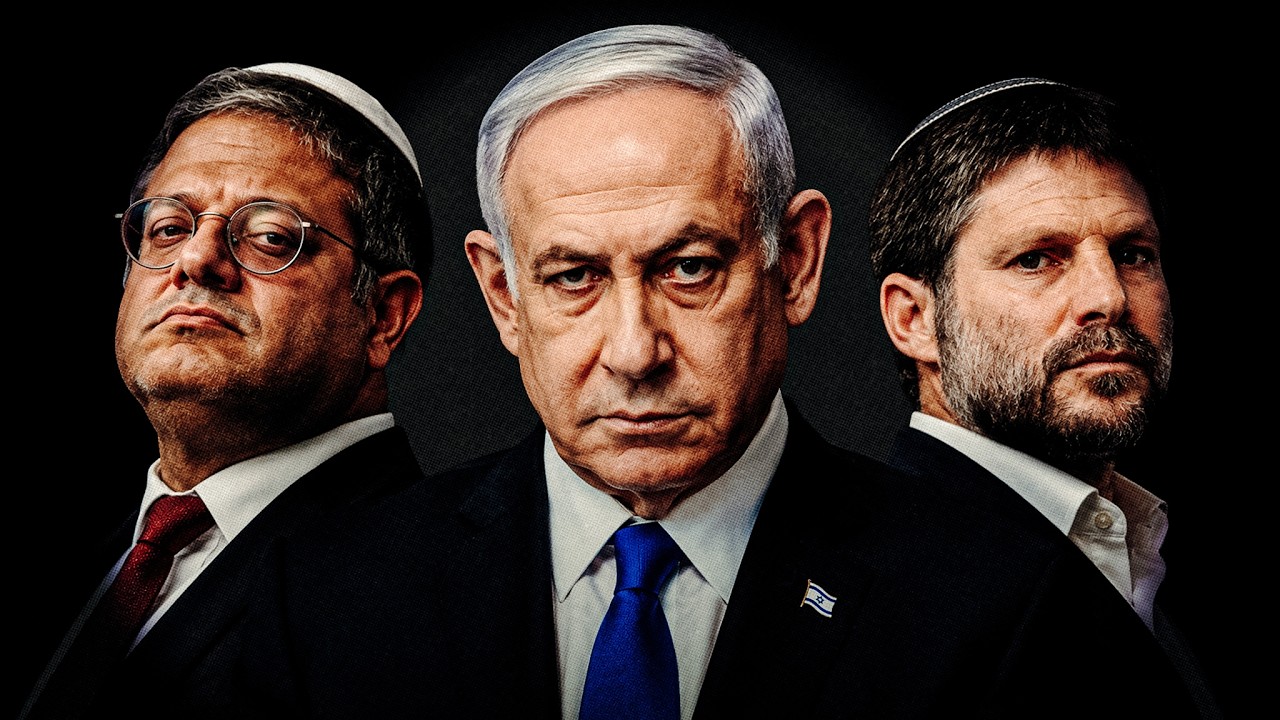
but is run by this trio: Smotrich, Netanyahu, and Ben-Gvir.
We already met Ben-Gvir, now the national security minister.
He belongs to a far-right movement called Kahanism,
that, TLDR, calls for the ethnic cleansing of Palestinians.
And to be clear, that's not, like, my interpretation.
Here's the Kahanist book-length manifesto,
"They Must Go," advocating the forced removal
of the, quote, "malignant and growing Arab population."
Ben-Gvir, for most of his life,
also kept a framed photo in his home
of a Jewish terrorist named Baruch Goldstein,
who mass murdered a bunch of Palestinian families
in the 1990s.
And the point is,
even as Israel has shifted right over the years,
Ben-Gvir was, for most of that time,
still so far outside the Israeli mainstream
that he was arrested a bunch for racial incitement
or possessing terrorist materials,
and now here he is, from the fringes to the center of power.
Okay, then the other guy up here, Bezalel Smotrich.
Let me give you the highlights
from this Times of Israel profile
and his unfiltered radicalism.
In the 2000s, Israeli police arrested him
for a suspected plot to bomb a highway.
The country's own intelligence service
concluded he was a Jewish terrorist
who'd planned to blow up cars on a major highway.
And more recently, he said his ultimate desire
is for Israel to become a Torah theocracy
and that he is an ardent advocate
of annexing the entire West Bank.
Here he is in a recent interview about Gaza.
(Bezalel Smotrich speaking in foreign language)
(interviewer speaking in foreign language)
- This is the triumvirate running Israel now
and defining what that final victory is.
And both Smotrich and Ben-Gvir
actually live in the West Bank as settlers,
so it's where they are focusing a lot of their plan
for that final victory.
And well, let's see what that looks like.
(tense string music)
This is an Israeli news report about the far-right settlers
who are now surging across the West Bank,
and they're not just building homes.
They form militias, attack Palestinian families,
and burn down their homes.
For a long time, the Israeli military
generally treated these settlers as sort of unwelcome thugs
and as a threat to stability, so would hem them in,
try to restrict them, sometimes even evict them.
But now, under the new regime,
the military often helps them.
That's what this news report is showing,
which gives the settlers cover to do whatever they want,
which is usually the same thing.
(sparse contemplative music)
This is from a Palestinian olive farm
near a town called Turmus Ayya.
Those are settlers who showed up
and started attacking the farmers and burning their cars.
The settlers even built an outpost
right in the middle of the farm
as a base for attacking the farmers.
These are the settlers just before the attack.
These guys are everywhere now, usually armed,
looking for Palestinians to terrorize.
And this is from during that same attack.
This shows a settler beating a grandmother in her '60s
just for being Palestinian.
This is Jasper Nathaniel.
He's the journalist who took that video a year later
on the podcast "Pod Save America."
He said Israeli authorities called him
and promised to intervene,
but listen to what actually happened.
- If you want to end the terror in this community,
you have to dismantle that outpost.
And these guys told me on the phone,
"Just watch, that's what we're gonna do."
Fast forward to my visit in June,
I went back to Turmus Ayya.
What had been a couple of shipping containers
is now eight shipping containers.
What had been maybe one family living there
is now maybe a dozen families living there.
- Here's video he took of settlements being built
right on that Palestinian farmland,
and here's what happened to the Palestinian homes,
burnt down by settlers.
The guy who took these, Jasper Nathaniel, does a lot of work
documenting settler violence in the West Bank.
He has a Substack, "Infinite Jaz."
Check it out.
It's valuable and important work.
And I wanted to show you this saga beginning to end
because things like this happen every day now,
all over the West Bank, backed by the Israeli government,
which is led by far-right settlers.
It is policy,
and the result is Palestinians driven from their homes,
the homes bulldozed, and their village erased.
Here are the residents of one village
watching Israeli bulldozers tear it down.
Here's what's left of another.
How often does this happen?
Well, let's look at the data.
(tense pulsing music)
This is the number of settler attacks
in the West Bank per day.
It has doubled from about three a few years ago
to more than six now every single day.
The number of settlements has been skyrocketing too,
so now I wanna zoom out and see what that adds up to.
So this again is the West Bank,
which, remember, is under agreements Israel signed,
supposed to become a Palestinian state along with Gaza.
And now here are the green splotches
of remaining Palestinian-controlled territory.
This is the before from our board, and now here it is today.
These blue dots are all settlements,
devouring the land and making it unlivable for Palestinians
within these increasingly isolated
and strangled little islands.
So I don't know how better to sum up the West Bank now
than this, the image of a razed Palestinian village.
It's not hard to see that all this activity
is very purposeful.
It is building towards something.
So what is it building toward?
Well, like with Gaza, they are now saying it out loud.
(Benjamin Netanyahu speaking in foreign language)
- [Max] This is Netanyahu last year.
(Benjamin Netanyahu speaking in foreign language)
- Okay, okay, so what's gonna happen to the West Bank
if Israel is never gonna let it go?
Well, here's Smotrich again.
(Bezalel Smotrich speaking in foreign language)
- He is talking about annexation.
Okay, so what is gonna happen
to the three million Palestinians who live in this place
that Israel now says it is never letting go of?
Here's Smotrich last month.
(Bezalel Smotrich speaking in foreign language)
- He goes on to say that if Israel doesn't launch this war
in the West Bank now, it is just a matter of time
until there's another October 7th.
So if, to him, the West Bank is another Gaza
and it is gonna require another Gaza-style war
but now launched preemptively, then to me, that means
that he is calling for the Gazification of the West Bank,
for Israel to do to the West Bank what it did in Gaza.
And he is not the only one drawing this comparison.
This is a news story about Israel Katz.
Remember, he's the defense minister
threatening full-scale war against the PA,
Palestinian Authority, the West Bank government.
And he said that war would include
removing residents from the cities and towns
from which terror activities are carried out,
and it would culminate in the Israeli military
remaining in the cleared-out territory, "just as we've done
in the security zones in Gaza and Lebanon."
(downbeat pensive music)
But, look, don't take it from me.
This is a New York Times article
interviewing former Israeli generals about the West Bank.
"This is ethnic cleansing, to put it simply,"
is what one general said.
Another compared it to what Israelis' ancestors endured
in the Holocaust, an effort to erase the Palestinians.
And here is another,
a former army chief of staff calling it,
"80 years after the Holocaust, 'Mein Kampf' in reverse,
the master race is us."
Look, I would not make that comparison myself,
but my point is that if even a bunch of
Israeli war veteran uber-hawk generals are saying this,
it tells you something about how far things have gone.
So lastly, let's look at Southern Lebanon.
And if you want the full story in this one,
you should check out Johnny's video
on "The Rise of Hezbollah."
I actually helped out a teeny bit with this one.
Anyway, TLDR, there have been past Israeli invasions,
usually to fight this armed group, Hezbollah,
but for most of the 20 years,
the border has more or less held,
thanks in part to UN peacekeepers
like this soft-spoken Irish guy.
- It is moving deeper into Lebanon.
- Both sides would fire rockets,
heavy munitions back and forth a lot,
but the border was solid enough that it even had a name.
It was called the Blue Line.
You can kinda see it there, the Blue Line.
(light contemplative music)
But then earlier this year, in the middle of the Iran War,
kind of impromptu, Israel invaded Southern Lebanon
and declared a huge chunk of territory theirs.
(light thoughtful music)
We showed this map in our Iran War video.
The red is already under Israeli control,
and this is the Litani River.
Israel says everything south of it
is now under permanent occupation.
This is a huge area, twice the size of Gaza,
a million people.
Israel doesn't control all of it yet,
but we are getting signs of what they have planned.
This is a Lebanese town called Dhayra.
There are countless videos like this.
Here's a bunch CNN collected.
It is the same thing over and over:
an entire town blown off the map.
And a lot of these come from the IDF.
They're broadcasting this.
How widespread is this?
Well, look at this map from the Financial Times.
Here's the Israeli-occupied zone,
and now here is every instance of organized destruction.
So the answer to what Israel is doing
to Southern Lebanon now is its total destruction.
But the thing we still have to answer is why.
What is the goal
toward which all of this destruction is aimed?
And, well, Israel isn't really pretending
that it has any military purpose.
Look at this.
(gentle pensive music)
The Israeli paper Haaretz
interviewed Israeli troops on the ground in Lebanon,
and they said they're not even fighting Hezbollah,
but rather "systematically destroying villages."
"The only mission is to continue the destruction.
There is no other mission."
Why?
"Because it will prevent villagers from returning home."
So again, what is all of this driving towards?
Well, we got an answer from Israel's defense minister,
Israel Katz, in a recent public statement,
and we don't need to watch his statement.
I can paraphrase it for you.
He said that, one, Israel would hold this entire area
indefinitely as a security zone.
Two, that the 600,000 Lebanese residents
who had all been forced out would not be allowed to return
until some vague possible point in the future.
And three, that he would follow what he called
the Gaza model in destroying all traces of Lebanese presence
in the border areas.
So this is what he said their goal is.
This is a tweet from Itamar Ben-Gvir.
Remember, he's the national security minister,
part of that triumvirate.
Here's the English.
He wrote, "For every tear of an Israeli mother,
1,000 Lebanese mothers must weep.
All of Lebanon must burn."
Which, as this community note says,
and they're right, is incitement to genocide.
But if it's coming from the national security minister
of the government being incited, is it really incitement,
or is it, I don't know, a declaration?
I have to tell you,
I have been shocked at how quickly Israel
has been leveling Southern Lebanon like they did in Gaza.
Maybe it's getting less attention
because they forced out the residents
so there are fewer witnesses,
or because the world's distracted by the Iran War,
or because Gaza already happened
and Israel just kind of got away with it.
And, look, to be, I guess, fair, as of this recording,
Israel has killed about 5,000 people in Southern Lebanon
compared to more than 70,000 in Gaza.
But it feels like, in some ways, that reflects Israel
getting more efficient at achieving these goals
of forcing an entire population off their land,
seizing that land for Israel,
and erasing that it ever belonged to anyone else.
It's not an eradication of a people,
but it is the eradication of a homeland,
which, again, is ethnic cleansing.
That's just what it is.
So I guess that's what we call this goal.
We call it ethnic cleansing
because that's what they're telling us it is.
(light thoughtful music)
So, okay, taking this in here,
I feel like we are seeing the same playbook
basically applied in all three of these places,
and the particulars of how it's applied
vary to fit each place,
but the end goal in each seems to be the same:
ethnic cleansing of an entire region
by forcibly removing its population,
turning it into a military zone
that destroys any trace it was ever Palestinian or Lebanese,
and converting the rubble into a new Israeli territory.
And, look, you saw that this is not me guessing
or speculating or making big leaps of logic.
We heard it from them, Israel's own leaders directly.
And it's not like the world doesn't know this is happening.
Every week, another head of state or UN official
gives a big speech calling it ethnic cleansing
and saying that the world has to act.
And I'm not gonna make you watch any of these speeches
because they don't lead anywhere meaningful.
You heard how these guys talk.
They don't care if the world condemns them.
Look, they think that this final victory up here
is really in reach.
They are willing to pay the cost
of being global pariahs to get it.
That's why they're so open about it.
And they are banking that when Israelis go to the polls
at the end of October, they will feel the same way.
I don't know if they will or not.
The polls are really close right now,
and even if they vote them out,
you know, this is a major political force in Israel.
It is not going away with one election.
So, hey, I'm not being coy here.
I don't have, like, some solution for all this
that I'm trying to wink at right now or point you to.
I just know that these guys are really determined,
and it's gonna take a lot more than words
to stop them before it's too late.
(gentle reflective music)
Interactive Summary
Ask follow-up questions or revisit key timestamps.
Loading summary...
Recently Distilled
Videos recently processed by our community