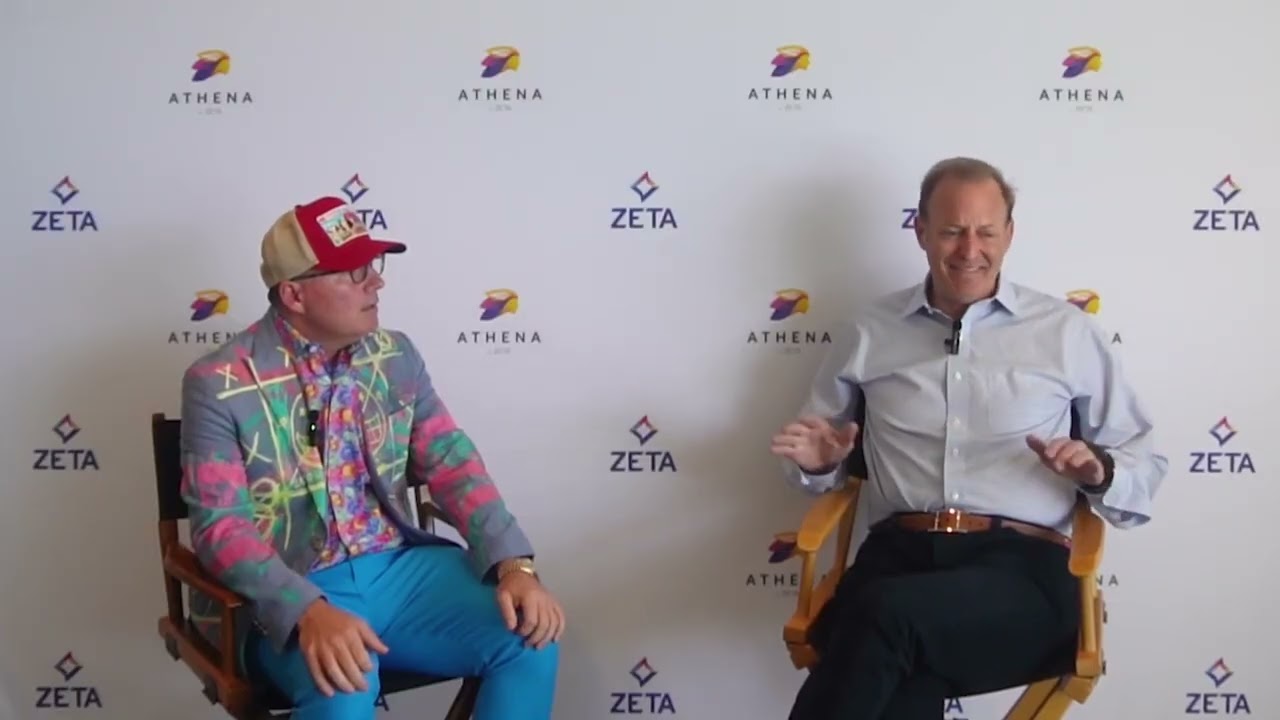
Highlights from David A. Steinberg and Dan Ives Fireside Chat | Milken 2026
Now Playing
Highlights from David A. Steinberg and Dan Ives Fireside Chat | Milken 2026
Transcript
885 segments
Great. Great to be here with you, as
always. Great to be here.
>> Yeah.
The uh we we decided we would interview
each other today, and I'm going to start
by asking you the first question. So,
Palantir just [snorts] reported while we
were in the back room getting ready, the
CFO of Palantir called you. What were
you guys uh I know without violating any
uh you know, privacy issues, what were
you guys talking about?
>> look, I mean, to me is I they they had a
robust quarter. I mean, if you look at
their growth, it's just phenomenal. I
think it's a good example of you know,
what's the validation for this AI
revolution, right? All the CapEx
spending. Palantir, I think, front and
center. And I think
>> they grew their US business 100%.
>> Exactly. Look, and I think I think what
Palantir is doing speaks to And
obviously, it's a big focus of
everything that you're doing when it
comes to Athena.
Look, I think this is just the beginning
of the AI revolution. The soft- like
when you think about the software, the
use cases, and I think what they're
seeing is a lot of the stuff that, you
know, you're seeing with Athena, right?
I mean, it's you know, I I guess I'll
I'll go to you, okay? Like, you know, we
talk about Palantir, and I know I think
also like a lot of the stuff that
that I see with Palantir, it it reminds
me, if I go back a few years ago, right?
Where like no one gave them the respect
in terms of on Palantir, and look what
Carpenter have done. When it comes to
like Athena, it really feels like Athena
is changing data. She is. Yeah, it's
funny, because if you look at our
quarter, we grew the business by 50% top
line year over year at scale. I mean,
that's, you know, then you look at
Palantir at 100, you know, you feel a
little like you're you're sleeping
there, but at 50% growth, we were I was
super super proud of what we did. I
think there was some confusion in the
quarter, and you know, listen, we've
projected $397
million in EBITDA
for this year, and you know, we very
much expect to be meaningfully net
income positive this year, which I think
is causing confusion.
>> It's good you hit It's good you hit on
there cuz right there is
>> Well, a lot of people are talking about
that. And and the truth of the matter is
that you're projecting 397 million in
EBITDA. We expect to be, you know, net
income positive. And the restructuring
from the Marigold acquisition, which by
the way, we are just
killing
with that acquisition. I mean, if you
look at the business, we grew 29%
organically in the quarter and 50% total
in the quarter. That's because Marigold
was so far ahead of where we expected it
to be. And you know, quite frankly, our
organic business is growing because of
Athena.
In the first quarter, we saw our Agented
volumes go up by 700%.
60% of which was Athena.
So, But but also goes I remember like
when we sat down and now is the at CES,
January and and now you think you're at
Milken I can't believe you're doing it.
You The outfits just get better though.
I know. No, you you're
you could wear the same outfit. I don't
think I could pull that off. But but but
but if I go back to CES in January and
here we are at Milken in May,
I mean, to some extent like the strategy
is really playing out exactly and even I
think almost ahead of plan. Yeah,
Athena's way ahead of where we expected
it to be. 100% of our enterprise clients
have Athena now in their hands and
everybody's using it. And and quite
frankly, if you look at Zeta's return on
investment, according to Forrester, for
every dollar that's spent on our
platform, we return 600%
return on investment.
So, $1 equals $6 in business. Our
clients using Athena are seeing a
substantially higher return on
investment than that. And and that
speaks like look, just like Palantir
>> way, we're supposed to be interviewing
each other. But but but to some extent
but you but but what I was saying is
like just like Palantir, what we've seen
there, it's really it's my view that
you're actually starting to see not just
validation, the actual use cases play
out. I mean, that's what that's really
what you guys are seeing in terms of
when it comes to Athena.
>> Yeah. The use cases have been
really surprising how many they are. And
And when you look at a 700% step up in a
Gentex utilization in the quarter, and
60% of that being utilized by the
platform that you put live in that
quarter,
right? And And you know, we're going to
be rolling out V2, V3, V4 of Athena, you
know,
you know, almost, you know, every month
or or every other month over the over
the next year. Let Let's talk for a
minute about SaaSageddon. Yep. Right?
So, you you're getting asked this
question. You're on CNBC, you know, if
not every day, almost every day. What do
you think? How does a company
like Palantir or us or others, how do we
react to something that's so
nonsensical?
Look, I think part of the pri- And I'll
almost
I'll almost call it it's like a we call
it the AI ghost train in terms of
Anthropic, basically that they're going
to, you know, structurally break every
piece of software and they're going to
ruin I think you have to separate out
are there going to be areas of software
disintermediated relative to Anthropical
but of course and like For sure. And And
And I think those companies could
clearly be exposed and those are the
ones either cause M&A or structure those
companies are on the loser category.
But I think for software companies, and
it's not just you, it's not just
Palantir, it's a Salesforce, it's a
ServiceNow, it's everyone. It's trying
It's trying to figure out, okay, when
does the monetization phase start? See,
my whole point is if you think about
data centers taking two or three years
to build and GPUs and the infrastructure
and the
we're only now just starting to get into
the software phase.
Yeah, cuz
all of these tech cycles start with
infrastructure. Exactly.
>> Right? And then the application layer
that sits on top of it comes next, aka
software. And that's why I think like
what we see with Palantir,
what you guys are seeing with Athena,
this is actually just the start
Snowflake seeing and others. So so my
view is that they painted software all
with the same brush and you see it
structurally if any sort of thing
happens it takes the stocks down
significantly. The reality is is that
the software use case phases are just
starting. I'm sure you see that when you
talk to customers, like when you talk to
customers today, how much different is
it today than 6 months ago? Oh, it's I
mean and I remember we started working
in AI in 2017.
So for years and years nobody even
cared. Like they would be like, "What
what What are you talking about?"
Now we're getting pulled into use cases.
We're you know, I think Athena is going
to solve far more problems for our
clients than people expect that she
will. Totally. And then look it just I
think so to your question I would just
say I think investors to me is covering
tech stocks in late '90s, it's the most
I think
incorrect narrative
that I've actually ever seen in my
career relative to software what's
happening. It will take time to prove
itself out, but the reality is AI native
stocks are never going to unseat core
install bases. If you look at the data,
if you look at ultimate lab use cases
where they're going to play on, LLMs
will partner with software companies and
over time LLMs will get commoditized and
you'll have you're going to have
hundreds or thousands around the world
relative to you know to models as they
ultimately deploy. Software will be the
hearts and lungs of AI.
>> Well, and and and data, right? I mean,
if if you look at it, proprietary data,
I think it's going to be the biggest
differentiator as you think about where
these models are going, right? Because
models are only as smart as the data you
feed into them. Exactly. And if you look
at and I'll talk about data again. We
have if you think of the mode around our
business, we have 555 million people who
have opted into our data cloud that we
have never fed that data into a large
language model ever, nor would we. It
simply trains our models, and then we
take our clients' first-party data,
which
includes 51% of the Fortune 100, we're
ingesting all of their data into a
consumer data platform, we're matching
the data together, and it's training the
models just for that client. One of the
really interesting things that I think
people missed about our company was last
year, our net retention rate as a
company was 120%.
And most software companies are happy at
100, we were at 120. That's because once
our clients ingest we ingest our
clients' data and we map it with our
clients' data, it's almost impossible to
fire us because you keep getting better
better return on investment for them,
therefore they keep growing with you.
But that really goes to the broader
theme here. And I think well, you saw it
in your in obviously in this quarter in
terms of those numbers, but I think more
and more we are now in the software
phase. We are and I think that's what
companies are starting to see like, how
do I deploy it? I've spent tens of
millions or more on infrastructure.
Where are the use cases
Where are the use cases Use cases aren't
not coming from Nvidia, it's not coming
from a lot of the infrastructure, it's
coming from software.
When do you think the street gets that?
Or how do we convince the street of
that? Like I I just That to me is
confusing.
>> But but I'd say David, I think like the
issue that like from a communication,
the street, and the SAS apocalypse, or
the AI ghost rate, it's not
These are conversations that I see with
so many of my some of the best software
companies in the world.
I think it's going to start Look, it
starts with the results. Just like you
guys are showing in terms of the actual
monetization.
And then I think it really starts to As
you start to see these stacks and the
infrastructure get built out, I think
investors are going to realize it's the
most disconnected narrative
in the last 25 years relative to the end
profits and others
the view that they're going to un-teach
software companies. And I think it's
really Our view is the second half of
'26
is where it really starts to play.
Because that's where the use cases start
to play. I mean, we've seen it, you
know, you showed it, you saw it on
Palantir, but it's really as we get into
the second half of the year, that's
where that starts to run. And that's our
view like software, and we think
software stocks are you know,
potentially they're up double what tech
is in the second half of the year.
Interesting. You know, it's funny, at
Zeta, this was our fifth consecutive
quarter of accelerating organic growth.
And it's it's all coming from Athena
now.
And it you know, it's one of the things
I I find interesting cuz we are a native
AI company. We We re-architected our
entire platform to put AI as native and
data as native, but foundational to the
application layer. It's been so hard to
explain the AI. When we go into a client
now and talk about Athena,
it's almost like we've been driving this
Ferrari. The AI's in the engine, but you
can't see it, and now Athena is the big
head ornament, hood ornament, sitting
right on top. We're going in with a full
Athena pitch to all of our
That's really what we're doing.
>> it almost Athena's really it's changed
the company in terms of like for sure
the go-to-market strategy
and at a time where customers across
verticals are looking at how they're
going to monetize AI. What what else are
you seeing in the markets outside of
this stuff right now? I mean I think
like right now and I just got back from
Asia for a few weeks. So like I could
tell you
>> I don't know how you do it. You like I
called you last week just to say hi and
you're like I'm going to go to Korea.
I think part of it is like the only way
you could understand what the demand
looks like you have to see it globally.
So I think it's very easy while the
bears they're negative on AI in the 35th
floor in New York City office building.
So you don't see AI when you're in Metro
North. And I think the reality is that
the demand that we see it's 12:1 demand
and supply. Wow. And obviously you're
going to get to be at Milken he'll be
talking about the massive AI
>> in about 20 minutes. But but the reality
is like the chip demand is unlike
anything we've seen. It's a super cycle
in terms of memory and overall chips.
But guess what? In terms of that capex
build out it's all getting built out for
what the use cases are going to be. And
I think more and more you're seeing I'm
seeing from CIOs in so many companies
they're now going into that next phase.
And I think there's an arm race, right?
Like which are the stack players that
are going to benefit? Like who are some
of the niche software companies where
some of them might get acquired? Some of
them might fall apart. And I think it's
trying to it's it's those that stay on
the treadmill will get passed by.
Well, that's I mean if you look at guys
like Palantir, right? Didn't they go
through something like this a few years
ago? So I look Palantir is a good
example like and obviously you know
being such a supporter of them over the
years
you know so many times
>> way, watching you talk to like the guys
who run that company while we're in the
other room. The These are your boys,
right? Like you get along really well
with them. Well, part of it is like I'm
a huge believer in what Karp and
Palantir have built. And but but it's
very easy to look at them today
just like it's very easy to look at
Nvidia today. You don't see a few years
ago. You don't see where like they were
building it all on government. They were
building the infrastructure. No one
believed in No one gave them a multiple,
and look where it is today. No, so I'm
saying like that's why like like I said
like it's a lot of the stuff that you're
going through that I think other
software companies that are that are
thriving are going to It's very similar
to what Palantir a few years ago where
it took time for them to execute, show
the vision, and then investors
ultimately rewarded them. And that's why
I just think right now we are going
through this massive prove me phase
for the rest of software. Because I
think right now it's like, okay, there's
Palantir, and they're maybe put up here.
And everyone's trying to figure out who
else
is going to join them. Is it Snowflake?
Is it MongoDB? You know, is it Zeta So
everyone's trying to figure out who
those software Where does Oracle fit?
Where does ServiceNow? Where does
Salesforce? And I think that's why right
now we're in that phase. Interesting.
So, we're sort of in the We've got
infrastructure and software in the same
sort of concentric circle growing
together right now.
>> Well, cuz like right now like every
investor, they're focused on like
hardware, chips. I I don't care if it's
easy or year up here. You own memory
stocks. You own chip. Software is still
do not enter zone. I think that's the
wrong trade, but it's really because
like you're not getting paid to own
these stocks right now because the more
And I think that creates the massive
opportunities.
>> Right. If you look at the reactions like
ServiceNow and others,
but if you look at how it plays out,
okay, as companies go from like the
prove it phase or maybe the skeptic
phase from an investor to here, that's
the huge multiple re-rating. And then
And that's what's going to separate the
companies where we'll be here a year
from now. And there will be stocks that
you look back on and be like, what? How
did no one think because it was the
prove it phase. And I think that's we're
going through that now, not in chips.
In software. Right. Cuz chips are
already seen that. We've already seen
that. And right now, but go back I could
go back in terms of like these periods
of AI revolution. Go back a year ago.
Or go back like 2 years ago. There was a
video It can only be a video. AMD can't
be successful.
Memory stocks
>> Intel can't win. Intel can't win. Micron
can't benefit. SK Hynix, no, it's the
memory stocks. They're What about
SanDisk? They're not No one's going to
pay a multiple like that. So, the point
is like now it's consensus and that's
that's where the crowd is. Software,
it's still No, it's the I I believe as
an investor that so many of them are
structurally troubled. But I disagree
with that because ultimately the hearts
and lungs of these use cases will be
software. We're going through from May
to let's say like December is the prove
it phase for software companies. Well,
it's interesting cuz if you look at most
of the infrastructure and and I mean,
listen, they've built some insane
companies. Like these are great great
great companies. But they're effectively
selling the infrastructure once. Yes.
When we sell a client, it's a
subscription for a very long time. And
if you look at those use cases,
you know, you you would think software
companies that win it I want to go back
to your original premise, right? Cuz I
do agree
they're going to be what I call workflow
management companies that have built
platforms that
if they don't pivot, they're going to
have some real problems. Sure. Because I
think agents are going to
disintermediate them. As well as
seat-based models.
>> Yeah, of course. Well, the seat-based
model people were beating the living
crap out of us for charging a
subscription fee and a utilization fee
year 5 years ago when we went public.
And somebody was asking me the other
day, well, it seems like you've done
really well on the transition
to subscription. I'm like, we didn't
transition. Like we're doing we've been
we're we're 60%
>> your premise before you
>> That was the premise.
>> It was a hurdle before everything. That
was the whole thing. And they beat the
living out of us at the IPO for that.
Like nobody wants a utilization model.
You got to have a seat-based model. You
got to have a CPU model. And we just
didn't think that model scaled.
But it looks like now everybody's trying
to move to sort of your subscription fee
plus your utilization fee. Because of
the worries, too. And again, this also
goes back to a lot of AI alarmist, job
growth job's going to everyone
everyone's going to lose their job. And
and I think a lot of that is more of a
dystopian type narrative. I I think a
lot of that is going to be I'm not
saying there's going to not going to be
areas around that, but the view and I
think you're starting to see changes now
even in the job market and some of the
ones, you know, that that we've seen.
I'm just saying I think that's also
playing into this narrative about seats
going down, job growth, pricing power's
going
>> Well, if you don't need the employees,
why do you need seats?
>> No, but that's
>> Right. But but but then to you like the
question I would say for a lot of
software companies like, are you losing
pricing power?
Are you? And like what would you say to
that? Like you know, there was like cuz
you know, there
>> Well, we we we grew 50% last quarter.
And if you, you know, looked at the
business, it we're adding operating
margin this year and getting more
profitable this year. The the the
interesting thing when you think about
sort of how this all plays out, right?
This morning I did a I was I was invited
to a panel at the Milken Global
Conference with some of the largest CEOs
in the world.
And I then ended up having Coke or diet
Coke with the Wait, cuz you only drink
diet I only drink diet Coke. I only
drink I love I have I have I love diet
Coke. My wife doesn't love me drinking
it. I probably shouldn't be announcing
this on a live stream, but I had a diet
Coke with a senator a US senator today.
And what I can tell you is
whether it's a global CEO of which there
were I'd say 15 to 20 Fortune 500 CEOs
in in the room.
Uh or the senator,
the job repercussions of AI are the
third rail discussion. Mhm? Nobody wants
to have it.
But unless we start having it, we're not
going to figure it out, right? And And
it's something like
when you look at sort of AI,
I look at Athena.
Last quarter, not only did we increase
our Gentik uh utilization by 700%,
but clients who adopted Athena used 78%
less labor to manage the platform. Now,
what I say lovingly is and they can use
those employees to be repurposed into
other functions in their business.
Productivity, yeah. Right? And And I
think that's that's going to be a big
part of it, but I think there's another
part of it that we're going to have to
think about where where do some of these
jobs go? But then I would say and I
would tell you like my whole career
coming from Asia to here and so many
times I'd be in Taiwan and you see you
know, you see a fab 18 hours a day. You
know, the amount of production and I
land in New York Airport there's a fist
fight at Dunkin' Donuts. And then you're
like there's a reason
>> Why are you in Dunkin' Donuts? At And
New York Airport.
>> Okay. And then you're like there's a
reason we're 17th in math.
At that point for so much of my for so
much of my career, now for the first
time
US is ahead of China when it comes to
tech. So, I can make the other argument,
the amount of data centers going to get
built, the ripple effect, engineer,
private companies, innovation. So, so so
that's why like I do think the view of
AI you have to address it, yeah, but I
do think going back to like even weaving
into like software and private credit
and seeds and pricing model, I do think
we're going to look back and be like the
bark was a lot worse than the bite 100%
100% 100%. And by the way, we're at, you
know, 4 4 and 1/2% unemployment for the
third or fourth year in a row.
Three years ago, and this is I think
I'll show how incredibly old I am. I
think this is my 25th or 26th Milken
Global Conference.
Three years ago, the entire conference
all
>> when you started to go to Milken when
you were 14 years old? I loved you.
That's a me That's That's why I love
you. So, 14 years ago was your first
Milken? That's a me Well, in in all
seriousness, three years ago, all
anybody could talk about was aging
global population, and we're never going
to have enough people for all the jobs
we're creating. Now, all we're talking
about is AI is going to disintermediate.
As you said, pendulums swing hard, but
they're almost always wrong. They
overcompensate,
and I think we are going to find great
great jobs for people. But but when you
look at the difference between the
winners and the losers, I think
productivity accelerants
are going to be major. Tomorrow, I'm
moderating the lunch in the main
ballroom, which is Yeah, it's huge. It
was It was nice of Mike to ask me to do
that. They obviously they probably asked
10 people and you know, nine said no,
and then they ended up on me. But
it's all about
is this going to be the step function
in the productivity curve, right? Cuz we
we've been stalled for a few years. We
had this massive productivity that
started with the computer.
Then we had this massive productivity
that started with the internet. And for
the last 5 to 10 years, we've been very
stalled in productivity. The question is
does is AI the next step function? Or is
it just going to keep us sort of growing
at 2 or 3%? And and I don't think
anybody's going to know the answer to
that for a few years.
>> But the use cases will be the key. And
now we enter the software phase, where
obviously that's a huge part of you
know, where Athena and Zeta Plus. Well,
the one good thing about our stock right
now is it's buy one get one free. And
you know, we bought back I think 25 or
30 million dollars worth of our stock
last quarter. We're going to continue to
aggressively buy back our stock. And and
you know, as long as it continues to be
uh, you know, buy one get one free,
we'll keep doing that.
>> also part of it, too, is that you can
just execute on the plan, show the
numbers, build it out, and everything
else, you know, takes care of itself.
Damn, what else do you want to talk
about tonight? I mean, I would just say
like who
when we talk about like SaaS apocalypse
and just everything that we're seeing
from cu- Can you just like maybe like
without obvious
>> I asked you the question. Now you're
asking me a question. Bu- bu- bu- bu-
without without without naming customers
can you just explain
how the conversations specifically have
changed? Like if you just go back to
>> So, back to what we were talking about.
Athena has changed the narrative with
our com- customers in ways that I didn't
even think possible. So, I think a lot
of our customers just looked at us as a
marketing platform. And we did a good
job, and we had a good return on
investment. And when Athena was first
sort of introduced at Zeta Live and then
really we got behind it at CES and then
she was born you know, in the first
quarter we did that big birth
announcement
>> birth announcement
Uh, you know, when she was born clients
started looking at us more like an
innovation engine
and less like oh, they can just help us
with return on investment for marketing.
Yeah. And it's opened up entirely new
doors and new use cases. One of the
things that I thought was the coolest
statistic we reported in the first
quarter was that clients who use
multiple use cases on our platform,
which is the single biggest driver of
revenue unlocked, went up 50%
year over year.
Clients who use us for, you know,
customer acquisition, retention,
monetization went from doing one
to two or more went up 50% and that is a
flywheel that's going to continue for
many, many years. I mean, I would just
say to that point from my perspective, I
think the main thing that software
companies right now are struggling with
is like a lot of acronyms, a lot of
great marketing stuff.
But We call it we call it roadmap AI.
It's like we're seeing a lot of roadmap
AI nowadays. But but but customers don't
want
roadmaps. No, so that's the that would
be the one thing that I would say is
that I'm seeing a lot of companies that
I meet with whether it's private or
public
it's like they have a lot of everybody
but they have a lot of roadmaps.
But right now customers want
action. Look, I think it goes back to
like part of why I think Palantir has
been so successful is like
if you work with them as a customer and
you do their own co-
they
they could show results. And I think but
but like to some extent like you guys
are almost like there there is a lot of
similar DNA in terms of like this is not
top like in the you're seeing
>> We've because of you we're spending more
time with them and getting to know them
better and and it's been really
interesting. But what I would say is the
thing that the Palantir guys do just so
incredibly well
is they solve problems and they execute.
And and that's sort of key to success in
almost any business. Solve your clients'
problems
and execute. And Palantir does that. I
mean, they do that as well as anybody.
And and it's 8 of we we feel like we do
it in in all the world as well.
But it is it is crazy to see
sort of we'll go It's funny. If we're on
a pitch,
we might go into a room where seven
other companies have said they do the
exact same thing we do. And then you
actually
>> Like they're they're just making it up.
And then we come in and they're like,
"Oh, we
I said I'll I can say this to a client.
Great. Test us.
If I don't cut your cost to create
customers by at least 50%, I will give
you your money back."
Even on a test.
Cuz there's so many things like that's
where like where you're going to thrive
and obviously have a massive install,
but but a lot of it comes down to that,
right? It's like proof of concept. It's
proof of concept. And if you think about
it, that's one of the reasons our net
retention rate's so high. Mhm. Because
if you land with a client and then you
massively expand with the client, your
net retention rate's going to continue
to go up. We've given long-term guidance
of 110 to 115% net retention rate. We
were at 120 last year and we were well
ahead of that, the top of the range in
the first quarter of of 2026, which is
traditionally our lowest net retention
rate quarter of any year for a whole
host of reasons, and we were still well
above the 115.
That's because we come in
and say, "We'll prove ourselves."
And when you do that, clients move more
budget, which then naturally drives your
your net retention rate. But
it it I do think that it's crazy how
much road map AI is out there versus the
companies that are really delivering and
really executing.
>> Well, that's the
I think that's the separation. And
you're seeing like from cybersecurity to
software to that is like a huge
>> are good cybersecurity companies at this
point?
>> to to me it's like when you look like
CrowdStrike and Palo Alto,
they're almost playing a different game
than everyone else in cybersecurity
because of I could argue like Palo Alto
in terms of like cyber arc acquisition,
what George has done at CrowdStrike in
terms of building out the AI suite and
what they've been able to be successful
cuz right now when you think about
cybersecurity, that's going to be a huge
piece of every
>> Oh, for sure.
>> you know? For sure. So, I So, I just
think like what what we're seeing in
cyber
is very similar to what we're seeing
across other areas of software. And
looking like physical AI is just
starting, right? Like when you think
about like autonomous and robotics and
what we see with physical like like that
phase right now is just starting to play
>> I think world AI is going to be very
big. And I I think you're seeing a lot
of that come down the pike.
>> And then when you think world AI, it's
like US, you still have less than 5% of
companies gone down the AI path. Asia
ex-China less than 2%. Middle East has a
huge build out in regard obviously, you
know, conflict now, but if you look at
the data centers that are getting built
in Middle East
>> Yeah.
>> Europe continues to build
>> and and once the the conflict is done,
that'll come right back.
>> data centers outside the US are
happening in the Middle East, which just
shows Well, they're the closest to the
energy, right?
>> Well, and also and who's who's really
front and center of all of those deals
US tech. Right. So, I just think and
then also what we're seeing on the
government side is just it's I I think
it this next phase right now where
you're going to see just massive
government spending on AI. It's a huge
part of the administration that we've
seen in the beltway. So, you would sum
it up by saying you think the back half
of the year, how does that look? Oh, I
think that I mean we've said it we think
tech stocks are up, you know, another 12
to 15% second half of the year, but I
think stars of the show
will be the software companies that
could produce show the use cases. We're
in a skeptical phase now, but I think
that this is now we're now going into
the software phase of AI. Well, and I
would tell you for Zeta in particular,
with in addition to everything else we
announced
coming out of the first quarter was the
highest pipeline we've ever had. Our
pipeline was up 40%. So, I I I see it in
the adoption and I see it in the use
case.
>> And the timing. So, look guys, first of
all, thanks everyone for coming and as
always
Interactive Summary
Ask follow-up questions or revisit key timestamps.
Loading summary...
Recently Distilled
Videos recently processed by our community