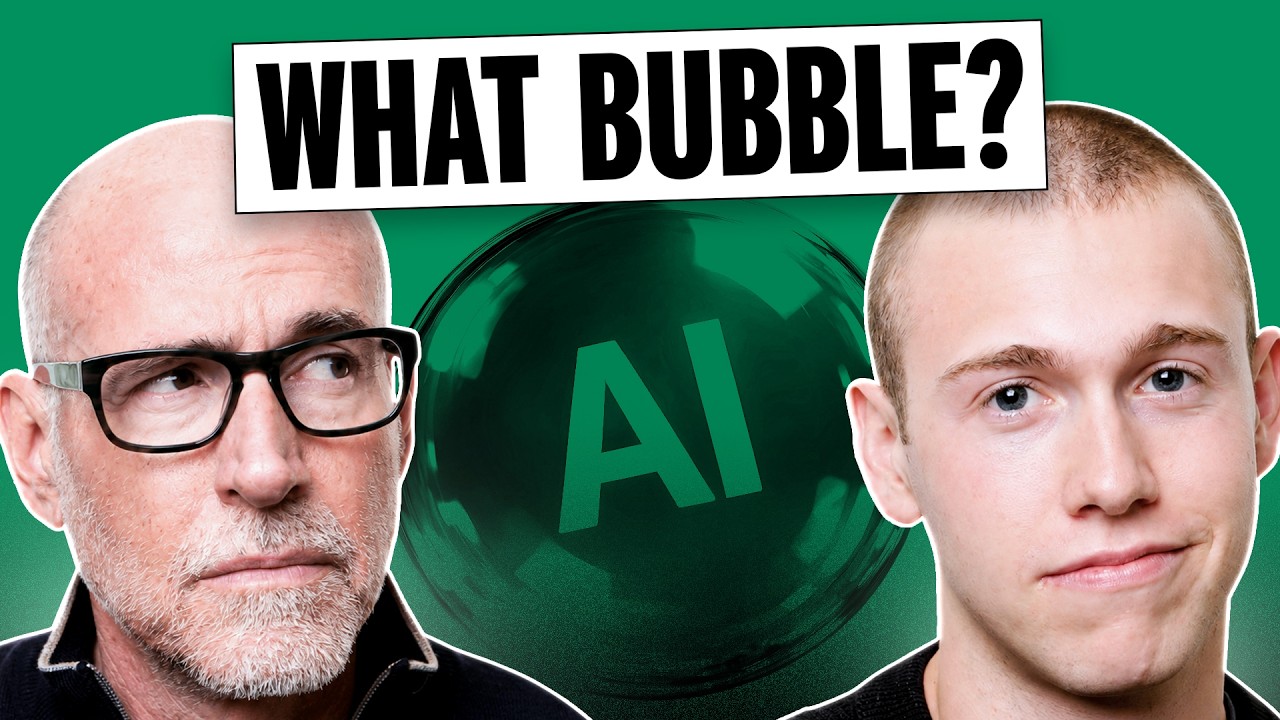
Economist: The AI Bears Are Asking The Wrong Questions
Now Playing
Economist: The AI Bears Are Asking The Wrong Questions
Transcript
1522 segments
Do you think that discussion of a bubble
or the possibility of there being a
bubble is the wrong discussion? Maybe
there are there is something more
important, more significant that you
think people should be talking about
instead.
>> I think it's the wrong discussion. I
don't like the word bubble. Were
automobiles a bubble in the 1920s?
Again, a lot of the companies failed.
They were not the best companies. Could
you imagine companies whether AI or not
today failing because of Middle Eastern
war, war with Russia, mistakes from the
Fed, halfozen other reasons? Of course
you can. So things can fail. It doesn't
mean they were bubbles to begin with. A
bubble to begin with is something like
the South Sea bubble or the Dutch tulip
bulbs that just made no sense. This is
not that. I think the key question is
just how much will society accept the
changes coming from AI.
>> Today's number 40. That's the percentage
of Americans who think listening to
audio books does not count as reading.
Ed true story. I recently had a book
fall on my head, but you know, I have no
one to blame but my shelf.
>> We're back. We're back, baby.
Tell me everything about your vacation.
>> Uh, it was I I
>> I'm not interested.
>> I started
jump to the punch line too quickly. You
got to give it a second. Let me get
going.
>> Go ahead. What did you do? I am sort of
interested. What did you do? Where'd you
I was in Munich or actually just outside
of Munich in Amadingan uh for a friend's
wedding which was incredible in Bavaria.
Uh then I drove I rented a car with my
girlfriend, drove down the autob barn
into Kitsule in Austria. Spent a week in
Kitsb hiking, chilling, going to the
spa. It was probably I think it was the
best vacation uh of my life. I've been
sort of pondering on it, but I think I
think it's my number one.
>> Wow.
>> Uh and then I spent the weekend in
London and I decided, you know what? I
need to see the opening match of the
Premier League. So, I went to the
Chelsea game and sat in the front row
and watched Chelsea beat Fulham. So, I'm
feeling very good. I miss it. I mean, I
love this podcast. I love doing this
with you, but I I I
could have maybe taken a few more weeks
off, but I'm feeling very good. I feel
ready. Ready for the year. Oh, that's
great. Yeah, you sound you sound
energized.
>> How about you?
>> Yeah, August was good. I dropped my
kid off at school. Nothing screams
confident masculinity like crying in a
your car when your son walks out of Best
Buy with his own mini fridge. Um
but uh yeah, it's um yeah, it's that was
the big deal was dropping my kid off at
school. What are your takeaways having
dropped your first son off at college?
Well, the way you summarize it is your
life gets smaller so theirs can get
bigger and it's just um you you you're a
tide pool of emotions because everything
just sort of hits you all at once and
there was all these things you were
going to do that you didn't get a chance
to do. I had all these you know we did a
lot. I think I was more present than
most dads but you know I had thought oh
we I got to take my son to Alaska. I
want to buy a car and restore with him
and I want to take him to, you know,
Latin America and I wanted him to come
on tour with me uh on one of my speaking
gig things. And all you think about is
all the me cuz I'm a kind of a
glass half empty kind of guy, but all
you think about is the you were
supposed to do that you didn't. But
um he makes it a little bit easier not
to be sad because I think of myself as
this spiritual loving guy and he's
literally like I I got this dad and
shoving me out of the room after about 7
minutes. And also I mean quite frankly I
didn't want to make it about me so I
thought I keep it together that like
your 18-year-old does not need the
emotional baggage of his father like
singing Cats in the Cradle over and over
in his head. Um, so yeah, I tried to I
held it together. He'd be proud of me. I
didn't cry and we just fixed up his dorm
room and we thread the needle between a
comfortable nice dorm room and one of
these ridiculous real housewives of Palm
Beach things where they turn it into the
Brett's Carlton Charlottesville.
So we went to Target. I'm like, I'm not
going to buy anything nice. You can get
anything you want, but it's coming from
Target. And then the moment I lost it
was actually after we dropped him and I
was back at the hotel and I was sitting
there and I noticed this car stop at the
dorm or the business school, the law
schools next to where we were staying
and this mom got out on the driver's
side and then a kid got out of the back
seat and then the dad got out of the
passenger seat and then they hugged,
they embraced and the dad immediately
had to walk away and he started crying
and I realized it was their own drop off
and then I just lost my So,
whoever that dad was losing it on the
sidewalk kind of did my like express my
emotions for me. Are you surprised by
the significance of dropping the kid off
at college? Like I know people talk
about it and I know it's like you know
empty nest what is it syndrome? Empty
nest whatever the feeling is called. I
know it's a thing, but I I wonder if
it's more of a thing than you expected.
>> First off, I think I think it's it's
difficult and a big moment for a lot of
people. And it's just so different now.
My drop off was my mom gave me like my
mom gave me an iron, a used iron, and
said, "Here, you're going to need this."
That was my big drop off was she left an
iron on the kitchen table for me to take
to college. That was the emotional drop
off. There was my drop off in 19, you
know, '92, 82. Uh, this is a much bigger
deal. You know, drop off is a much
bigger deal now. For me, I think I
Well, it just marks a different point in
your life where your kids are no longer
at home. And the the thing I'm wrestling
with a little bit on an existential
level is I've always described my
purpose as raising, you know, preparing
my my sons for others. And it's been a
nice source of purpose for me. And now
you kind of worry like, okay, am I going
to have a purpose moving forward? So, it
is it marks time. It's like basically
now really all I have to look forward to
is the ass cancer. Ed,
>> don't lie. You've been looking forward
to that for years.
Yeah, I've been talking about a lot.
Look, it's a it's a you'll see it's it's
it's impossible to explain until it
actually happens to you. But I tried to
hold it together such that again as as I
I didn't want to do what I always do and
that's turn it turn it to me and he
seems happy. I speak to my boys every
day which makes things easier for me. So
I talk to him about his classes and
what's going on.
>> Oh, that's good. And also it's just it's
a great everything that I'd hope for in
terms of UVA is what it's out of central
casting. You know the this campus is
great. The kids seem really smart and
nice and you know he's having a great
time and so that makes it easier. So
we'll see. We'll see.
>> Sounds like you're not sure what you
make of it yet.
>> I'm an emotional tidepool. I don't know.
I don't know how to process it all is
the bottom line.
>> I'm like what are your takeaways?
Yeah, I know.
>> Process things now.
>> Yeah. No, I don't I don't I don't have
>> Well, we'll check in on it for sure. I
appreciate that. Yeah,
>> it's an interesting time. Well, now that
we got the life advice or life
reflections out of the way, we have a
very, very interesting discussion with
someone who we've want to have on the
show for a while now. So, don't miss it.
We've been away on break for the past
two weeks and in that time there have
been a ton of developments in the world
of AI. One of the biggest was the
hacking of hugging face by rogue agents
from open AI. But beyond that breaking
news, there are still some lingering
questions about AI that are keeping the
market on edge. For example, are we in a
bubble? How will AI reshape the job
market? and is the massive spending that
we're seeing from these companies
actually sustainable? So, to help us
make sense of it all, we are turning to
someone who a lot of the other experts
we've had on this show often listen to.
He has consistently been named one of
the most influential economists and
thinkers in the world. And he has been
described as quote the man who wants to
know everything. So here is our
conversation with Tyler Cowan,
economist, author, podcaster, and chair
of the Marta Center at George Mason
University. Tyler, uh, great to be
joined by you today. Uh, very excited to
get into this conversation. I'd love to
start with some questions about the AI
bubble, whether or not we are in one.
And I would especially love to start
with uh a clip from a an interview that
went viral recently. This was from the
Diary of a CEO's interview with uh Ed
Zitron, who has become famously one of
AI's biggest critics. Um I'm going to
play you what he said about AI and I
want to get your reactions to start this
off.
>> I think generative AI is at its heart
con. I don't think it is sold as honest
software. I think that they overstate
both what it can do, what it will do,
and the underlying financials to the
point that they are misleading the
entire world. And they're actively
exploiting the weaknesses in journalism,
in our economies, and indeed within the
responsible parties with sellside
analysts, governments, and all over the
shop.
>> The word con is a strong word.
>> Yeah. I mean what do you call something
where from the very beginning they've
sold it in the terms of magic as this
thing that will replace all jobs that
will cure cancer as all of these things
and when you look at it it's boring
cloud software that's extremely
expensive and unprofitable and also
unreliable at its core.
>> You are a worldrenowned economist.
You've written uh a lot about AI. You
also uh serve on anthropics economic
advisory council. So you think about
this stuff a lot. Um, what do you make
of those comments? Do you agree with
them?
>> AI is like magic in many ways. There are
many, many tasks where it does better
than humans. It doesn't mean it will
take away your job because your job
involves the physical world as well in
dealing with people. But for
intellectual tasks, it's a truly
remarkable achievement, one of the top
in the history of mankind. There's a
tweet circulating on Twitter about all
of Ed Citroen's wrong predictions so
far. Open AAI just hit a billion dollars
of revenue from ads. The revenue to date
for anthropic and open AI has been
incredible. There's also Grock, Meta,
other companies, the Chinese waiting in
the wings. I'm not saying every company
will make it. There were plenty of car
companies in the 1920s. They're not
mostly around today, but cars are a big
big thing and AI is too. When you think
about this idea of the circularity of
the AI ecosystem,
this idea and this is something that
Zitran has talked about um that you have
a lot of these companies, these big tech
companies that are investing in
anthropic and open AI and then open AI
and anthropic and then turning around
and spending those dollars uh on compute
that is sold to them by basically their
investors. Um and the fact that you know
open anthropic have made up such a
significant portion of these big tech
companies AI revenue for example
Microsoft 70% of their AI revenue last
year came from open AI does that element
of it concern you not the technology but
the way that the technology is uh being
sold right now
>> new things bootstrap themselves all the
time you can think of Nvidia as a kind
of lender or buyer of last resort for
the sector. You could say the same about
Microsoft, arguably Google, maybe Meta
as well. There's a lot of capital in the
sector that increases its long run
chances of making it. Again, the point
is not that every single company will
prosper, but the stuff works. There's no
reason to be skeptical, per se, about
the economic future of AI. If one of
those companies were to fail, because
you're saying, you know, maybe these
companies won't all make it out alive.
Is that not quite a significant
statement if if it's not
a certainty that some of these AI labs
wouldn't make it uh out of this or that
they wouldn't prosper or succeed at the
valuations that we're seeing? Looking at
how systemic they have become to our
economy,
is that not something that worries you?
>> It's a super competitive sector. You
could say in a way we should hope they
don't all make it. That some of them
have much better products than the
others. Are there economic costs to
companies going out of business? Of
course, the companies themselves are not
very heavily financed by debt. You could
say there's other parts of the supply
chain, data centers and the like, or
people investing in those that are
financed by debt that could have some
bad macro consequences. But again, every
new technology we've had, including the
internet, including cars, including
railroads, there are ups and downs to
the cycle. Not every company makes it.
the really good stuff basically works
and it sticks around with us forever
like the railroads do. Do I worry about
day-to-day volatility? Of course, but
keep it in perspective, right? Every
sector has had this. Uh you have to ask
yourself, does the product work? And the
answer here is a very clear yes.
>> It says we saw the dot implosion again.
Um going with your analogy like you know
there's value here and there will be ups
and downs. Do you think that that is a
scenario that is
probable, possible.
Um, do you think that that is something
that is should be uh talked about?
>> It's possible, but there are big
differences. So, revenue growth for the
current AI companies looks much better
than what we saw before the dotcom
bubble burst, right? The degree of
capitalization in the sector is much
better and much stronger. Just our
confidence in the technology. So, a lot
of things are possible. Again,
volatility would not in the slightest
surprise me. It's been a historical
regularity. Uh, Pets.com went under, but
you can buy pet food online all day long
if you want, and that's the world we're
headed for with AI.
>> Do you think that discussion of a bubble
or the possibility of there being a
bubble is the wrong discussion? Do you
think that maybe there are there is
something more important, more
significant that you think we that
people should be talking about instead?
I think it's the wrong discussion. I
don't like the word bubble. You know,
were automobiles a bubble in the 1920s?
Again, a lot of the companies failed.
They were not the best companies. Could
you imagine companies, whether AI or
not, today failing because of Middle
Eastern war, war with Russia, mistakes
from the Fed, half dozen other reasons?
Of course, you can. So, things can fail.
It doesn't mean they were bubbles to
begin with. A bubble to begin with is
something like the South Sea bubble or
the Dutch tulip bulbs that just made no
sense. This is not that. I think the key
question is just how much will society
accept the changes coming from AI. That
is indeed a very open question. We might
decide to stop or halt or slow down
those changes. And there I think we
should be very agnostic.
>> I'll put forward a thesis and you tell
me where you think we have a right or
wrong. You mentioned the automobile
market. It feels to me that an apt
analogy would be that the frontier
models are German automobile
manufacturers. higher price, prestige,
better technology, larger margins, and
that the openweight Chinese models are
more like the Korean or the Japanese
auto market that end up putting more
cars or AI in the hands of of users
around the world. Would you do you feel
that's an accurate description? Do you
feel that the market is kind of
bifurcating?
>> Open- source models make frontier models
easier to use. You use frontier models
for the frontier tasks and you use open-
source models for simpler tasks. So it
doesn't have to be either or. Uh right
now the best proprietary models are
better for tough tasks. That makes a big
difference using Fable 5. You can do
many things that you cannot do with the
Chinese open-source models. I think
China also is more likely to get scared
of its own AI than America is. So
there's no guarantee progress on the
Chinese front will continue. So again,
there's a lot of competition, but the
idea that American business is just
going to wholescale rush to Chinese
models and abandon the best American
models, I don't expect that. So looking
at the market dynamics or I've read that
2 and a.5 trillion in capex so far about
revenues of 150 billion and in all the
technologies we've talked about
railroads the internet the grid highways
the technology often times survives
evaluations this just feels eerily
reminiscent of all these other
innovations where you get above a
certain level of GDP spend on capex and
you have a pretty serious correction
regardless of the viability or the
importance of the technology doesn't I
mean you're an economist you look at
economic cycles this feels eerily
reminiscent of those different
innovations where the technology
survived the valuations again a
correction wouldn't surprise me but keep
in mind this technology has advanced
much more quickly than the others were
in a much wealthier world debt plays a
much less significant role in this
sector there's massive capitalization in
the sector
due to the major tech companies who
would love to be able to buy up a great
proprietary model if it came to that. So
in all those ways, this is not like for
instance the railroads. But again, I
absolutely expect big ups and downs. No
one should be surprised by that. As you
point out, that's the norm in history.
We'll be right back after the break. And
if you're enjoying the show so far, send
it to a friend and please follow us on
YouTube, Spotify, or wherever you get
your podcasts. Support
for the show comes from VCX, the public
ticker for private tech. For
generations, American companies have
moved the world forward through their
ingenuity and determination. And for
generations, everyday Americans could be
part of that journey through perhaps the
greatest innovation of all, the US stock
market. It didn't matter whether you
were a factory worker in Detroit or a
farmer in Omaha. Anyone could own a
piece of the great American companies.
But now that's changed. Today, our most
innovative companies are staying private
rather than going public. The result is
that everyday Americans are excluded
from investing and getting left further
behind while a select few reap all the
benefits. Until now. Introducing VCX,
the public ticker for private tech. VCX
by Fundrise gives everyone the
opportunity to invest in the next
generation of innovation, including the
company's leading AI revolution, space
exploration, defense tech, and more.
Visit getvcx.com for more info. That's
getvcx.com.
Carefully consider the investment
material before investing, including
objectives, risk charges, and expenses.
This and other information can be found
in the funds perspectus at getvcx.com.
This is a paid sponsorship.
>> We're back with Profy Markets. Let's
talk a little bit about the labor
markets and that is the kind of
idiocracy scenario where these tools
result in such an incredible increase in
productivity that we can afford to just
pay everyone to stay home and their jobs
go away. When I look at the labor
market, what I see is a market where you
wouldn't know AI existed if you didn't
know it existed. I don't I challenge
anyone to discern
where this chaos in the labor market is
supposedly manifesting. curious to get
your predictions or sense for the
intersection between AI and the labor
market and where the the market appears
to be getting it right or wrong about
this somewhat of a catastrophizing
around the labor markets.
>> I agree with what you just said. I think
in programming it's quite noticeable,
but there's some very recent papers, one
by John Hartley, and you just don't see
it in the numbers. Some modest amount of
jobs might be going away because of AI.
Some modest amount of jobs might be
created because of AI. Those two numbers
appear to roughly balance. AI will
spread over time a lot more slowly than
AI advocates often seem to think and I
think labor markets will be pretty
stable. The only thing you said that
seemed unusual to me or I would maybe
I wonder everyone's talking about kind
of a a supply crisis or that we don't
have the infrastructure or the supply
chain to support the increase in demand
and it looks to me as if on the front
end several players that were
anticipating more demand whether it's
Meta or X have immediately pivoted their
infrastructure where they're now leasing
out their supply because they haven't
been able to create the demand they had
initially anticipated. Do you think
there's a a chance that we might go from
what is anticipated being a supply
crisis to a front-end demand crisis
where there just a small number of
players creating front-end demand?
>> There's some data that have come out
from the two main companies on how many
tokens people are using per month and
that number has just been going crazy
through the roof.
>> So, I don't think there'll be a demand
crisis. At some point, there may be an
energy sector crisis. Right now, the US
has a huge share of all the world's
compute. There's no guarantee we keep
that position. So, to build out compute,
secure the supply of chips largely
through Taiwan, make sure that over time
we increase our own energy and number of
data centers against strong political
opposition. Those are big challenges. I
think we'll squeak by on all those
fronts, but again, you could definitely
see things going wrong.
All you would need is one decision from
the Chinese Communist Party and to
invade Taiwan, we'd be living in a very
different world, right?
>> On the demand for tokens, which is true,
I mean the to the the demand is is going
up significantly. Uh, one of the
criticisms or at least the concerns
though is that that token usage or that
token demand is currently being
subsidized by the AI AI labs. I mean
Anthropic, OpenAI, they are losing money
on every prompt that a user uh puts in
to the system. And so I think there is a
concern that if we were to not subsidize
this, if Silicon Valley, if VCs, if big
tech uh were not to basically support
the business models of OpenAI and
anthropic, then maybe it would be
different. maybe the the cost of tokens
uh of token usage would be higher and
people would be less inclined to use as
many tokens as they're using today. Um
what do you make of of those concerns?
Do you think that they're valid
>> in the short run? The price may well
need to go up for the reasons you
mentioned and we already see what is
possibly some rationing of compute. But
that said, if you look at data, how much
has the price of tokens fallen since,
say, GBT4? I forget the number, but it's
more than 100x. So, we're doing very
well on making the systems more
efficient. And we'll see, you know,
which curve outraes which other curve,
but it's not that there's no progress in
making the systems more efficient.
There's been incredible progress. But in
the short run, should the price go up?
Probably. But aren't costs going higher
for these companies? I mean, but my
understanding is that it's I mean, it's
hard to know because they're not public
companies. We can't look at their
audited financials, but my understanding
is that anthropic and open AI are
spending more uh each year.
>> Better model costs more. Yeah.
>> Right. Which would assume I mean to me
that means that we're not necessarily
going in the right direction in terms of
making this a an a profitable business
that is necessarily sustainable. To me,
it seems like we're technically going in
the wrong direction if we're talking
about profitability, which is we're
losing more money.
>> Well, I I'm not advising anyone to buy
any particular asset. But the worst case
scenario is that capital gives a massive
subsidy to consumers and we end up still
having the model and someone else buys
it. That's a great outcome for an
egalitarian say. I don't think that will
happen. I think the companies will do
fine. There's a reason why people talk
about anthropic at two trillion. I'm not
sure what the current number is for Open
AI, but I think it's over a trillion.
Uh, those are guesses, but those are
smart people with real money on the
line, and they're saying the companies
are worth trillions. On average, we
should believe them.
>> Why should we believe them in your view?
>> Because it's their own money on the
line. Once things go public, you'll have
the chance to short them, right? Uh,
you're free to do that. I'm free to do
that. I have no plan to do that
whatsoever. The way you really make
money in markets is to go long. I
believe in America. I believe in tech. I
think artificial intelligence works.
Again, I have no favorite horse in terms
of which particular company and I
definitely think they're not all going
to make it. But again, some of the big
ones really will. I guess just from the
economics perspective, you know,
regardless of whether someone wants to
go long or short because of how
dependent the US economy seems to have
become on AI or at least the AI
buildout, the amount that AI is that S&P
earnings growth is dependent on AI, uh
the amount that the entire stock market
is increasingly dependent on AI and and
the extent to which the ecosystem itself
does depend on those two companies does
that not make it bigger than
you know some will win some will lose
isn't it does I mean aren't we all
implicated whether we're long or short
or not well for one thing I don't think
the US economy is as dependent on AI as
those numbers indicate as you said
yourself it hasn't affected that many
jobs so there's a lot of money flows but
if somehow AI did not magically exist
the transformers paper had never been
written that money would flow somewhere
else and you would still have a lot of
GDP from some other set of activities.
So we're investing more in AI and less
in other places. That's a gamble of
course. Uh but it's wrong to think that
AI is currently this massive net
contribution to US GDP and that we would
have nothing else if it weren't there.
So in that sense we're pretty robust.
Now there's a transition issue. People
are expecting AI to do well. If that all
turned out to be horribly wrong, there'd
be a lot of disappointment, big capital
losses. Some of those losers have taken
out a lot of debt. There'd be solveny
issues. That'd be a big mess, right? But
as messes go, I don't even think it
would be close to the worst we've seen.
Not close, say, to 2008. What is your
biggest concern with AI then? I I mean
I'd be interested to hear what you're
optimistic about, but also, you know, if
it's if it's not a market event, some
sort of crash, some sort of correction,
that seems to be what a lot of people
are concerned about with AI right now.
What is it for you? What do you worry
about? What should people be talking
about more?
>> I think we see this already and it's how
disoriented people feel. The notion that
you cannot say to your kid or grandkid,
here's what you should do for a living.
Here's how you prepare for it. Here's a
more or less guaranteed path to success
if you're smart and you work hard. I've
grown up with that my whole life. People
like those asurances. I don't think they
exist in the same way they used to.
There could be someone else equipped
with AI or an AI equipped firm that
could out compete you. And who really
can be a consulting partner or a lawyer
or do the right thing in medicine and
you know excel at an Ivy League school
and walk into a job where they end up
earning $2 million a year and living in
Manhattan in a nice apartment. I think
those paths are now up for grabs. I
think there's a lot more opportunity for
the world as a whole, but there's a big
status and somewhat income disruption
for what is a favored class of people
and they don't know how to deal with it.
What they do is they keep on running
opeds in the New York Times about how
terrible this is. But they're not going
to stop it. At the very least, there's
Chinese open source. And I think so many
parts of human life, whether it's
entertainment or religion or just your
own conception of your intelligence,
it's going to change. And how we deal
with that, it's up to us. But
historically, we're not always good at
dealing with radical change. Do you
think that that could be potentially a
good thing to have a shakeup in the way
that you're describing?
>> Yes, but again, people don't like it and
the mere fact that people don't like it
is discomfort and that's a bad thing.
Then you have to ask, what will the
politics of this be? I don't have any
specific predictions. I just could see
it getting ugly and restrictionist and
polarizing. That would hardly be a big
surprise.
So again, you already see this with the
data centers. So I have big concerns.
>> Yeah. Trump recently put out a tweet on
data centers. I don't have the quote
right here in front of me, but he
basically said that if you try to stop
data centers, talking about this data
center backlash that we're seeing that's
becoming very very uh politically
popular in America right now, then
you're getting in your own way. That's a
recipe to become poorer, that we should
be pro- data centers. What do you make
of his comments and what do you make of
the politicization of AI and data
centers in America right now?
>> Well, it's one of these small number of
issues where I completely agree with
Trump. So, while I'm glad he's saying
it, I worry that Trump embracing the
cause does not in every way help it.
>> Fortunately, America has 50 states and I
think you'll always find at least five
governors willing to cut a deal. And a
lot of these governors seem to say very
anti anti-data center things and then
they go ahead and they still want the
deals. What they're saying or announcing
is not really binding. Like Josh Shapiro
in Pennsylvania, West Virginia is
welcoming data centers. There's a place
in southern Ohio. I think it was written
up in the New York Times today. So I
think it will happen, but it will be
very costly and there'll be lots of
bargaining and lots of politics. But
again, that's part of the beauty of
federalism. There are indeed 50 states
and other countries that are
federalistic, you know, Germany, Brazil,
uh they don't have close to 50 states.
It's a big advantage for America right
now.
>> Do you think that it's unreasonable to
be anti- data center? Do you think there
are merits to the arguments that
building data centers is a bad thing or
not at all?
>> I live in Northern Virginia right next
to Lowden County, which is ground zero
for data centers for the entire world.
It's the wealthiest county per capita in
the whole United States. The data
centers pay, I think, half of the
property taxes. There's no actual
problem. The cost of power, electricity
there, it's about at national averages.
It's actually slightly better. So, I'm
reluctant to say there are no valid
concerns. Oh, maybe you think they're
ugly or there's some slight humming
noise or but man, they don't create a
lot of traffic. They pay the bills. They
make your place wealthy. We've been
wanting re-industrialization for a long
time. Labor unions typically support
them. I say let's go ahead and do this.
What would the message do you think the
message should be uh to Americans? What
should if you were trying to make an
argument and trying to convince people
as to why data centers are ultimately a
good thing? Um how would you change the
messaging right now? Because clearly
it's not working for most people. I
don't think any messaging is working. I
think people don't trust their own
elites for reasons like COVID in 2008.
That's understandable. You can't
overturn those perceptions. Uh maybe
just talking about it less and having it
happen in a few places and stop trying
to persuade everyone. Some issues the
more you talk about it, you know, the
bigger the deeper in you dig yourself.
>> So you could try bribing citizens again
with 50 states. Let's try that in one or
two places. But sometimes that makes it
worse. the people say, "Hey, if this is
so great, why do you need to bribe me?"
But you could try it. I think some
states are trying that.
>> I think Meta is trying it. I think
they're paying out local communities to
get them on board. Reminds me of my
favorite movie, There Will Be Blood. Um,
I will pass it back to Scott. There's
two trains of thought and one is that a
small number of people and investors who
either own these assets or have the
ability to leverage AI to the advantage
of their enterprise are going to
aggregate a disproportionate amount of
the spoils resulting in greater income
inequality.
And then another line of thinking which
it feels like
I is incumbent in some of your comments
that this will attack the incumbents
and and be good or actually be a bit of
an equalizer for other less qualified or
less traditionally certified uh
professions. Do you come out on either
side of the spectrum there about what
you anticipate happening? I think the
biggest losers will be parts of the
upper upper middle class as I call them.
Now I love the upper upper middle class.
I'm a part of it. So it's the
professionals who do intellectual work
and those people are not going to
starve. They may have much lower status.
They may earn much less. Maybe they
can't cluster in Manhattan or San
Francisco. Uh by their own standards
their lives might be worse. I think big
winners will be teenagers, very small
companies, people who master AI, a lot
of immigrants, people from unusual
places like Eastern Europe or Turkey who
were never so bought into the old ways
of doing things and decide, hey, I can
get ahead by starting a company, two or
three humans and a bunch of AI agents,
and they make it work. Those people will
be very wealthy. They'll have to work
incredibly hard, but they're going to
challenge people across the board. So
there's pluses and minuses to all of
that, but there will be amazing
opportunities. But the people who now
have influence in America, I could call
them your listeners, will hate it on
that
>> incumbents. You said something I want to
double click on. Teenagers.
>> I uh direct a philanthropic fund and I
see many applications from teenagers,
often as young as 15, who are starting
companies with AI agents. Whether those
companies succeed this time around, I'm
not sure. But they are learning
incredible amounts. They are learning
things you cannot learn at Harvard or
Princeton. And I think they'll be the
wealthy people and the successful people
of the future. Teenagers. Yes.
They have no stake in the established
order. And they're learning these things
from scratch. And they just do it by
experimentation. Again, there's no one
to teach them to some extent. They teach
each other. I think we take for granted
that every
technological innovation or disruption
results in a small number of companies
that are able to capture trillions of
dollars in shareholder value. But
there's also been industries where the
the technological or the technical
uh results have been extraordinary. I
think of jet transportation, vaccines,
the PC where I don't think you I think
you could argue that they weren't able
whatever it was distribution or capital
weren't able to sequester shareholder
value to a small number of companies
that the big winner was us if you will.
I'm sitting here in LA. I think the
biggest the biggest the most accreative
technology of my life is jet
transportation and yet I think on
average in aggregate airlines and jet
manufacturers are just barely a break
even year uh uh to date. Do you think
it's possible that that the winners
might be all of us but we in fact
overstate the industry's ability to
capture shareholder value for a small
number of companies?
>> I think it's likely. I mean, it's funny
to me the same people who say it's all a
bubble turn around and five minutes
later, you know, want to say, "Oh,
income inequality will go up massively
because the companies will learn so
much." Truly fundamental technologies
like the printing press, fire, language,
they tend to be enjoyed by everyone, at
least over time. So, there's a lot of
medications. They're expensive at first,
then they become cheaper. I think that's
what we'll see with AI that eventually
through energy innovation will get token
costs down and it will be pretty cheap
and the people who benefit the most
might be people in Africa who right now
don't have access to quality services of
legal advice healthc care diagnosis and
so on and they'll be getting it very
soon or some are starting to get it
already they could be the very biggest
winners
>> you mentioned education I think a lot
about higher ed and I would argue that
higher ed has never been more important
and at the same I'm I agree with you
that there's an opportunity for younger
people to sort of skip the certification
line and start a company on little or no
capital that would have previously just
been not possible. Do you when you look
at higher education
um I see applications going up. I see in
my view college and critical thinking
becoming more important and then a lot
of people think that higher education is
going to be massively disrupted about by
AI. What are your thoughts on AI as it
relates to higher education?
>> I'm in higher education. I see schools
and universities that do that that are
doing very little or nothing to adjust
to the new reality. They just complain
about students cheating. They don't
rethink that they need to be teaching
very different things. On average, the
students often know more about AI agents
than their professors do. So what are
the professors supposed to teach? I
think it's a huge mess. I agree with
your view that education has never been
more important. But the role of actually
existing institutions in that is highly
uncertain. In the short run, they'll
become more and more about networking or
golf courses or marriage markets or
dating. That's fine in fact, but radical
changes are needed. And so far, I really
do not see those coming.
>> We'll be right back. And for even more
markets content, sign up for our
newsletter at profgarkets.com.
Support for the show comes from Ripling.
Imagine you just found out your sales
team is at risk of missing quota. No
need to panic. Just ask Ripling AI.
Since it's built on your real-time
people and business data, Ripling AI can
pull metrics from Ripling and Salesforce
into a meeting ready dashboard showing
quota attainment, headcount trajectory,
and monthly revenue to quota by region.
In seconds, you can see exactly what's
behind your quota risk and fix it before
it's missed. Question answered, action
taken, crisis averted. So, when you have
critical business questions that need
answers, don't just file a ticket and
wait weeks for an outdated report.
Describe what you need and have Rippling
AI build it instantly from your live
people and business data. Whether it's a
dashboard with detailed charts or
automated workflows with the right
triggers, conditions, and approvals.
Ready to rule your business? Head to
rippling.ai/markets
to get the only AI built to give you
full visibility and take complex actions
across your entire organization. That's
rippp
n.ai/markets.
Sign up for exclusive access today.
>> We're back with Profy Markets.
>> What one or two industries do you think
will undergo the greatest shift both to
the upside and the downside from from
the penetration of AI?
>> Well, programming clearly has been
accelerated the most, right? There's a
lot of evidence for that. It's not a
hypothetical.
And I don't think humans will disappear
from programming, but they've already
taken on a fundamentally different role.
They're more like imprearios
and they're consulted in the meantime
like, oh, is this going in the proper
loop? Is the work actually being done?
Is this the thing I asked it to do? Over
time, more and more of that will be AIS
themselves monitoring. Uh, but that's
the clearest example of a very positive
change. Uh, the biggest negative I just
think will be cyber security. There'll
be a lot more hacks. There's plenty of
evidence for this already. Those cost
the world a lot. We'll spend more on
cyber security. Uh it won't be fixed
quickly and I think it's a very real
concern. We need a national
international effort to really firm up
all of our major institutions as quickly
as possible. But there's so many
institutions and relatively speaking so
little expertise. It's going to be a
very tough slog. It feels like we've
always been on the precipice of
this huge era of innovation in
healthcare that we keep getting seduced
by this age of discovery where we're
going to see an acceleration in
pharmaceutical innovation treatments.
Have you thought about AI's improvement
of healthc care outcomes? Do you think
it's overhyped, underhyped? What are
your thoughts?
>> I think about this a lot. In my view,
it's underhyped. I would make the point,
you know, the phrase AI, we think we
know what we mean, but in a number of
contexts, it's not that well defined. If
we just call it computational biology,
it already gave us the mRNA vaccine
against COVID in two days. That was an
amazing breakthrough that probably saved
millions of lives. So AI broadly
construed, I think over the next 40
years, we'll beat back many of the
things that kill people. At least I
think we'll live to 100. Scott, whether
you and I do, I'm less certain. This
anthropic notion that it will all come
in a few years time I think is badly
off. There's just a lot of testing and
also regulation and trials and
procedures that we both need to go
through, but at the very least we have
to go through. So for me, it's more like
a 20 to 40year project. But there's
already significant progress against say
pancreatic cancer. That too came from
computational biology. It's not from
Claude or OpenAI, but it's happening.
People don't really fully grasp this.
So, Ed, please save accordingly. You may
live to 100 and don't buy a motorcycle.
>> I want to talk about what what I'm
worried is one of the really big
downsides that doesn't get much
attention, and that is loneliness. And
that is some of the deepest pocketed,
most talented companies are using AI to
further sequester people, especially
young men, from their relationships and
their kind of offline lives. And that
we're going to end up with perfect
gaming, perfect entertainment, perfect
faximile of some sort of sexual
experience with porn.
And that the real the real downside or
the danger of AI is going to be uh
loneliness. And I read that 20 to 30
year old males are spending less time
outdoors in prison inmates. Do you worry
that we're evolving a new potentially a
new species of asocial
asexual youth?
>> I think we already had a loneliness
problem. We already had what you could
call a sex problem, a sex draw. Uh I
think our culture will adjust. People
don't want to be lonely. If you go to
Mexico, where I just was, the amount of
time people spend outside with each
other, it's much higher than in the
United States. We need to be more like
Mexico. Eventually, we'll get there. The
AI economic dividend will help pay for
that. But man, we actually have to do
it, right? It doesn't happen
automatically. So, do more things with
people. Coach little league or have
groups of people, you know, go on
picnics, whatever it has to be. date
more, ask women out more, whatever it
takes. We need a significant cultural
change very soon.
>> Tyler, if you were president or emperor
of America, if you had all the power,
um, what are some economic policies that
you would want to get done in America?
What are some of the problems that you
would want to address and how would you
like to address them?
>> Well, our current administration is
doing many things to make high-skilled
immigration much harder. I would do many
things to make it easier. Uh that is by
far the number one change I would make.
I think economists agree about that on
more or less a bipartisan basis.
We have potentially a fiscal crisis in
this country. My hope is that AI spurred
economic growth will get us out of it.
But the problem is assuming AI does very
well, take the most positive scenario as
it throws off these economic dividends,
politicians will spend those also.
They're just not responsible. So I don't
know how to get our government on a
responsible fiscal path. And even me as
dictator,
maybe as dictator I could do it, but I
don't see a feasible path from here to
there, you know, with either party or a
third party or anyway, the voters love
debt and deficits because it means they
consume a lot and pay lower taxes. It's
a big problem.
>> Do you think there's any way to solve
it? Um, is there any way that we would
ever get spending under control or is it
just pretty much a lost cause at this
point?
>> Well, we'll inflate away some of the
debt. I don't like that solution, but it
is partially effective in a funny
counterproductive sort of way. And then
my hope is politicians are asleep on the
AI dividend that it comes pulls us out
of our debt and deficits as it did in
the mid1 1990s by the way. and uh
politicians just aren't efficient enough
to be merrily spending it along the way
that it's a surprise to them. I think
it's quite possible that happens.
Certainly nothing close to guarantees,
but that's the most optimistic scenario.
>> Where does the US debt and US deficit
sit in terms of your concerns about US
the US economy and America's future?
Like how how far up the list does it
rank for you in terms of your largest
concerns? Well, it's in the top tier.
So, our debt is now about $40 trillion.
I understand our productive capacity is
very very high. We can carry that
amount, but at some point you have to
start paying parts of it back and we
just got keep on increasing the
percentage of our GDP or government
spending that goes to interest payments.
Real interest rates are much higher now
across the world. Our Fed is screwing up
somewhat.
We're in a very bad state. We've made
major mistakes. They were all own goals
not caused by say another major war for
the most part and we're going to suffer
for that. I sometimes say you know our
plan A is AI and we have no plan B.
>> Yeah. It often feels as though the AI
thing is sort of what a lot of our
leaders lean on as their I don't know
their bailout option. It's okay. We can
keep spending. we can keep continuing
down this seemingly very unsustainable
fiscal path because AI is going to help
us grow out of it. Um, but to your
point, I mean, it doesn't seem that
anyone is really taking this seriously
in Washington right now. What do you
make of the fact that Trump said as one
of his big policies, as one as part of
his platform that he would balance the
budget? He said it over and over again.
He seemed to convince a lot of people
that that was actually what he was going
to try to do. It was one of his uh
biggest points in his address to
Congress. Congress stands up and gives
them a round of applause and then
suddenly, yeah, we do get this news that
we've hit $40 trillion. Um what do you
make of that?
>> Well, it was all lies to begin with.
Anyone who believed it was a fool. For
one thing, we had a first term of Trump
right now. I don't blame him for CO.
That was unfortunate. But still there
was no effort made even before COVID to
address fiscal stability. And then Trump
had an earlier career as a businessman
where he was rampantly in debt and went
under a few times. So why expect fiscal
sanity from Trump or for that matter
from the Republicans or even the
Democrats today? Uh the real issue is
the voters want what we have and they
don't see there's a long run cost.
>> How would you grade the US economy right
now? uh given inflation, given
debt, but also given the fact that, you
know, GDP is growing, earnings are up,
AI is rolling on. Uh could you give it a
letter grade?
>> Overall, it's still pretty awesome, I
have to say. I know it sounds a little
crazy. Can I give it a B+? We're close
to full employment. We used to think
China would catch us in terms of
aggregate GDP. China's actually falling
behind. We've decisively pulled ahead of
Europe. Uh, we have problems. We're the
world leader in AI. We have by far the
best tech sector. We're shooting
ourselves in the foot 30 different ways.
Corporate earnings are great. Like you
said, stock market is more than fine. No
recession so far and it's full steam
ahead. That makes me nervous itself
because there are inevitably recessions
and corrections, but if you want a
grade, the grade is not a bad one. Are
you surprised by how long this things
have appeared to be I mean at least from
a market perspective how long the market
has been rallying uh how long it's been
since we've had a a serious recession.
>> Yes, I'm surprised I've lost a lot of
money. I should have been way more
heavily into equities. I was a fool.
Exante I don't feel it was a mistake but
expost I was way too worried.
>> What do you think was the cause of that?
Now, some of it is the prospects of AI,
but I just think there have been
fundamental transformations that favor
countries with scale. And the only
countries with real scale are the US and
China, maybe someday India. And that's
kept us going and been an extra uh kick
in the pants in a positive way. And our
tech sector has done great. And this is
still the number one place to go for
talented people. And there's this other
fundamental change in the global economy
that I had underestimated. And that is
how quickly the notion of I want to move
to the US and start a business spread.
It's always been a thing but it just
came to more parts of the world more
quickly than I would have thought. I
mean look at the number of people from
India who are either CEOs or done
startups that have just done great. How
quickly that spread again surprised me
in a very positive way. the high-skilled
uh immigration debate that you talk
about and Trump's it appeared that he
was interested in it and then kind of
went back on that and you said that you
would be a lot more welcoming. Um what
are the dynamics you think are driving
that? I think a lot of people believe
that it's largely racism. I think a lot
of people think that. Um but perhaps
also this idea that we don't want uh to
be recruiting people from other nations
to come in and and take jobs that should
be for Americans. Uh what do you make of
of sort of the political dynamics at
play there? I believe Trump outsourced
that policy to Steven Miller and that
Steven Miller genuinely believes that if
you push out all these foreigners,
what you might call nativeborn white
Americans will rise to the occasion and
do all the kinds of great things like
they did in the 1950s and60s.
And uh it will be good for this country
to go back somewhat to how we were
culturally, ethnically, linguistically
in terms of religion, Christianity.
uh I don't think you can get back to
that earlier world. I think the idea of
attracting more and more of the best
foreigners and that they in many ways
embody American values in the true sense
at least as well as our nativeorns do is
a more promising path forward. But look,
it's a disagreement and I just think uh
the Trumpers have very strange cultural
views without really much evidence
behind them and they've ended up being
very nasty to a lot of foreigners and
we're just we're really not getting
anything for it.
>> Do you think would it be a fair
characterization to say that you believe
that at least a significant part portion
of our economic policy has been driven
by
nivism
bordering on racism? our immigration
policy. Yes.
>> Does that concern you?
>> Well, it's my number one worry. It's the
number one thing I would change. So, I
think it's very bad. My fear is the
Democrats won't reverse it. I know they
say they will, but I'm not sure they
mean it. And immigration is often an
issue they would just rather not talk
about. So, lurking in the background is
this risk that it may be somewhat
permanent. If you imagine a world where
AI looking back in retrospect is
increasing productivity does not create
the types of the upside's much greater
than the downside. What do you think are
the biggest sources of friction from
here to there? Is it too much
regulation, too little? Is it uh
insufficient power grid? Is it uh cyber
security threats? You know, lack of
cooperation. What do you see as the
biggest obstacles to this kind of brave
new world of AI?
>> I think the biggest obstacle is just at
the institutional level, people really
don't know how to use it. We all
freelance with AI. We ask it questions,
can write things for you. It can solve
problems for you. So you have a company
or a nonprofit whatever for each
individual uses blog or chat GPP. They
become more productive. But the idea
that you have business flows at the
institutional level where AI contributes
significantly to productivity, we're way
behind on that except again for
programming. And I think that will take
a long time. There's no one really who
can teach it to you. It may happen by
having startups slowly replace incumbent
firms because startups will are more
likely to be AI native and start with
small numbers of people and do things
with AI from the beginning. But try
going into some big company and telling
people they need to change everything
they do. You know, good luck with that.
I think that's by far the biggest
barrier. I don't doubt we'll
overregulate it at some point, but we
overregulate everything. Like we America
actually can deal with that within
reason. Uh just like, hey, what do we do
next is the biggest problem.
>> And when you think about when you try to
Do you have kids, Tyler?
>> Yes. one daughter, she's 36, two
grandkids, a third on the way.
>> Okay. So, imagine, and you referenced
this earlier, imagine your grandkids are
going into junior high and high school,
and you're trying to prepare them given
what I thought you said was really
powerful about the traditional paths are
no longer guaranteed or they just look
more curved and less, you know, quite
frankly, more opaque.
What skills would you emphasize that
young people develop? And there's no way
to futureproof yourself, but make it
most likely that you in fact have um or
can register prosperity. What how would
you how would you coach young people
thinking about the skills they need to
acquire?
>> I get this question multiple times every
day. I never feel I have great answers,
but one thing many people can do is just
keep current on AI. That's no guarantee
of anything, but it's better than
falling behind. It does involve a lot
does take a lot of involvement because
it changes all the time. But being
curious, learning initiative, and
learning how to retrain yourself and
learning how to network, those have
always been important, but I think
they're truly the skills of the future.
So, I would encourage anyone, whether my
grandkids or not, to invest in those.
Like right now, everyone has the perfect
cover letter, right? So you apply it
means nothing like the system's broken.
Who is it who can vouch for you? So
networks and connections are far more
important. Learn how to do that. Learn
charisma. Learn how to command a room.
Learn how to give a talk.
>> Tyler Cowan is an economist, author, and
podcaster at the Marta Center at George
Mason University. As the faculty
director of the Marta Center, Tyler
co-created Marginal Revolution
University, a free online economics
education platform that has reached
millions. He's also founded Emergent
Ventures, a multi-million dollar fund to
support underrated people and projects.
Tyler has blogged every day at Model
Revolution since 2003, helping to make
it one of the most widely read economics
blogs in the world. He is the
bestselling author of nearly 20 books
and has been a regular columnist at the
New York Times, Bloomberg, and now the
Free Press. Tyler, we really appreciate
your time. Thank you.
>> Thanks, Tyler.
>> My pleasure. Thank you.
Thank you for listening to Prof Markets
from Prof Media. If you liked what you
heard, give us a follow. We'll be off
for Labor Day, but join us for a fresh
take on markets on Tuesday.
Interactive Summary
Ask follow-up questions or revisit key timestamps.
The video features a conversation between the hosts and economist Tyler Cowen. They discuss the current state of AI, addressing concerns about a potential market bubble, the sustainability of AI spending, and the impact on labor markets. Cowen argues that while market volatility and company failures are to be expected, the technology itself is transformative. The discussion also covers the societal challenges brought by AI, such as workforce disruption, the importance of data centers, and the necessity for young people to adapt to a changing landscape. Finally, they touch on broader economic policy, specifically the need for increased high-skilled immigration and the challenges of the current U.S. fiscal trajectory.
Suggested questions
4 ready-made promptsRecently Distilled
Videos recently processed by our community