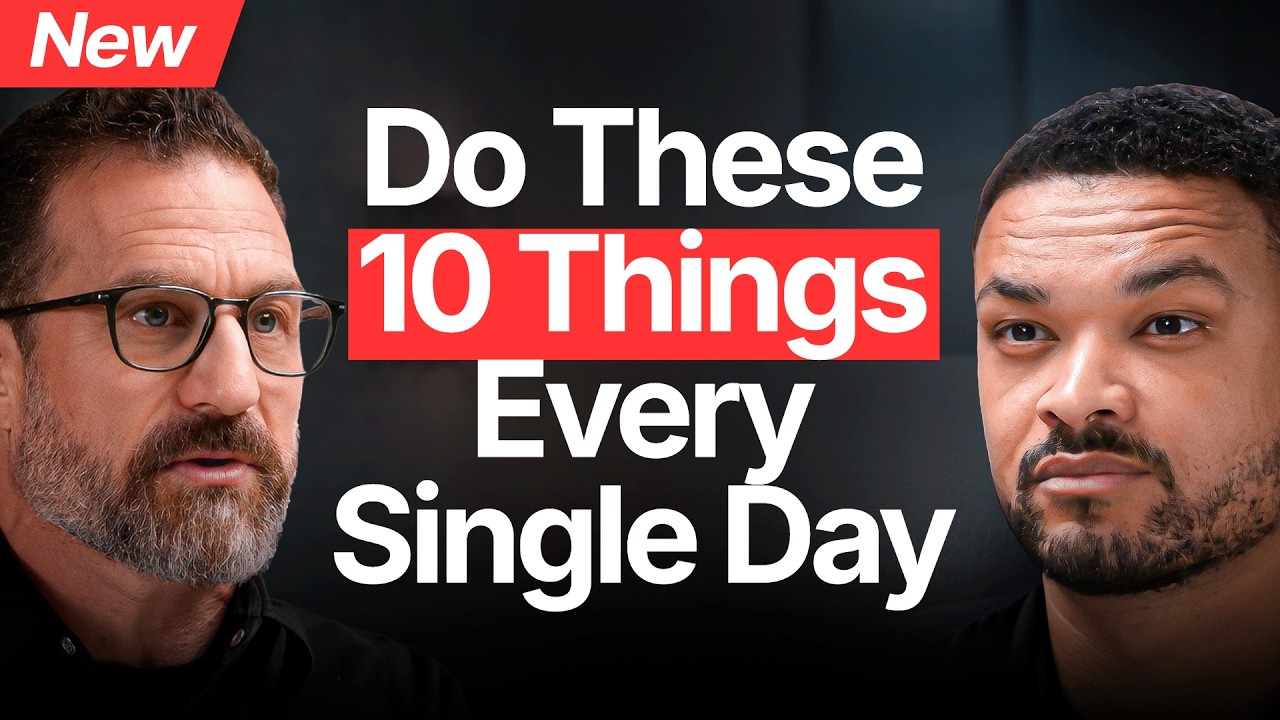
Andrew Huberman: My Exact Routine To Optimize Brain & Body, I Do All Of These Every Day!
Now Playing
Andrew Huberman: My Exact Routine To Optimize Brain & Body, I Do All Of These Every Day!
Transcript
4096 segments
Here's the diabolical thing. The risk of
dying early if you have bright nights
goes up immensely. There have been a lot
of studies on people after 6 p.m. on
devices getting artificial LED exposure.
They live shorter lives. Cancer rates go
[music] up. They're metabolically
unhealthy. But here's the really scary
thing. We have a generation of kids that
are metabolically sick. [music] They
cling to their iPads. They're on
devices. But the problem is most things
are designed to make people do [music]
less of what's good for them. And we
don't talk about this enough. And
Andrew, you're one of the most trusted
voices in health today. And we've waited
many, many years for this protocols, an
operating manual for the human body.
These 10 protocols are well established.
They're the ones that are going to move
the needle the most in terms of one's
mental health, physical health, and
performance. Okay, so let's get into it.
So protocol number one, you want [music]
to get sunlight because exposure each
day to the skin, increases testosterone
and estrogen in both women and men, and
is important for libido. [music]
And then the second, and this is really
key, is to reduce stress fast. And I'll
explain how to do that in a moment. And
then number three, working out with
weights for 45 minutes, taking your sets
near to failure. It will triple or
quadruple your cortisol levels. But a
lot of people have been told, don't
spike your cortisol. It's the stress
hormone, but it's a preparation hormone.
You're preparing for adversity, but also
great things. The next thing, and this
is one of the most valuable skills. If
you do it for 5 minutes per day, you
will experience a significant
improvement in mental and physical
health. And then sleeping on your side,
very important for [music] offsetting
dementia, getting rid of bags under your
eyes. But Stephen, the number one thing
that you need to know about is the
moment I started, my life got so much
better [music] and I really started to
see what I could only describe as
miracles. Andrew, I have this
outstanding question that I have to ask
you. You don't really talk in depth
about supplements. I Oh, I do. I go ham.
>> So, you can only do five for the rest
[music] of your life.
>> Oh gosh. I highly recommend getting a
>> This is super interesting to me. My team
given me this report to show me how many
of you that watch this show subscribe.
And some of you have told us according
to this that you are unsubscribed from
the channel randomly. So favor to ask
all of you, please could you check right
now if you've hit the subscribe button
if you are a regular viewer of the show
and you like what we do here. We're
approaching quite a significant landmark
on this show in terms of a subscriber
number. So if there was one simple free
thing that you could do to help us, my
team, everyone here to keep this show
free, to keep it improving year over
year and week over week, it is just to
hit that subscribe button and to double
check if you've hit it. Only thing I'll
ever ask of you, do we have a deal? If
you do it, I'll tell you what I'll do.
I'll make sure every single week, every
single month, we fight harder and harder
and harder and harder to bring you the
guests and conversations that you want
to hear. I've stayed true to that
promise since the very beginning of the
Dio, and I will not let you down. Please
help us. Really appreciate it. Let's get
on with the show.
[music]
Andrew Huberman, um, we've waited many,
many years for this and now it has
arrived. This is your long-awaited book
called Protocols, an operating manual
for the human body. And inside this
book, I counted roughly 50 different
protocols split across seven different
areas. Um, sleep, exercise, stress
control, nutrition, light, focus,
motivation, and learning, and personal
growth. You've written 10 of the
protocols you want to focus on sharing
today. Can I ask why did you choose
those 10?
They're the ones that are going to move
the needle the most in terms of one's
mental health, physical health, and
quote unquote performance. Your life
will be so much better if you do them.
>> And do they cost a lot of money to do
the 10 that you've picked?
>> No, they could be done either at
completely zero cost or on a existing
budget.
>> And do you do these 10 things
>> every day?
>> Every day.
>> There's one on there that I don't do
every single day. I take off one day per
week, but every single day without fail.
And when you wrote them, did you write
them in order of sequencing?
>> Yeah. Throughout the day, from from
start to finish throughout because this
is the other thing. Protocols synergize.
They ratchet together. How well you
slept last night is dictating how well
you feel now.
>> These are gears in a larger system. One
moves, the other ones move. And while
there is a place for pharmarmacology and
supplements and things that you take,
>> ultimately these gears fit together
based on what you do.
>> Okay. So, let's get into it. What was
the first uh thing that you drew? cuz I
saw there was a picture there.
>> Okay, so in my unelegant drawing, but I
I am a you know biologist, so we're
allowed to do this. I mean, this is
essentially a plot of where you wake up
in the morning and then where you go to
sleep at night, you know, and these are
not hours of the day. These are the
different protocols. 1 2 3 4 5 6 7 8 9
10. Okay, so um this line represents the
healthy cortisol curve. Most people
don't realize that, but you wake up
because of a rise in cortisol. It's
literally called the cortisol awakening
response. If you've ever woken up 1
minute before your alarm clock, it's
because the cortisol awakening response
is heavily entrainable, meaning it can
be matched to external stimulant. You
want this peak in cortisol as high as
possible in the first 60 minutes of your
day.
Everyone thinks you want low cortisol,
but here's the deal. High cortisol in
the early part of your day is what
provides for elevated mood, focus,
attention, your ability to learn. It's
also what establishes low cortisol in
the afternoon and at night which is a
requirement for falling and staying
asleep.
>> So this peak sets up this trough. So you
want high morning cortisol, low
nighttime cortisol. These represent
melatonin, the hormone of sleepiness. As
we know, if you slept the night before,
then melatonin essentially is low at
morning. And the dash line is adenosine,
which is a downstream product of of the
use of ATP in your cells. The more
you're awake, the more activities you
do, the more you think, adenosine builds
up. That's why you get sleepy.
[clears throat]
>> So, what's very interesting is that when
you spike your morning cortisol, and
I'll explain how to do that in a moment.
And you do that within the first hours
of your day, you also establish a case
where these little blips are stress,
stressful text, stressful event, but
they're brief. We always hear that
cortisol is bad, but our ability to have
big inflections in cortisol, stress out,
and then they come back down to normal
is very very good. If this peak was
high, if this peak is not as high, and
this is kind of a like a medium or or
flat what they call a flattening of the
cortisol curve, you see shorter
lifespan, less recovery from every kind
of illness, and and these stress bouts
last a very long time because they're
riding on a higher baseline. So if your
morning cortisol level is lower or flat,
>> right,
>> then if I get that stressful text during
the day, it will be a longer cortisol
spike. More stress,
>> bigger and longer.
>> Oh wow.
>> And not only that, but there's an
indirect but very important interaction
between cortisol and melatonin. Your
sleepiness hormone doesn't come on and
function as well.
>> And so sleep gets very disrupted. So a
lot of people think, "Oh, I don't want
my morning cortisol high." And a lot of
women in particular have been told,
"Don't spike your cortisol. that's going
to lead to excess visceral fat, moon
face, etc. There's this a condition
called Cushing syndrome, which is a
massive overp production of cortisol.
Very rare condition. I mean, it happens,
but most people are not dealing with
that, right? Most people's morning
cortisol is too low and their afternoon
and nighttime cortisol is too high.
>> How do they know this stuff? Like, how
do they test this?
>> This healthy curve, as it's called, um,
was measured through just consistent
blood draws around the 24-hour cycle.
And then it's been looked at in response
to everything from caffeine to cold
plunges to exercise to sunlight. And
there's this very So protocol number one
is hydrate. Your mind is exceedingly
more sharp when you're well hydrated.
And it actually helps boost your morning
cortisol. There's a very interesting
interaction between when the bladder
being emptied as usually after people
wake up, they use the the restroom, they
urinate, and then hydrating. And there's
an I'll talk about this a few times, but
there's an ascending pathway along the
vagus nerve that serves to wake up the
brain. And part of that has to do with
hydration first thing in the morning.
You awake from bed to urinate in the
middle of the night because of an
arousal phenomenon of hydration and the
bladder being full.
>> When you say hydrate, do you mean
electrolytes or just water?
>> 16 to 32 ounces of good clean water is
fine. If you want to add electrolytes,
great.
>> How much is that? Is that a cup or is
that?
>> Um, this is 16 ounces. Maybe 18 ounces.
>> Okay. So, like a big a big mug. You want
to consume about 80 ounces of water
throughout your day. It's a lot, but you
don't want to cons basically everything
you want to do in the early part of the
day, you want to do less in the evening
part of your day. The next thing, and
this is really key, it could have gone
first, but you want to view sunlight or
10,000 lux artificial light. I could
spend 3 hours talking about this, but
I'll keep it really brief. When you view
sunlight, there's this beautiful
phenomenon. It activates these
melanopsin intrinsically photosensitive
ganglen cells. You know, the major focus
of my work for many, many years. So I'll
resist saying more. They literally
extend physical wires that we call axons
into your hypothalamus. Your master
circadian clock resides there. We call
that your super chaismatic nucleus. And
when you view low solar angle sunlight,
sun low in the sky, there's an abundance
of yes UV, but it's lower when it's low
in the sky. You actually can look at the
morning sun more easily than you can the
overhead sun. Why? The morning sun looks
more yellow, orange, or even some red
tones
>> compared to the overhead sky. Well, the
light coming from the sky is the same,
right? But the specific wavelengths of
light, as we call them, that are coming
from the sun when it's low in the sky
are the optimal stimulus for these
melanops and intrinsically
photosensitive cells that tell your
central clock it's time to wake up. The
day is beginning. Okay. There's also
something incredible that happens if you
get bright light in your eyes in that
first ideally 30 minutes but even 60
minutes of your day which it there are
two pathways by which your brain
circadian clock wakes you up. One is it
sends signals through peptides it
releases and neural signals but it's
able to activate what we call the HPA
axis hypothalamus pituitary gland which
is sort of hangs outside the brain and
then adrenals you release adrenaline
there's a unique window that passes
after about an hour following waking
where your supercismatic clock can
trigger an alternate pathway that
literally goes down your spinal column
and triggers your adrenals to release
additional cortisol. In fact, viewing
sunlight in the first hour of your day
takes this peak. Here's what it would
look like if you didn't view bright
light in the first hour of your day. It
would be here, which is bad. And your
stress responses then would be bigger
and longer.
This
increase in cortisol is driven by
viewing sunlight. Now, when I say
sunlight, people say, especially in the
UK, they'll say there's no sun where I
live. Okay, this could easily see say
daylight. Why? Because there's always
daylight out. If you look at how bright
it is on an overcast day in the middle
of December, even in the UK at 8:00 a.m.
versus midnight the night before, it's
different.
>> Mhm.
>> You know, it's obvious when there's
overcast skies, less of the long
wavelength light, the oranges and reds
are coming through. But you want
daylight in your eyes in the first hours
of your day. Go out on your balcony if
that's all you can do. If you're in a
car, roll down the window. It's not good
to try and do this through a window or
windshield. There's so much data showing
that spiking your morning cortisol this
way establishes low cortisol and high
sleepiness hormones let's call them at
night which is great buffers stress and
moreover kickstarts your immune system
to protect you against bacteria and
viruses you can encounter during the day
it is great for your metabolism mood
ability to learn and on and on and in
the book I explain a number of different
ways how this peak relates to this
trough if people are interested but if
you don't have access to sunlight or
daylight light. Having a using a 10,000
lux artificial light can be very
beneficial. These 10,000 lux lights have
been shown to significantly
offset the symptoms of seasonal
effective disorder, etc. But what we're
finding from this huge study from the UK
bio bank is that you want bright days
and you want dark nights and they're
additive. So having bright days is great
for your mental health and physical
health along a huge number of
parameters. Significantly improves them.
But having dark, even if you were in dim
light all day, making it dark at night,
people are healthier. The risk of dying
early, if you have bright nights, goes
up immensely. And we don't talk about
this enough. If you don't have access to
enough daylight, like you wake up before
the sun comes out and you're up for 2
hours, let's say before the sun comes
out. I highly recommend getting a 10,000
lux artificial light.
>> And last time we spoke, you took me
outside after the conversation and you
had an app on your phone,
>> right? Light meter. I have no relation
to the app, but I use it. And that is
able to tell you how much lux of light
you're getting at the moment.
>> But it's additive. So one thing that's
important to note is let's say you miss
a day, right? The next day get outside
for twice as long. How long should you
do it on a very clear morning with the
sun rising? And by the way, you don't
need to see the sun cross the horizon.
You can just wait till it's elevated but
it's low in the sky. People who are
concerned about UV damage should know
that when the sun is low in the sky, the
UV index is much lower. And there's a
reason for that. It's a phenomenon
called relay scattering. Sunrises and
sunsets are very beautiful and colorful.
When the sun's overhead, it's hard to
look at. It's this big ball of light.
It's so bright because you're getting
all the wavelengths, the UV all the way
out to the infrared coming at you in
more or less equal intensities. When the
sun is low in the sky, the UV is it's
not completely scattered, but not as
much of that is is reaching your eyes.
Much lower risk of sunburn, much lower
risk of eye damage, and so on. So,
here's the diabolical thing. Your
screens are not nearly bright enough to
kickstart this increase in cortisol in
the morning, but they are very capable
of increasing your cortisol levels at
night because the this low level of
cortisol makes you vulnerable to big
increases in cortisol. It's a little bit
of a detail that I explain in the book,
but
>> I was going to say on this point, is it
just exposing my eyes to the light or
does my body need to be exposed to it?
>> Great point. And one of the protocols in
there, it's not one of the 10 I listed,
is about the importance of getting
sunlight on as much of your skin as
possible as is socially appropriate. Uh,
beautiful work from Glen Jeffy's lab at
University College London. You know, I
can believe this. They do a glucose
tolerance test. So they fast people,
they have them drink a glucose drink.
They measure how fast a blood sugar
rises. And if they shine red light, so
long wavelength is red is long
wavelength light
>> like that. Like that.
>> Yeah. Like this would be medium
wavelength because it's yellow. A red
would be um so this is probably I'm
guessing somewhere between 500 and 600
nanometers of light and red would be
probably somewhere between 580 and 700
and then infrared goes out further you
know into the 800s and thousand. The sun
emits all of those. Okay, so this is
long wavelength light. Okay. So, they
shine a long wavelength light on
people's backs and they do the glucose
tolerance test and and they observe a
more than 25% reduction in the peak and
they also look at the rate of rise of
blood glucose. It's buffering blood
glucose rise which we know is a good
thing.
>> Just to summarize, they shine red light
on someone's back while they have a
glucose shot and their glucose spike is
lower.
>> That's right. And you can do this onto
bare skin or you can do it through a
t-shirt. Turns out that these people's
metabolism rose significantly. Why? How?
Well, long wavelength light can actually
go into and through your body. It can it
gets absorbed and it can go about 8
centimeters into the body. Red light
wavelength light of infrared can pass
all the way through the body. They show
that beautifully in this study. So
that's not good. No, it's fantastic
because along the way it makes
confirmational changes in the way that
your mitochondria handle the electrons.
Basically this long wavelength infrared
light that comes from the sun. It's the
heat that you feel from the sun or from
a long wavelength light device allows is
so amazing. It actually allows your
mitochondria to to function more
effectively, more efficiently. Now, it's
not to say that short wavelength light,
blues and greens and ultraviolet light
are bad. We need ultraviolet light. We
need it on our skin to make vitamin D.
What you want is full spectrum balanced
light, but not so much UV that you get a
sunburn. And you don't want a lot of
shortwavelength light in the absence of
long wavelength light. Best way to do
that, sunlight in the early and later
part of the day because the UV index is
low. You're getting the full spectrum.
Indoor LED lights like this, which we
all spend a lot of time under. There's
now evidence from from Glen Jeffy's lab
and others that it actually may damage
the mitochondria. We talked about
melatonin coming coming from the pineal
gland that makes you sleepy at night.
You also have melatonin in most all of
the cells of your body. And there it
doesn't make you sleepy. serves as an
antioxidant but it's sort of captured
and the way to liberate it is through
long wavelength light. So you have a
protective mechanism that's kicked on
with long wavelength light that protects
you protects you against the oxidative
stress and damage to cells
>> and this has many many positive effects.
So Glenn's lab has done experiments
where they literally take in a light
like this and they have people look at
it like this for one to three minutes a
couple times a week. They look at people
different ages, different eye
conditions. He's a serious vision
scientist, right? He's not he's not a
biohacker. He's not he's has no interest
in commercial products actually,
although sometimes I wish he did. People
over 40 who experience age related
vision loss, we all do a little bit,
experience improvements in vision when
they do this simple thing. And why would
that be? Well, it turns out that your
photo receptors, which absorb light and
convert it into electrical signals that
allow you to see, are the most
mitochondrial rich and metabolically
active cells in your entire body. Now,
biologists love to play this game where
they go, "Your tongue is the most
metabolically active." Then they go,
"No, you're you." Everyone makes a claim
on this. The photo receptors, my
friends, are the most metabolically
active cells in your entire body. So,
they have a ton of mitochondria, and
they need to protect themselves against
the oxidative damage that comes with
generating a bunch of downstream
products from ATP. So, long wavelength
light is what protects us in this. So
you can see significant improvements in
vision for people that view long
wavelength light couple times a week.
But only in people older than 40. And
get this, only in people that do that in
the first 3 hours of their day.
>> What?
>> Yes. Your eyes and your body and brain
are not the same at this first third of
your day versus this middle third of
your day versus the last third of your
day and at night. They're not. Your
sensitivity to bright light causing bad
effects on you after sundown increases.
Not immediately, but it increases
gradually. Your need for bright light in
your eyes in the early part of the of
the day is immense. You need this. You
you want this. And if you miss a day,
get out the next day and view some more
light. You asked, will light to other
parts of the body work? Not for setting
this system in motion, but it's a great
idea to get out two to three times per
week when the UV index is low. you can
just look on your phone what's the UV
index and in general be the early or the
or the later half of your day when the
UV index is lower and to get out and get
some light onto your skin. You don't
have to be naked or in a swimsuit. Great
if you are and that's appropriate, but
you can also just wear a t-shirt because
the long wavelength light will go all
the way through. So Glenn Jeffrey and
Robert Roger Schwelt, he's a physician
who talks about the immense benefits of
getting sunlight onto the skin for
getting over disease for state for
enhancing immune system function and on
and on.
>> Can you because there's going to be a
lot of people right now that are going
to go buy a red light lamp.
>> Not necessary.
>> Not necessary.
>> No. Sunlight. Pink Floyd. Pink Floyd
album.
>> Pass sunlight through a prism. It bends
the light and you see the rainbow. Red,
orange, yellow, green, blue, indigo,
violet. But also in that sunlight is
ultraviolet light, some UVB exposure
each day to the skin, increases
testosterone and estrogen in both women
and men and is important for libido. It
actually reinforces romantic
relationships for reasons other than uh
sexual interactions, um attractiveness,
etc. Strong effects. So sunlight has it
all. What you don't want is to go
outside when there's so much UV that you
get a sunburn. And you don't want to
think that, you know, red light's the
only light you need. You want that
warmth from from the sun. And it gets
better because and notice I'm I'm sort
of like it gets better like a salesman.
I'm selling nature. Okay, I'm telling
you when you go outside and there's a
lot of greenery. Greenery reflects long
wavelength red and infrared light. Throw
on some infrared goggles and you're not
going to do this, but you look and they
all that stuff would be glowing white in
those goggles. Greenery reflects down
infrared light. How do you know it
reflects light? I'm stealing Roger's
words as I say this, but where's the
coolest place to be on a hot day? Under
a tree. Why is that? Because it's
reflecting the heat, the infrared light.
But when you're out in greenery, you're
getting all that long wavelength light,
and it bounces around and it goes
through you. So, get out into nature,
walk outside. If you work and live in a
city, get outside, take off a brimmed
hat because you do want the the sun
getting down onto your onto your face.
People are so terrified about
accelerating aging based on UV, but
we're not talking about baking yourself
in UV light all day. The the health
benefits of this are immense. There's a
Swedish study that actually showed that
the more sunlight people got, the longer
they lived, in fact, smokers who got a
lot of sunlight, this isn't my favorite
study, but um but we have to admit it's
there, lived longers than non-smokers
who didn't get enough sunlight. There
and there are other things too like
exercise, etc., but don't smoke, but get
sunlight. There'll be a lot of night
shift workers listening.
>> I have a section specifically for night
shift workers because
here are the two scariest things. Night
shift workers
live shorter lives. Cancer rates go up.
They're metabolically unhealthy. And
it's very hard to mitigate. But I
provide some tools specifically for
night shift workers and for jet lag, by
the way, because people travel. Here's
the really scary thing. you and I
qualify as night shift workers because
the studies on night shift work, barring
some of the more extreme ones, was most
of them were on how many people after
6:00 p.m., right, are on devices getting
artificial LED exposure or doing
activities besides eating and
socializing with their family or in bed.
If you work at night at home, you're
still a night shift worker. You don't
have to work all night to be a night
shift worker. So, we have a generation
of kids that are metabolically sick. And
I don't like to be one of these like
fearmonger people, but here's the cool
thing. I'm going to skip because we're
on to this. I'm going to skip to number
six.
>> Okay.
>> Okay. As the sun is going down, you
don't have to watch the sunset. That
would be cool to watch the sun. Everyone
loves sunsets.
>> But try and get some daylight in your
eyes in the late afternoon or evening.
If you're going to be working indoors
from like after lunch until nightfall,
try and get near a window. Do your best.
Go out on a balcony, take a quick walk
around the building, do what you can to
get some sunlight in your eyes without
sunglasses. When you get some sunlight
in your eyes in the late part of your
day, let's just say in the last third of
your day, and the clock times don't
matter here cuz we all get up and go to
sleep at different times. You buffer
those cells in your eye against the
negative effects of artificial light at
night. This is your Netflix o
inoculation, as I call it. Like you can
be on your computer at 9 or 10 at night
without it damaging your melatonin
levels quite as much, without it
disrupting your blood glucose levels and
your sleep if you get some bright light
in your eyes in the later part of your
day. But there's one population of
people for whom this doesn't work and it
seems to be adolescence. You can't
buffer them against the negative effects
of screen light at night. What happens
if you use screen light at night? You
get big bumps in cortisol and people
say, "Well, I can fall asleep just fine
after being on my iPad or screen." True,
some people don't have as much of a
negative effect from blue light at
night, but the blood glucose effects and
the next morning cortisol effects are
the problem. Remember I said high
cortisol sets you up for low cortisol.
>> Yeah.
>> Low cortisol sets you up for high
cortisol. So you've got a population of
people, kids who have their cortisol is
slightly but significantly higher in the
evening and at night because they're on
devices and the next morning their
cortisol levels are struggling to get
up. M
>> you know this is a tough one because
teens socialize that way and you don't
want to take their phones away and they
cling to their iPads like you know like
my new bulldog strummer clings to a chew
toy you know it's like you can take it
away from them but like they hate you
for it. So I said view daylight cuz you
can't always see the sun but even if
it's overcast just get out for a few
minutes and take a walk your sleep will
be better.
>> I feel like I'm [clears throat] giving a
lecture in class.
>> That's amazing. That's what I want.
>> So we said hydrate sunlight. And then
number three, I know everyone's heard
it, but if you can exercise in the first
3 to four hours of your day, you could
do it in the afternoon without problem,
but there's a huge advantage to doing
cardiovascular resistance training in
the first 3 hours of your day.
>> Cardiovascular or resistance training.
>> Yeah. And in the book, I devote an
entire chapter, chapter 2, to exercise.
And I explain what I think personally is
the best way to structure an exercise
program for somebody who doesn't want to
be the most jacked, but wants muscle and
definition and strength. somebody that
doesn't need to run a marathon for a
record time, but wants endurance.
Somebody who wants to be able to sprint
reasonably fast and has middle distance
ability, too. And it's basically
structured. You either lift or do cardio
on alternating days, three days total of
lifting. Warm up reasonably low volume
of work sets, two to three work sets per
exercise, emphasizing compound
movements. So, not a like a preacher
curl or a tricep kickback. Those are
fine, but you're going to get a lot more
bang for your buck if you're doing
pull-ups, rows, dips,
>> multiple muscles at once,
>> multiple joints moving at once as
compound. Um, some hip hinge movement.
So, could be squat, hack squat, some
deadlifts, and I talk about how to get
specific aesthetic effects in there,
too. I mean, I'm by no means an exercise
physiologist, but I've been resistance
training since I was 16. I'm I'm now 50.
I'll be 51 in a month, so I feel great.
cardio at the start if you're doing
resistance training or not at all.
>> I warm up for 5 minutes of cardio and
then resistance train, but I do the
cardio on alternate days. Three days
total of cardio. One day of cardio is
long and slow for about an hour. One is
about 30 minutes at moderate intensity.
One is a short one like I did this
morning. Jumped on the air bike, pedal
easy for a minute, then go all out for
30 seconds, easy for 10, 30, 10, 30, 10,
30, 10, and then you're off the bike.
Basically max heart rate training. Yeah.
>> And the day after leg day, if you do
your legs right, take a rest day.
>> Yeah. But the here's the interesting
thing about exercise. You notice I
didn't say deliberate cold exposure.
>> You [clears throat] want to blow some
minds? I will go toe-to-toe with anybody
on the internet or off the internet.
Deliberate cold exposure does not raise
cortisol.
This much. It's amazing to me that the
same people that are suggesting moderate
to high-intensity exercise are saying
that deliberate cold exposure raises
cortisol. is simply not true. Not true
for women cuz a lot of people said, "Is
your book going to be for women and
men?" I distinguish between data when
there are data showing that it's
different for women and men. I
acknowledge when there's no data in
women and the data are very clear in
women and men, trivial increases in
cortisol, magnificent huge increases in
adrenaline, norepinephrine, and dopamine
from deliberate cold exposure. And that
those so so-called catakolamines are
great to have rolling into your day.
They're the things of alertness and
focus. The appropriate stressor for
cortisol, appropriate meaning the one
that you want, is a psychological
stressor. We know that.
>> Working out with weights for 45 minutes,
taking your sets near to failure, going
for a run for 30 minutes. So, the point
being, if you do this exercise in the
first three hours of your day, you're
getting a big inflection in cortisol.
Again, this is what you want. Now, some
people can't exercise first thing in the
day. They either don't want to or they
can't by way of schedule. And if you go
into exercise in the later part of your
day, that's fine. Your cortisol will
come back down. You can do some long
exhale breathing to slow your heart
rate. Andy Galpin talks about that. Take
a hot shower, which paradoxically lowers
your core body temperature. And then
helps you sleep. When you heat up the
surface of your body,
>> you have a thermostat in your brain
called the medial preoptic area, and it
goes, "Oh, the surface of my body is
warm. I should probably cool my core
body temperature down." And you fall
asleep better. You know, this is like
the the putting socks on effect or the
hot bath effect, right? I assume a
massage or something like that also.
>> Great. You have access to that in the
last hour of your day. Like uh we need
to learn more about your life.
[laughter]
>> My fiance used to be a masseuse for many
years. So she
>> awesome.
>> So when you exercise for a few days
early in the first three hours of your
day, let's say you do that two times.
The next morning you wake up feeling a
little bit more willing to exercise. Did
your willpower change? Well, in some
sense, yes. But what happened was your
cortisol entrainment mechanisms changed.
Your superc kaismatic nucleus all day is
clocking what you're doing. Let's say
you eat like 9, 12, snack at 3 and 6:30.
You have a food anticipatory signal. You
have ghrein is secreted makes you
hungry. We are clocks and the
synchronization of those clocks is very
very important. When you exercise at
roughly the same time of day, early in
the day, you will have more energy to
exercise in the first 15 minutes before
that. You'll notice you kind of start
stirring around. Yes, part of it is
cognitive, but a lot of it actually is
your brain is anticipating
exercises coming. Oh, cool. That's why I
I teach neuro anatomy, so this is fun.
>> I have a a brain here in front of me. It
does open up in case you want to open it
up. But you just reminded me of
something.
>> You reminded me of something that I saw
you talk about, which was the anterior
mid-sulate cortex.
>> And I think you described this as being
one of the most interesting
>> discoveries of neuroscience. So
singulate cortex I mean it's not
directly exposed here but the anterior
mids singulate cortex would sit
somewhere like there this is an amazing
structure right I mean just to remind
people like when we feel some sort of
pressure social pressure physical
pressure that we hate and we decide I'm
going to lean into this like I'm going
to compete or I'm going to push through
this internal or external resistance
neurons in the anterior midsulate cortex
are just firing away and if that area is
stimulated my colleague Joe Parvevesy at
Stanford showed this he's a neurosurgeon
people say I feel like a challenge is
coming on and I'm going to lean into it
this is the brain area of tenacity
and the amazing thing is it has
connections all over the brain with
reward systems etc so it's collecting
information about when it gets activated
what's going on in the world that makes
you feel pressure when you feel like
pushing back when you don't but the Best
part is it is highly subject to
plasticity. People who diet successfully
their anterior mids singulate cortex
gets bigger and more active. People who
embark on a new exercise program adding
some component of exercise. For me it's
mobility work because I've got a little
stiff over the years. I know. So when
you do something that you don't want to
do, that you don't reflexively do, your
anterior midsulate cortex gets bigger
and more willing to engage in
challenging things going forward.
>> Yeah. So that's the key point, which is
that sets you up to be able to do more
challenging things in the future.
>> That's right. Why would you do
deliberate cold exposure? I'll tell you
why. Because your ability to sit calmly
or even not so calmly when your system
is flooded with adrenaline and
norepinephrine and to be able to trigger
that with cold water safely like cold
shower, getting into a cold ice bath,
it's safe as long as it's not so cold.
As long as you're not hyperventilating
beforehand on purpose, that carries over
to your ability to keep your head
straight when other things trigger
adrenaline. You don't get 10 stress
systems, you get one. And stress looks
like your adrenaline goes and it comes
down slowly. This is a hallmark of
stress. Cortisol goes up goes down.
Right? So the Oh, you are prepared, my
friend. My goodness, you should be a
university professor. You want to teach
with me at Stanford? So I came up with a
model for arousal, right? People hear
arousal and they think, "Oh, it's got to
be romantic arousal." It can be, but
arousal is really just how alert or
sleepy you are. So you can be really
sleepy, like in a coma, or you can be in
full-blown panic. Nobody wants that. But
a seesaw is the right analogy here
because we have this thing called the
autonomic nervous system. And the
autonomic nervous system is made up of
two parts, parasympathetic and the
sympathetic nervous system. They're in
different parts of the body. They both
connect to most every organ. But in
general, when you are relaxed, that's
what we call the reflection of
parasympathetic tone going up. When
you're stressed, it's the reflection of
sympathetic tone going up. But as you
get sleepy, your parasympathetic nervous
system starts to dominate a bit. And as
you get really sleepy, it dominates more
when you wake up in the morning. And
then if you do the right things like
hydrate, get sunlight and some exercise,
well then your cortisol goes up and
you're going to be more alert. The
ability to navigate stress of all kinds
depends on your ability to do what I
call is control the tightness of this
hinge. When you train your ability to
think, breathe, stay calm, when your
system is flooded with adrenaline and
that happens later in a way that was
nonvoluntary, something happened that
you didn't want to happen, your brain
immediately flits to the understanding
of that place and you are able to
maintain thoughtfulness. You can know to
not speak. That's often the best thing
you can do. You know to react or not
react. In fact, when you get into a cold
plunge, one of the beautiful things
about cold is that your prefrontal
cortex that's involved in strategy
setting and making meaning out of what's
going on, its activity is greatly
suppressed for the first 20 to 30
seconds. Know this about every stressful
circumstance. In the first 20 to 30
seconds, you are brain damaged. You are
brain damaged. You're you are in that
mode of like you could react physically.
Sometimes that can save your life, but
most times you just don't want to do
anything. Step out of the way of the
car, get away from the aggressor,
whatever. But most times you're best off
not saying a darn thing. And then your
prefrontal cortex slowly starts coming
back online. And then you're back again
cuz you're ruminating, you know? And
>> this is good relationship advice.
>> Very good relationship advice.
[laughter] I wish I had learned it long
ago. Right. Actually, last night I
looked on Twitter and I saw something
that was both perplexing and a little
bit upsetting to me. And I went to sleep
like, I know how to deal with this. Some
long exhale breathing, which will slow
your heart rate. and we'll talk about
that. But I woke up this morning, turns
out it was a complete misunderstanding
and everything was reversed. But last
night I thought about sending a text,
but I thought later at night the
prefrontal cortex is already diminished.
This is why stress feels so much harder
to deal with at night
>> and prefrontal cortex. We should
describe that logic and stuff.
>> So um frontal cortex, so here it's
logical. You have the frontal and motor
areas here. And your prefrontal cortex
is basically a big patch of real estate
behind your forehead that in humans is
greatly expanded compared to in other
mammals. I don't like calling them
lower, but they have less prefrontal
cortex. So, they're more driven by their
impulses. One of the most incredible
things that every child and adult needs
to develop is what's called top- down
inhibition. You feel an impulse, but you
resist the impulse. M
>> in fact the way I've mostly trained my
dog strummer because it works is I
taught him at 9 weeks of age put down a
piece of food of course he goes for it
he loves food and you teach him wait and
he sits there and you teach him to look
at you and then now he I can have him
moving toward a piece of food and I say
wait and his nose can be this far and
he'll just stop. He has great top- down
inhibition. Is it about food? No. Am I
trying to torture him? Of course not.
It's so that if I say wait, he can
suppress his arousal.
>> This is one of the most valuable skills.
And people with frontal damage show an
inability to do that, which is why
sometimes they're violent or they say
inappropriate things. People who are
tired, stressed, drunk, prefrontal
cortex activity is suppressed. Get in a
cold shower. First 20, 30 seconds, it's
kind of fun. You're you're like, here I
am with less of a brain than I had
getting in. And then 30 seconds later
you're like, I can do this.
>> This explains why you do things tired.
>> Don't do things tired. Don't say things
tired. Impulse control is way worse.
>> So when I heard you talk about the
anterior mids singular cortex and that
there was this part of the brain that
was kind of like the willpower or you
described it then as the tenacity
muscle. It completely changed my
relationship with hard things because it
made me realize at some sort of like I
guess some conceptual level that every
hard thing I overcome is better
equipping me like when I you know curl
weights in the gym to do harder things
tomorrow.
>> Yes.
>> When I heard other oh there's like a
neurological I'm making a neurological
investment in my future and then you
talked there about doing voluntary
difficult things like the cold plunge
whatever
>> or learning a new language. It can be
cognitive in nature. It can be learning
to dance if that's stressful for you.
And it can be anything that creates some
resistance for you, internal resistance,
anything of that sort. This is a a
beautiful structure because it's wired
into cognitive capacities and our
ability to build them and challenges
with that to emotional challenges.
>> We're kind of optimizing our lives
towards comfort though, aren't we?
That's like a winning formula is more
comfortable things.
>> I think Jack Dorsey said it best.
There's this great video of him online.
It was it was a small lecture that he
was giving where he said anytime we
exchange ourselves, our money, our time
for convenience, we are almost always
giving up something that's like
fundamentally useful for us
neurologically. And it's okay to do. I
order food on Door Dash cuz there's
great food and I don't have a lot of
time to cook. I'd like to devote my time
to other things. I'm trading for
convenience. But if you're aware of the
trade-off, you're much better off. And
the real question is what you're going
to do with that additional time. While
I'm against, you know, overoptimization
to the point that it pulls you out of
life, like it diminishes life, I am all
for striving and optimization quote
unquote in ways that allow you to lean
into the rest of your life with more
vigor. I think Arthur Brooks says it
best. You know I mean we are wired and
meaning comes from striving and within
striving is some struggle and within
struggle is also the release from
struggle and that's also very uh
satisfying. Here's the overoptimization
thing to me in a nutshell which is
there are people for whom doing two of
the things I described for 5 minutes
each per day will experience a
significant improvement in their mental
and physical health. There are people
for whom they're sort of like junkyard
dogs. They can live on anything. They
have a ton of vigor and they're going be
like, "Yeah, I didn't feel that much
from like drinking some water and
getting sunlight." Cool. I got you.
You're one of those people who can fall
asleep in front of the screen, get up,
and just keep going on a, you know,
sugary muffin and something like great.
>> But everyone can afford to take a look
at what they're doing now and try and
move the needle toward more vigor,
well-being,
happiness, peace by doing certain
things.
>> Do you become more sensitive to the
thing when you stop doing the thing?
>> Depends on the thing. So, for instance,
if people like I talk about nutrition in
there and all we it's one of the cards I
actually cover everything from the all
meat diet to vegan diets to I really go
into the literature so people can choose
but really if you look at what most
people could benefit from doing and you
could do this with vegan or vegetarian
it's a little harder but the best diet
is going to be the following right not
too many calories not too few that's
individual you can calculate that it's
an easy thing to do but I provide a way
to do that you need to get what's what
are high complete protein to calorie
ratio proteins. This is a concept I came
up with because if you look at the
literature, yes, we need the essential
amino acids. So that's a complete
protein, but you can get that from beans
and rice, but to get 30 g of complete
protein from beans and rice, you're
going to consume about four to five
times as many calories as is required if
you get it from a chicken breast.
>> So this is the the factor that's kind of
obvious, but no one ever talks about. So
you want to eat some high complete
protein to calorie ratio protein. So you
know eggs, lean meat, fish and then
everyone knows you need fiber,
>> right? So vegetables and fruits. But
what I will say is that many people who
remove us starches entirely.
>> Mhm. [clears throat]
>> Or remove vegetables entirely will find
that they their autoimmune issues
resolve and there are reasons for that
and we have to acknowledge that. But
most people should be eating some
vegetables and fruit for micronutrients
and fiber. Low sugar fermented food.
very clear Justin Sonnenberg's work from
Stanford very clear lowers the
inflammatome in fact when they had
people eat more fiber for many people
inflammatory markers went up no one
likes to talk about that especially not
the vegans but too much fiber can be
noxious for some people and
pro-inflammatory so low sugar fermented
foods like sauerkraut kimchi beet kvass
is delicious problem is they tend to be
expensive but you can make your own and
there's recipes online to do these
things I don't want to get into the seed
oil debate. Just eat just use olive oil.
It's delicious. It's relatively
inexpensive nowadays to get real olive
oil. Small amounts of butter. Okay. Like
like why are we even debating seed oils?
It's so dumb. It's like the the seed oil
debate is like the fastest way to kill
neurons that I'm aware of. You know,
it's like so dumb. It's like because the
studies are not well done. You're
comparing a processed food diet that
includes seed oils versus or you're
talking clean seed oils versus a high
meat diet with processed meat. It's a
it's a mess. It's like as a scientist,
you just look at this and you go like
this field sucks.
>> Like it someone wants to have a
magnificent career in science. Go into
the field of nutrition and do some
really good studies because the studies
are a little lousy. 90% of them like you
can look at it. You don't even have to
be trained in nutrition. You go there
five different variables here and four
over here. This is like what you would
call a bad experiment.
>> So olive oil the data are great. It's
impressive. And then starches are great
for fueling muscles and glycogen and
brain, but you don't want to overdo
them. And the way that people tend to
overdo starches is by eating starches
combined with a lot of fats. So
sourdough bread is great. Sourdough
bread with butter is even better if you
ask me. Sourdough bread with equal
amounts of butter and bread, you're
starting to get into problems. It's very
hard for people to go from like to
overeat starches unless they have a lot
of fats with them or sugar with them. on
starches. Is there an impact? I think
I've heard you talk about an impact on
your sleep with what you eat late at
night.
>> Many people who don't eat enough
starches find that they have sleep
issues. And there are reasons for this
because we talk about comfort foods.
>> Typically, people think junk foods when
they think comfort foods, but foods that
increase glucose lower cortisol. H,
that's weird. Starches lower cortisol.
And you want your cortisol low at night.
Helps you fall and stay asleep. Now, you
don't want to eat too close to bedtime.
You also don't want to have gnawing
hunger at bedtime. We talked about that.
But here's the interesting thing. What
is cortisol? We I should have mentioned
this earlier. What is cortisol? Is it a
stress hormone? No. It's a hormone
that's released during stress. But
cortisol's job is not to deal with
stress. Cortisol's job is to mobilize
energy in the body. When cortisol goes
up, glucose is mobilized and other
fuels, too. So when you eat starches,
you buffer cortisol.
There's a very clear relationship here.
So people who are not eating enough
starches who then allow themselves that
bowl of rice or a bowl of pasta in their
final meal of the day or a little bit at
lunch and at dinner, maybe even a bowl
of oatmeal breakfast, they feel more
even psychologically. They have more
physical energy. Sometimes people with
chronic stress issues notice they stop
shaking. People with autoimmune issues
sometimes resolve those because your
cortisol is buffered. Mhm.
>> Because your blood glucose is elevated
and so your body isn't tapping into the
survival system to try and mobilize
glucose. So
>> I have this outstanding question that I
have to ask you. It goes back to the
picture that you drew of the graph.
Where is that one? You said high
cortisol in the morning is a good thing.
>> Yep.
>> So what if I pick up my phone first
thing in the morning and I look at my
worst emails
>> in some sense from the perspective of
spiking your cortisol? Like it's a good
thing. But can you do it outside while
getting sunlight? I was wondering if it
matters like how the cortisol comes
because what if I stress myself out in
the morning? I I really
>> doesn't matter. The problem is the
rumination that comes with stress,
right? So, you know, the nice thing
about physical stressors that we control
like a workout or a cold plunge is that
they have an onset and an offset. And
yes, they start faster than they end,
right? You have stress and it kind of
carries over. You ruminate. But
psychological stressors tend to bang
around in our brain a lot and late at
night and they tend to come back. I will
say this, I think 2027 is going to be
the year that we close the coffin on
this cortisol is bad thing.
>> So, how should I think about cort
cortisol? Because right now, I think of
it as the stress hormone.
>> It's to mobilize energy,
>> okay?
>> So, you can use it,
>> okay?
>> And if you're going to sleep at night,
you don't need to mobilize energy so you
can use it. You need to rest and reset
your body.
>> Okay?
>> Cortisol is an energyromoting
hormone. So if I walk up on stage, my
cortisol level, like before I go up on
stage and there's a big audience,
whatever, my cortisol level is going to
go up then.
>> Yeah. If you're stressed about it, maybe
a little bit more, but it's it's it's a
preparation hormone. You're preparing
for adversity, but also great things.
There are these beautiful studies from a
guy named James McGaw and Larry Cahill,
which showed do you know that if you
want somebody to learn something, you
know what you do? You spike their
cortisol before, during, or after that
thing should work. Why not? Trauma does
that and you never forget. All you do is
work on trying to remove the emotional
load of that traumatic thing.
>> Wait, so if does that mean that someone
who's listening to this podcast right
now in the gym
>> is going to have better knowledge recall
of what we talked about than someone
who's listening in bed?
>> Great question. So I have a a chapter
that's all about learning motivation and
plasticity. And we've all heard exercise
makes your brain better. How? Why? Turns
out it's very important to understand.
There are two ways it does it or at
least two. One is it raises your levels
of arousal. Exercise doesn't make you
smarter. Exercise makes you more alert
coming out of the exercise so you can go
learn things because it turns out you
have to be alert to learn things. In
particular, you need adrenaline and
cortisol elevated to learn things. So
when people say, you know, weightlifting
makes is good for your brain. Cardio is
good for your brain. Turns out long slow
cardio, my endurance friends aren't
going to like this. Not that great for
your brain. It's not bad for your brain,
but it's not that great for your brain.
Turns out an intense weightlifting
session or high-intensity interval
training session in the 4 hours after
that you are primed for learning. Why?
You got a lot of stimulatory molecules
in your body and you can focus better.
>> What about if I'm a podcaster and I want
to be able to ask good questions and use
my mouth and my brain uh in that context
not not necessarily just learning but
performance of my sort of cognition.
>> So the performance curve basically is
inverted to you. If you're not alert
enough, you can't do what you need to
do. If you're too alert, you can't do
what you need to do or learn. So, you
want to be at the top of that inverted
U. And a lot of what learning is about
and a lot of what the intermedulate
cortex is about is getting from I don't
want to do it up to the top of that U.
Then it's usually about not getting too
stressed. Now, I learned the best trick
for this, like the two best tricks. And
in fact, that will take us to number
five. You can use any time of of day,
which is use physiological size to
reduce stress fast. Okay. Okay. So, I
have a a chapter on stress mitigation
and it's got essentially two components.
One is how to limit stress in the
moment.
>> Okay.
>> Very very important to know how to limit
stress in the moment. And here,
>> why is it so important?
>> Oh gosh. Because meditation, great
night's sleep, massage,
social relations, being wellfed,
hydrated, all of that helps you buffer
stress. But when something happens and
your heart rate is too high or you're
shaking and you can't organize your
thoughts in the way you want, none of
that helps. you've gone over the line.
You're too far on the arousal spectrum
towards alert.
And it was about 2016 that I realized
I'm going to take a significant portion
of my lab and work on this problem. I
want to find real time tools for
mitigating stress. So I started hanging
around with people from special
operations who sit in ice baths and cold
water. And they don't actually do ice
baths by the way in the SEAL teams. They
spend a lot of time in cold water during
their training. And I started talking to
people in performance fields in
particular neurosurgeons, people who
deal with life or death circumstances
for many, many years and maintain
immense calm. One of my closest
childhood friends, he's you should have
him on this podcast. It's his name is
Dr. Eddie Chang and he's a neurosurgeon
at UCSF. He's the chair of neurosurgery
and he's brought people out of lockin
syndrome to speak through AI. He's also
a bioengineer. He's also been my friend
since we were 7 years old. And we talk
three times a week these days about
science. And I actually visited his
laboratory and got to see him take a
golf ballized tumor out of a guy's
forebrain while the guy was awake.
>> Wow.
>> Eddie is the calmst guy you'll ever
meet. Why? Because a movement of less
than a millimeter in the wrong direction
for him could cost a patient's life.
People have ways to calm down in real
time. So I teamed up with a colleague,
his name is David Spiegel. He's our uh
at that time he was our associate chair
of psychiatry and he studies hypnosis
but clinical hypnosis for smoking
sessation pain management and anxiety
and I should say mainly Malise Yilz
Balban in my lab did the study she built
this stress lab with VR and stress and
that's a whole other thing and then we
did this study where about a hundred or
so subjects were fixed with um trackers
that measured heart rate and heart rate
variability and sleep and people were in
one of four groups. They either
meditated for 5 minutes a day or they
did box breathing. Inhale, hold, exhale,
hold for 5 minutes. Okay?
>> Like 4 seconds each or something.
>> There's a way you can measure it, which
is the carbon dioxide tolerance test.
Like how well you can control an exhale
will tell you a little bit about how
stressed you are. When you're stressed,
you tend to blow off carbon dioxide very
quickly. And when you're less stressed,
it tends to shift towards long exhales
become easier. So one of the groups, and
then I'll say what the mechanism is, did
cyclic hyperventilation.
Some people call this Wimhof breathing,
tumo breathing, pranayyama breathing.
It's big inhales,
passive exhales. Repeat it for five
minutes. [snorts]
[sighs]
Massively spikes adrenaline, which isn't
a bad thing. You're controlling it
anyway. Does not spike cortisol very
much, incidentally.
And when you do those exhales, you're
blowing off a lot of carbon dioxide, so
it shifts your internal state and tends
to make people very alert. or they did
there was a fourth condition where they
did a double inhale long exhale repeat
the so-called physiological sigh. So
Jack Feldman at UCLA and some other
folks in the 30 1930s had observed that
animals and people when they're very
relaxed would do this kind of strange
pattern of breathing where they would go
[sighs]
[gasps]
it's a double inhale long exhale.
Jack's lab discovers there's a brain
area called the parapacial nucleus which
is specifically there to generate this
double inhale exhale pattern in animals
and in humans wild nature doesn't make
mistakes like that okay turns out there
are two breathing centers one is in
called the pre-bot singer complex named
after a bottle of wine [gasps]
pattern of breathing where you inhale
exhale what that you alternate this
other structure the parapacial nucleus
which we all have is involved in anytime
you double up the inhales or exhales.
And it's involved in breathing while you
speak or sing or eat. And it generates
these physiological size which it turns
out get triggered in environments where
there's not enough oxygen or when you
get claustrophobic or when you get very
stressed, carbon dioxide goes up. Your
brain senses that and it triggers the
gas reflex. That double inhale maximally
inflates the millions, hundreds of
millions of little sacks in the lungs.
And then when you exhale, you offload
the greatest amount of carbon dioxide.
So if you just go,
you're not offloading as much carbon
dioxide. But if you [snorts]
[sighs and gasps]
second short inhale
takes these little sacks in your lungs,
which are like balloons at a kids party,
and they're empty, but they're fluid
lined on the so there's some surface
tension inside them. they're sticking
together. So, you go, it's the double
inhale that opens those up and then you
offload the carbon dioxide. Now, that's
great. But the real magic of deliberate
long exhales is that they slow your
heart rate down through a process called
respiratory sinus arrhythmia. This is
like the most important thing for anyone
exed stress, exercise, sleep, and
wellness because the wild thing is we
have this Vegas nerve. Everyone likes
talk about the vagus nerve. It's a
massive nerve bundle that collects
sensory information and chemical
information from the organs of the body
and sends it up to the brain. Cool. And
it's classified as parasympathetic
calming. But you know what's funny?
Neuroscientists when they want to wake
up and a person during an experiment
like a neurosurgery experiment, they
stimulate the vagus. A treatment for for
depression is to stimulate the Vegas.
Guess what that does? makes people more
alert. So, it's a mixed nerve. But the
really cool part about the vagus is that
it's not all ascending.
The 85% of the information is going up
from the body through the vagus. But
there's another pathway too and it goes
down and it goes down to your heart and
it controls the slowing of the heart
rate when you exhale. Heart rate
variability is the slowing of your heart
rate when you exhale.
You want to increase your HRV, do a few
deliberate exhales during the day.
People go, "How do I get my HRV up?"
Well, yeah, you do some V2 max training,
right? Like, you know, obviously you do
some max heart rate training, some HIT
workouts, etc. You really want to
increase your HRV in sleep and while
waking, just do some deliberate exhales
during the day because that's the
parasympathetic, the calming arm of the
Vegas pushing down
on your heart rate. And all of the
groups I described saw benefits, but it
was the people who did these
physiological size that benefited the
most. So then I started exploring, well,
how fast does heart rate slow down with
physiological size? And it turns out you
don't need to do it for 5 minutes. Do it
once. You just go, "Okay, you're feeling
stressed. You're going on stage. You're
waiting for a diagnosis. You're you
don't feel you feel too alert relative
to how you want to feel for whatever
reason, good or bad. You're about to get
married, right? You whatever.
>> You just
[sighs]
[gasps]
until your lungs are empty and it's
immediate."
And I for me that was immensely
gratifying. Yes. Because it's fun to
publish papers. if we publish it and
sell reports and Meliss gets let's the
lion share the credit for that there
were other people on the paper but she
did so much hard work from that and
analysis I was so gratified because I'm
like ah finally like if I didn't sleep
well or if I something stressful even
though I slept well I can calm myself
down like like that
>> I thought real time tools for stress are
what we all need the interesting thing
is that you can also raise your stress
threshold and a lot of the stress
mitigation chapter is also about how to
do that we need to train for discomfort
so that the little things don't feel so
big.
>> Yeah,
>> this is also important in survival
situations, right? You need to be able
to think very clearly about what order
of operations to take, what direction to
escape through. This is not about like
setting yourself to tolerate more pain
and abuse. This is about the exact
opposite. So, this is about safety. This
is about self-p protection. And this is
about noticing when you're when we're
alert but calm. We can notice the subtle
ripples in people around us who needs
[clears throat] our attention who we
really don't like
>> but we never really realized it. You can
notice that stuff.
>> A lot of people they wake up at like 2
3:00 a.m. in the morning.
>> Yeah.
>> In the middle of the night and they
don't really know why. They don't know
how to get back to bed. They start
worrying and remuner remunerating.
>> Very very common.
>> Yeah. So what they can use this as a
tool in that moment
>> definitely 10 long long deliberate
exhales. There's also this really crazy
trick that I put in the book has
indirect scientific support. You want it
like best way to fall back asleep. You
want to hear this crazy this is so nuts.
To fall asleep or to fall back asleep,
you need to stop thinking about your
body position. H turns out there's a
direct relationship through a few steps,
but there's a dedicated circuit I should
say between your eyes, their movements,
and your cerebellum, which is involved
in propriception and balance and a
number of other things. We call we call
the cerebellum the mini brain, but it's
this this guy back here. We really get
nerdy. These hyperfoliated loes back
here. Foliators are just folds. It's
just nerd speak for foldy bumpy. It's
involved in balance. It's involved in
learning. It's actually very important
for generating and responding to the
error signals between what you're trying
to do and what you can do. That error
signal turns out to be one of the most
important things for generating learning
to make errors through genuine attempts.
And your cerebellum is critical for
that. It's also involved in timing. So,
you need to kind of turn off your
recognition of your own limbs to fall
asleep. How do you do that? You know
what works with babies? Walk back and
forth at a particular pace. And this was
defined in this Japanese study. And have
people swing the baby back and forth
just gently as they do it. And the baby
falls asleep. Guess what? Parents figure
out the exact cadence with a very small
margin of error through trial and error
to figure out how to get their kid to
sleep. It's like a natural experiment.
It's been looked at in the lab.
>> Turns out when you rock back and forth,
your eyes move. This is a very, very
ancient system that exists in all jawed
animals, including us, that as we move
through space, walking, running,
swimming, whatever. The world is gliding
by, what we call optic flow. You would
see the world blurry. But you have a
compensatory eye movement that
unbeknownst to you because of a
connection between your eyes and these
brain stem areas whose names aren't
important right now and your cerebellum
creates a visual slip error and your
eyes automatically offset that error. So
when I go like this,
the world seems stable. And it turns out
there's a pattern of eye movement that
can shut down the propriceptive circuits
in the cerebellum make you forget your
limb position and it greatly facilitates
the speed at which you fall back asleep.
>> Okay. You're going to close your eyes.
Great. You're going to move your eyes
slowly to one side underneath your
eyelids, then to the other side.
>> Mhm.
>> Then up, then down. Now you're going to
move them counterclockwise in a
circleish
and then clockwise in a circleish. And
now still with your eyes closed, you're
going to kind of point them towards your
nostrils. You're not going to cross your
eyes and you're going to do a long
exhale.
Great. That done two or three times
generally has people waking up the next
morning and like wild. What happens?
What happened is your propriceptive
circuits are shut down. Now, that's kind
of fun to do and you'll see and it costs
nothing and it generally works. Some
people, if they're really, really
stressed, it might not work, but this is
what I do if I wake up in the middle of
the night. I usually go to the bathroom,
get back in bed, do long exhale
breathing, and I do that and I wake up
the next morning. It really works well.
So well, in fact, that there's a company
based on work done from two MIT
scientists. They have a sleep mask that
generates this pattern of eye movements
through a little electrode behind the
ear. It just like and it stimulates the
extraocular muscles in just the right
patterns. And I tried it and you fall
right asleep.
>> You're joking.
>> No.
>> And it monitors REM.
>> No, you know, we monitor REM through
like an eight sleep or a Whoop or some
other device through changes in heart
rate and breathing. This is direct
monitoring of REM.
It's wild. And it can control your eye
movements to induce more REM if you want
more REM. There will be a time very soon
like within the next 12 to 14 months
when because of devices like the one
they and others are making when you're
going to be able to say, you know what,
I want 2 hours of deep sleep. I want 2
hours of REM across a 6-hour night
because I can't afford to sleep my
ration of eight. And you will be
generating those eye movements during
sleep in order to facilitate, not force,
but facilitate those patterns of sleep.
I've spent the last decade building and
investing in companies. And so often the
conversation around marketing budgets
follows the exact same pattern. The
budget gets approved, but then the
results don't come back. And most of the
time, the creative pitch and the offer
is fine. The problem lies with the
audience. Ads reach people who will
never buy or refer, nor do they have the
power to sign off anything at all. And
this is why so much budget gets wasted.
LinkedIn Ads, who are sponsor of this
podcast, lets you reach them
specifically by job title, seniority,
company size, industry, the skills that
they have, and much more. You're no
longer hoping your ad reaches the right
person. Instead, you're defining exactly
who sees it. And LinkedIn Ads drives the
highest B2B return on ad spend across
all major ad networks. Give them a try
at linkedin.com/diary.
And if you spend $250 on your first
campaign, you'll get a $250 credit for
your next one just by going to
linkedin.com/diary.
Keep this to yourself. Terms and
conditions apply. I want to speak to the
business owners listening and watching
right now. I know what it's like to be
personally responsible for every
decision. I founded my first company at
21 years old and honestly the pressure
can be immense. It's the kind of mental
load that takes its toll below the
surface. I recently did some tests
through our sponsor function which got
me thinking about that invisible impact.
I found that I had low levels of
omega-3s. I had deficient levels of
vitamin D probably because I sit inside
this dark room all day. And that has
totally changed how I construct my day
going forward. I get up in the morning
and the first thing I now do is I go for
a walk outside in the sunshine. in part
to help my vitamin D levels increase,
but also because it helps to reset my
circadian rhythm. With Function, you can
check your brain health, your aging,
your stress, and so much more. They
provide over 160 lab tests for what is
equal to a dollar a day and member
pricing on advanced imaging. Head to
functionalth.com/doac
to join and use code DOAC25
for a $25 credit. Did I hear you say
that there's a peptide that can help
your REM sleep? Yes, I have no
affiliation to to it because um it's
called pinealon. I I will tell you in
the book I do not talk about hormone
therapies, peptides or psychedelics.
The book is about what I know for sure.
Hormones, peptide therapies and
psychedelics are at the front edge right
now. I'm very much involved in
looking at the research, talking to the
people that are doing these things. And
yes, I I dabble in these things, right?
I'm very interested. I experiment on
myself and I'm an adult. I can do that.
So, pinealon is very interesting because
I found that if I took an itty bitty bit
every third night, I tried this
experiment for about a month. I got
massive amounts of REM sleep that night,
but also on subsequent nights. I hosted
a Dr. Abud Bakri on my podcast who's in
my view is the most knowledgeable
physician on the topic of peptides.
>> Oh, I saw that episode. It's amazing.
>> He's amazing. And I think you guys would
have an even better conversation,
frankly. But in any event, he tells me
that pinealon is potentially involved.
There are some data supporting its use
for encouraging pinealy health. So the
actual health of the pineal pineal
gland.
>> Yeah. The pineal gland which makes
melatonin and it does other things too.
So I think pinealon is a great tool to
use sporadically. I don't use it
regularly. You know as long as we're
talking about peptides I do think that
there's I mean I'm peptide curious is
you know I'm from the Bay Area called
peptide [laughter] curious. I have not
tried any GLPS yet, but I'm getting
curious about very very low dose
tepatide or reatrite.
>> I'm peptide curious, but I'm scared.
>> Yeah,
>> I'm scared because I don't You've got to
inject most of them, right?
>> It's a tiny little thing, you know. Um,
>> what's your take on peptides as like a c
It's a big category, isn't it? Bloody
everything seems to be a peptide these
days.
>> Here's my opinion. It will be popular
with some people, unpopular with others,
but
obviously as with hormone therapies or
anything else or supplements like sleep,
hydration, sunlight, exercises,
nutrition, like you need all that stuff.
The behavioral tools are the foundation.
>> Great things can happen when you build
on a foundation.
Okay, things can happen when you build
on non-foundation, but it doesn't last
long. But the combination of the two can
be pretty awesome, especially if
somebody has the means and the interest.
So the GLPS
>> Mhm.
>> which are the weight loss drugs.
>> The weight loss drugs. I think Redat
True Tide is amazing. It's not just a
GLP. It also hits the glucagon and GIP
pathway. This is the one that Lily
invested. Eli Lily invested hundreds of
millions of dollars if not more into
researching and it's went through phase
three. People lost onethird
approximately of their body weight in
about a year or so.
>> Is that a is that a good thing for
everybody?
>> No. So what's happening is people are
Okay. So the psychedelic
community talked about micro doing
>> that micro doing phrase has been now
incorporated into GLPs and people
realized they could bypass a lot of the
side effects and the cost by micro doing
GLPs. These are anecdotes so I want to
be clear and I'm not pushing peptides or
selling peptides. I say quite
comfortably. I have a friend who's very
very skeptical about anything that's not
fully FDA approved. I don't want to hear
about your biohacking nonsense. this
kind of thing, but she has chronic
fatigue syndrome. And she talked to me
about like what can I do? She's seen all
these physicians. Mind you, these are
physicians at Stanford. These are
physicians at UCSF. Like she's and she's
a very smart, nuanced person, but she
has a wall there.
She's started taking a very low, very
low dose of tratide once every 10 days.
>> And trite is
>> it's one of the GLP drugs. So we could
talk about Mjarompic, but it's it's not
>> it's not touching GIP or glucagon. It's
mainly just increasing levels of of
glucagon like peptide which is this
thing that suppresses hunger and
appetite but also seems to lower
inflammation. Yes, there are concerns
about vision loss in people who have
certain structural abnormalities of the
eye. Yes, there are concerns about
apathy if people take too much of them.
You know, it seems to reduce alcohol
craving for people that like alcohol
>> and sugar craving more generally. And it
can reduce craving for everything if you
take enough of it.
>> Yeah. Keep in mind these drugs are
ramping up levels of GLP a thousandfold
or more. Thousandfold or more. The body
has never seen this level of of glucagon
like peptide in the history of humans.
And remember this whole thing was
discovered because a smart biologist was
studying why helila monsters, these
reptiles that I think are ugly, he
probably thinks they're beautiful, only
have to eat a couple times a year. It's
because they make a peptide called
extendin which turns out to be
homologous to glucagon like peptide one
in humans. The reason these reptiles
don't have to eat very often is because
they always feel satiated. Why? Because
they have very high levels of glucagon
like peptide circulating. We don't. And
it works through two mechanisms. Tells
the brain mechanisms for satiety to ramp
up their activity. And so your brain is
telling you, I don't really want food.
And it also makes people feel full,
which is the basis of some of the side
effects of nausea and other things. So
she will tell you, oh my god, my
energy's back. My inflammation markers
are way lower. I I'm not cured, but I
feel so much better. Very, very hard to
dispute that kind of experience if
you're the patient. We could talk about
safety and sourcing and, you know, etc.
But anyway, so people are starting to
realize they can micro dose stuff, but
you won't see randomized control trials
that are going to push this kind of
notion. You can tell it's terrible for
business, right?
>> So then there are things like pinealon
for sleep, epalon perhaps for DNA
repair. I haven't dabbled with that one
yet. And then there are the so-called
growth hormone secrets. So we're talking
about tessamellin, hypermearin, cjc1 uh
1295. These will promote more growth
hormone release and sleep. They will
have a negative feedback effect where
they're going to shut down some of your
own production and people get a bit
leaner and they claim their deep sleep
is better and it can increase insulin
sensitivity. I'll tell you, I've tried
serellin. I've tried a few of these
other ones. They nuke my REM sleep. They
give me a ton of deep sleep. I don't
like them. I've tried pineal and I'll
take it now and again. I don't do it
right now. And BPC is the one that gets
everybody talking because body
protection compound 157 is made in the
gut. People claim, and I do think their
claims are accurate, that they feel,
notice what I said right there, is they
feel as if their recovery from injury
was accelerated. And I believe them
because I've spent a lot of time with
the animal data whether it's an Achilles
tendon transsection or nerve regrowth or
or tendon or ligament regrowth and
vascular. Yes, it does seem to
accelerate healing across the board. But
the concern is you could vascularize
tumors. Now
would I take it? No, I don't have an
injury right now. I don't have any
reason to take it. So I don't think
people should say should I take
peptides. You should ask what effect in
your life are you trying to achieve?
Right? And then maybe BPC makes sense.
Maybe it doesn't. You're not going to
find many clinical trials on it. It has
a very very high maybe infinite, you
know, LD50, meaning no one has really
figured out how much can kill you. But
that's not a good kind of way to run
your life. And
you know, it's somewhere between a drug
and a supplement.
>> I think this is one of the concerns or
one of the conversations I often hear
around JLPs at the moment is that
they've just not been long around long
enough for us to know the side effect
profile over a long period of time. Is
there any truth to that?
Well, do you want to be in the
experiment or out of the you want to be
in the control group or you want to be
in the experimental group? Well, for
somebody who has like serious obesity
issues, the tepatides and mjaros and
ompics and reatride could potentially
save their life. Okay. Vision loss is a
serious consideration. Although, I'll go
on record, you know, vision is my home
and I'll just be direct. I don't tap
dance at all and I'm not trying to start
any battles and David and I can talk
about it uh directly. David Sinclair
recently went on Rogan and said, you
know, the amount of of blindness caused
by GLPs has doubled which scared
everybody.
>> I heard that.
>> But there's a structural abnormality in
the eye of a subset of people for whom
that's true. And it's a great idea to
get your eyes scanned. But yeah, so as
the ah comes apart.
>> Yeah.
>> Oh man, this is fun. It's a good thing
only come on here every once in a while
because I do this I do this all day
every day. So you know, light obviously
comes in. You got that cornea on the
outside of the eye and the lens focuses
the the light onto your retina which is
this
pie crust like structure that lines the
back of your eyes. It's an amazing
structure you know three cell layers
thick catches light absorbs light. The
photo receptors turn that into
electricity through photo transduction.
Amazing. Then that electricity is cast
forward to a set of cells that line the
inner part of the retina that we call
retinal ganglion cells. And then they
send their wires, their so-called axons
out the optic nerve into your brain.
They course along the bottom of the
brain and they enter your brain,
including your circadian clock. You get
vision, you get sleepwake rhythms, you
get hormone regulation by light. You get
it's just incredible. Well, where they
exit the eye is called the optic nerve
head. And if the optic nerve head is a
nice nicely shaped and sized tube for
them to exit, great. Too big, that's not
good. But too tight's not good either
because those wires get pinched off.
This is part of what happens in the
disease glaucoma which is the eye
pressure goes up and those axons die
away. These cells die away and people
it's the second leading cause of
blindness in the world. So in some
people who have a structural
abnormality, a structural feature of the
optic nerve head here where these these
wires leave the eye, it does seem that
the GLPS put them at greater risk for
causing some cinching off of those of
those cells and and there have been
cases of blindness. But the thing that
wasn't really cool, David, is this. He
is developing some very potentially
impressive tools to rescue vision in
glaucoma, etc. But meanwhile, GLPS are
not making many people go blind. Okay?
You know, that's about as true as
masturbation is making people go blind.
I'm not saying you should do either one.
That's your personal choice. But the
point here is that he scared the
daylights out of people, pun intended,
telling them that they can make you go
blind. But everyone should get this area
of their eye image. And it turns out
it's very easy. You can go to your
opthalmologist or optometrist, ask for
an eye pressure test. Usually insurance
covers it, but definitely worth paying
for.
>> That was number five.
>> Number five,
>> we got into peptides. Yeah.
>> Yeah. We've done a question.
>> Good thing we're not talking about
psychedelics. We'll do that another
time. We won't do them another time. Um
I don't do psychedelics publicly.
>> Listen, I'm open-minded. I did DM. I
don't care.
>> Not as openminded as you be if we do
psychedelics. No.
>> True.
>> Uh you took you took DMT
>> in a far away land where it was very
legal cuz you know, I sit here and talk
about these things and psychedelics. And
I actually did work in a psychedelics
company for about a year. But it was
deeply deeply fascinating. And I the
reason I was compelled by it is the
efficacy as it relates to mental health
and the studies being done out of London
>> around things like, you know, psilocybin
and ibeane and
>> DMT treatments. And I just thought, wow,
you know, it's unbelievable some of the
clinical data. I'd love to learn more.
So I did a psilocybin and then I did DMT
and it was really just
>> I've not done DMT.
>> You've never done DMT?
>> No. No. I've done um clinical um MDMA
and psilocybin. I think I'm done with
that. Not because I had a negative
experience, but I got what I wanted out
of it and um I found it to be immensely
beneficial.
>> The combination of therapy going in,
therapy during and therapy coming out of
of combination MDMAs psilocybin.
>> Do you know what it it's one of the
things that made me think a lot about
religion?
>> Mhm. [clears throat] was having a DMT
experience where what I experienced felt
indistinguishable from this reality in
terms of the vividness and the the
realness of it and me just pondering
this this concept that a tiny little
inhale of smoke could completely change
my material reality. So therefore I
concluded that my material reality is is
literally but I mean tell me if my
logic's wrong is a small amount of
chemicals being uninterrupted. Does that
make logical sense?
>> Yeah. So I I think about this way too
much. I guess we are going to talk about
psychedelics, [laughter] reality and
religion. Um couple short statements
about this. You're I fascinated by this.
I'd love to hear you talk more about it.
But here are a couple ways that I think
about it in a non um dismissive way.
Most all of biology is just
compartmentalized chemistry. So whether
or not it's the flow of electricity
along neural circuits to generate
tenacity for instance or learning,
you're just guiding chemistry in
particular ways. Okay, that's not a way
to trivialize it. It's kind of a way to
think about it. There are two ways that
you can change brain function, behavior,
and chemistry. One is mechanical.
I can breathe differently. I can get a
massage, right? I could poke myself with
a knife. Okay? So, there are mechanical
forces that change our physiology. And
then there are chemical forces,
pharmarmacology, things we eat, and
chemicals within us, serotonin, etc.
That's really it. There's no other
thing. In many ways, you're absolutely
right. It's compartmentalized chemistry
and mechanics and other chemicals are
what control that chemistry. And
I think organizing one's thoughts
sometimes in that way can be helpful
because you realize the stress response
is really just a bunch of chemicals
happening in certain places and so on. I
personally am intrigued about the idea
of things outside of our conscious
understanding in biology that maybe
things like DMT give us access to or
maybe just prayer gives us access to or
faith gives us access to. And it comes
from my recognition both as a
neuroscientist and just a human who's
been alive for 50 years and some change
that our biology and psychology, let's
mold those together, are
extraordinarily good at accomplishing
certain things.
But there are certain things that are
outside the abilities of our psychology
and biology. And if we are asking our
psychology and biology to satisfy
something that our psychology and
biology simply cannot satisfy, we're
going to miss out on a lot of potential
meaning in life. And what I to be very
direct about it like at the point where
I decide to really embrace the idea of
faith of a god, right? That there are
powers outside of human understanding
that can be very useful.
everything got better. It It relieved me
of the pressure to control everything
internally and externally. And I find it
not just intriguing, but absolutely
captivating that
a force outside of us, some people call
it God, the universe, right? Some people
might think it's Jesus. Some people
might think it's something else might
actually hold some power in how we could
potentially behave, be better, be
Wouldn't it be wonderful if there's this
thing planted in us or some of us, which
is a question about things outside of us
that if we were to embrace
could allow us to get to a better place
as a species? Why would we think that a
a technology like AI would do that? AI
is wonderful, but why would we think
that it would come from computers?
That's of us, right? Why would we think
it would come from anything that humans
and only humans could do? To me, the
embracing the notion of a God and having
faith, which by the way is about having
doubt, but still doing the the things,
the practices, prayer is like to me one
of the most liberating and educating
thing not just about stuff of God in the
universe, but about the human brain.
Okay, I've got some questions.
>> Yeah, I mean it's like we're not meant
to solve this on our own.
>> Do you believe in God?
>> Absolutely.
>> When did God come into your life?
>> Very early, but I was very
good at suppressing the notion that it
was real. Like I would pray in private.
I would hide it and um and not just in
bad times. And then I think I lived
enough and observed enough hardship.
We've talked about some of this on a
previous podcast. I talk a little bit
about that in the book, but but I
observed it out there, too, not just in
my own life that I I started to realize,
especially if you stick your hands in
enough brains. And you see my good
friend Eddie Chang record from the brain
of a awake human and remove a tumor and
save that person's life. And you also
realize that brain areas are controlling
things because when they're stimulated,
that person feels and responds in a
certain way. You realize that we're not
all meat and potatoes in there. there's
something
else. But I'm not sure that it all comes
from us. It's it's sort of hard to
explain. The the best way I kind of
wriggle out of this is that I I brought
my dad on my podcast. My dad and I for
many years had a choppy relationship. We
have a great relationship now. He's 83
years old. He's super vigorous. He loves
ideas. He's into quantum, you know,
quantum computing. And he he's a
theoretical physicist, right? And I
asked him to explain quantum mechanics.
I go, "Okay, like tell my audience how
relativity works." He worked on chaos
theory. Okay, tell us how chaos works.
And he said, "I'll do that, but you have
to understand that one of the most
important things about understanding
quantum mechanics is that early on you
are told and you learn that the human
brain can't wrap its head around quantum
mechanics with logic, with the with
human understanding. You have to rely on
the math." And he says anyone who talks
about the quantum field who can't show
you the math, can't show you the proofs,
is lying. He loves it when people are
like, "Oh, the quantum this and the
quantum that is often is in like the
meditative communities, but others too."
And he goes, "People throw this word
around because very few people actually
understand quantum biology. There's gaps
in there's some logic, but there's gaps
in their logic that the math doesn't
line up with.
>> And the math doesn't lie." So what he
was saying and we were having a
discussion about God and he said yeah at
some point if you're going to have faith
in a higher power God you have to depart
this notion that your logical brain can
go from A to B to C and boom you're
there but in quantum mechanics it's the
same thing but on the basis of quantum
mechanics you can build stuff you can
engineer stuff in the real world like
that red light or a rocket
>> are you saying but you don't know all of
this
>> there's no math to prove this thing that
I call my the existence of God. There's
no math and it's not worth torturing
yourself over. What I believe is worth
torturing yourself over. And there's
also great beauty in there is embracing
the practice of prayer, embracing the
questions and the like opening the
aperture of your beliefs just for a
moment going maybe I'm going to just
believe in God for 10 seconds.
>> See what that's like. And I started to
experience beauty and experience um
peace around not trying to control
things that obviously were not under my
control, not just within me, but in
other people. And I really started to
see what I could only describe as
miracles. And by miracles, I mean I
would pray for some indication of what
the right path might be on something
where it wasn't clear to me. And then
two or three days later something would
happen which would like seem almost
completely unrelated and the answer
would come in that thing. And then I
just locked in. I'm like listen I'm a
disciplined guy when I really want to
be. I'm going to pray every night before
I go to sleep. If I fall asleep I'll get
out of bed and pray when I if I wake up
in the middle of the night. I've not
missed a night in nearly 3 years. I was
recently invited up to Stanford to give
a talk with Arthur Brooks who's a
lifetime Catholic. He's in mass every
morning. You know, he and I have very
different experiences of God and
religion. My family was mixed religion.
I got to sit up there and just say,
"Listen, I'm gonna tell you that I for
sure am the person who's least
knowledgeable, least versed in this
room. But what I can tell you is my
experience with prayer. What I can tell
you is what I've observed in myself when
I open the aperture for faith. The
reason I did that talk is because our
former director of neurosciences at
Stanford um had written to me and said,
'I think you should consider talking to
this group. And he did some of the most
important experiments in the history of
neuroscience linking neuronal activity
to perception. He really showed that if
you stimulate certain brain areas,
people perceive things a certain way
regardless of what's happening out in
the world. Mhm.
>> Like there's a brain area I could
trigger right now and I could show you a
movie of a bunch of dots moving up and
everyone here would be like, "They're
moving up." And if I tickled the right
neuron in your brain, you'd say,
"They're going down." And like that's
wild. Then I turn it off and you say,
"Oh yeah, of course they're going up."
Your understanding of the world is an
abstraction
that occurs inside your skull on the
basis of photons that come in through
your eyes, sound waves that hit your
ears, mechanical forces that hit your
skin, and chemicals that go in your
nostrils and in your mouth. And then you
create you abstract reality in here.
Now, the laws of physics dictate how
those things like photons have
properties, sound waves have properties,
and those are converted. they're
transformed into signals. But then you
abstract the world with enough
accuracies that I can pick up this pen,
>> okay, and not miss it, at least for now.
So
if you understand neuroscience that way,
and then you go, we don't see infrared
in this room because we don't have the
sensors,
>> but a pit viper does, does that mean
that there's a god? No, not necessarily.
That alone doesn't prove that. But what
it does prove is that we only have
access to the physical events in the
world that we have the filters within us
to extract which is a kind of
mealymouthed way of saying you can't see
it cuz you can't see it.
>> You don't have the sensors. You can
throw on infrared goggles and then you
can see it. But that's a technology
there. I don't think there will ever be
the god goggles. The emotional goggles
so to speak come from this thing that we
call faith. Faith is the infrared
goggles of of human understanding about
why we're here. And the the challenge
for people is I feel like people come in
three categories. They they either at
least three. They either would force
religion in a bad way so they hate it.
They never had access to it in a way
that made them gently pulled toward it
or you know they were like it was like
people knocking on their door. It felt
like a disturbance. And I, you know, I'm
not against proilitizing if it's done
kindly and with, you know, delicately.
Or they are absolutely convinced that it
can't be, which I look at as sort of a
spiritual anorexia. You know, there are
regions of the brain that when
stimulated, people get a godlike exper
the experience of God, not as
themselves, but they feel it. You had
this idea. And so people have said, "Oh,
well then there's a God region of the
brain, and it's just a brain region.
It's just a brain region. That can't
be." But we have brain regions. Arthur
says this much more eloquently than I
could. There are brain regions for
thirst which in the philosophical
way again this is coming from him not me
would say well that proves the existence
of water. The thirst proves the
existence of water right. So I have a
thirst circuit for gaining understanding
of this thing that we call life and
whatever comes after it. And in that
thirst, I decided to open the aperture
to the idea that it's that the thing,
the stimulus, the water, the photons,
I'm not able to extract that through
thought, through my eyes, through my
ears.
Just like my dad couldn't come to
understand quantum mechanics by thinking
really hard about it, you have to do the
math. And there are gaps in the in my
reasoning here. Like it's not a perfect
one to one, but also life's just so much
better, man. I don't think anxiety
sticks in us very long. If we we're
feeling anxious, he pray God please like
help me remove help me remove this. It's
not do this for me. It's help me
put energy in me to do the right things
today. Put energy in me to serve people.
I prayed before I came in here
>> on get on my knees before every podcast
guest or host and I prayed. I prayed for
I just said please help me move my ego
out of the room. We all have an ego.
help me move my ego out of the room. I I
would hope that people could learn
useful information that might help them
and that they would propagate that
information. Please make sure that I
maintain humility, maintain like help me
help me strive for clarity and I also
said and help Stephen and I do something
that we're not predicting that would
happen but you want us to happen that we
don't understand. And maybe that's this
part of the conversation, [laughter]
right? Like you know, I don't know. And
the point is not to know. It's also fun
as a scientist who loves mechanisms and
cells and circuits and neurom modulators
and it's enriching to have a part of
life that like I can just
explore in like it's I like mysteries
like science is about mysteries and it's
about solving mysteries but it's also
about being in awe of the the mystery
and um I'm all in man. I mean I'm
different allin than
other people talk about being allin and
I don't tell people what to do morally.
I'm I'm really just trying to navigate
my own my own path. But it is uh it's
like one of the best things that ever
happened to me. It's so liberating and
life is still plenty hard. But I love
it.
>> It seems to be an antidote that a lot of
people are reaching for now based on the
way that we've kind of designed our
lives over the last couple of decades.
the sort of individualism, the
loneliness, the I don't know nihilism,
the me me, the material success, the you
could say like low-level narcissism of
being on social media and trying to get
as many followers as you can. And we've
become islands. And I I've been thinking
a lot about this idea of like God and
meaning because it does appear to me
that we are meant to be like anchored
to, you know, ourselves and our family
and then like, I don't know, our
community and then maybe our city and
then maybe our country and then maybe
the planet and then something above.
>> I mean, you're an ambitious guy. Go
bigger, man. I'm not trying to push you
like No, no, please.
>> Bigger. The biggest thing is that the
that is a nonhuman force in the universe
that wants goodness
and can exemplify perfection
and you and I if I may by virtue of
being human by virtue of having circuits
that I mean the famous studies like
people get to stimulate different areas
of their brain you know the area that
people like to stimulate a lot the area
that generates frustration and anger
that arousal I saw that result and I was
like oh man that's disappointing why not
beauty, giddiness or even feelings of
being drunk. Though they found that too,
but they were not as interested in that.
You know, are we bad? No, we're not bad.
We we are wired with an animal part of
our brain and we are wired with a
conscious thoughtful part of our brain.
And it's a lot of work to ascend. I know
that word is like it in the looks maxing
thing now but like it's a to ascend as a
human to a place where you're living in
a controlled and thoughtful and peaceful
way with yourself and with your pursuits
and you're putting trying striving to
put goodness in the world and take care
of people and and to do that uh with a
little less friction. I know from
experience that comes from trying not to
control every aspect of every process
and somehow everything just goes much
better. So, you know, people will be
like, "Oh, he really drank the
Kool-Aid." Like, I don't know. I I
actually think that this was pumping in
my veins from go. Yes, I worked on a lot
of topics um stress, vision, etc. But I
studied neural development for a long
time and you know sperm meets egg and
cells start dividing and you get a human
and um yes we understand induction
factors. I teach developmental robotics
cell migration axon guidance you know
misoderm ectoerm etc.
Great. Like compartmentalized chemistry
can give you a human, but there are gaps
in our understanding and there's magic
in that orchestration that goes beyond
what the science can even begin to
understand. And it's nothing short of
spectacular. You just like also who
doesn't want more awe in their life?
It's like Dr. Kelner is like the the awe
guy at Berkeley like he said. Yeah. Awe
is when you go from small aperture to
big aperture and from big aperture to
small aperture. That transition induces
awe and you can hear it in sound too.
Like when you walk in off the street and
you go into like Stanford has this
incredible church. Memorial church is
unbelievably beautiful with this giant
organ and you walk in there and people
change. Not just because it's a you like
there's this high ceiling and you're
like wow like this is incredible. Of
course, I know humans made it. Like I'm
not an idiot, but
day aperture to
holy aperture. The like these and you
can get this other ways, right? I'm not
saying you can't get this other ways,
but I like the idea that if we dial out
really far
>> that there's something much greater than
us. And and I don't know what it exactly
what form it takes or exactly what shape
it takes or exactly what ways that it um
God would exert
uh influence over our minds. But
>> you don't need to
>> you don't need to.
>> This is the thing that I have to I think
I have to come to terms with is I I go,
okay, this is really interesting.
There's lots of meaning and benefits to
my life. You know, if we're just
thinking about benefits, right? And then
I go, okay, so which which Bible have I
got to believe? And then I start looking
at the Bibles and I'm like, "Okay,
Noah's arc."
>> Look at a bunch of them. I think one
will call to you more than the others.
Listen, it may end up being atheism for
some people. But when I said um when I
said spiritual anorexia earlier,
anorexia is the most deadly of the
psychiatric illnesses.
It's like it's incredibly deadly. And
it's a something happens to the neural
circuits where people with true anorexia
feel reward some sort of sense of quote
unquote reinforcement is better than
reward. Reinforcement from avoiding food
as opposed to eating it. So that's very
like runs against our evolution as a
species, right? And our health. But the
desire for food, as Arthur would say,
proves the existence of food, right? The
desire of thirst proves the existence of
water. And there are atheists who are
like, "Yeah, I don't need it. Not for
me." And then there are atheists who are
who have a kind of spiritual anorexia.
It's almost like they get their
spirituality is not believing in a god.
And I look at them and I go, "Well,
you're kind of on the like the same like
extreme. It's almost like it wraps
around so far that you you the the truly
religious people and the atheists kind
of meet right here. They both have the
same sort of thing, but there's kind of
an inversion of the circuit right there.
And so I don't know someone will work
out the neuroscience or not. I'm going
to keep praying because my life is that
much better.
>> When you when I heard you talk about it,
I started praying a little bit.
>> Oh, right on.
>> Not all the time, but there there's
several moments where I thought, do you
know what? Now would be a good time to
just pray. And someone like you saying
that you do it gives a lot of other
people permission to try and to
investigate for themselves because you
know you like if I'm in the human camp
maybe I'm someone that really cares
about scientific rigor and precision and
and then if you if that if you change
that camp to also be open-minded to
spirituality and religion and these sort
of other pursuits I can still [laughter]
be sort of ideologically who I believe I
am while also investigating these other
things. So when I it was really
impactful for me to hear you talk about
prayer because it impacted my
>> it gave me permission I should say at
some weird level to also investigate and
yeah like I report the same findings as
you that
>> it helps. [laughter]
>> Yeah it helps. My former chair and
director of neurosciences at Stanford
who encouraged me to do that talk at
Veraritoss where I mostly talked about
how ignorant and naive I am on these
topics. He's a brilliant neuroscientist.
He has faith
>> and I respect him and I respect his
mind. I also think there's maybe a kind
of fun analogy here that just came to
mind. You know, it happens in every
dimension like audience and podcasters
or but this happened during the pandemic
with the with the health community and
we're seeing the the long tale of that
now. But you know, when you're a kid,
you think your parents are everything.
you think they can do no wrong and then
there's this thing called being an
adolescent teenager and you catch them
doing like lying or saying things
occasionally or doing things you go wait
you said that and and it's like this and
all of a sudden you're like you don't
know anything
>> then you gain some hopefully some agency
and some philosophy in life and you get
to this point where you think you know
everything and you accept that they
don't but you're really the one that
understands
I think that as adults, we eventually
get to the place after that where we go,
"Oh, wait. It's outside of me. I'm got
to look outside of me." And then you go,
"No, every like all these adults, we
were all they went through it and we
went through it." And the real like it's
going, "Oh, wait. No, no. I'm looking at
humans for something that doesn't isn't
going to come from human beings. We're
all flawed. We're all we're all
imperfect." And so the the notion the
belief that there's the perfection
exists outside us and that we can strive
for certain things through works through
practices
that's not just compelling that's just
like downright fantastic to me because
it you fully embrace the the woes and
the the beauty of being human in
embracing God. It's kind of a weird
thing. So listen, more power to the
atheists if they if they can pull it off
without all that. Great. But you know,
meanwhile, I'm going to keep at it.
>> Amen.
>> This is something that I've made for
you. I realize that the DEO audience are
striv
goals that we want to accomplish. And
one of the things I've learned is that
when you aim at the big big goal, it can
feel incredibly psychologically
uncomfortable because it's kind of like
being stood at the foot of Mount Everest
and looking upwards. The way to
accomplish your goals is by breaking
them down into tiny small steps. And we
call this in our team the 1%. And
actually this philosophy is highly
responsible for much of our success
here. So what we've done so that you at
home can accomplish any big goal that
you have is we've made these 1% diaries
and we released these last year and they
all sold out. So I asked my team over
and over again to bring the diaries back
but also to introduce some new colors
and to make some minor tweaks to the
diary. Now, we have a better range for
you. So, if you have a big goal in mind
and you need a framework and a process
and some motivation, then I highly
recommend you get one of these diaries
before they all sell out once again. And
you can get yours at the diary.com.
And if you want the link, the link is in
the description below. There should be a
button just down below here. And if it
says subscribed, you're already
subscribed. If it says subscriber, that
means you're not yet. And if you're not
subscribed, please could you do us a
favor and hit that button? It helps the
show more than you know. And according
to the algorithm, you're someone that
watches our show, but you haven't yet
hit that button. Thank you so much.
>> Okay, so we haven't done number seven
and we And what's number eight then? We
haven't done number eight.
>> Yeah.
>> And we haven't done
>> Well, we sort of did this. So, at night
once you're asleep, try and keep your
sleeping environment as dark as
possible. A good eye mask is useful.
Some people like earplugs, too. If you
wake up in the middle of the night, do
some long exhale breathing or do the,
you know, the this wacky eyes to the
side, eyes up and then, you know,
counterclockwise and clockwise. So, at
night, dim the lights. Why? Bright
lights stimulate cortisol release. You
want your cortisol low at night.
Everyone says, "Yeah, dim the lights to
because it suppresses melatonin." That's
true,
>> but that's just half of the story. The
other reason is it increases cortisol
and you want your cortisol low at night.
>> What about this whole conversation
around phones at night?
>> Yeah. And blue light. Okay.
>> Dim dim your phone or or triple click
program it to the go to the red screen.
Oh yeah.
>> Yeah. Just do that.
>> I I think in the last let's be
reasonable. The last 30 minutes before
sleep. No screens. First 30 minutes
after waking you should be looking at
the sun and exercising, hydrating, and
doing that kind of thing.
>> And chuck the partner out of the bed.
I've had I've had some
>> really sleeping. They've been joking.
>> I'm the opposite. I'm I'm a spooner.
>> So am I. I read some studies.
>> I sleep best as big spoon. Yeah, I have
no choice. I don't get Yeah.
>> Yeah. [laughter]
No, but I I did hear a study that, you
know, it does impact sleep, but who
cares?
>> I don't know. I mean, uh the the bed
cooling thing is very helpful because I
tend to run warm. So, having another
person in there is like really warm.
Like it it's like sleeping with a
>> That's so funny.
>> I don't want to diminish into a giant
hot water bottle, but she runs really
warm. So, having the cooling mattress
helps. But, okay. You really want to do
these two things. These actually go very
well together.
You need to do a bout of work of 90
minutes to two hours. You like you got
to strive and try and learn something.
Do something hard every day mentally.
This is critical for your ability to
focus. And by the way, you you asked
about phones. Awesome study came out.
They had people with their phone off
upside down on the table or in their bag
underneath their chair or in the
opposite room, a separate room. And what
they found is people can focus just fine
in all three conditions. But if the
phone is anywhere in the room, the
amount of cognitive flexibility they
have with the material they're focusing
on is diminished. In other words,
requires more energy to focus. Even if
they're not getting calls and
notifications, there's a subscript
running in the brain apparently that's
anticipating that this thing is going to
reach for me. It's going to call me. So,
it's calling you even if it's not
calling you, which is pretty cool. And
so the way to increase focus and
cognitive capacity is actually to just
get the phone out of the room. That's a
big part of it. And actually visual
field matter matters a lot too. You know
like the the kid in school with the
hoodie who's not asleep like that
actually is helpful. I talk about some
of the the history of tools for focus
pharmarmacology but also physical
devices. You know they used to design
helmets for kids to like try and focus
the kids that had troubles f problem is
now with the with the phone you've moved
the whole world right in front of you.
So focusing just here doesn't work but
get the phone out of the room and do
some effortful learning bout and it
should feel like a fight. Keep in mind
the friction you feel trying to learn
something that's adrenaline. The
remember how do we block learning? We
block adrenaline and its downstream
effects with propranolol.
being alert but calm or a little
stressed and making errors through
deliberate attempts to do something, not
just throwaway errors.
That's how you learn. Why? If I can
reach out and grab this pen, my brain
doesn't change. One of the biggest lies
in public education about neuroscience
is that every experience changes your
brain. By the time I'm done saying this,
your brain will be different. No, that's
absolutely not true. That's a bunch of
hoie. I studied neuroplasticity. I teach
neuroplasticity. I'll tell you, you know
what induces neuroplasticity? being a
baby who's trying to learn or being an
adult who's forcing yourself to try and
learn and you can't do the thing the
error is what stimulates the plasticity.
So if you and the the appropriate level
of difficulty say the computational
modeling is somewhere around 15% on
average. Now what does that mean?
There's two kinds of practice. One is
practicing doing things I already know
how to do. There you're aiming for 100%
performance, right? You're reinforcing
what you already know how to do. talk to
a great dancer and they'll tell you they
drill drill drill drill the things they
already know how to do. But when you're
trying to learn the new language, the
new emotional skill, the new physical
skill, the new cognitive emotional
skill, you need to make genuine attempts
and you need to fail some of the time.
And those failure signals are relayed to
your cerebellum and your cerebellum
propagates through networks that say
change.
>> So there's a set of conditions in the
chapter on plasticity that say you need
to be alert. So I talk about all the
ways you can get alert including
pharmarmacology supplements and
behavioral tools. Then you need to be
focused. I talk about all the tools for
focus which you can devote to anything
not just learning. And then I talk about
the conditions for plasticity and you
need to get this friction and these
errors and then you need to stop. You
need to come back a day or two later do
it again and then you need to make sure
that you reinforce what you learned. The
beet here's where AI is going to be a
wonderful tool already is a wonderful
tool. The best way to learn is to not
forget meaning
if you test yourself mentally or you
could use any one of the LLMs but I'll
go into chat GBT and I'll just say um
generate a short test of a graduate
student at Stanford level questions
about neuroplasticity and I and I and I
go and I remember this this is there's
this one thing I don't remember. That's
how you maintain and build knowledge
over time. Self- testing. Self- testing.
People hear the word test, they think of
external tester. You're the test taker.
Self- testing.
>> That's a really interesting idea for
this podcast episode, which we should
definitely run. Team,
>> should we generate a quiz?
>> Yeah. So, we can take the transcript and
we can turn it into a a test.
>> Cool.
>> Of the 10 protocols that you've talked
through and we'll link it below if you
want to take the test.
>> Awesome.
>> JBT is great at doing this. you can
change the difficulty and you can
actually say I'm a professor of
neuroscience and I want a 15% error rate
on average [laughter]
and it so it's pretty cool you know the
the study I love that really backs this
up is that there have been a lot of
studies of learning where they have
students read the same passage one two
three or four times and then they also
have them highlight or take notes or
they just have them read it once and
self test and they look 6 months and two
years later reading it once no notes
notes, no highlighting and self-
testing, you know, about a week later
and looking up what you got couldn't
remember or got wrong led to much more
stable learning over time. Awesome. Now,
this doesn't work so well for physical
endeavors cuz there you have to like
actually do the physical thing. You have
to test yourself physically. But I love
that set of experiments um because tells
us everything we should be doing. So, I
think in doing this for me, it could be
a book. It could be. Lately, I've been
podcasting and recording my audio book.
Have you done a a book?
>> Yes. And I did the audio book, which was
horrific.
>> Are you due for another one?
>> I am. I've I've actually written it
already. I wrote it. I finished writing
it last year, but I
>> Oh, man. What's it about?
>> It's called Just Do It. I asked
the audience multiple times what I
showed them multiple covers of books,
hundreds of them, and asked them what
they wanted,
>> and that was the one that most of them
tried to buy. And so, it's really just a
it's really a breakdown of how to do the
thing. And actually I referenced you in
that in the chapter about the anterior
mids singular cortex and what you said
about it. And
>> so
>> well to be clear I didn't discover that
structure but I'm happy to u to expound
on all its incredible abilities.
>> I just quote what I heard you say about
it in your podcast but I'll show you
what I what I wrote. Um
>> cool. I'll get a copy. I'm late to the
train obviously. [laughter]
>> So I think it's it's it's enriching as a
person. It's not about optimization
per se. A it's it's about being a human
being and learning and effort that's
followed by learning and reward
especially for things that you might
well including things that may not
immediately benefit you but just to
enrich your mind is is cool like if
you're interested in the history of
medicine read a hard book the prince of
medicine about Galen. If you're
interested in light, there are a bunch
of cool books about sunlight coming out
now from people other than me about how
cool sunlight is. And there's just like
cool books out there.
>> But this is this is linked to brain
health and dementia, these kind of
things. No,
>> to some extent. Yeah. I mean, the data
on dementia say that people who stay
mentally and physically active and are
socially enriched um do very do much
better. In fact, Massud Hussein uh who
is this brilliant neurologist from
Oxford um has been talking about
patients who it turns out live a very
long time, have lots of plaques and
tangles, the signature anatomical
features of Alzheimer's dementia, but no
dementia.
>> Oh yeah.
>> And these people are exercisers and they
are people who stay very avidly engaged
in learning. So there are a lot more
people with quote unquote al with
Alzheimer's walking around. they have
all the diagnostic features of
Alzheimer's except the memory loss and
dementia. So this says that to some
extent the physical
ramifications of Alzheimer's and the
consequence of those changes in neurons
are somewhat somewhat separable. We want
to be fair. I mean he also told me that
there are patients who have Parkinson's
who can't generate smooth movement but
if they have to escape a burning
building they can which is
interesting a little frustrating as a
message because it sort of sends could
potentially send the wrong message like
they're just not motivated enough but it
points to the fact that if motivational
systems are high enough that there may
be alternate motivational systems in the
same way that kids with very severe ADHD
if you give them a video game they love
they are locked and loaded.
They're in they're in a focus tunnel
like this for two hours which tells you
they can focus but not on things they
they're not really interested in. And a
lot of life is about forcing yourself to
be interested in things you don't really
want to do.
>> So that's number four. We got one left.
Number 10 is it?
>> Yeah. You said they were linked.
>> Number 10 to frame this a little bit.
The last chapter of my book is on
personal development. I thought a lot
like am I going to write a book the last
chapter on like relationships? That
seemed like a no. Not because I haven't
had them or not because I haven't had
some great ones. Um but because I think
people who like work on that as their
academics, you know, fundamentally
should do that. Then again, I had a
chapter on nutrition and exercise. But
um in any event, I decided to write
about relationship to self.
And then I thought, no, personal
development is something we're all
trying to do. And here's the key
question set up at the beginning. I talk
about grief and what the science of
grief is and and how to navigate grief.
But early on in that the chapter on
personal development, I sort of set it
up the following way. I look out on the
landscape of all the personal,
psychological, and relationship
development stuff out there online, in
books, in papers, etc. And it looks like
there's sort of a two bins. One is how
to
find what's important to you, do what's
best for you, and be the person you're
supposed to be for the world and maybe
for you also. And then there's this
other bin which is that we need to be
very careful about pursuing things and
fulfilling roles because we can get very
far off track from our core like what
Martha Beck would call our essential
self. and I'm a huge fan of her work if
in no small part because she talked
about that in her books which were very
very impactful for me. But she also has
three degrees from Harvard. So this
isn't somebody who like can't get stuff
done and she's a mom and she's navigated
complicated life landscapes.
So I was like, "Okay, this is this kind
of it." And then I I hosted um James
Hollis, this 84 year old Yungian analyst
on my podcast. And um he just wowed the
heck out of all of us. And he basically
said this, here's a really good life.
Mind you, this guy's written books like
the Eden Project on on relationships.
He's written books like Under Saturn
Shadow on the healing and trauma of men.
He's a he's a brilliant thinker. And he
said, "Look, there's three things you
got to do every day." And he encourages
his patients to write this on their
refrigerator or carry it around with
them. He says, "First, shut up." I'm
like, "What? I thought it was gonna be
like this like nice young analyst."
Like, he goes, "Shut up." There's always
somebody suffering more than you. You
have to have gratitude. You have to have
a gratitude practice. So, I spent some
time talking about what that really
looks like because there's a science of
gratitude and then there's the common
understanding about what that is. It's
really about
receiving gratitude or yes having a
gratitude practice of all the things
that are good in your life, but really
it's about giving gratitude and
receiving gratitude. And that's a I talk
about that and how to accomplish that.
The second thing he he said, so I go,
okay, now he'll kind of soften up and he
goes, he says, um, suit up. You're not
going to be able to do well in anything
in life unless you prepare. Get up in
the morning, take care of your health,
do what you need to to shower, brush
your teeth, get organized. This sounds a
little bit like Jordan Peterson's Clean
Your Room, but it was even like edgier
than that. It was like, how in the world
could you perform well on an exam or in
a relationship or in a sport or at work
if you don't actually do your homework?
I was like, oh man, this guy's like some
like boomer knowledge right here. And
then he says, "And show up." He said,
"Happy people fulfill outward roles
for the world. They fulfill roles.
Father, mother, sister, brother. They
look at themselves and this is not the
totality of it but they look at
themselves as somebody who needs to
fulfill roles. Teacher,
mechanic, whatever, engineer, podcaster,
but you have to shut up, suit up and
show up. You need to fulfill roles.
There is no human being that doesn't get
doesn't have to do stuff for the world.
You can't freload. But then he said
there's this other bin which is if you
carry on like that for 10 20 30 years
you can end up [clears throat] quite
happy but most of the time if people
just do those things they end up pretty
miserable.
>> And I was like oh man like and he said
the other piece is once a day you need
to get out of role fulfillment. You need
to get out of preparation suit up and
you need to get out of trying to be more
grateful.
You still need to do that, but you need
to get out of that and you need to go
into what he called exiting the stimulus
response mode of being, which could be
sitting quietly in meditation. It could
be drawing, listening to music. You're
not trying to accomplish anything. And
you're just letting your unconscious
mind feed you information about what he
called your deepest heart's desires.
And I was like, "Yes,
this is why we go camping." He said,
"Yes, you can take longer extended
breaks. You can go backpacking. You can
run. You can do that. You can allow this
to happen in any number of ways. But
once a day, take some space for yourself
and just touch in with self. Now, if
you're sitting there going, "Okay, what
do I want to be when I grow up? It
should happen." It's not the way it
works. Your unconscious mind speaks to
you in emotions, in analogies, and it
sets you up to go back into life to be
able to see connections and start
navigating in new and interesting ways,
ways that are unique to your heart's
desires about what you like and what you
don't like. and to know that those
choices are in goodness and in keeping
with who you are. I can't tell you what
your deepest heart's desires are. Only
you can come to that clarity, but you
need to do it through a practice where
you're not trying to be the football
coach, the mom, the best this. You need
to listen to yourself, but you also need
to keep fulfilling those roles because
he and I both agree, and I mentioned
this several times because I get asked
all the time, how do I find my calling?
You find it while working your butt off
doing something else. That's how you
don't sit around going that's my
calling.
>> You work your butt off doing that
something else and you hate it. So you
do something that you hate a little less
and you do something you hate a little
less maybe and eventually you get pulled
forward to this thing that is your key
self
>> and there's not necessarily a sing cuz
people often when they talk about
finding a find your passion passion is a
word happens to be singular which can be
somewhat
>> distorting. Yeah. Because then you think
almost like an Easter egg I have to go I
have to go search for it and there's
going to be one of them somewhere.
>> I can handle fiveyear chunks. Maybe this
just reflects my years and years of like
getting degrees where it's like 3 to 5
years for this then 3 to 5 years for
that posttock, graduate school, etc. I'm
navigating from 50 to 55 now. That's
what I know. I know what I'm going to
carry forward. Exercise, faith,
hydration. I know what I'm going to
carry forward, but I don't know what's
coming next. I've never been 60 before.
>> So, the end of the day, and there were
two questions that I had for you here
based on some of the research. Um, the
first is I'll say it's a technical one,
but sleeping on your side. I heard
there's um there's different outcomes
for your brain based on how you sleep at
night.
>> When you sleep, you have a wash out of
waste products from the brain.
>> Very important for offsetting dementia.
Very important for feeling rested. And
if that's not enough incentive, very
important for for getting rid of bags
under your eyes. You know, in the
morning when you're Have you ever seen
yourself after one night's shitty sleep?
>> Oh my gosh.
>> Right. Sleep two nights well. You see
yourself?
>> Yeah. Yeah. What the hell?
>> Yeah. You're handsome self again,
Stephen.
>> You know, so what is that? That's
accumulation of of lymph and other
fluids and waste products here. This
>> one flushed out.
>> Yeah.
>> Really?
>> So during sleep, there's this lymphatic
clearance. Um, and it does seem it can
be slightly but significantly improved
by sleeping on your side with your head
slightly elevated. We used to think it
was slightly inverted. Now we think it's
slightly elevated. When you get up in
the morning, I'm actually a big fan.
I've got one of these inversion tables,
but most people won't, you know, where
you lie back and you go upside down. No,
you hang upside down. This feels good on
my back. But some people get the shaker.
Some people do some jump rope. You can
just kind of shake out and move because
the lymphatic system is really
incredible. It's one-way valves stacked
up from your feet all the way up to your
brain. The people think about the the
role of lymph and lymph nodes in immune
checkpoints and immune system. That's
all true of course, but the lymph system
is taking liquid and it's dumping it
back into your blood circulation and it
can accumulate when you're lying or when
you're you know this is lympadeema is
you know swelling of the lower limbs
etc. you so you need to move when you
move the you essentially squeezing the
lymph in these one-way valves up to dump
back into the general circulation. Your
brain doesn't have that mechanism. So
miraculously in sleep you get the
aststerytes the gal cells actually
create a bit of extra space in the brain
between neural tissue that allows the
waste products the glimp as we call it
ga lymph glymph to flow up and out
towards the surface of the brain and
then it dumps out of the brain
still in the body of course and down and
out actually the puffiness of the eyes
the anterior chamber of the eye some of
the cloudiness of the eye these systems
are shared and actually some of it
actually comes out through the nose
which is wild but get upright move
around there's a a bunch of ways of like
you know these like tapping shaking it
looks silly it looks kind of crazy looks
like you've been in California too long
if you do these things but it can help
move lymph out but sleeping does that
clears glimp the other thing that's
there's a recent study published in
proceedings in the national academy of
sciences that I do detail in the book
which is a short meditation
believe it or not, increases glimpy
clearance in the daytime. Now, this is
super interesting because folks like you
and me always want to figure out how we
can get by with less sleep and still
feel awesome and not short circuit our
health. Turns out that the regular
meditators are probably able to shave an
hour off their sleep, 20 minutes a day
meditation, because they're getting the
glimp clearance during their meditation.
And so in sleep, the timing of sleep and
how long you sleep has a lot to do with
body temperature, but also there seems
to be a drive for glimp clearance that
says you need to sleep longer, which is
why one of the reasons why when you're
sick, you sleep a lot more. One of them.
There are others as well. So short, I'm
now back to meditating. And my
meditation practice is pretty feeble
compared to many. But here's what I do.
I wake up in the morning and the first
thing I do is 10 breaths of meditation.
I tell myself if I can't concentrate for
10 breaths without my mind going
elsewhere, what kind of day am I going
to have? And also, what kind of human am
I if I can't organize myself for 10
breaths? Then I get out of bed, I
usually go straight to the bathroom,
pee, then I go hydrate, then I get
sunlight, then I try and get some
movement. Although these days I because
of the dog, I get a walk in, then I come
back, drink some caffeine, exercise,
>> and the 10 step starts and it starts all
over again. We are this rhythm. No human
being has ever escaped these circadian
influences in cortisol and melatonin.
>> Do you take uh you don't really talk in
depth about supplements or recommend
supplements?
>> Oh, I do. I always get asked what should
I take? I talk about alpha GPC,
elyroine. I talk about theine. I talk
about theine's use with lowdose caffeine
for enhanced task switching, which is a
very interesting literature. I talk
about um ways to improve sleep.
Everything from tart cherry to apagenine
to queivic um which is one of the doras
one of these uh orrexin drugs I talk I
oh I
>> but what do you take every day
>> you got another three hours really is a
lot
>> n not really
>> what are you like if you had to pick
five if they said to you can only do
five for the rest of your life
>> what five supplements would it be
>> well if somebody's sleeping terrifically
well I'd say nothing for sleep if
they're not sleeping terrifically well I
would suggest they they try magnesium 3
and8 or magnesium and bislycinate.
They're interchangeable for sleep. Okay,
that's one. I'm a big believer in
getting at least one gram per day of EPA
omega-3.
>> Okay,
>> I suggest getting it because it's now
available generic and cheap, but
prescription form, Lovaza,
>> EPA, would
>> that form of of omega-3 that's that you
want for brain health, probably also for
cardiovascular health and reduced
inflammation.
>> How do I know if that's the omega-3 that
I have?
>> You need a prescription. Oh, you need a
prescription.
>> But here's what's awesome about it. It's
very high concentration EPA and it's
cleared of all heavy metals.
>> Okay?
>> And it's very very inexpensive. So the
challenge is getting a doctor to
prescribe it for you. Just tell them you
want Lavaza or else you're going to take
a bunch of stuff over the counter. You
might get mercury poisoning. There you
go.
>> Don't threaten your doctor, but you get
the idea. So that's for mental health,
physical health. Big believer in
boosting omega-3s. Also, I don't eat
fatty fish. I don't like salmon unless
it's sushi and like I'm just not good at
eating seafood. Um, so that's two
vitamin D.
>> Vitamin D.
>> 5,000 to 10,000 IUs per day. People be
like, "Oh, you don't know that. You need
to blood test. You don't want to over
Okay, don't take 25,000." But most
people are underdosing vitamin D. And
also, I'm not I know it pisses people
off, but I'm not trying to like hit the
RDA, okay? Just like I
>> the recommended daily loss.
>> Yeah. I'm not just trying to hit the
RDA. I'm also not trying to like blow a
gasket by taking too much. Like, let's
be rational here, right? I'm trying to
get to a point where I can derive
safety but additional benefits. And it's
clear that dosing of 5,000 IU per day
has some additional benefits that go way
beyond conventional benefits of vitamin
D that are discussed. For instance,
hormone health. Like I can see my bloods
getting better when I take 5,000 as
opposed to 3,000 IU of vitamin D. And
I'm not changing anything else. So
vitamin D and I get sunlight. Maybe
10,000 was a little high, but I take
five to 10. Um, so that's three. And
then the other two would be if you're
going to exercise or work intensely late
in the day or if you're going to if you
really want a stimulant to go with your
caffeine. By the way, 90% of the world
consumes caffeine every day. So that's a
foregone conclusion that they're already
taking it. I am a big fan of alpha GPC.
I am 600 milligrams or 900 milligrams of
of it. It increases choline which
increases acetylcholine.
>> Oh, I feel like acetylcholine in the
cupboard.
>> Yeah. Which can increase your ability to
focus. I'm a big believer in this in not
for everyone, but rather than going
straight to a a prescription stimulant.
And I'll tell you why. There are very
very few things that can increase focus
and energy that don't damage your sleep.
But even better, alpha GPC gives you
more REM sleep. Nobody wants to hear
this, but it's absolutely true. But the
other thing, the important caveat is
that it can increase something called
TMAO, which can increase cardiovascular
risk. So, a simple way to mitigate that
is you take 600 milligrams of of of a
garlic capsule, and it doesn't smell
like garlic. So, I kind of tuck that in
with it. And you can take it anytime,
same day.
>> Is that five?
>> That's five cuz I threw garlic in there.
No, because we said it was um magnesium
bislycinator 3 and 8. We said um
omega-3. We said vitamin D and then we
said alpha GPC would be my preferable
thing to nicotine or prescription
stimulants and I'm but caffeine is great
great data on caffeine um in fact 200 to
400 milligrams of caffeine per day has
been shown to offset dementia in
meaningful ways meaningful ways it's not
causal it's correlative but those data
are covered in there as well so I'm I'm
going to continue drinking my yerba mate
and my coffee and then the so I suppose
the Last one
>> I have,
>> you know, that's kind of like you Oh,
creatine.
>> Yeah.
>> Yeah. So, I was going to say dealer's
choice, but creatine seems to work best
for cognitive enhancement when you're a
bit sleepd deprived or stressed. This
kind of thing. I don't know. I've been
taking creatine since I was 17 or 18,
somewhere in there. 5 to 10 grams per
day. I like it because it I mean, I'm
trying to maintain or build strength and
it puts water in your muscles. It makes
you stronger and it feels good to be
strong. and you got you got trained, but
that's why I take it.
>> Okay. The last thing I want to ask you
about is um I saw a clip, I think it was
one of your most viral clips um of all
time where you just talked about how
going for a walk after you eat can have
a really big impact on your body.
>> Yes.
>> That most people don't realize.
>> Most people don't realize. There's a
section I think walking is necessary but
not sufficient for health. You know, I
don't think you need to count 10,000
steps per day, but I I think 7,000 to
8,000 steps per day should be the goal.
You can do it. I'll pace while I'm on
calls. I take every when I finish a
podcast with my team, we take a walk. I
I'm always trying to take stairs. When I
travel, I take stairs, not the
escalator. You arrive a little sweatier
to your plane, but you're also rucking
your bags and this kind of thing. So
walking is is incredible because those
low-level repeated muscle contractions
really help buffer blood glucose
especially after a meal. But there's
this wild study where the solius muscle
the one that gives the calf width width
you know when you do seated calf raises
right you're it's this muscle underneath
the gastro nemius right
>> that muscle is about 1% of your total
musculature
>> but it has an outsized and significant
glucose utilization interesting so in
this study which is not practical they
had people do what they called soius
push-ups which are basically
non-weighted seated calf raises while
sitting and they had them do it
repeatedly and they looked at blood
glucose regulation and that powerfully
regulated blood glucose increases. It
buffered the peaks and it turns out that
this is related to walking. So I'm not
suggesting unless perhaps you're stuck
on a plane or while while in the office
that you you know if you're a knee
bouncer rejoice. You know you're doing
yourself good. Um but this movement
really seems to help blood glucose
management. Now some people say, "Oh
yeah, this is so silly. They're talking
about all day you're going to do this.
Yeah, some people probably accuse us of
this. No, what I'm saying is walk
because when you walk, you're getting
that low-level repeated muscle
contraction. It's a slow twitch muscle
and it seems to be I don't want to call
it a sink, but it seems to be an
unsuspected um furnace for glucose
utilization.
>> And why does that matter?
>> You don't want big peaks in glucose. You
can manage them. I mean, you get more
insulin will be secreted if you have a
big peak in in glucose. That's why
insulin's there to make sure that um
glucose is managed. You don't want it
too high. You don't want to be
hypoglycemic. In fact, that can be
deadly. You don't want to be
hypoglycemic. But when people eat, they
experience an increase in blood glucose.
And while the peaks are manageable, if
you're buffering them, so you're you're
you're sort of flattening out those
peaks with, you know, 5 to 10 minutes of
walking after a meal, you will have
fewer energy crashes. In theory, over
time, your metabolic health can be
better or at least cannot get worse. And
you know there's Dr. Rhonda Patrick has
has pointed out there's a sort of a
comparison study where people either
walked after meals were for 30 minutes
or or so on per day or they did you know
10 air squats every 45 minutes or so
just stand up and do air and it looks
like they were comparable. Maybe the air
squats were better. I don't know about
you but I'm not going to stand up and do
air squats in a restaurant or when I get
out into the street of New York if I
have the great, you know, experience of
having dinner with you and James Ston
again. the last time you shared a meal
like I'm not going to do air squats. Oh,
we're going to walk. So, I think I'm not
being disparaging of of Rhonda. I think
she was pointing out a a mechanistic
feature, not not a not a a protocol, but
necessarily, but if you're stuck on a
plane, you could do some air squats. You
could you could, you know, bounce your
knee. And, you know, non exercise um
induced thermogenesis is a massive
calorie burn. You know, people who move
a lot tend to be rather thin. They tend
to be lean. it the studies on those like
I go back to my undergraduate days when
we worked on metabolism and physiology
like Rothwell and Stock and some other
folks these scientists who figured out
that there were people who could eat a
lot more than you would think they
needed but they always stayed lean turns
out they're moving a lot during the day
burning up to 1,800 calories a day. Now,
that's extreme, but some people who just
move a bit more at a thousand calories
per day. And there's this paper
published in the journal Science, which
is a great journal, not as great as
nature, but the Brits get the cake
there. And people will argue, but it's
true. That the decline in metabolism
that we all associate with aging, like,
oh, metabolism slows as you age. Turns
out that's not true. Turns out that if
people maintain muscle mass, that
doesn't happen. And you say, okay, well,
then aging is muscle mass loss is
reduction in metabolism. Actually, no.
people are moving less and I've been as
everyone else has been absorbed with
this longevity thing. I look at older
people and in particular people in their
80s and you know what I see a lot of a
lot less spontaneous movement and a lot
of mouth breathing [gasps]
[panting and sighs] which at rest is not
good. We know this that deprivives the
brain of oxygen. It's not good. You can
mouth breathe during exercise,
physiological size, etc. But you don't
want to be a mouth breather in sleep or
in wakefulness. And then you host people
like James Hollis or Twyla Tharp who's I
don't know her exact age. I think she's
in her early 80s, but choreographer,
world-class dancer who deadlifts a lot
and works out for 2 hours a day at 5 in
the morning, who boxes, who
choreographs. They're so mentally sharp.
They're physically lean. There are other
examples I could rattle off and you go,
"What is happening?" Mike Snyder, my
colleague at Stanford, who's not that
old, but he's in his 70s. You look at
them, you go, "What's going on?" And
they're moving all the time. They're
moving. They're mentally active. They
have posture like you. They're
exercising, sure, but they are moving,
moving, moving. The spontaneous movement
is burning calories. That's one piece,
but it's also the glucose regulation.
It's the fact that they're not sitting
stagnant in their own it, you know,
there's Bla Norton has pointed out quite
beautifully actually that what's the
problem with caloric excess? Okay,
there's the fat aesthetic piece, right?
body fat aesthetic piece. But that
aside, it's that you have a toxicity of
over of of energy. The world's expert in
mitochondria came on my podcast
recently, Jared Ruer. I mean, he's
phenom in the the biochemistry and the
the genetics of mitochondria, and he
will tell you, he's like, when you
overload a system and therefore a cell
with calories, the mitochondria, the
whole system gets sick. the energy
management system of a cell gets sick
and your metabolism, this thing that you
call your metabolism is the collective
makeup of all these trillions of cells.
So you jam too much fuel in there, like
they don't work as well.
>> And caloric restriction at times might
be beneficial. Cloric maintenance maybe
a little bit more, at times a little bit
less. This is good. So movement,
movement, movement because it's
obviously calories in, calories out.
>> You know what this is, right?
>> You're telling me I need to stop.
>> No, no, no, no, no. This is not a clock.
This is a
This is a This is a CO2 monitor.
>> I thought it was a lux meter. Okay.
Okay. How high Oh, we have a lot of CO2
in here.
>> Yeah. It's It's something that we always
have in the studio because I I think I
learned over time that the higher this
got, the more sort of tired I felt.
>> And obviously because there's not great
ventilation in this studio here. We
started at 600 and we're now at 1,700.
>> And we're under short wavelength light.
But before we came in here, what did we
do? We went outside and we had a blast
of full spectrum
>> sunlight.
>> Sunlight. Yeah. Yeah, I always I Yeah, I
think about this a lot now when I'm
trying to do good cognitive work. I read
some studies that if this gets above a
thousand parts per million, cognitive
performance starts to go down. So,
>> well, if your cognitive performance gets
any better, we're all hosed cuz you're
>> you're very kind, Andrew. Thank you so
much for so many reasons. It's such an
honor to get to learn from you. But I
you know, there's I'll be honest,
there's no books that I'm waiting for.
There's no books that I've been waiting
for. Is there any book in my life that
I've been waiting for? No, there's not.
This is the only book in my life that
I've been waiting for for years now. And
um I say that to say because I I I
believe in your approach. I believe in
your approach, your scientific rigor,
the nuance you apply, the stories that
you tell, the experiences you've had,
the unbelievable almost like mesmerizing
ability you have to remember things,
remember name. You didn't reference one
study without referencing like the
author of the study. And I've like never
seen I was thinking how the has he
done that? Like how do you know all the
names of all these people? years of
years of training and advisers who
drilled into me that attribution is
important.
>> It's remarkable. There's so much
information out there around health and
all the things that we've graced today.
But um I was waiting for your book
because I'm not very good at reading
books, right?
>> Well, there's an audio version too if
you prefer. [laughter] It'll be a long
run.
>> No, I'm trying to build the anter and
mids singular cortex, Andrew. I'm going
to I was I I always said to myself
whenever he whenever he publishes that
bloody book, I will read the whole thing
from cover to cover and uh this is the
first book in the world I believe that's
been printed.
>> Yeah. Can this is an opportunity to say
what I've been waiting this entire
podcast to say the copy you're holding
in your hand is the first the very first
and the only hardcover copy that I have
or have touched or have seen. And I'm
gifting it to you if and I'm gifting it
to you. I want you to have the book.
Seriously, I want you to have it. and um
and I'll sign it if you want or not sign
it if you don't. But um it would be an
honor for me uh to be able to do that
because I've learned so much from you.
You've been an amazing colleague and
friend and and supporter, but also just
really a you're an amazing human being.
You're a truly good human being. And I'm
I've spent time with you on and off Mike
and you know the number one thing that
you need to know about Stephen is he is
who he appears to be. He's a super kind,
curious, loving person. Flawed like the
rest of us,
>> albeit less flawed than me. That's
clear. Um, but you really are a a great
human being and you're trying to do
great things in the world, for everyone
around you and for the world. So, um,
it's a vastly lesser token of of my
gratitude to you for all those things
than than it it could be or should be,
but I'd like to give it to you.
>> No, it's such an honor. I was like
thinking of ways to steal it. So
[laughter] so glad.
>> Well, I'm gifting it to you. I'm gifting
it to you and and um and now I'm gonna
go read your book and I look forward to
your next book.
>> Yeah. Yeah. Thank you so much. It's such
a such a beautiful book and I I'm really
glad that it netted out at the size that
it did as well. It is I think the
perfect size and I think you've you've
done a wonderful job throughout as I was
flicking through as you're speaking and
jumping to different sections. I think
you've done a wonderful job of making it
really accessible because, you know, I'm
not the smartest cookie as it relates to
science, but I was able to understand
everything and I think that's a really
remarkable thing. It is also gorgeous.
>> Um, I dare I say, and I'll probably get
up for this, but I think uh
sometimes the the British version of
books is is good-looking and then the
American versions, I always wonder why
they're a little bit uglier.
>> The the aesthetics in Britain, you know,
um like
>> people dress really well in Britain.
They take care. They like pay attention
to these little details like in their
shoes and things like what do you call
it? Smart. Like they dress really smart,
right? I'm a big fan of like Ben Sherman
and Fred Perry clothes and things like
that and like the the details are what
make those look so cool.
>> Well, this felt like a very sort of
European designed beautiful book and uh
and also your podcast is incredible. I,
you know, I have to say so many of the
guests that I've had on here are because
I listen to your show and I get mind
blown by the guests that you have on
your show and then I'm like to my team,
"Oh my god, this person is unbelievable.
He said this one." And I'm sending your
podcast all around whenever my someone
in my life is really struggling with
something. I go out and search usually
on YouTube and then I stumble across
your channel and find an episode that
you've done about that particular thing
and I'm always sending them around. So I
highly recommend anyone that subscribes
to my channel to go and subscribe over
on um your show as well. I'll link it
below so everyone can get it. So, it
turns out Huberman Lab is the sort of
gateway drug to Diary of the [laughter]
CEO for science and health content.
>> Literally, legally, it's worth being
honest about it. Um, and you've got to
get the book. It's finally here. Um,
comes out September. So, this episode
will will air in September. So, it
should be out now for pre-order or
order. You've got to go get it. It's
it's the for me the definitive book on
this subject. Thank you so much, Andrew.
>> Thank you, Stephen.
>> Love this conversation. I hope to have
another conversation sometime soon.
>> Yes.
>> Thank you. YouTube have this new crazy
algorithm where they know exactly what
video you would like to watch next based
on AI and all of your viewing behavior.
And the algorithm says that this video
is the perfect video for you. It's
different for everybody looking right
now. Check this video out and I bet you
you might love it.
Interactive Summary
Ask follow-up questions or revisit key timestamps.
Andrew Huberman discusses his new book 'Protocols', an operating manual for the human body, which outlines key practices for mental and physical health. The conversation covers essential daily routines such as hydration, morning sunlight exposure, structured exercise, stress management techniques, and sleep hygiene. Huberman emphasizes the interconnectedness of these 'gears' and explains the science behind his recommendations, including the physiological sigh for stress reduction, the importance of long wavelength light, and the role of the anterior mid-cingulate cortex in building tenacity.
Suggested questions
4 ready-made promptsRecently Distilled
Videos recently processed by our community