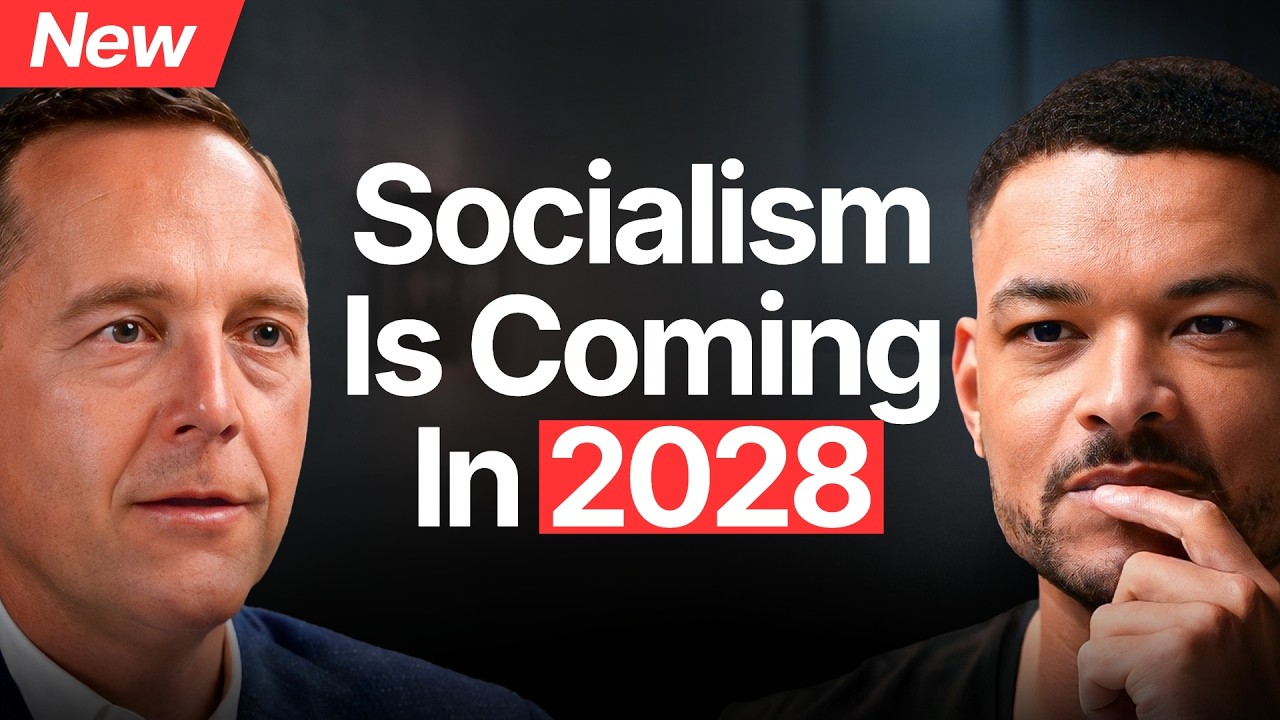
Top White House Advisor: The US Empire Is Declining And Socialism Is Coming Next! | David Friedberg
Now Playing
Top White House Advisor: The US Empire Is Declining And Socialism Is Coming Next! | David Friedberg
Transcript
4049 segments
It's inevitable that socialism will
happen in America, but I don't want to
lose my agency, my liberty, my freedom.
>> Do you think the US as an empire is in
decline?
>> The answer is yes. I was appointed to
President Trump's Council of Adviserss
in Science and Technology. And one of
the great lies is that the government
will save you. But the more government
has tried to create services for people
and help bring them up the ladder, the
more expensive those things get. [music]
63% of Americans live paycheck to
paycheck. People can't afford to pay
their bills and it needs to be fixed.
What will ultimately happen? So, all my
politician friends are about to chop my
head off about this, but
>> David Freeberg, what is the most
important subject of our time?
>> AI. We're entering this golden age, and
people don't realize we're in it. And I
don't buy into the narrative that
Daario, Elon, and Sam [music] end up
having all the value in AI because in
the next 10 years, there will be a
billionaire that will emerge that has
zero net worth today, downloaded open
sourced AI, and built a company that
made them a billionaire. And they're
going to be someone that's going to come
from nowhere. And there's going to be a
lot of these sorts of stories.
>> But this narrative that AI will take
jobs [music] away, you don't believe it.
So from data, from evidence over all
periods of technological [music]
revolution like this, we've never seen
jobs decline. And the average person
doesn't see it. But oh my god, the stuff
we can do is unbelievable. Right now we
have a billion people in [music] the
world that are starving. We have
hundreds of millions dying from curable
disease. These are the sorts of things
that are [music] going to get resolved
because AI unleashes this capacity for
human advancement and it's transforming
every aspect of biology and our
understanding of life sciences.
>> So I wanted to ask you, do you think
we're going to be able to live forever
soon? The truth is
>> this is super interesting to me. My team
gave me this report to show me how many
of you that watch this show subscribe.
And some of you have told us according
to this that you are unsubscribed from
the channel randomly. So favor to ask
all of you. Please could you check right
now if you've hit the subscribe button
if you are a regular viewer of the show
and you like what we do here. We're
approaching quite a significant landmark
on this show in terms of a subscriber
number. So, if there was one simple free
thing that you could do to help us, my
team, everyone here, to keep this show
free, to keep it improving year over
year and week over week, it is just to
hit that subscribe button and to double
check if you've hit it. Only thing I'll
ever ask of you. Do we have a deal? If
you do it, I'll tell you what I'll do.
I'll make sure every single week, every
single month, we fight harder and harder
and harder and harder to bring you the
guests and conversations that you want
to hear. I've stayed true to that
promise since the very beginning of the
D of Sio, and I will not let you down.
Please help us. Really appreciate it.
Let's get on with the show. [music]
David Freeberg, you're someone that
graces lots of different subjects. If
you were to sort of self-define who you
are and what you do, now this is
difficult because you've got to kind of
put yourself in a label here. What would
that label be? How would you
self-categorize yourself?
>> I would say I'm deeply curious about the
world and the universe and how it works
and why it works the way it does. And
I'm a big believer in human agency to
affect the universe around us. And
that's kind of my core kind of driving
motivation. A lot of the other stuff
ancillary is about how do you enable
that?
>> And I think that that's sort of probably
where I also spend some time is in the
enablement of those things.
>> Got a nice cute photo here of that kid
that wanted to be Einstein.
>> Yeah.
>> And then as it relates to how that
manifested into like a professional
journey, what's your professional
journey been for anyone that might not
know? I started in college majoring in
math and physics and then I changed my
major to astrophysics and it was during
the time I was in college is when
the.com boom happened in the heart of
Silicon Valley. There was a kid in my
dorm room who started a website selling
DVDs online and he sold it for a million
dollars in our junior year of college.
That was like an unbelievable
unfathomable amount of money. And so
there was this change that was happening
in the world. And I got enamored with
this idea of businesses and how do you
use businesses to change the world, not
just use scientific discovery as a
method to change the world. So I decided
to go work in Silicon Valley. I
interviewed for jobs. I didn't get a lot
of offers, but I played a lot of poker
during uh my college days. It's how I
was able to make money. I read all the
strategy books on playing poker. I
actually spent a year working in a pool
hall and the manager of the pool hall
and the bookie invited me to their home
poker game. Took all my money that I
made at the pool hall. I was making four
bucks an hour, 425 an hour. And so I was
like, I'm going to learn poker. So I
learned it. That's how I made money. And
I put that on my resume when I applied
for jobs after college. And I got
interviews with investment banks. And
the investment banks were like, oh, we
want to talk to a kid that knows how to
play poker. Cuz this was before internet
poker, before ESPN poker. So it was like
an interesting thing. And so I ended up
getting a job working in investment
banking and then worked in on tech
companies. So then I got to learn
business, finance, accounting, mergers
and acquisitions, all this sort of
stuff. And then I ended up working at
Google. I worked at Google when it was
started when it was a just under a
thousand employees and I left a couple
years later started a business uh called
the climate corporation and so I've been
in Silicon Valley my whole career
>> and that company you end up starting
does pretty well
>> the climate corporation
>> the climate corporation
>> that one we sold in 2013 so we sold it
for a little over a billion dollars
which was a great outcome for investors
and shareholders and today you know it's
software for farmers
>> and today that software is now owned by
Bayer which is the big kind of pharma/ag
company. Uh it's used across 200 million
acres every year. That's a pretty
sizable amount of farmland that uses
that software still. So yeah, it's it's
done fairly well.
>> So I'm 33 now. You were 33 when you sold
that?
>> I was 33.
>> 33. A lot of money, 1.1 billion. And
you've done lots of other things since
then, which we can go into. But you've
also, I think from March this year, you
were appointed as an adviser to Donald
Trump. Yeah, I was appointed to
President Trump's Council of Adviserss
in Science and Technology. And
>> what does that mean in reality?
>> So, if you look back in the last couple
administrations, there have been
different themes over time on who is
appointed to PCAST. In historical
context, like Bill Clinton had a PCAST
that was set up just for the internet.
>> Pcast,
>> president's council of adviserss in
science and technology.
>> And so, he set one up focused on the
internet. And this current pcast under
this administration is heavy in AI. So
it's like Mark Zuckerberg, Mark Andre,
Sergey Brin, that that's kind of the
cohort that's on this advisory council,
but it's always included folks that are
involved in things like biotechnology,
sciences, and to help guide science
policy for the administration. So it
involves having conversations with
people in the administration on things
that are happening in industry, things
that are happening on the frontiers of
science and technology to help guide
some of the policy decisions that the
administration is trying to create or
enforce. And what is the most important
subject of our time?
>> AI. And right now the big question in
the United States from a policy
perspective seems to be the regulation
of AI. What role should the government
play in determining where AI goes, how
it gets built, how it gets deployed, who
gets to use it, who owns it, where the
value lies. a lot of these factions that
emerge inside a government even today on
the same political party on whether or
not for example to allow Chinese open-
source models to be used by American
businesses. You know these
[clears throat] Chinese models are as
good as or in many cases better than
private American models and because
they're open weights you can download
them and run them on any computer you
want that works. A lot of companies want
to use those because they're cheap.
there you can pay effectively 50 cents
for a million tokens of output which is
a measure of how productive the model
is. You know this is a a token is kind
of like a word versus $50 from anthropic
which is a private model. So the
question is do we allow these Chinese
models to kind of become ubiquitous in
industry and if so what does that do to
American AI? What does that do to our
capacity to compete?
Is there security risk? Uh so there's a
lot of this kind of debate underway. Uh
and that I think is probably the hot
topic dour. I don't know if it's the hot
topic tomorrow, but today that's kind of
the big thing. But all of this this
administration I think from a science
and technology policy perspective will
probably be viewed as on the one hand
what's the enablement acceleration
regulation of AI and on the other hand
you know there's this question still on
what is science today in an era of AI
science is also changing and so there's
this kind of I think big shift underway
>> we'll go into those subjects
specifically the subjects on AI and
everything that it interfaces with but I
think it's important also to get kind of
like a a backdrop of the economic state
and like the social state of the nation
because all of these things feed into
these big questions on AI and they also
inform everyone's biases on this subject
because if you're at a different sort of
socioeconomic position or if you're
feeling a different thing your
perspective on AI is going to be
radically different. So if we started
then first on like if we just focus on
the United States which mean in some
respects is a little bit of a proxy for
the rest of the western world. Where is
the United States at at this moment in
time in terms of is it on the rise
inequality? What are the what are the
sort of pertinent factors here that help
us understand the backdrop of this
nation?
>> The biggest drivers for this nation at
the moment in terms of what public
policy and private markets will do is
number one the unaffordability crisis.
>> What does that mean?
>> 63% of Americans live paycheck to
paycheck. They don't have enough savings
to pay for a fiscal emergency in their
household. 63% of Americans and the cost
of things is rising faster than wages
are increasing. So things feel less
affordable to most Americans. And then
there's this wealth inequality concern
which I would say is both kind of a
perception issue. There's definitely
policy issues that has allowed it to
happen and we can talk about those. But
I think America is in this kind of
crisis of classism, this crisis of us
versus them. And it manifests in a lot
of different ways. So, you know, you had
Ray Dalio on, and if you think about Ray
Dalio's kind of like cycle of empires,
you know, this is this idea that there's
been six empires in the last 500 years
and the United States is on the decline
and China's on the rise. And it can be
measured across a number of different
dimensions. One of which is this crisis
of internal struggle which manifests
often with external struggle, the Iran
war. Like why can't we stop having
external wars? Well, you know, a nation
that's happy with itself generally
doesn't go to war. A nation that's not
happy generally does go to war. And so,
um, a lot of this stuff gets tied up, I
think, in this economic distress that
the United States is feeling. My
contention
which may not be very popular is that
the more government has tried to uh
create services for people and help
bring them up the ladder the more
expensive those things get
>> i.e. socialism
>> policy in the United States and this is
one of the great lies and I think
there's a series of great lies in US
policy over the last half century but
one of the great lies is that the
government will save you the government
will help you by giving you these
essential services that you want more of
education healthcare housing and as the
government has entered into those
markets because remember there are
people making those things offering
those services and there's someone
paying for it so as the government
enables more money to flow into those
markets, the cost of those things has
just gone up. And you can see how this
plays out, for example, in education. So
higher education, if you want to go to
college in the United States, and I'll
just give you a statistic. 30 years ago,
administrative staff were like 10% of
colleges. Today, they're like 60%. In
just 30 years, give me a rational reason
why we should have 6x the administrative
staffing at colleges and universities.
There isn't a good reason why. The real
reason is that because the federal
student loan program doesn't
discriminate against a university on how
well they do with their graduating
students or the degree or the individual
that's taking out the loan. The federal
student loan program has just allowed
more money to flow in to universities.
Now, if you're a university
administrator, there's no constraint on
how much you can charge for tuition. So,
hey, we'll raise tuition 5% this year.
We'll raise it 8%. We'll raise it 10%.
And we'll hire more people. And if
people hire more people, they get a
higher salary. If you think about the
individual, I don't get to make more
salary until I'm a manager. Now I want
to be a director. Now I want to be a
senior director and the organization
grows. That's very natural for any
organization whether it's a nonprofit, a
university or a private company. You
want to grow and people want to make
more money year after year. So they
because they can collect more money can
charge more for tuition. There isn't a
natural market force that says your
tuition is too high now because the
government has provided unlimited
funding to higher education through the
federal student loan program. So, as a
result, education has gotten so vastly
expensive that everyone now looks at it
and says, "We got to do something about
this." And both parties seem to say,
"Well, here's what the government's
going to do to do more." And it's like
putting fuel on the fire. So, the
challenge right now is people are
feeling left behind. There's massive
wealth inequality. Things are extremely
unaffordable. And the solution that's
being embraced is for the government to
do more, which the facto leads to
socialism. What is wrong with socialism?
I would argue that the key measure of a
country's success is how many people are
transitioning from labor to capital each
year.
>> What does that mean?
>> That means every year I'm working
paycheck to paycheck. I'm collecting
check. I I I I graduated college. I had
$19,000 in debt. I went and worked. I
got paid. I saved up. I paid down my
debt. I was able to get out of it. Then
I worked at Google. We had an IPO.
Suddenly I had assets. I had stuff. I
had money in the bank account. And it
was like an incredible moment for me.
And I said, I could live off that money.
I don't need to live off a paycheck
every month. I now have savings. I have
assets. That is capital. And everyone
talks about capital versus labor. But
the real advantage of America is
enabling people to go from labor to
capital. Every individual that works,
saves, invests, does whatever they need
to do to accumulate enough capital ends
up in the capital bucket. And then
you're no longer stuck needing to go
paycheck to paycheck to pay your bills.
That's the dream. That's the real
American dream. It's not just about
owning a house. If you own a house and
you own a have a bunch of debt and you
got insurance payments to make and you
still got to work every month to make
those payments, you're not necessarily
living the American dream yet. The
American dream is being freed of that
burden
>> because you can live off the interest of
your assets.
>> That's right. And so you're earning
income. You like, let's say you have
$100,000,
you know, saved and you can make 10% a
year on that. That's 10,000 bucks.
Suddenly, if you get to a million dollar
saved, you can make $100,000 a year and
you can live on that. That's economic
security. That's financial security.
That's what we should give to every
American is the ability to own assets
that give them freedom to choose what
they want to do in their life rather
than be stuck in work. And the problem
with socialism is it takes away that
transition moment. It eliminates it
because it says everyone has to be labor
all the time for the rest of their
lives. And then no one has freedom. And
that's what America was founded on was
this ability to find through freedom of
choice, through agency, the ability to
transition from labor to capital. And I
think our goal as a country should be
get 2% of Americans across that line
every year, then I think we'll be
successful going forward. But if
everything's all about like give people
more stuff and have the government do
it, we're just going to keep raising the
debt, making things more expensive,
inflating the cost away, and it's
inevitable that socialism will happen in
America. It's absolutely inevitable. Do
you think the US as an empire is in
decline
>> in terms of the power of the dollar in
terms of prosperity of Americans? The
average American or majority of
Americans the answer is yes. But um the
potential hasn't been deleted meaning
decline is not inevitable to be very
clear like we are not yet at a point
where it's a runaway train. In the
history of democracies, there's never
been a place like America where an
individual like myself, you know, moving
here from South Africa, going to public
college, graduating with debt, and then
being able to work my way out of the
debt and find myself in the position I'm
in today with no nepotism, with no
handouts, with I mean, you could argue
about privilege and all these other
sorts of things that I was vested over
my life. But like, it's an amazing place
that that sort of story can be told a
million times over, that there's not
just one or two people that this has
happened to, but there's millions of
people. The problem is it's all the
other hundreds of millions that didn't
get to live that opportunity. And if we
can fix that, America is not in decline.
America is a prosperous nation and has
centuries ahead of it.
>> When you look at this, you're talking
about runaway trains. When you look at
the national debt, though, it does look
very much like a runaway.
>> Want to know where inflation comes from?
That's where inflation comes from. By
printing more dollars to pay for that
debt, which is what happens, the Federal
Reserve buys the debt and they issue
dollars to the bank system to to buy the
debt from the government. Remember, the
Federal Reserve is separate from the
government. So, the Federal Reserve can
print dollars. They can send dollars to
banks and now the banks can loan money
out and it makes its way into the
economy. Now, there's more dollars in
the economy and that money was, you
know, owed back to the government at
some point, but the Federal Reserve may
never get paid back. They may just keep
adding and adding and adding and adding
and they're just printing more and more
dollars.
>> Is that sustainable?
>> No.
>> So, so I I don't understand the force
that's going to intervene to stop this
sort of compounding debt.
>> The outcome of this is socialism. That's
the moment we're in right now. That's
why we're seeing this wave of socialism.
I've been saying for five years, we're
going to face a wave of socialism. And
after Donald Trump was elected, my
prediction for the next year was that
the next wave in politics in America
will be socialism. And people thought I
was crazy. And I'm like, it is
absolutely inevitable. If you look at
this, this is where we're headed. It it
is deacto socialism when the government
employs roughly 1/ half of the people of
the United States. Right now, if you
look at all the federal, state, local
agencies, so the people that are
employed, the people that are
contractors of those agencies, and then
um the people that live off of uh some
sort of government pension or social
security system, the total amount is
close to 50% of Americans. So, we're
getting to a point where people are
like, the only place I can go is more
money from the government. And then
eventually the government becomes the
whole economy.
>> If the outcome of socialism was the
cause, capitalism,
>> it's a great question. I think it was
capitalism plus policies. Let's say you
have a million dollars.
>> Yeah. you're making, say, 10% a year.
Next year you have $1.1 million. The
next year you have $1.21 million or
whatever. And you keep adding it up.
That's called compounding. After a
couple of years, your million dollars
turns into $10 million.
>> And you never have to sell shares along
the way. You can just own the shares and
whatever's going up. Your value just
keeps going up. You've never paid taxes
along the way. Boom, boom, boom, boom,
boom. And suddenly, fast forward a
couple years, instead of having a
million, you've now got 10. That's
capital compounding over time.
Meanwhile, if you're working, every
paycheck, taxes are taken out. Every
time you get a check, every time you get
more money, more capital, taxes are
taken out. So, if you don't get capital,
if you don't get enough savings to allow
you to compound, you are never going to
get there. So, from a tax policy
perspective, labor working for your
money should have never been taxed
higher than earning returns on your
capital. So you're saying tax the rich?
>> I'm saying tax capital at a rate that's
equivalent to labor.
>> Wealth taxes.
>> Wealth taxes are asset seizures.
Definitely no. So one of the principles
of the United States and the principle
of what this country was founded on is
private property rights. If you go back
to England, right, like 500 years or
like let's just do let's just talk
Europe broadly. There were very few
places where you as an individual
citizen had rights to own private
property. There were very few places
where you could say I have this thing
and it doesn't belong to the king or it
doesn't belong to whatever the local
lord is. Like everything was the
property of the lords of the higher
class of the upper class. It was endowed
to them as vested to them by birthright
for centuries. Same in Asia, same in the
Middle East, same in Africa. I mean like
every nation started out with this
system where people didn't have rights
to private property. Those who had kind
of these systems above could decide who
got what. So the United States was
founded on one of the principles of
private property for an individual that
you you know I think when they were
drafting the Declaration of Independence
it was about life liberty and the
pursuit of property and they later
changed it to pursuit of happiness and
the pursuit of property was really the
measure of what you've accumulated as an
individual. You now have a right to
accumulate things. You now have a right
to build value to build wealth to build
a house and and have your family in your
house and have all these things. That
was a principle of the United States.
I'm all for taxes when people transact.
When they turn their stock that they've
held for a couple years into cash and
buy something with it, boom, tax. You
get taxed on that. If that's the right
model, that's when you should get taxed,
right? Then when you're able to turn
that asset that you own into another
asset. So that's what we do today.
That's an income tax or a capital gains
tax, like when you realize that gain.
But if I go into your shares and I'm
like, "Hey, I'm going to take 5% of your
shares." What are you losing? Well, you
can't use those shares to buy anything
because if as soon as you try and buy
something, you owe tax on those shares.
So, by taking away your shares before
you've actually transacted with them,
before you've actually sold them, or
taking away your private property, your
home, or giving the government the right
to come in your garage and audit
everything you own, and say, "Hey, this
year we're doing a 2% tax that is
antithetical to what the United States
was founded on, which was a founding
principle of private property." Now, if
your property goes up in value, and then
you eventually turn it into some other
property, that's a transaction. And
that's when you get taxed. That's how
the system's set up. So if we have an
issue with people having too much
wealth, that's the moment to increase
the tax rate. That's capital gains tax,
income tax on high earners. Those two
things can get you 97% of the way there.
And you're not really going to gain
much. You know, separately, we can kind
of talk about the numbers on this, but
like tax the rich, all for it, but tax
the rich when they transact, when they
sell, when they when they have a capital
gain, if they borrow against their
assets. This is another thing that's
that's wrong about our system today. If
I'm very wealthy, I own a bunch of stock
and I've never sold any of the stock. If
I borrow against my stock to go buy a
yacht, I don't pay taxes.
That should be a taxable event. We
should fix that. That's an easy fix in
the tax system. I'm not taking away your
private property, but as soon as you
borrow against that, it's effectively
like transacting on that property. So,
that's a moment to pay a tax. And if we
think that the rich aren't paying enough
taxes, you can raise income tax or
capital gains taxes to get them to pay
more. This is what I was going to say,
but you you arrived at it was most
people that own stock in big companies
will just borrow against their stock and
they never pay a tax.
>> I didn't know this until I was I'm going
to say 26. And my company had gone
public and the this bank in Europe
approached me and said, "By the way,
we'll give you 20% of whatever your your
the value of the stock you have in my
company called Ocean AG
>> is a tax-free loan." I was like,
"Explain this to me."
So, you'll just send me millions of
pounds and I don't have to pay tax.
>> You don't have to sell your shares.
>> You don't have to sell anything. I said,
"Well, look at the rest of my
portfolio." And I had some Facebook
stock at the time. They're like, "We'll
give you 50% to 60% loan to value on
that. I.e., if you have a million
dollars of Facebook stock, we will
transfer you today 700 grand taxree and
I can do without whatever I want." I
thought, "Fucking hell, this is what the
rich do."
>> That's exactly right. And the truth is
that no one talks about behind closed
doors. Everyone knows that it needs to
change,
>> but no one wants to say it because
>> I'm saying it.
>> Yeah, it's
>> got to change.
>> What's interesting about that is say
that I have 10 million of Facebook stock
and I I take a loan and they give me 5
million in cash. What a rich person then
does is they take that 5 million and
they go and buy other assets.
>> Exactly. Right.
>> And then they start acquiring more and
more assets. That's what's unfair about
the system because then when you have
capital, you're accumulating more
capital while labor, if you haven't made
that cross that chasm from labor to
capital, you're still here grinding
every month, grinding every week, trying
to pay your freaking bills, and then
these guys have all these shenanigans
that are going on. Yeah,
>> it is wrong and it needs to be fixed.
The answer though is not taking private
property. As soon as you start taking
private property, those gates are open.
By the way, it's not even going to be
constitutional in the United States. The
fifth amendment has this taker clause.
you know, it's not it's legally like not
going to win in federal court. It could
work in some states. Some states there's
seven states that actually have a
constitutional ban on private property
tax like this. There's uh you know 43
states where it's game on and we'll see
how they play out in the courts as they
try to pass these wealth taxes as well.
But these are asset seizure taxes there.
You you can have a wealth tax by raising
capital gains, make high income or high
asset people pay more taxes or whatever
when they sell stuff or when they buy
stuff. There's a lot of ways to tax
wealth. But taking assets from people
after they've paid their taxes or before
they've paid their taxes is not the
right way to do it.
>> What will ultimately happen?
>> So the ultimate outcome will be that 51%
of people will say, "Hey, give me all
the stuff that the 49% have." What would
stop them from doing that? Because
ultimately you can take as much as you
want from a minority of people and
distribute it to the majority. And that
minority starts out with a few
billionaires, then a couple more 50
millionaires, then a couple more 10
millionaires, then millionaires, then
100,000. And there's no limit to where
this thing goes. And that is socialism.
>> And what what does that do in terms of
how talent moves
>> and how people, you know, move to
different places.
>> I know billionaires.
>> Yeah.
>> Many of them have moved or are planning
to move out of California. Yeah.
>> Just on the threat of this.
>> And [clears throat] people say, "F them.
Good riddance. Get rid of them. You
know, the top 1% of taxpayers in
California pay the majority of taxes in
the state. I think it's probably it's
definitely north of 40%, but it's
probably the majority.
>> The top 1% of earners pay 40 to 50% of
California's total personal income tax
depending on stock market capital gains
performance.
>> There you go. So, that 1% are the people
I'm talking about that are leaving the
state because they see where this is
headed. I don't think California wants
that. [laughter]
Those are very productive people for the
state. They're people that create
companies that hire people that pay
well, go to fancy restaurants, pay for
cars. I mean, they support the economy.
It's not just the taxes, but they're a
big part of capital flowing through the
economy. We saw this happen in France.
You know, France had this wealth tax and
then their total tax revenue declined by
more than they were making on the wealth
tax because everyone left France. Then
they stopped doing the wealth tax and
everyone came back and the income came
back. So, this is a wellstudied kind of
case. So, I don't think that a wealth
tax or an asset seizure tax is the
solution. I think we've got to fix all
the other stuff that we've talked about
and we've got to fix the government
spending problem. And if we can do those
two things, then I think we can bring
inflation down. We can bring the wealth
inequality down and give more people the
ability to make that transition. But I
do think every politician should be
talking about the focus on what percent
of people in the United States every
year are moving from labor to capital.
How many people can say, "Hey, I've got
enough cash to retire if I wanted to."
That's what we want to try and get
everyone towards. Not just convincing
people, and this is one of the great
lies, convincing everyone that the great
American dream is to own a house. When
owning a house for a lot of Americans
ends up putting all your capital in one
asset, and you've got to basically get
the price of housing to go up every year
to keep everyone moving up the ladder.
So now, fast forward 30, 40, 50 years,
young people can't afford to buy a house
anymore because we've pushed the asset
value up so much to try and make sure
that everyone's got good good household
wealth. We are told that I mean that's
the sort of central idea once you leave
university is to figure out how quickly
you can get a mortgage or buy a house.
>> Great lie. It's one of the great lies.
And there's a lot of countries where
people have been able to accumulate
capital and jump that that ravine from
labor to capital much more quickly when
they don't buy a house because they can
invest in stuff. They can buy, you know,
the the S&P 500 which you can just buy
on an Erade or Robin Hood account and
you can just own it on average will make
you 10 11% a year. You just put your
money in that you're making 10 11% a
year and it can go up every year and you
don't have to pay taxes. You don't have
to pay property tax. You don't have to
pay insurance. You don't have to deal
with repairs and maintenance. All that
sort of stuff. So, a lot of people would
have been better off, depending on the
markets that they're in. There's some
markets that that ballooned, but a lot
of people would have been better off
over the last 30 years, actually owning
the S&P 500 than owning their home and
paying for the rent on a home.
>> One of the things I see in the comment
section whenever someone makes that
point is you'll have someone who bought
a house 20 years ago saying, "Well,
listen, I bought a house 20 years ago
for this amount, and now it's worth
this." And this is every single time
that I see this this argument being made
from financial advisors or investors,
that is always the top comment is,
"Well, I bought one and I did good."
>> Yep. It actually indicates a problem,
which is if your house went up in price
so much, that house is much less
affordable to a young person that's
going to buy it next. And that's what we
fundamentally done with this asset
class, residential real estate. We've
created a system whereby residential
real estate prices go up so much and
there's a whole bunch of policies around
making this happen.
>> Got a graph here showing all the things
that have gone up and you can see
housing is one of them.
>> Yeah. The stuff on the bottom the
government doesn't touch. The stuff on
the top the government touches. And so
the more the government's involved, the
more expensive these things get. But all
of the policy around residential real
estate has allowed the middle class in
America, which has the majority of
wealth, and I'll give you the statistics
in a minute, to grow their asset base,
to accumulate more assets, to become
wealthier. All the boomers, they're so
wealthy because they owned all these
houses. And now young people graduating
college can't afford a house. It is a
bad fact that a lot of people got very
wealthy by owning a home because it
means that the next generation is going
to say, "I want socialism cuz I can't
afford a home." That's the moment we're
in. 40 million Americans graduated from
colleges in the United States in the
last 10 years. 45 million. So if you do
the math on this, that's a large number
of people that are now on average
encumbered with some amount of student
debt, facing a challenging job market.
And then the only way to buy a home is
you got to come up with a million bucks.
And you know, it leads to this problem
where everyone's like, "Man, I need mom
Donnie." So what would you say then to
people that are in that 62% was it
>> 63
>> 63% of people
>> and that statistic changes year to year
but that's roughly the number 63% of
Americans you know less than $500 of
savings and working paycheck to paycheck
and can't pay for a fiscal emergency.
>> So for those people the the 63%
who you're telling them that buying a
house is now like unaffordable it's and
also it's potentially not a good
investment if they're trying to sort of
cross that cousin and get over to the
side where they have assets. What would
what would your prescription be for
them? What should they do?
>> Man, that's a great question. People
will challenge it, but I would have
never thought that podcasting would be
such a massive business. I would have
never thought that being an Instagram
influencer would be such a massive
business or a Tik Tok influencer. I
would have never thought that individual
artists could publish online and make
money without getting a record deal. I
would have never thought that individual
artists would be able to sell their work
and make a living on eBay and Etsy. I
would have never thought that crafts
people would be able to find jobs
through the internet. I I think the
internet has been this incredible
enabler of millions of new ways to work,
of new ways to earn an income. And a lot
of people will roll their eyes and say,
"But that's not what the system was
supposed to have set me up for. The
system failed us." Maybe the system did
fail you. And maybe the government's
solution wasn't the right solution, but
human agency is what got all these
people there. They all got to this
place. Did the government give you your
job as a podcaster? Did the government
teach you how to podcast and build this
incredible media empire that you've
built? I don't know if the government
played much of a role in it. I think you
played the role in it. I don't know. You
tell me if I'm wrong. But I think that
this is really important for a lot of
people to observe firstly, which is the
government isn't going to save
individuals.
The government's going to make things
harder for individuals to find their
path. If I have to go and start a barber
shop, I got to go get all these
cosmetology licenses. I got to go figure
out a way to go to school, pay thousands
of dollars, get health inspections done.
There's a lot of government layers that
stop me from doing that work. There's a
lot of ways that the government actually
inhibits people's agency and makes it
harder for them to do the things that
they want to do and progress. I think
that's just fundamental for me, one of
the observable truths. But I think the
second thing is I never discount human
agency. There was this great um podcast
done years ago by those guys at the
Hoover Institute where they talked about
the success of China and a lot of
people, you know, where China grew GDP
per capita from like 3,000 to 30,000 or
whatever it was and they're like, "Man,
Chinese central planning is brilliant.
They're so good at this." And these guys
made the argument which I discounted at
the time but I often think about
nowadays that it was actually the agency
of the individual choice, the
entrepreneurship, the drive, the
motivation of the population of the
individuals in China, not central
planning, but basically the government
enabled free markets. They allowed
people to work. They allowed people to
trade. They allowed people to create
value for each other to do something
that someone else might want. They
looked around and they said, "I think
you want this." and they started making
it and when the government loosened the
shackles on individuals that population
grew the economy and the government
still has a big role in central planning
in China but it was a really important
point if you think about all the success
that's come from the United States it's
not a central message that the
government said let's do this and then
we're going to do this and we're going
to do this it's individuals making their
own choices you've seen what people want
to learn what people want to watch what
they're interested in and you give it to
them you create value for them you
deliver that value and you've you've
earned something from that people are
willing to pay for that. And I think
that that's core to kind of where we can
go from here. And I don't think we teach
it in schools. I don't think we teach it
as a value. We've lost that value of
agency. The importance of the individual
taking their own action. Every
conversation we have in every frigin
context is all about the freaking
government. Government this, do this, do
this, do this, do this. For me, what
individuals can do is limitless. And
that's where I think we fall short.
Every day someone should ask themselves,
I tell my kids this, but what did you do
today that someone else valued? And if
you focus on figuring out something that
you can do that someone else can value,
then you do that over and over again,
rinse and repeat. I think there's paths
for people.
>> So, couple of counter-arguments here.
Yeah.
>> So, we can stress test this thinking.
Um, you pointed at me and said I was,
you know, I started podcasts, I started
businesses, those businesses grew. Um,
and it was, you know, you were very
generous in giving me probably more
credit than I deserve there. But if I
was to, if I was to rebuttal that, I
would say, I was born in Africa. Would
that have been possible in Africa? Would
that have been possible in like Nigeria,
where my mother's from, or would it been
possible in Botswana where I was born?
Is it the fact that I moved to the UK
where I had this sort of foundation of
stability because of the government
where school was free for us? Healthcare
is taken care of. So I never had to
think about those things which allowed
me at 18 years old to like not go to
university, take a risk, drop out, be in
that room. No. When I was sat in that
room in Manchester, I actually at one
point printed off the jobsekers
allowance forms, which are basically the
government will give me free money if I
if I get to the point where my
shoplifting of pizzas um is no longer a
reliable way to feed myself.
>> Yeah.
>> But I had that form on my desk and it
was there. And there's maybe something
psychological about knowing that I had
this sort of like underlying safety net
where I could rush back a 300 mile round
trip to my parents in Plymouth and I
could like live in the house or I could
fill out this form, this job seekers
allowance form and they would like pay
me money that allowed me maybe at some
deeper level to go and take that risk.
And I never even realized the privilege
of like, oh, there's like healthcare and
there's laws and there's roads and
there's like this Wi-Fi thing that
allows me with this laptop in my room to
like build this website that I built.
Um, so that's the government's
involvement in my success. They gave me
this great foundation of stability and
infrastructure.
>> Great. Great role for government to
play.
>> But the problem is that's a slippery
slope, right?
>> That's right.
>> And so there's balance here. There's
nuance of like personal agency, but then
also the government, do you need to give
me a good foundation?
>> That's right.
>> And it's and it starts
>> and the government shouldn't employ you.
And that's the slippery slope that we
end up on. And that's where I worry
about our ability to come back from that
because if you do end up with 40 50% of
Americans getting paid some check from
the government, it becomes very hard to
get off of that check. And then people
vote for that check to get bigger and
bigger.
>> The other point I wanted to point out of
maybe a counterpoint is just like, and
you know this cuz I've heard you say
this before, but like there is a
privilege that we both have in terms of
our just
>> nature. Yeah. Nature, nurture, whatever
it might be. Yeah. And I I said nature
because yeah upbringing implies that our
parents were great to us and that's what
made us whatever. But also the opposite
can be true if you think about someone
like Elon Musk. You go his dad wasn't
that nice to him. So not necessarily a
lovely upbringing but the circumstances
>> he was never without a meal and neither
was I. And I mean you know those are
important facts of privilege. the
circumstances of the of our upbringing
and maybe our nature, maybe our biology,
maybe set us up to be the certain type
of person where agency, however that's
defined. And again, I I pause there
because
>> I think you're exactly right and I think
that that's what education should be
teaching that value that that's that's
where I think this role of like what's
the role of a public school? What's the
role of this infrastructure that
government's building around us? If it's
teaching you that your next job is to
come and work for the city or come and
work for the state, it's not teaching
you that you have agency. It's not
telling you if you if it's telling you
that the only path you're going to have
coming out of this rural school is to go
work in the military, it's not teaching
you about your agency. And I'm not
saying it's wrong to do civil service or
to do military service. I think those
are very important parts of what all of
us should strive to do is to support the
government that makes our society
possible. But I think that this idea
that we should all be proposed as like
the government role, the government
path, the government work is what we
should all be stuck doing for the rest
of our lives is the wrong setup.
>> The opposite is though also probably the
wrong setup which is that we should all
start a business or become a creator.
>> I think that's a mistake too. But I
think that this idea that you can find a
path where you can provide value to
someone as part of an organization as as
an individual as a leader you can choose
your path. But the idea that you should
be accessing your capacity that you can
create value for someone else should be
the objective.
>> Do you think there's always going to be
inequality?
>> Yes. I mean it's either inequality
or it's lack of progress. I think those
are the
>> that's the dance.
>> That's the dance. So China's very good
at this. If you watch their their
policy, they just recently shifted to a
free market policy. They literally just
have like a throttle. Uh, I always
vision AI has this lever in his big room
where he goes like free market, not free
market. Like he's just kind of like
rolling it back and forth. When you have
a free market, people push the frontier.
They discover new things. They make new
things that have never been done before.
They create new value and the economy
grows. The problem is it doesn't grow
evenly initially. So like let's say that
you came up with a goose that lays
golden eggs and AI
>> AI and you've got this technology
And this technology is making golden
eggs. And you're getting very wealthy
with these golden eggs. And then that
goose makes two geese and three geese
and four. It starts breeding and you
start selling the goose. And it takes a
number of years before everyone has a
golden goose. During that time, you've
raced ahead cuz you've got now dozens of
geese making lots of golden eggs for
you. And a lot of people are like, I
want a golden goose. By the time they
get a golden goose, you've now got a
million golden geese. And it feels like
inequality. But the truth is now
everyone here has a golden goose. And if
you told them 30 years ago you would
have a golden goose, they'd be like, "No
way. That'd be amazing." So every day
they're making the golden goose, they're
printing the money, they're buying stuff
with it. That's the problem with
progress, whether it's medicine. You
know, a lot of medicines today are
million dollars a dose for like CARTT
therapies, for example. These can save
you from cancer. Only 50,000 people in
the US can get them every year. And
there's hundreds of thousands of people
that die because they don't have access
to these therapies. So it's limited in
terms of its availability. There's
technology like AI. Not everyone has
access to it. Not everyone owns a piece
of a model, etc. Not everyone's using
it, and the people that are using it are
getting ahead faster than the people
behind.
>> In your golden goose analogy, by the
time that the golden geese get down to
the sort of lower end of the
socioeconomic ladder
>> or def I would I would use the word
diffuse. Yeah.
>> Those those golden eggs or whatever, buy
less
>> because something happens along the way.
>> That's right. So along the way, the
government says, "Let's give everyone
that. Let's give everyone access to more
stuff to make up for that difference."
and then things get more expensive.
>> Is this in part because when the nation
becomes prosperous because the GDP is
high uh when you have four-year election
cycles, politicians get in by offering
you lots of free stuff. And that is the
nature of the four-year election cycle.
>> I always said the the kid that got
elected president in middle school was
the kid who said he's going to make the
vending machines free. That's always
going to be true in any election. And at
the end of the day, that's how the
system grows. We don't talk about this
fourear election thing enough as maybe
as being a bit of a causal factor that's
causing short termism amongst these
leaders where they're all just spending
more money to
>> I cannot tell you how much it drives me
nuts when I go to Washington DC and I go
to Washington DC
every couple weeks or whatever and I
meet with Congress people senators and
representatives literally all of them
just talk about getting stuff for their
constituents. Yeah, that's all that
they're there to do. just get stuff for
their people. That's their job and
that's how they get elected. And the
incentive is I'm going to get you
something. Vote for me. Now, the
founding fathers kind of had this idea
that they would rotate into public
service and rotate out and go back to
private life. There's a lot of writings
about this, you know, in the early days
of the formation of this republic. And
it was like, we should all go do our
tour of duty. We should go in. There was
never this belief that America would
evolve to a world where you have career
politicians. People that are just
constantly trying to get elected and
their job is to be a politician. It's
just such a mind-numbingly crazy idea to
think about. And all my politician
friends are about to chop my head off
about this, but I think it's nuts. I
don't think a person should be a
politician. I don't think that job title
should exist. And I'm sorry to all the
politicians out there. I think the
people that represent the people should
have the best long-term interests of the
people in mind because they should be
constrained to serving for a limited
period of time and then they go back to
private life. That means that we should
have term limits. So you should never be
able to be elected more than two terms
as a senator or you know four terms as a
representative or whatever it is. And it
should be the case that if you're in one
public office, maybe you shouldn't go
transition to other public offices under
those same limits because at the end of
the day, you have created a system
whereby you've proven that you can get
stuff for people and your job is to go
get stuff for people and that causes the
government to inflate, be mismanaged,
you know, and then there's all the
waste, fraud, and abuse stuff that
happens along the way.
>> Everything is a trade-off, right? Even
in that example, if some people did 8
years in government and they know
they're going back to private life, they
could be dealing their friends. I'm
going to do eight years in government.
I'm going to run the transportation
division. I'm going to serve some nice
benefits to my friend who runs Boeing
and then when I step back in, I'm going
to step in as the chair.
>> That's a law to make sure that doesn't
happen. And he goes to jail if that
happens. That's a pretty easy fix. You
can't buy stocks. You can't own stuff.
You can't trade. I mean, there just so
many obvious things. If you're going to
go serve in government, you can't do
stuff that you can do as a private
citizen and you shouldn't be able to
enrich yourself as a private citizen. If
you do, you should go to jail. But we
should also make sure that the incentive
structure is set up right so that good
people come and work in government and
that we have good rotation between
public and private life.
>> It's a hard problem though, this problem
of how you fix this incentive structure
so that you don't just get I mean this
stuff inevitably happens cuz we we hand
out lots of free things and we don't
think about the long-term consequences.
Has anyone fixed it globally? Is there
any nation you look at as a model for a
better
>> you know a lot of people will point to
Denmark they'll point to places like
that and say hey these guys do a great
job and you know there's a lot of public
services and people pay high taxes but
you know there's not a lot of great
progress there's no entrepreneurial
success coming out of those places what
happens in America the freedoms that
were afforded the individual agency and
liberty and rights to private property
creates an incentive structure that says
go try and do crazy stuff that could
work And if it works, there's tremendous
return. So it's worth taking the risk.
And that level of risk is what pushes
the boundaries. It's what discovered
CARTT therapy, what discovered gene
editing that can lead to curing human
diseases. It's what's discovered new
advances in agriculture, new physics,
new engineering, AI. All of these things
came from this risk-taking system that
we've set up in the United States that's
built around these individual
incentives. And it works. So you can
have great comfort for a great many
people in Denmark and people will be
very happy living there and they will
have a good life, but you will not have
progress like you have in the United
States. And we push the frontier because
we create this incentive structure and
that's where progress comes from.
>> Would you say the vast majority would
choose to live in a place like Denmark
if it, you know, I'm looking at some of
the stats here. They have higher
societal trust in government, police
institutions, and strangers. They have
standard 37hour
work weeks, 5 to six weeks of paid
vacation and cultural emphasis on
balance. They have lower ceiling of
extreme wealth but a higher floor so
less poverty and financial ruin. And
according to global happiness metrics,
Denmark consistently ranks significantly
higher than the United States. Most
people would choose that, right?
>> Absolutely.
>> So central planning, it might stop a
few, you know, very high agency
ambitious people, but the vast majority
would theoretically be happier with a
Denmark model. the vast majority maybe.
>> And do you think the vast majority of
this country actually would if there was
two buttons and they had to press they'd
press Denmark.
>> One of the things that I think makes
American culture different from Denmark
is this idea of individual progress.
So I think if you ask the majority of
people, you can have that, but you don't
get to progress. Meaning you don't get
to earn more next year and you don't get
to earn more next year. You don't have a
shot at becoming a millionaire. You
don't have a shot at building something
great. You don't have a shot at buying a
second home. You're limited. But you get
that over here. You don't get anything
guaranteed to you or you get some stuff
guaranteed to you, but you don't get
much more guaranteed to you. But you
could have the world.
You could make a million dollars. You
could own a second home. You could buy a
second car. You could pay off your kid's
college tuition debt if you earn well.
There's more options here. There's more
guaranteed here.
>> You think the 63% would pick? I think
even within the 63% there would be some
percent that would say this. But I do
think this is why we're headed the way
we're headed in the United States.
People want more of a guarantee. The
question is, do you want to maximize the
number of people that are happy or do
you want to maximize the number of
people that are truly free? And by being
truly free increases the rate of
progress across the whole population.
And that rate of progress may be
asymmetric. It may be diffuse. Starts
with some makes its way to others over
time.
I think that that's what America's
chosen to be for the last 250 years. I'm
not sure we're choosing to be that for
the next 250 based on what's going on
across the country right now.
>> Maybe because people aren't happy and
actually maybe that was always the more
important thing versus progress.
>> Important in an aggregate way. Again,
I'll come back to the individual.
We choose to live in a society because
it gives us that foundation that you
described, that ability to have the
safety, the security to take risk, to
make our own decisions, and potentially
build a media empire as you have done.
And maybe you would have been happy in
the other context where you didn't have
that, but would you have reached your
potential as a human?
>> I'll be honest, I'm not sure I would
have been happy because again, that goes
back to my own nature. It's just the way
that I am. If you put me in a room, I'll
try and create something and build
something. But I I've come to learn with
time that not everybody has that bias or
those desires. Not everybody has that
loerty trauma from their childhood of
being the only black kid in all white
area and thinking money was really
important and it was freedom and it was
selfish. Like not everybody has has
that. So I I realized that when I design
solutions, they shouldn't probably be
designed for me. Yeah. You know, it's
taken me a long time to get to that
place cuz I kind of I was very much
>> the challenge with America in this
moment is can you give what you're
describing the Denmark answer to enough
Americans without taking away the
liberty that the Americans that want to
have that liberty have today. And I'm
not sure the answer is yes. As soon as
you start taking private property from
these people, the ones that are
successful in this bucket,
>> then you're sort of taking away the
incentive for them to be in this bucket
in America.
>> And I'm seeing that.
>> Yeah. I see people want to leave and so
you're not going to solve for everyone,
but if you solve for this Denmark
solution, I think you lose a lot of
this.
>> Well, the UK is quite an interesting
example here for this very reason. I
mean, one of the big subjects of
conversation in the UK is that the the
millionaires are all leaving or at least
in high volume and they're coming to
other places. If you look at the
millionaire access maps that they
publish often, they're going to Dubai or
they're coming to America. A lot of my
friends that are building technical
companies in particular have come over
to America.
>> Yeah. for this reason.
>> Yeah.
>> And I do think we might have a little
bit of a we have a bit of a spending
problem, it seems, but also I think we
might have a bit of a productivity
problem
>> in the UK.
>> In the UK.
>> Yeah.
>> Well, do you think the productivity
problem is related to the spending
problem?
>> Oh, yes, of course.
>> Right. If you're collecting checks or
getting services provided to you, the
incentive to be more productive as an
individual goes away. But also as a
system, it becomes a lot harder to
create economic incentives for
productivity gains when tax rates are
very high and you don't actually get to
reap the benefits of the risk you take
and and so on. That's the economic
argument.
>> Listen, I've been catfished by furniture
my whole life where something has looked
fantastic in the picture, whether it's a
sofa or whatever it might be, and I
order it and I get so excited and then
it comes and it's something entirely
different. the quality was significantly
different to what it said or looked like
online or the the texture was different
or or it it didn't hold up in the same
way. And so one of the things that I
love about our sponsor Wayfair who have
helped us fit out our green room which
is in the room behind me is they have
this system called Wayfair Verified.
Wayfair Verified takes away all of that
second guessing. Products are handetted
by Wayfair specialists for quality so
you can feel more confident when you
found the thing that you love. So, if
you're looking for furniture for your
house, whatever it might be, any room of
your house, go to wayfair.com to start
your home refresh today, and make sure
you use Wayfair Verified. It is amazing.
Hello, I wasn't able to make that
finance meeting. Can you tell me what I
missed? What I have in front of me is
Whisper Flow's new notetaker. And for
me, it's been an absolute game changer.
I spend most of my life sat in very,
very long meetings with lots of
different teams and lots of different
departments. In any given week, I could
have 40, 50 meetings and sometimes more.
but also I sit in podcasts where lots of
very interesting things get said and I
need to focus on the conversation. What
Whisper Flow's notetaker does for me is
it captures the entire context of
everything that's happened throughout my
entire week. It labels who the people
are that said what and I can ask it for
things that I might have forgotten for
actions things that I said I would do
that I haven't yet done. It's building
this sort of broader context of
everything that's happening in my life.
And it's an incredible incredible
superpower. I love the fact that so many
of you come up to me in the street
because you know I'm an investor in
Whisper Flow and tell me how much it's
changed your life. It is the worstkept
secret in productivity. If you want to
give it a go, head to
whisperflow.ai/stephven
to download it right now and give it a
try. And once you try it, I think you'll
realize why we let them sponsor this
podcast. It's amazing. I mean, this kind
of does tie into the subject of
artificial intelligence and where it all
fits in part because the narrative of
artificial intelligence is that it's
about to take our jobs. And you think
about the that's why I wanted to start
with the backdrop. Think about that
backdrop of I'm already struggling. I'm
I'm in the 63% and now you're telling me
I'm going to lose this job
that's paying me and I'm already living
hand-to-mouth. And what's the offer? We
might get UBI. We might be sent checks
in the post at some point. Well,
actually, I like my job. It's a
community, a sense of purpose. It gives
me something to do. And that's the
narrative.
>> Yes, that is the narrative.
>> You don't believe the narrative.
>> I believe what everyone's feeling. But
this narrative that AI will take jobs
away, you don't believe it.
>> I recently pulled up and you you guys
can go to archive.org.
There's a Newsweek article about
computers will take all the jobs from
1963. So the main frames are what got
put in the basement in the '60s and
everyone like had to walk past the scary
mainframe on the right. It's like
blinking lights and buzzing and making
sounds. And it's like the main frame is
going to destroy all the accountant
jobs, all the typing jobs, all these
things that we all do that we get paid
to do. And I like working in my office.
I like my colleagues. I like coming in
every day having lunch. That's a good
life. This mainframe is going to ruin my
life. And so there was this effort to
legislate against these things at the
time that didn't get through in
Congress. And then in the 80s there was
another wave on computing where it was
like, hey, now we're all getting desktop
computers. it's going to replace the
workers and it's going to be a desktop
computer and a worker and like 50 people
disappear out of the the workforce. So
empirically, meaning from data, from
evidence over all periods of
technological revolution like this,
we've never seen jobs decline. We've
always seen jobs go up and we've seen
demand go up and therefore incomes rise
when new technology enters the
workforce. That's because the new
technology makes an individual more
productive so they can do more per hour
with their time and as a result they can
get paid more for doing that work. So
imagine instead of having a painter
painting a wall, what if he was in
charge of the five robots that are
painting the wall? Okay, great. Now he's
going to get paid more because you can,
you know, get so many more homes painted
in a day. He's going to get paid more to
do that work. People are going to be
like, well, there's only so many homes.
That's always the argument is you always
think about the fixed pie argument that
the pie doesn't grow. But what always
happens is that the pi grows, the
economy grows is the way to think about
it. And so as automation or technology
is used to give individuals more
leverage to do more things with their
time, then more things get done. People
come up with these new product ideas
with hey, we've got excess capital.
Let's build new homes. Let's build a
building.
>> But who gets who benefits from the
expansion of that pie?
>> In all cases, it's been there's been
deep economic value created for the
entire workforce all the way down to the
lowest level. It doesn't happen
overnight. And that's where during that
period of time when you see the new
technology, oh the main frame's in the
basement or the desktop computers on my
uh my colleagueu's desk and you're like,
"Oh my god, I'm going to lose my job."
To the time that your company is growing
considerably their revenue and giving
everyone raises and everyone bonuses and
adding more product lines and doing more
stuff, you're like, "Oh man, okay, I
feel better." And and I think that would
be the argument from the 60s and 80s and
even back in the industrial revolution.
The question today is how does work
change? Cuz remember in the industrial
revolution, people moved from farms, 60%
of labor was in farming. Today it's like
2%. Into factories and they got paid a
lot more and they lived a better life.
They actually were able to afford
healthcare, yada yada yada. And the the
the transition in any sort of like
technological revolution is net
beneficial for all parties involved. But
there is a transition. So what's it
going to look like? Are we all going to
lose our jobs? AI is definitely
different, but I don't think that AI is
this world where humans are going to
look around and be like, none of us have
anything to do anymore. [laughter] Like,
I don't believe in that narrative. And
the reason is I already see
extraordinary creative things being done
with AI that were not possible years
ago. People are creating TV shows, one
person, that they would have needed a
staff of 20 people to do. and they can
use AI to create AI generated content
and put these shows out on on YouTube or
Tik Tok or Instagram. I mean, look, you
may not like how it looks today. There
may be a lot of AI slop out there, but
as this stuff gets better and better,
the creative output of people using AI
on creative channels where we're all
consuming media is only going to go up
and people are going to make money that
they weren't able to make before from
that output as other people consume it.
My ability to do work, I don't have to,
you know, think about my, you know, four
hours a day that I'm writing documents
today. I can get all that work done in
10 minutes or 15 minutes and then I can
spend the other three and a half hours
doing other things that create new value
for my company.
>> If we go back to the top of this um the
robot painter analogy.
>> Yes.
>> You said a guy might have had five
people painting, now they can have five
robots painting.
>> No, I was saying the guy instead of
painting on his own, he can now have
five robots painting.
>> Yeah.
>> And then he can now produce five times
as much with his time. Think about what
we saw with the desktop computer
revolution, right? Adobe Photoshop came
around and everyone was like, "Oh my
god, like photographers are out of work
because a big part of being a
photographer was all the post editing
and cleaning up of your and airbrushing
and all this sort of stuff." And they're
like, "That whole industry is destroyed
with Photoshop." What ended up happening
is a ton more media was created and
print media was created because
Photoshop created leverage to create
many more beautiful images and then all
these magazines took off and it like if
you look at magazine circulation, they
grew considerably as Photoshop came out
because it allowed much more production
on you know highv value photography. I
think the reason why it feels different
is because that's I mean the industrial
revolution example is kind of like
physical work moving to cognitive work
that was cognitive work creating a new
type of cognitive work the the Adobe
analogy if AI takes the cognitive work
and from what you said about robotics
robotics takes a lot of the physical
work what is this third type of work I
think it's cognitive and physical it's
it's it's no different than what we've
seen in the past but it doesn't mean
that there isn't an individual who's
going to program the robot on what rooms
to paint how to paint them how to do the
detailing correct. The homeowner doesn't
have the level of skill that the painter
does, right? So the painter
>> and I couldn't do that.
>> Maybe at some point, I mean, you could
make this argument on a continuum where
eventually everything nothing exists,
but along the way there are new things
that are emerging. Think about going
back 50 years. There was no yoga
instructor. There was no dog walker.
There was no Instagram influencer. There
was no podcaster. I mean there's a
million versions of new work that
emerged along the way as the internet
took hold and people could start to
spend their time or market themselves or
market their capabilities in other ways.
So I think it's a pessimistic view to
assume that robots replace all humans
and then humans have no logic, no
agency, no capacity for creative work
anymore. I have an optimistic view on
this which is that AI and robotics
enables individuals to do far more
things than they ever could have
contemplated and that's going to give
everyone much more ability to realize
their potential with their agency. I
mean, even the podcast, I think a game
is going to be significantly disrupted
in some some part. We we ran a test a
couple years ago to figure out if a
synthesized voice of me could have the
same average view duration um as me and
uh it was just me reading out the
stories of founders through history. So,
I'd do I did like a Steve Jobs episode
where it was my voice. AI had written
the script. AI had synthesized my voice.
So, I had no involvement. And the amount
of people that got to the end was 40 to
50% of an hour. uh and they knew it was
AI because it said at the top this is an
air podcast and so I thought okay there
is a lot offormational part of what we
me and you do where we're sharing just
in pure play information that will be
taken away however what I hear through
listening to your answer about creators
and art you're saying that there will be
this human sort of irreplaceably human
component yoga teachers yoga teachers
aren't telling you yoga it's also
community and gathering in real life and
being there amongst other people
>> I think the IRL job is going to explode
and I think it's going to be extremely
valuable I always had this view like,
oh, coffee shops will be automated. But
I actually think the opposite is
probably true. I think there will be a
premium on coffee shops. I'll pay $40
for a latte because that human is making
the latte and I get to go be with other
humans. I get to go to a workout class
with humans. I get to go spend time at a
concert. I get to go spend time at
dinners. I think this like event live
space experiential part of our world
that we kind of think about as luxury
today, maybe it becomes more core. Like
maybe it becomes more of how we spend
our time. Maybe we spend 30 40% of our
time, you know, in these sorts of spaces
and automation is generating income for
us and supporting us in, you know,
whatever pursuit we're interested in in
work and we spend far less time doing
work and far more time paying a premium
in the economy in the live space
economy.
>> It's hard, isn't it? Because we don't
know what these jobs are.
>> We just don't. And that's
>> I mean imagine telling someone that
worked in a factory in 1923
that fast forward a hundred years
there's going to be people making X
dollars as personal trainers
or there's someone that has a job dog
walking in their neighborhood. I don't
know if that would have been like grock
fully.
>> But the pace of disruption here seems to
be different than like the industrial
revolution. It's targeting cognitive
work. It's built on this platform called
the internet who which has this
>> I'm telling you I just don't see it. I I
like at my work everyone's using AI and
everyone's just doing more and then they
ask for more employees. You can kind of
think about a business having two sides,
revenue and costs. Revenue is I'm making
stuff and people are paying me for the
things I'm making or doing. Cost is how
am I operating the business? Like what
am I spending? And the argument has
always been like, okay, you're going to
lose customer service reps. You're going
to lose all the cost side of the
equation. No one ever says you're going
to lose the revenue side. The truth is
on the revenue side, what ends up
happening is you create new products
that you couldn't create before because
of AI. The technology enables so much
advancement in your business. Let's say
you're a material science company. This
is totally esoteric, but like let's say
your job as a company is to discover new
materials, new pl new synthetics that
can be used to make microchips or be
used for computing or be used for travel
or for airplanes. The material science
world has been challenged by its
experimental cycle. You got to create an
experiment, make a product, test it, do
it all manually. It's all creative
ideas. It's all human potential. AI can
now screen through millions of material
science ideas in a computer, print them
out, test them, and you can automate
that throughput. Therefore, that
materials company can now have more
revenue. They can make more products. Do
you not think that maybe there's a
possibility that people like me and you
exist in this particular band where
because we're both founders and we have
capital and we're thinking about how to
really push intelligence to create new
things that maybe we because what you're
saying I I can relate to. I can relate
to the fact that AI has made me actually
quite has probably made me more
ambitious about hiring especially in the
near term. I would caveat it by saying
that there's a certain type of role that
I'm now hiring much less and as
especially when you think about entry-
level roles, I have to pause a lot more
now because a lot of the agents and some
tooling can do some of those things that
I would have otherwise hired for. But
generally, I feel like I'm hiring as
fast as I possibly can. But would you
not say that for like the 21-year-old
that's graduated from university or the
Door Dash driver or those types of
individuals where the the leap from
where they currently are on a factory
floor assembling uh a part or flipping
packages, the leap from where they are
to this new world is so great that
there's going to be this messy middle.
>> Yeah. But what I'm saying is as new
products are created, new revenue comes
in, you you don't cut costs, you grow
costs and you hire more people and you
uplevel and you train people. That is
what I'm seeing on the ground. You know,
we just published I think one of the
lowest unemployment rates in the US. And
I think that this idea that your current
job is going to get disrupted and you're
going to lose your job. I don't think is
how the enterprise transitions. the
enterprise transitions, meaning
companies, by doing more things and
bringing people up the ladder, hiring
more people. And that's just what I'm
seeing on the ground. I I think that the
there's a media narrative on like, oh my
god, there was a layoff at so- and so
company because it underlines what
they've been promoting to everyone,
which is AI is going to cause job loss.
>> The interesting thing is it's it didn't
come from the media.
>> It came from the AI guys.
>> Yeah.
>> Yeah.
>> This is the the biggest I I listen to
all in podcasts, by the way. It's one of
my favorite podcasts. I don't think I've
ever missed an episode. So, I I very
much understand your perspective in all
of your
>> I had no idea you were a fan.
>> No, no, I I've listened to
>> I've gone on people's shows where
they're like, I don't know who you are,
and I'm like, [laughter] it's good to
meet you.
>> No, no, no. I've I don't think I've ever
missed an episode since the beginning.
So, I I understand.
>> You've been through You've heard all
this.
>> I've heard all of this. I've heard like
Jason's opinion. Weirdly, I tend to side
a little bit more with Jason on this
because I think Jason I don't know why
his arguments seem to present the most
nuance and and also I would say when we
think about different people's
incentives. Yeah, you're right. often on
that show that it's framed as a media
narrative whereas it's actually all your
friends.
>> Yeah. No. So, first of all, none of them
are my friends. But, um,
>> he loves your friend.
>> Okay. So, what I will say, look, I've
said this on the show, I'll say it
again. I think there is a deep arrogance
in making these sorts of proclamations.
>> Which proclamations?
>> That we're not going to work anymore.
>> Mhm. [clears throat]
>> It effectively discounts the human. It's
like what you do today is your limit.
But I think that this idea that like
these jobs will go away is sourced by
people that are seeing the crazy stuff
that they're doing and they're like, "Oh
my god, this is amazing. I'm responsible
for this. We are going to change the
world. We are going to take all jobs and
they're all going to sit in my
computer." I don't think that that's
what happens because I think that humans
have a profound capacity for doing
things that, you know, these
technologists don't necessarily see. The
great technologists see technology. They
don't see people.
>> Mhm.
>> I think you have to see people meaning
the the potential of people of
individuals and you have to believe in
that. They believe in technology. They
engineer technology. But I I am not
going to like be pessimistic about
people. Like I think that people have
capacity in any environment. I mean the
amazing thing about humans is our
adaptability. We can live in any
climate. We can eat any kind of food. I
mean that's all this like we can work
all these different jobs. I mean we're
amazing. Humans are amazing. And
arguably many humans have been limited
in their potential. And I think that AI
enables more capacity for those
individuals to realize more of their
potential.
>> Much of the conversation we've had about
the US economy has centered around
incentive structures leading to
inevitable outcomes.
>> You know, the older I've gotten, the
more I just try and look at incentives.
>> Yeah.
>> To figure out behavior and also to
figure out who to trust.
So when I look at the incentives of the
people that are building the AI
companies, Andy Jasse has said that
there's going to be fewer people doing
some of the jobs that are being done
today. Um then they cut, you know, tens
of thousands of jobs. Mark Benov, who I
know has been on your show, cut 4,000
jobs and said, I need less heads because
of AI. And I like, okay, maybe they're
saying that because they want their
share price to go up because it's a
good, you know, we're going to reduce
cost is a good narrative. But then I
look at the other the AI CEOs, Dario,
Elon, Sam Alman, and I go their
incentives, I'd say other other than the
exception of Elon, um, have just kind of
changed with whatever's good for them at
that moment oftent times. I I actually I
think Daria might be the exception a
little bit because he seems to be a bit
more nuanced. If I go back through the
quotes of these individuals, you have
Sam Alman in February 2015 saying,
"Development of supermachine
intelligence is probably the greatest
threat to the continued existence of
humanity." You have Elon in 2014 saying,
"With artificial intelligence, we are
summoning the demon. It's far more
dangerous than nukes. Mitigating the
risk of extinction from AI should be a
global priority alongside societal scale
risks such as pandemics and nuclear
wars." And that was signed by Sam Alman,
Demis, Dario, Bill Gates amongst many
hundreds of others. Sam Alman in the
Senate in 2023. I think if this
technology goes wrong, it can go very
wrong. Open AI super intelligence
letter. They wrote the disempowerment of
humanity or even human extinction could
be caused by super intelligence. Again,
in the athletic sortman, jobs are
definitely going to go away. Full stop.
Barry Arma Day May 2025 he predicted a
white collar blood bath half of entry
level white collar jobs gone
unemployment at 10 to 20% within 1 to
five years 10 to 20% unemployment in 1
to 5 years it's pretty high
>> and Alman at the Federal Reserve in July
2025 said um whole job categories will
disappear customer support first that
one is quote totally totally gone and
then suddenly the message changed before
his sort of preipo discussions he said
things could go pretty wrong and then he
says that he now has changed his mind
and he's delighted that he feels like he
was wrong and suddenly he's talking
about how open AAI and chatting will
benefit all of humanity
>> and that's their goal. Should we trust
the same people that told us to be
scared when they say don't be scared?
>> First of all, I think there was a bunch
of companies that said early on that
they were like cutting all their
customer service reps, which was the big
company starts with a K.
>> Cler, but I did call the founder.
>> And what did you find out?
>> He said that he's been misinterpreted in
the press. So, I heard you guys talk
about this on the Allen podcast, but
I've actually called him live on this
show.
>> And did he rehire or like what did he
do?
>> He said that the miss the media just
completely miscon
>> He said he had 7,000 employees by the
end of last summer. He said he had on
3,000, but the media framed it as I had
7,000 employees and then I tried to cut
some. I realized I couldn't and I went
back. That's not what happened. And it's
it just I see it on all these podcasts
and I'm just repeating it. I heard it
repeated on your show like
>> but he said we are cutting because of
AI.
>> Yeah.
>> And he's confirmed that he's doing that.
He's DM'd me on on X. I've got the DM
and live on this show he confirmed it to
all one of our listeners.
>> Is his business still growing?
>> The business is growing. What he did
say, and this is a point of nuance, is
with the cost savings, he's able to
offer better white glove services to his
highest ticket clients,
>> which it makes a lot of sense.
>> Yes.
>> And you could think about that analogy
being in like another business where
they would take that capital, invest in
offering new products, new services, but
then you need employees to offer those
new products and new services. And so
you do actually hire up and I think that
is what I am actually seeing on the
ground. And while he may have this acute
restructuring he's doing on the ground I
just see people hiring more because they
can do more with AI. It's
counterintuitive but if you're a
business manager you can invest $10 and
make one product a year or you can
invest $20 and make five products a
year. You're going to invest the $20 to
make five products a year. You're going
to spend more. And I think that's what
AI does. as soon as you have the ability
to get leverage on how much more
productive people are, you'll put more
capital towards hiring more people and
scale up. I that's just what I'm seeing.
And look, I could be wrong and all jobs
go away in 5 years and we have 20%
unemployment. I don't think that that's
the case. I think that again like we can
go back to this like where are people
going to be spending their time? I do
think that there's going to be a big
growth in media. I think there's going
to be a big growth in um and media
encompassing everything, digital content
creation, etc. I think there's going to
be a big growth in entrepreneurship and
I think there's going to be a big growth
in IRL stuff.
>> I'll play this interviews and um client
has always mentioned because I think the
media has said that you like double down
on AI then you reversed because it
didn't work out. So I know I spoke to
you a while ago and we exchanged a
couple of DMs about it but that was more
than a it was almost a year ago now. So
I just wanted to get an update on Cler's
business AI agents and all of that if
possible. This was 5 months ago. First
and foremost, we were early on uh
released um AI uh to support our
customer service which had that uh
initial uh benefit of uh more calls
being dealt with by AI which customers
liked because those calls or chat
messages were much much faster and more
qualitative. Then since then that has
actually expanded slightly. Um what we
did however try to communicate as well
is that we believed in a world of where
AI is cheap and available the value of
human interaction will be regarded as
higher. So the future of customer
service VIP is a human. Um we have then
hence doubled down on providing more of
that but at the same time the efficiency
gains within the company has continued.
I mean we used to be about 6,000 people
and and now we are less than 3,000 which
is 2 3 years since we stopped recruiting
and at same point of time our revenue
has doubled right so
>> no this is a startup just to be clear I
I don't know if we can and again I'm not
going to like sit here and concede or
argue jobs aren't going to change but a
startup that grew very quickly and then
to cut heads is a pretty common
phenomenon um so I don't know how much
restructure ing he was doing in in his
AIification of his business. That's
totally fine and totally fair. But the
question is what are the people that
were doing customer service calls and
sitting, you know, how many of them were
actually fully occupied on the phone? I
don't know.
>> Like were they on the phone for 4 hours
a day, 2 hours a day, or 8 hours a day?
Were they actually fully employed?
Really? Were they truly fully employed?
I don't know.
>> And what are they doing now? And is
whatever they doing now, is that
defensible again from this spread of
intelligence? Yeah,
>> they could be Door Dash. I know. They
could be lawyers, but they could also be
doing Door Dash. And Dar sat here and
said that the 9,000 people that are
riders won't have jobs.
>> The ones that are driving food around.
Yeah. And drivers.
>> Yeah.
>> That's obviously all their big
investments. I was with him the other
day and he was talking about their
autonomous vehicle investments.
>> Yeah.
>> And how I mean that's the big
>> What does he What does he think?
>> He thinks that those drivers will have
to go will do something else.
>> What does he think that something else
is?
>> He loosely hypothesized [laughter] what
it might be. It could be data labeling.
Now, let me just go back because your
whole point about like AI is going to
destroy us all and these guys were
making all these claims and then they
all kind of backtracked. I think there's
an important question to ask which is
like should we stop AI development and
can we meaning can we really affect what
China does? Can we really affect what
Europe does? Can we really affect what
some lab in Indonesia does if they get a
group of people together? The there are
moments in human history when technology
advances and it's not like you can just
put the catapult away and be like let's
like no one can develop the catapult
anymore. Like once the catapult's out
there, the catapult's out there. We're
just there. So the the the question is
like it's what is going to enable the
most kind of productive path forward
for, you know, US policy for US
citizens? And China's asking themselves
the same question. What's the most
productive path forward, China policy
for China citizens? China's answer, I
think, is to make models free and
ubiquitous, which by the way benefits a
large part of the global economy, but it
doesn't do very well with Sam Alman,
Daario, Google, or others that have
invested billions or hundreds of
billions of dollars in model
development. And now those those
investments that they've made have been
reduced to to rubble because China's got
a model that's as good or cheaper. So, I
think the more important question is
like what does the US do to navigate? If
we stop data centers, those data centers
are going to be built somewhere else.
Mhm.
>> They'll be built in Iceland. They'll be
built in China. They'll be built in
Indonesia. They'll be built in places
where you can get access to energy and
plug them into the internet. Now they're
on the internet. So, do we want those
data centers to exist in the US because
they're going to create jobs and create
economic value or do we want them to be
built offshore? Do we want to have the
AI models built in the US or do we want
to have them built by China? Those are
the I think the important policy
decisions. The idea that you can slow or
stop AI development, I unfortunately
think at this moment it's too far too
late. Like the AI is out there,
the framing on is it bad or is it good
um I think requires
a observation on what's going on on the
ground. And I do think there's a ton of
stories. I mean look at the number of
companies that are doing stuff that you
could never do before because of AI. I
mean just just to get into your point
about delivery. I mean, there are
delivery companies delivering robots on
the ground, robotic cars, drones. Those
companies aren't employee lists. There's
now 15,000 new jobs being created at the
factory that's making the the robots or
15,000 jobs to service the robots cuz
they're breaking down all the time or
15,000 jobs to get the food made that
goes into the robots or maybe that gets
automated. But like, as you kind of
think about the impact, the economy
doesn't just shrink in terms of jobs.
We're just not seeing it in the data.
It's not happening. and and and when it
does happen, I think that's a good time
to have a conversation about AI taxes
and all this sort of stuff.
>> Let's ask that question. And what would
have to happen? What what sort of metric
or piece of evidence would be?
>> Job loss.
>> Job loss.
>> Yeah. And wage growth, right? So, if
wages are declining and um uh uh
unemployment is climbing, that's a red
flag. I mean, that's an alert moment and
that's when we have to address this from
policy. But it's very speculative right
now. And if you get in the way and you
stop it and you stop advancement or like
the ability to create higher paying
jobs, the ability to create new jobs and
you turn it you turn all of that off,
it's going to happen in China, it's
going to happen in Europe, it's going to
happen in South America and the US gets
left behind. Maybe that's the decision
that, you know, we decide to make. But I
would argue that this kind of tracking
of what's the consequence that we're
worried about is the most important
thing to be doing at the moment. You
might have heard about the study that I
think it was Stanford that did it and
they showed that there was a 13%
relative decline in employment for
workers aged 22 to 25 in roles most
exposed to generative AI. Could it be
that by the time we start seeing
significant job loss, it's a little bit
too late to be having the conversation
because it could be quite a rapid
decline. If you think about the nature
of this technology and the adoption of
it.
>> No, no. I think what you're describing
is exactly the right time
>> when when we see the the first sign.
>> Yeah. So what are those changes that are
happening? Now the question is if you
dig into that and I do understand this
like in in software engineering what's
happening right now is young people are
not getting hired. You can use AI to
write a lot of code
>> but in order to be really good at using
AI to write a lot of code you got to
have experience writing code.
>> Yeah. And so there's a fight for senior
experienced software engineers and
there's disinterest in junior software
engineers because you're not just
putting a junior software engineer in a
seat to have them write their first line
of code which is what you used to do.
With AI you can turn one engineer into a
hundred but the junior guy is not going
to do that. The senior person is. So you
want to hire more senior people and
that's what's happening in software
across the board right now.
>> But more of the operational functions
that used to be done by people are also
just being done by software. So, if I
think about you might have had a p a PA
whose job was to respond to your emails
and check your emails and organize them
and put them in your Monday board. Now,
with agents, I have an agent that goes
across all of my inboxes every single
day, pulls everything into this central
system. And I would have I used to have
someone doing that kind of work. Now,
it's a software job. Now, it's Claude
doing it.
>> So, now the PA can use Claude to do it.
>> I I don't need the PA. I can just do it
myself.
>> Okay. What What else could you use that
PA for in your life that you couldn't
even contemplate using that PA for in
the past?
>> At the moment, it's real world stuff. I
probably would have continued to hire
more in that team,
>> but now I don't need to because I've
got, you know, this agent that does my
scheduling can help me with my
scheduling.
>> What are you gonna do with the money you
have? The extra money you have that
you're not spending.
>> This is a good point.
>> And then that money you're investing.
You're not going to just put that money
in the bank and leave it as cash. You're
going to invest it in something.
>> I could invest it in assets.
>> What's an asset? It's either productive
or non-productive asset. If it's
productive, it's employing someone. It's
doing stuff.
>> I could I could theoretically go buy the
S&P 500. And when you buy the S&P 500,
that money goes to individuals that are
now going to be able to employ more
people. That capital finds a way to get
spent. It goes into the economy. And
that's my point. This is why economies
grow when technology shows up. The
leverage you got gave you more capital.
You could either build a new product and
hire more people to do it here or you
could choose to go buy the S&P. But when
you buy the S&P, that money ends up in
other people's coffers, and they're
using that money to hire people and do
new stuff. there. At some point, the
whole point of the economy is that money
flows and that money is going to
ultimately flow into individuals that
are productive.
>> Do you not think a lot of it's going to
flow disproportionately into the
billionaires and the the most wealthy
that are building the robots and that
are
>> I am a huge advocate for open source for
this reason.
>> Open source. What does that mean for
Janet and Dave who might not know what
that term means?
>> So open source just means that the
software is free for anyone to use. If
you go back to the early days of the
internet, Netscape made server software
>> and Netscape [clears throat] made a
browser. So in order to produce a
website, you needed to pay for Netscape
software and you installed it on a
server and you pay Netscape a fee for
that software and then you could create
a website. Okay? And then if you want to
browse the internet, you got to pay for
Netscape Navigator and then you use that
navigator to browse the internet. So
charge charge gatekeeper gatekeeper and
guess what came along? The Mozilla
Foundation made an open-source browser
called Firefox. And the Apache
Foundation came along and made an open-
source web server. And now anyone could
download Apache and make their own
website and plug it into the internet
and it would be available to everyone in
the world for free. And anyone could
download Firefox, go on their computer
and browse the internet for free. Open
source then enabled all the
entrepreneurs that built websites that
made money to proliferate. They weren't
gatekept in the idea of AI openw weight
models, open- source models are free. So
now you don't have to go pay anthropic
or claude or Gemini or chat GPT for AI.
You can actually use this AI model for
free and no one's making money off of
you using it. There's no one getting
paid. The only cost is the cost of
finding a computer to run that model. So
you could have your own computer, you
could rent one, but that cost is coming
down like crazy now, too. So this is the
benefit of like this is why technology
without government intervention is so
amazing. It always gets cheaper and then
everyone benefits.
>> There could be a risk. Is that one of
the key arguments of the open source
idea which is if anybody can download
these AIs onto their computer they can
jailbreak them. They can use them as
>> so there's two things that people are
fighting about. Number one government
people are saying hey that's coming from
China. We don't know if there's back
doors. That's not how openweight models
work by the way. So people that are
technically deficient don't fully grock
what the openweight model really is.
It's not like some backdoor program that
you're running. It's literally just a
list of numbers in a in a in a docu.
It's just, you know, trillions of
numbers. That's all it is. And then some
people are arguing like, okay, so now
that AI is everywhere, everyone has
access to it. You can use it to design a
cyber weapon. You can use it to design a
bioweapon. You can use it to design a
physical weapon. There's all these
things that you can now do. You know,
the same is true with DNA printing and
DNA sequencing. Everyone can buy a DNA
sequencer and a DNA printer and they
could theoretically make a virus. That
exists today. We haven't stopped DNA
sequencing. We haven't stopped DNA
printing. We don't have like constraints
around it. Similarly, we haven't stopped
people from buying guns. We haven't
stopped people, you know, in the US. I
mean, we can roll our eyes at this one.
[laughter]
>> That's a good one,
>> right? Yeah. But but I mean look there
there's a very good argument to be made
that you could um say that any sort of
technology that theoretically could be
used to cause harm should be banned and
or the government should control it and
decide who gets access to it. And the
flip side is that if it's allowed to
proliferate there's far more benefit
than risk and the risk side needs to be
mitigated and that's where you build
good defense systems and so on. So we've
got all these technologies for
monitoring, for cyber defense, for bio
defense and all these sorts of things
that are critical for you know
especially in a post AI era like what
are the big attack vectors so I think
that's probably the way to think about
this
>> and that might help the sort of
inevitable inequality golden goosees all
collecting into insight. I I will bet
you anything that in the next 10 years
there will be a billionaire that will
emerge that has absolutely zero net
worth today downloaded open sourced AI
and built a company that made them a
billionaire 5 years from now 7 years
from now and they're going to be someone
that's going to come from nowhere and
everyone's going to be like wow look at
that and there's going to be a lot of
these sorts of stories and that's what
we saw with the internet
>> this is something that I've made for you
I realized that the diio audience are
strivvers whether it's in business or
health We all have big goals that we
want to accomplish. And one of the
things I've learned is that when you aim
at the big big big goal, it can feel
incredibly psychologically uncomfortable
because it's kind of like being stood at
the foot of Mount Everest and looking
upwards. The way to accomplish your
goals is by breaking them down into tiny
small steps. And we call this in our
team the 1%. And actually this
philosophy is highly responsible for
much of our success here. So, what we've
done so that you at home can accomplish
any big goal that you have is we've made
these 1% diaries and we released these
last year and they all sold out. So, I
asked my team over and over again to
bring the diaries back, but also to
introduce some new colors and to make
some minor tweaks to the diary. So, now
we have a better range for you. So, if
you have a big goal in mind and you need
a framework and a process and some
motivation, then I highly recommend you
get one of these diaries before they all
sell out once again. And you can get
yours at the diary.com.
And if you want the link, the link is in
the description below. There should be a
button just down below here. And if it
says subscribed, you're already
subscribed. If it says subscriber, that
means you're not yet. And if you're not
subscribed, please could you do us a
favor and hit that button? It helps the
show more than you know. And according
to the algorithm, you're someone that
watches our show, but you haven't yet
hit that button. Thank you so much. So,
when Elon says that working will be a
choice, you think he's wrong.
>> He's selling robots, but uh [laughter]
like
um I do think he's right in a sense. And
what I mean by that is like think about
how many hours a week you work. Do you
have a sense?
>> Just I work all the time when my fiance
is not around cuz she's not around at
the moment.
>> You and I are similar in the sense. So
like like every moment I can I work. But
like we're more entrepreneurial. I would
say that like um you know look at
Denmark for example 37 hours a week.
What was the average number of hours
worked 50 years ago, 60 years ago, 100
years ago in the US when you did farm
labor and you were managing your own
farm and that was your whole business or
you worked in a factory. I mean there
was 12-hour shifts. There was a lot more
work per week being done. Going from 100
hours a week to 80 to 60 to 40. I mean,
that is part of the progress of humanity
is that we're no longer encumbered by
this labor category, being told what to
do and how to do it and when to do it in
order to get money to pay our bills. But
we get to this world where we have more
capital. That capital is also time. And
I've now accumulated the ability to make
a choice on what do I do with 40 hours
of my uh my week.
>> You know, we all have a hypothesis about
how AI is going to play out. And I've
heard many different hypotheses here.
Which is the the part of your hypothesis
like the principle within it that could
quite easily be be a miscalculation and
how could you be wrong?
>> Mass unemployment.
>> But but but where in your hypo your
current hypothesis would you have been
do you think is the weakest part of your
sort of first principles that could
result in that?
>> The choice that people will make to go
to higher paying jobs to different jobs
that they see an opportunity and they
make a choice to change cuz I think that
that's the key to this whole thing. Like
if you were a a taxi driver in New York
and you were paying rent on a medallion.
>> What's a medallion?
>> So medallion is a a right to drive a cab
in New York.
>> Okay.
>> So there was a limited number of them
and so the medallions were restricted.
The New York City said we'll only allow
so many cabs on the streets. So the
price of medallions went up and up and
up. So then New York cab drivers would
trade the medallions and the price on
medallions got up to 500 grand. And
Cityroup was a big lender on medallions.
So they would loan you 500 grand to go
buy a medallion. Then Uber came along
and this was one of the big battles
around Uber at the time. You could get
paid more and there's more rides with
Uber. Uber grew the number of people
taking car transportation around New
York considerably. And when Uber demand
shot up, a lot of these guys said, "I'm
not going to be a cab driver anymore.
I'm going to be an Uber driver. I can
make more money as an Uber driver." And
the number of Uber drivers grew. And
look, there's a lot of regulation that's
happened in New York since then with
respect to Uber and whatnot. But
everyone made the choice. They moved.
They found the market found its way.
Individuals said, "Oh my god, I can make
more money doing that. I could pick my
own hours. I don't have to rent the
medallion."
>> It's a very similar sidestep.
>> Yes.
>> And going from being a taxi driver to a
taxi driver for a different firm using
an app is is quite a is
>> like so so I could sit here and
pontificate all day with you on this and
we we'd both be wrong, I'm sure, cuz I
don't know what the the leap is going to
be for an individual. I think we have to
start to pull these stories out of the
economy. What's going on? Palanteer put
out this promotional video which I
thought was quite good where they
interviewed like a hospital
administrator and she's like, "Well,
I've got the AI doing all my paperwork
so I get to spend more time with
patients now." Sorry, it was a nurse,
not an administrator. She was a nurse.
So, she's like, "I normally spend like
most of my time filling out paperwork on
the computer, but Palanteer, the
software takes care of all that for me.
So, now I can spend more time doing
rounds face to face with patients. It's
a better job
>> and it's better for her." And so she,
you know, I think it it was a very
poignant story about kind of what AI
actually does on the ground. So, you
know, look, I mean, I think there's a
lot of these sorts of examples. We could
we could counterargue back and forth
about them all day long and probably
both be wrong, but this is what I would
kind of observe on the ground and what's
actually happening.
>> I think we agree on the fact that jobs
are going to get more human in every
sense of the word. That was your yoga
teacher example. That was the nurse that
can spend more time with her patients
and actually that will become even more
valuable. It'll become more scarce. I
think my my concerns still or the gap
that I have in my head is like that how
that transition looks especially at
speed retraining you know you talked
about the human agency point and do
should we be preparing for such a
transition cuz I do also believe that
we'll we'll get to a providing there's
no existential issues I do think we'll
net out in a better place
>> but the journey to that better place I
still is just this big question mark
>> I think that's right and I'm not trying
to defend it and say it's going to be a
clean smooth line I'm just trying to say
like we are going to get to a better
place you know we could argue all day
long about displacement or dysfunction
along the way. [gasps]
Or maybe a lot of people are smiling as
they jump to new jobs and try new stuff
out and they're like, "Oh my god, my
life's better." I'm optimistic in that
sense. I think you're right. We have to
track it. And if people are out of work
and can't find work and they're
challenged in paying their bills, we
have a freaking problem.
>> And what's the solution to that problem?
Is it UBI?
>> Well, it's going to be socialism.
>> So, in that in that messy middle, you
think we'll adopt socialism if that
messy middle does occur?
>> Yeah.
>> And what does that look like in reality?
Is it just giving money and free food?
And I saw the Mundan grocery stores.
>> Well, that's not going to work, but
that'll take time to not work. But in
the meantime, it'll look great. But
yeah, it'll be more more checks, more
government employ. It's like the
government creates jobs to pay people.
They're not productive jobs. Meaning, if
you get paid $100, do you create $120 of
value? No, you're getting paid $100,
maybe you're creating $60 or $80 of
value. But you know that's just there's
going to be more government payments
whether it takes the form of UBI
government um uh jobs grow or some other
sort of financial support.
>> I mean that's the direction of travel at
the moment.
>> Yeah.
>> All directions point to more socialistic
>> Yeah.
>> America. How do you feel about that?
>> I'm actually I don't want to lose my
agency. I don't want to lose my
capacity, my liberty, my freedom. And I
feel sad for people that embrace it
because I think that they don't realize
that they're losing their freedom in
that process too. I think they're losing
their agency. But it's it's offering
them a solution where there is
>> there's no other solution being offered
for them.
>> But they feel there's no other solution
being offered. That's right.
>> But is is also logical to say if we talk
about incentives that billionaires want
to stay billionaires and billionaires
aren't actually that um philanthropic in
as they claim to be. And actually what
billionaires are protecting are their
interests. They want to remain free.
>> I had a call with Roana about this.
>> Can you give context on who he is for a
moment? Roan is a congressman from
California who's been um he's he used to
be a moderate Democrat and he's kind of
pivoted to becoming a hard-left true
socialist in Silicon Valley is his
district. California 17. He was asking
me why are people so outraged at my
support for a wealth tax.
>> He means billionaires being outraged.
>> No, it's not billionaires. It's anyone
that has built something and created
value.
>> Yeah.
>> And it's just entrepreneurs, people that
have had success. And he's like, I don't
get it. it's just 5% or 2% a year or 1%
a year. Like, why do people care? And
I'm like, Ro, it's the first time in
American history
that you're talking about taking
something from someone after they've
paid their taxes and it's now their
private property and the government gets
to decide how much of their private
property they get to keep. It doesn't
matter that it's 1% or 5% or they'll be
fine and Bernie Sanders like the
billionaires will be fine. It's
fundamental to private property rights.
It makes me feel like and and everyone
can think about this. It's not just rich
people. Anyone can think about what does
it mean to list out everything you own
and send it to the government every year
and they decide what you get to keep.
That's what it feels like to everyone.
Also, financially, it doesn't solve a
problem. And I'll just give you the
statistics. Total net worth of people in
the US is 183 trillion.
Billionaires total net worth is 8
trillion. And even if you take it from
billionaire down to 50 millionaire, so
people that have 50 million or more, the
total assets, the total net worth is 23
trillion. 160 trillion is everyone else.
The problem is that the bottom 50% of
Americans only have 6 trillion.
And the middle, that kind of 50% up to
the 50 millionaire, you know, they've
got 160 trillion. That's where the net
worth is in the United States. It's in
that kind of population that people call
boomers or Gen X or whatever, the bottom
50% have nothing. And so if you taxed a
100% of the billionaire's net worth,
that's $8 trillion. That's one year of
the government spending. One year. It
doesn't stop fundamentally a wealth tax.
Doesn't actually solve a fiscal problem.
It creates a system where you're like,
everyone feels better about taking money
from the billionaires. Are the
billionaires paying their fair share of
taxes? This is the politician's trick.
The politician's trick is they say, "How
much tax did you pay as a percent of
your assets versus how much tax did you
pay as a percent of your income?" Your
income is when you sell stocks or when
you make money for services you provide.
And every year, if you're wealthy in the
United States, in California, I pay 53%
tax. I pay like 14% in California plus
39% federal.
>> But you must try and avoid that.
>> No, I just pay it.
>> But But I mean, in terms of when I say
avoid that, I mean you would rather take
it like a capital gains tax, which is
lower. California, there's no
difference.
>> Oh, there's no difference.
>> Yeah. In California, capital gains or
income is is the same, which by the way
should be the case at the federal level
if you want to solve this compounding
problem. So, can we lower income tax in
the United States and raise capital
gains tax? Absolutely. Can we make
income tax lower for people that are
working for their money versus people
that are earning gains on their capital
assets? Absolutely. And we can solve the
problem that way. But by taking their
assets, even if you took a 100% of the
billionaire's assets, that's one year of
spending. it doesn't actually solve a
fiscal problem. The tax rate is the
fiscal problem.
>> So for these people, the 63% that are,
you know, potentially championing
socialism because they need a solution
and it sounds like a solution. Make my
bills cheaper. What they don't hear
from, you know, other politicians is a
better solution. And this one sounds
great.
>> This is what's crazy to me. I don't get
why all the politicians are fighting
against a wealth tax or for a wealth tax
when there's like literally 15 other
things you could do to make this better.
Like this is crazy. make the capital
gains and income tax the same, cut
stupid spending at the federal level,
and all of a sudden things become more
affordable. People have more take-home
pay, they can afford more stuff.
>> But let's be honest, you're not going to
be able to cut the the spending at the
federal level. We they've tried that.
And because of this four this whole
thing we just talked about, the
four-year election cycles, Elon went in,
he tried to cut it, he bounced straight
back out.
>> Yeah. And I think that that to me was
the most depressing piece cuz I was
like, "Oh my god, Elon's going to go in,
he's going to blow up spending. We're
finally going to cut all the nonsense
out of the spending. And if Elon can't,
no human can." Yeah.
>> And then I went and visited DC and I
went to all these Congress meetings and
sat with senators and I was like, oh my
god, none of them want to cut it. Like
they're all on board with it. This isn't
even a party thing. This is [laughter]
just like everyone's doing it. And I'm
like, this is the system. This is how
it's set up. Holy
>> We we've had Brian um slightly change
direction, but linked to AI. Um I know
you you work in the life sciences. So I
wanted to ask you, do you think we're
going to be able to live forever soon or
at least extend life significantly
within the next couple of decades? I do
and I think the reason is we've
discovered the mechanism of aging which
is the most fundamental of human
diseases. We have 10 trillion cells in
our body. Every one of those cells has
our a copy of our DNA in the nucleus of
the cell. That DNA segments of it are
called a gene. AC and G make up the
little nucleotides and you put a bunch
of them together and that's a gene. What
is a gene? Well, a copy of that comes
over to a protein printer in the cell
called the ribosome. And the act is the
programming for which of 20 amino acids,
three letters is one amino acid. That
ribosome takes a segment of the DNA
copied as RNA and it prints out amino
acids and a sequence of amino acids from
that gene which is defined by that gene
makes a protein. So all a protein is is
a is a chain of amino acids. As soon as
it's done printing, those amino acids
collapse into a threedimensional machine
called a protein.
>> So proteins are three-dimensional
machines and they do crazy Like
there is a protein in your mitochondria
that spins 6,000 times a second as
hydrogen protons go through it and
that's what makes energy in your cells.
That's what makes ATP. It's literally
like a propeller, like a turbine in your
mitochondria in your cell. It's an
incredible machine. There's machines
that carry oxygen from your lungs into
your cells in your body to give them
oxygen that they need to work. I mean,
there are proteins that do all sorts of
crazy stuff. So, all that genes are are
the programming for making proteins in
your cell. Now, your DNA is not a strand
like this. It's actually kind of a small
clustered thing. And there are little
molecules that sit on top of the DNA
that turn a gene on or off. So if the
molecule is sitting on top of a certain
gene that gene is off
>> like a little switch
>> like a switch.
>> What's it called? Someone used the name
before.
>> Histones.
>> Histones. Okay.
>> Or acetal markers. And
>> I thought it's epigenetics. But maybe.
>> So this is all epigenetics. Okay.
>> So for a given cell there are genes that
are on or off. The genes that are on
those proteins are being made in that
cell. And the genes that are off those
proteins are not being made in that
cell. And that's what makes all of our
cells in our body different. Every one
of our cells has the same DNA, but our
eye cell and our brain cell and our
heart cell and our skin cell just have
different genes that are on or off.
Okay? So, those markers that sit on the
genes, those little switches, every time
you drink a glass of alcohol or you go
in the sun and get hit by the sunlight
or smoke a cigarette or eat some bad
food that's burnt, all of these things
can cut DNA. And when DNA gets cut, your
cell is really good at fixing it. Puts
it right back together.
happening millions of times a second in
your body, literally all over your body
and your DNA is breaking and your cell's
fixing it. But every time your cell
fixes it, there's a chance that that
switch moves a little bit. And if the
switch moves to the wrong place,
suddenly that cell starts making the
wrong protein or stops making the right
protein. So statistically over time when
you're a baby, everything is tuned
great, working right, all the right
proteins are being made in every cell.
You're young. Your skin is not wrinkly.
You can run. You can breathe. You can
see perfectly. As you're a young person,
suddenly you turn 30 and you're like,
"Wait, my vision's kind of fading a
little bit. I can't run as fast. I can't
breathe as deep. Oh my god, I'm getting
wrinkles around my eyes." 40, 50. What
happens as we get older is those
switches kind of move around to the
wrong places. And as those switches move
around, that cell stops making the right
protein
and starts making the wrong protein and
it becomes dysfunctional. And if that
happens in enough cells, then that
tissue starts to misbehave. You get
wrinkles. Your heart can't beat quite
right. Your retina doesn't pick up light
as well and transmit the signal of the
light and things get blurry. Your
hearing starts to lose. You can't think
as quickly. You can't respond as
quickly. That's what aging is. Aging is
the core human disease. And as
epigenetics, which is where the switches
are on a cell, start to get moved around
to the wrong place and that tissue
starts to misbehave, we get all these
diseases that could be one of the core
drivers of cancer.
>> Why is aging so even across my body?
Then
>> because all these cells are suffering
the same statistical effect of time as
DNA breaks happen in every cell in your
body. And as those DNA breaks happen,
those switches are moving around the
same rate in all parts of your body. And
that's why parts of your body start to
suffer kind of a it's like, "Oh my god,
my hip hurts, my eye, my brain." Your
young viewers may not appreciate this,
but being 46, I'm starting to appreciate
it. And it's becoming more of an issue
now. In 2006, a guy named Shinya
Yamanaka
discovered four proteins that you could
put into a cell or apply to a cell and
it would basically take all the switches
in that cell and move them to the place
that a stem cell has, which is basically
an embryo in a human. And now that cell
operates like an embryionic cell. And
you can take that embryo cell and you
can put other proteins on to move the
switches around even more to turn that
stem cell into an eye cell, into a skin
cell, into a heart cell, into a lung
cell, into a brain cell. So we suddenly
developed this technology in the mid
2000s to take any cell and turn it into
a stem cell, redifferiated, it's called
differentiation from one cell type to
another. But then years later, another
guy said, "Well, what if instead of
putting a lot of that protein on the
cell, we just put a little bit?" So they
took the Yamanaka factors, which are
just four proteins, and they put a micro
dose of them on a couple cells, and the
switches started to move around, but
they didn't move back to being a stem
cell. What happened is they moved back
to being a young version of that cell
type. So the eye cell basically became a
young eye cell. The skin cell became a
young skin cell. the heart cell became a
young heart cell by putting a small dose
of these proteins. So it turns out that
these proteins kind of move the switches
around. And if you put just a small
amount of them on, you can move the
switches just back to their right
position. That's now called epigenetic
reprogramming. That's this new area of
science that seems to indicate and
they've now done it in mice where the
mice can live to the equivalent of 100
plus years old. They've put it on the
tissue of monkeys and gotten rid of the
the wrinkles. We now have just David
Sinclair just his one of his companies
did the dosing in the retina to reverse
blindness in people uh with a
retinopathy. So this epigenetic
reprogramming is an entirely new lane of
medicine that says not just can we
address all of the downstream effects of
aging but can we go to the core? Can we
reset aging in all these cells in the
body? And the answer so far is yes. The
risk is if you reset it too much it
becomes an embryo and it turns into
cancer. So that's what everyone's been
working against in the last couple years
is how do you put the right dose of the
right proteins in the right cells to get
them to reverse their age and become
young again. And the path it's really
just an engineering exercise at this
point as opposed to a biological proof
of concept. The science is there, the
foundation is there. We're just doing
the engineering. So I am extremely
excited and optimistic about this work.
It seems very likely that in the next
couple of years, we're going to have
more human therapy trials that are going
to not just address the core of aging,
but they'll start to put in like, you
know, like they did with the ISEL, maybe
reverse wrinkles, maybe improve uh
cardiammyio, improve the uh heart
tissue. So, I think there'll be a lot
more of this sort of thing coming to
market over the next few years.
>> And AI is going to play a role, I
assume, in accelerating this because you
can perform I mean, you can
theoretically make new discoveries, but
you can run the tests faster, right?
>> You know, just to help
uh provide some context on like what
goes on in a cell. You can kind of think
about a cell uh has about 10 billion
proteins interacting with each other,
building things, breaking things,
creating new molecules, creating new
proteins, interacting, interacting. So
the proteins are these machines, 10
billion of them in a cell. So if you
assume each protein is the size of a
human, the cell would be the size of
Manhattan. So now imagine a city the
size of Manhattan with 500tory tall
skyscrapers in the Manhattan skyline and
10 billion people living in these
buildings going back and forth building
stuff together talking making babies and
assume they just do this for 80 years
all these humans interacting 10 billion
humans in Manhattan for 80 years
non-stop they don't sleep and they just
keep working that entire set of
interactions is 1 second in one cell
that's how complicated biology is and we
have 10 trillion cells in our body and
those cells are all shooting out
proteins and messages to each other all
the time. To answer the question, AI
allows us to build models to better
understand what the heck is going on and
to make predictions about proteins we
could put into the cells that can affect
the outcome of changing the epiggenome
on that DNA without us having a
deterministic understanding of what's
going on. So with AI, I can come up with
a million different ideas for a new
protein. I can test it in silicone, how
it would interact with other stuff,
meaning on computers. I could see what
happens. I could see if it actually has
the same sort of effect as the other
protein. Would it be more efficacious?
And then I reduce my candidate list
down. And I take that candidate list and
I put it in a lab. And now the labs are
being automated. And I can test it on
cells and see if it's actually reversing
aging. I can test it in models. And then
I take that candidate and now I've got a
probability of success in 10 years that
instead of being 1% is now like 75%. And
so [clears throat] that's the way AI
plays a role in life sciences discovery
and it's transforming not just
epigenetic reprogramming which is this
whole big avenue of medicine now but
it's transforming every aspect of
biology and our understanding of life
sciences where we can use AI to make
these simulations and have a better
understanding of what these complicated
incredibly immense interaction sets look
like or drive at the end state versus me
needing to kind of be a scientist being
like oh I got a good idea let's try that
okay 5 weeks later okay another good
idea let's try that and that all gets
reduced to silicon
>> and are you using your own model? Are
you training your own AI or are you
using some of the publicly available
frontier models?
>> In my world we use both. So we take our
own data and then we build our own
predictive models from it and then
separately we use offtheshelf life
sciences models and then we also use
some of the general models. So it's a
great combination. And to your questions
and talking about AI earlier, oh my god,
the stuff we can do is unbelievable and
it's mind-blowing and we're hiring more
people because of it. So like it's not
like AI got me to get rid of jobs. It's
like the frontier has gotten so much
wider. That's why I'm so optimistic
about AI not destroying jobs because all
I see is opportunity with uh new
companies, new ideas, new pathways, new
things, new breakthroughs in in
sciences, in materials, in engineering,
things that we could have never ever
tackled, we can now tackle with AI.
>> It is a persuasive argument. Okay. So,
what are the great lies in America in
your view?
If you go to any college with any
degree, you're going to have a great job
waiting for you at the end.
>> Okay? Number one,
>> if you buy a home, you've achieved the
American dream, and all of your assets
should uh be in that home.
>> Okay? [clears throat]
>> Social security will take care of you
when you get old and it's a fair system.
Everyone should have ownership in stocks
is the truth about that lie. uh because
all the money that went into social
security went out to the government to
pay bills and it wasn't actually kept in
the trust and so as a result social
security is going to go bankrupt. So
social security was one of the great
lies on you know you'll be safe and
protected when you retire.
>> Mhm. Those are three great lies. Is
there any more that come to mind?
>> I don't know about public pensions and
the it's the same as the social security
lie. When you put money into a pension
plan and you're that's called a defined
benefit plan, when you retire, you're
going to get $1,000 a week or whatever
it is and every every paycheck some
money is taken out. And the idea is that
the accountants and the investors will
do a good job investing that money for
you and you'll get your benefit at the
end. If they don't do a good job, then
the pension plan is bankrupt and you
don't get your retirement check. And if
they do too good a job or you put too
much money in, then the pension plan is
overfunded and you should be getting
more money out than you're actually
getting. M. So what companies realized
was that pension plans are unfair. They
either go bankrupt or they're
overfunded. So that's when everyone
moved to 401ks. And that middle class
that we talked about earlier, those
people that have $160 trillion of
assets, the reason they have $160
trillion of assets, it's because a lot
of them had 401ks. Meanwhile, the bottom
50% of people that are just relying on
social security, they were making less
than 3 and a half% a year on their
money. So that's the great lie is that
these defi these public retirement funds
would take care of their people.
>> Is there a fifth great lie that comes to
mind?
>> I actually don't have a great answer for
you on healthcare. I think that there's
a moral obligation on healthcare.
>> Mhm.
>> So I do buy into this in a in a civil
society. I could make the libertarian
argument but I won't because I do think
it's probably the right thing to say in
a civil society no one should be without
healthcare.
How do you make that work where the
government's paying bills and the costs
don't just go through the roof? That's a
long probably six-hour conversation and
it's very technical, I think, on what
you have to do uh to make healthcare
accessible. And it's definitely got to
be a multi-tiered system.
>> Mhm. I guess one of the things that I
was curious to get your take on because
I've not really heard you talk about
this a lot on the All-In podcast is your
view on everything that's going on with
this bloody war and the situation there.
I'm not sure if this is within your area
of expertise, but it appears that the US
is now stuck. It's a quandry. I read
that Ray Dalio's piece a few weeks ago,
which I thought was exactly right. The
Chinese make their influence known
in the same way that you would kind of
read about it in Sunsu's Art of War. If
you have to go to war, you've already
lost. And that's a big difference
between how the US behaves and how China
behaves. If you look back on the track
record of president's decisions as it
relates to foreign policy in the United
States over the last
>> couple decades, there have not been a
lot of good actions that have ended up
in a good place.
>> I think China has this capacity for
influence without action, which is a
really interesting model to observe. And
the US has this kind of
I don't want to say incentive, but when
you go to a general and say, "Hey,
should we go attack these guys?" the
general spends the whole time training
to attack the guys. So, you know, and
then you have a national security
council and you have advisers and all
this sort of stuff, but there's a
there's a priming uh in the US that I
think maybe plays out in a way that
maybe we take action when we shouldn't
always be taking action.
>> China's position there only possible
because there is a dominant force that
is running around trying to police
everything. So, they can kind of chill
and let the US go police all the the
problems and wars. Their military
capacity is pretty impressive, but it's
untested at scale, I guess, is one
argument you can make against that
point. I mean, China's got a lot of
economic gamesmanship that they do. You
know, we'll give you cheap stuff. If we
can get these things from you, uh, you
know, we'll keep an eye on you if you
need help. I mean, there's like a lot of
stuff that doesn't require direct
kinetic action that they can kind of get
things done. In terms of the US's
position in Iran right now, there is um
it appears an a threat to oil in terms
of like the price at the pump and the I
think it's the US oil reserve is down to
a couple of weeks.
>> I want to say this on the order of 24
million barrels in the SPR.
>> So at the G7 summit in France, President
Donald Trump addressed the precocious
state of global oil inventories
following supply disruption. He said,
"We run out of reserves at about four
weeks. You know, there are reserves all
over the world and we would really run
out and there'll be a time when you
wouldn't be able to get it. It would be
bedelum.
>> Mhm. And this was just as I think this
was the explanation as to why he signed
that with Iran.
>> Uhhuh. So I mean if this is true then
something needs to happen. But again it
doesn't appear that Iran have much of of
an incentive now you've decapitated the
leader for to do really anything. They
can kind of wait out. Game theory is
Iran knows that the US can't do much
more.
>> Yeah, we going to do drum roll bombs,
>> right? And well, I mean, Iran's now
threatened uh Arab uh neighbors with
retaliation against their energy
infrastructure, which would be
devastating to Saudi, Qatar, UAE. So, at
this point, it seems like a bit of a
stalemate that the US can't act for fear
of the retaliation and the impact it
would have on America's actual allies in
the region.
>> What do you think happens here? Trump
straight up news, Iran now have this
sort of choke hold on the world it
seems.
>> I mean the biggest driver also is the
election cycle we're in.
>> The midterms
>> the midterms. So going into November
this war is deeply unpopular both sides
>> and so trying to get rid of the war is
the incentive at the moment.
It's tough situation.
>> You seem um hesitant. Yeah.
>> No, I just I'm not a I'm not a great guy
to appine on this. I just I don't know
what to do. But just when you look at it
from the outside, you see a president
that says he's going to bomb, he's not
going to bomb, he's calling it off, he's
bombing, he's not bombing, he's calling
it off, we've got a deal, there's no
deal,
>> and you're you're flopping around. And I
think even that as a behavior to observe
from the outside, you go, "Oh, okay."
>> Um,
>> well, let me ask you one question. It
kind of makes him unpredictable, right?
>> And that unpredictability can can in
some cases be an advantage. I do think
people have made this case that the
president's unpredictability makes it
hard for people to have a clear path on
how to attack. Like my poker player
buddies, their whole poker strategy, the
guys who are the best in the world, who
I'm friends with, their whole strategy
is like create randomness in your
gamesmanship. So that it's very hard for
someone to exploit your gameplay. And um
you know, I just don't know if you know
what you're going to get with President
Trump. You can meet with him and hear
him say one thing and then he'll do
something different later.
>> I understand the merit of that argument.
I in this situation, what I'm observing
now is he's become predictable.
>> Yeah. in in terms of
>> in terms of not being able to do any
like not not
>> not taking action
>> not taking action threat post it biggest
strike coming since World War II call it
off
>> what would you do if you were him
[laughter]
what would I do uh there's only bad
outcomes so it's which bad out honestly
I think which bad outcome am I willing
to accept the most
>> and I guess for someone like Trump I
don't know him but I I guess he's
probably thinking which one would save
the most face
>> that's probably the right kind of you
know objective function for him.
>> I think the worst thing is all outcomes
in my view lead to the straight of
hormones being now basically a a tool of
Iranian negotiation and it wasn't
before.
>> New point of leverage.
>> Yeah. New point of leverage in that
region which is a powerful point of
leverage.
>> Yeah. Yeah. But it may create um
alternatives. There's conversation about
creating other pipelines out to Israel.
Oh yeah.
>> And so on. So maybe at the end of the
day it creates incentive for other
channels to be opened. uh TBD. I do
think the um it's not just about the
Iranian
program, but it's like where's all the
enriched uranium? That's probably if
you're kind of asking a military
adviser, I would say that's probably
what they're thinking about as the the
core because it takes a long time to
enrich uranium to use for nuclear fuel
like this. So getting the enriched
uranium is probably a key objective.
>> The next election 2028 for the president
presidential office. Do you think a
Republican's going to win on in the
course of how things are going
>> for 28?
>> Yeah.
>> No, I think it's going to be AOC. You
think it's going to be ARC?
>> Yeah.
>> Really?
>> At this point,
>> why?
>> It's all the stuff we've talked about. I
just think that that's the the state of
the nation. I think that's where people
are at. They they want help. People feel
desperate and they want a candidate that
can promise to help make their life
better. I think they're less concerned
about, you know, freedom of movement,
the kind of stuff we talked about. I
think they're much more concerned about
paying their bills and getting
healthcare and getting child care. And
>> you think she's going to run?
>> I think she'll run. I think she'll beat
Buddhajed and uh
>> Kamla
>> Kamla
>> Newsome
>> Newsome I don't think Nuome's gonna have
like a great
presence on a national stage. I think he
he he he he looks and acts the part but
it's going to be hard for him to sell
the rest of America. And I think Kamla
is just like it it's just no one wants
to take the risk. AOC is just like mom
Donnie in the sense that she brings a
very different voice, you know, and I
think this DSA movement has real legs to
it because I don't see a lot of young
people speaking out against the DSA
movement. I see a lot of old Democrats
speaking out against the DSA movement.
>> You see Kla Harris being perceived as
more of a risk than AOC.
>> Yeah.
>> Because she's lost before and they've se
>> Oh, okay. Yeah. Because she's lost
before.
>> Yeah. But look, what do I know? It's
interesting to I've heard you I think
I've heard you guys on the Allin podcast
say before that you think in 2028 it
will be a Democrat or a socialist that
wins. So
>> I mean there's a lot of runway between
here and there.
>> And look I mean I want to talk about the
the profound frontiers in front of us
because I think that there really is
this idea and you know there's a lot of
my friends who have this idea of this
golden age hypothesis that we're
entering this golden age and people
don't realize we're in it. that AI
unleashes this capacity for human
advancement. So the the the age reversal
stuff. Right now we have a billion
people in the world that are starving.
We have hundreds of millions of people
dying from curable disease. I think
these are the sorts of things that are
going to get resolved more quickly than
we realize. I think that the
productivity gains that are going to
arise from AI are not just going to kind
of, you know, be a battle on does the
painter have a robot or not, but I think
it's going to be about all this new
stuff that's starting to be realized.
Material science, it's going to have a
profound revolution right now. Traveling
to the moon, which might seem like a
billionaire's fantasy, but ends up
becoming kind of a real true industrial
frontier that everyone's going to
participate in. There's just
extraordinary abundance that arises from
the stuff. Not in the sense that, oh,
we're just making everything that we've
had in the past cheaper, but the stuff
that's in front of us, the frontiers
that all of the entrepreneurs want to
pursue, that all of the dreamers see as
the opportunity and the hope for
tomorrow, that all of the pragmatists
are kind of acknowledging is like legit
for the first time in our history.
That's where I think there's a light
kind of rising off this horizon. And I
feel very good about that. Maybe AOC
gets elected. That's just my view on
timing where we sit today
sociopolitically. But I do think that
the light is rising in a way that like
everyone's going to have a profound
change to their lives in the next couple
of years. So I am profoundly optimistic.
We kind of talked a lot about socialism
and government spending and all this
today, but my experience on the
ground is just like holy And
there's no stopping it. Like this this
amaz these amazing breakthroughs are
here. One of the things you learn when
you hire lots of people is that um in
every change or every announcement you
make in your company or we've raised
money or whatever it might be, there's
an there's a second question which is
what everyone all of your team members
are actually asking. What does it mean
for me?
>> What does it mean for me?
>> Mhm.
>> And actually on the ground talking about
being on the ground, it's the 63%. They
can't they look up and they see a
trillionaire, world's first
trillionaire. They see AI
>> Katy Perry with the flower out the
window. They see a job displacement
coming and then they go well listen
can't can't pay the bills. So what's the
mechanism for doing that right now for
helping the people on the ground to
benefit from the advances in this
technology? What would the mechanism be?
>> 401ks to own this stuff would would be
what we need to change from a public
policy perspective so that they all have
direct ownership in these things
>> and they can look on their phone and see
how they're benefiting from
>> I'll tell you everyone thinks that AI is
going to accumulate to two or three
companies. I don't think that's how it's
going to play out. Everyone's using AI
and everyone's using open source AI now.
Meaning every company's going to benefit
from AI, which means every company is
going to have more money to pay their
employees, hire more people, train them
up, do other things with them. So I'm
like I I don't buy into the narrative
that Dario, Elon, and Sam end up having
all the value in AI. I think the Chinese
blew that up. I think the open source
stuff is the best thing to happen.
>> Doesn't that mean there's going to be a
bit of an e economic collapse here?
>> Those data centers still need to exist
to run the models. Are we in an AI
bubble in that regard?
>> If this this capex on AI, if the cost to
uh run a Chinese model comes down by
some number of fold over the cost to run
a proprietary model, I'm going to run
more models. I'm going to do it more.
And as I do it more, I'm going to need
more compute. I need more data centers.
I need more thing to do that. So that's
where she go. By the way, on the data
center argument, I totally buy into
people's concerns about data centers
driving up the cost of energy. I the
water thing is I think BS, but um the
cost of energy thing, every data center
should be on its own grid and every data
center should make enough power not just
to be on their own grid, but to pump
energy back into the grid. If you set
that as a standard for every data center
project in the US going forward, you've
solved the data center problem because
now you're dropping the price of
electricity for everyone in America and
these data centers are all off the grid
and then everyone can own those. They
can all be in REITs and people can buy
stock and and many of those are publicly
traded so they should be in your 401k
and everyone can own a piece.
>> David, we have a closing tradition on
this podcast where the last guest leaves
a question for the next guest not
knowing who they're leaving it for. And
the question left for you is, what is
one idea you have that is uncomfortable
for people to hear that you don't
typically say out loud?
Um, I think we should end the federal
student loan program in the United
States and I think education cost will
come way down and the private market
will still provide all the student loans
that people need.
I think if the federal student loan
program because it doesn't discern
colleges, degrees,
individual performance, I think that by
ending that federal student loan
program, the quality of education in the
US will improve dramatically and the
price will drop dramatically and more
people will have access to higher
quality education. I know it's
counterintuitive, but that's what'll
happen. It's sort of like, you know,
Malay removed rent control in Argentina
and rents declined. [laughter] like the
the we've propped up the price of
education in the US with the federal
student loan program. And so the federal
student loan program was replaced by a
program that is accountable, meaning the
person that's underwriting the loan
knows that that loan has to perform,
meaning that that school has to be good
or that individual has to be doing a
good degree,
the market will correct itself and
people will end up getting a loan if
they go to one get one degree versus
another. So if you get another if you
get a bad degree, you know, pick your
basket weaving, you know, major, there's
no loan available. But if you get a
degree in something that might be useful
and you're likely to get a job, there's
a loan available.
>> But for those people that can't get a
loan because they want to do basket
weaving, they're going to have to go
find something
>> else to do
>> else to do. So they might have to go
work somewhere else.
>> So the alternative was we put them in
$200,000 of debt and then they didn't
have a job afterwards. Is the
counterargument also that the most
privileged will get the best education
and that privilege can be intellectual
privilege or it can be financial
privilege but there's there'll be a
divide between okay you guys are all
going to Harvard
>> you still have a scholarship system
scholarship system doesn't change you
still have scholarships and solve for
that
>> and education is with AI is changing as
well
>> but you know I'll just say like there's
a lot of these universities that get
accredited and they provide terrible
education
>> yeah it's true then just give you debt
>> and then they give you debt and so you
graduate with a degree from, you know,
whatever crappy university or college,
but you assumed that because the
government gave you the loan, you were
going to have a job at the end.
>> Yeah. It's a scam.
>> It's a scam. It's one of the great lies.
Imagine if it was all privately funded.
There's plenty of lenders. I mean, the
amount of money that's going into
student loans is actually a small
percentage of what's going into home
loans. So, there's plenty of bank
capital out there to fund student loans.
So the student loan debt would suddenly
become, hey, if you go to this crappy
university, we're not giving you
$200,000 of debt.
>> True. I see what you're saying. It would
also force people to pick things that
were linked to the employment market
versus say like basket weaving used as
an example. But maybe if you know, maybe
I'd be forced more into things that had
a higher guarantee of return because of
the private markets.
>> And it doesn't mean
>> it's a retraining mechanism in that
regard.
>> It is. And I think this is a great reset
that's needed if we got rid of the
federal student because I don't think
you can reform federal student loans.
It's just too complicated. But if you
shut it down the and you know or you
transition it over time and let the
private market underwrite it, you'd have
a better path.
>> David, thank you. Thank you. Thank you
to you and all your co-hosts on the
All-In podcast. It's one of my favorite
podcasts. So, I highly recommend
everybody goes and listens to that. I I
listen to it all the time and it really
helps me develop my own perspective on
the world. So, I really appreciate the
fact that you guys take the time to do
that amongst your very busy schedules.
>> Well, thank you for having me
>> and uh yeah, appreciate you coming here
today and hopefully we can continue this
conversation once uh we get more of
these answers and the fog clears a
little bit. Absolutely.
>> Thank you so much. And I'll link all of
your links below for people to go read
your stuff. Is there anywhere else in
particular people can get more of your
content?
>> All ends really where I'm at.
>> Okay.
>> Yeah.
>> Anywhere else follow you on social
media.
>> Follow me on uh Twitter at Freedberg. I
don't post very much, but that's it. I
[laughter] mean, um that's where I'm at.
>> Great. We'll see you then. Thank you.
>> Thank you, David. YouTube have this new
crazy algorithm where they know exactly
what video you would like to watch next
based on AI and all of your viewing
behavior. And the algorithm says that
this video is the perfect video for you.
It's different for everybody looking
right now.
Interactive Summary
Ask follow-up questions or revisit key timestamps.
This video features a deep dive into the state of the American economy, the role of government, the transformative power of AI, and the importance of individual agency. David Freeberg discusses his career journey, his role in the President's Council of Advisers in Science and Technology, and his perspective on how innovation and free markets can drive human advancement while criticizing the current trend toward government-led socialism. He addresses the fears regarding AI-driven job displacement, arguing that technology historically creates new opportunities and raises productivity, and explains how life sciences are entering a golden age of medical breakthroughs, particularly in epigenetic reprogramming.
Suggested questions
4 ready-made promptsRecently Distilled
Videos recently processed by our community