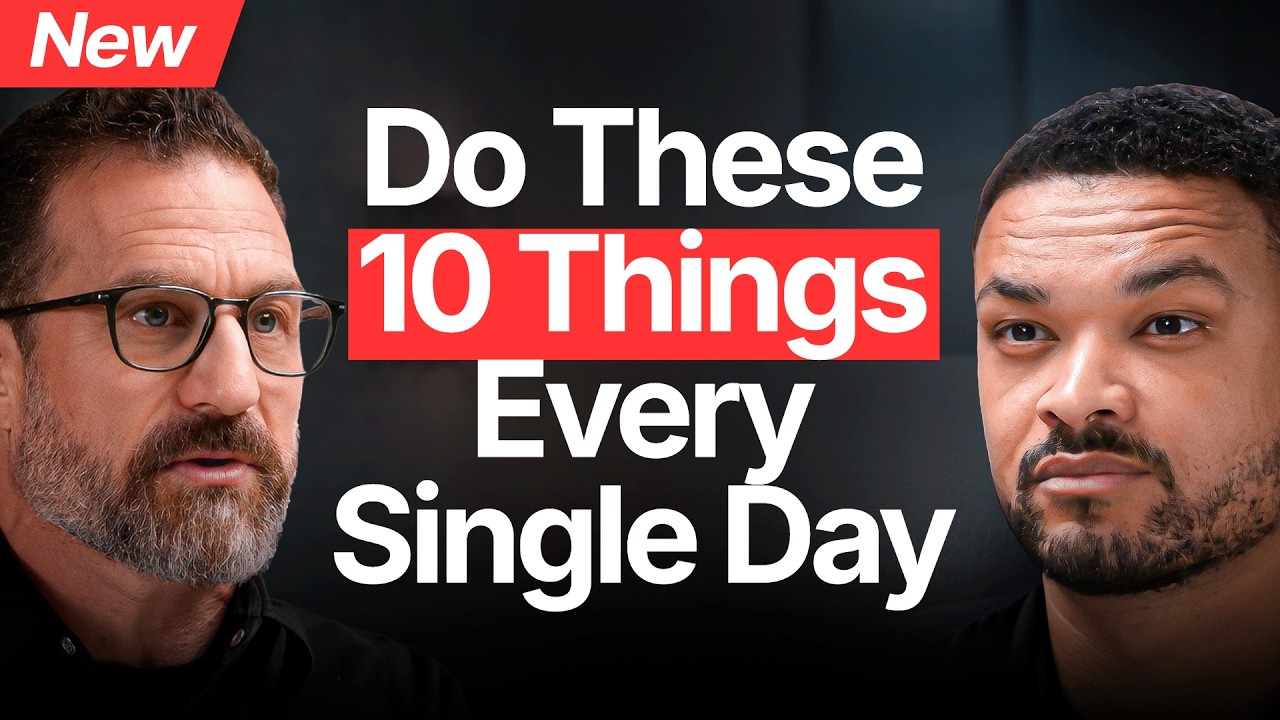
Harvard Professor's Extreme Protocol for 4 Hours of Focus — Arthur Brooks
Now Playing
Harvard Professor's Extreme Protocol for 4 Hours of Focus — Arthur Brooks
Transcript
281 segments
Our routines have a lot of similarities,
>> although the flavors are slightly
different. We could talk about that.
>> Probably the neuroysiological effects
are the same.
>> Very, very similar, I would imagine. So,
after the holy half hour, what happens
after the holy half hour? Now, I've
taken no nutrition except for, you know,
salty water with some, you know, a high
dose. I take highdose creatine
monohydrate with my workout drink.
>> What's high dose?
>> High dose for me is 15 to 20 grams a
day.
>> That is a Okay. In a single day. five.
The first five is for, you know, muscle
protein synthesis or volumization of
muscles, which is really good for your
workout. The other is for this just
exploding area of research on the on the
biological benefits of it, the
neurobiological benefits of it. And for
me, that's really really important
because, you know, I'm a crummy sleeper
and and you know, Rhonda Patrick has
done a lot of stuff on how how creatine
is really good when you don't sleep.
>> Yeah. It's also really good because I'm
trying to bank neurologically
four hours of concentration and is
mostly creativity.
>> So I have to I have to set myself up for
optimal creativity and that's one of the
best ways to do it. That's the best
supplement that I've been able to find
that affects my creativity later on in
the morning.
>> So I'm adding that to my pre-workout
drink.
>> I'm not taking no caffeine.
>> Yeah,
>> this is important. I don't take any
caffeine to wake up. Hubman's right on
this and this is this is very contested
in the literature about A2A adenosine
and how caffeine blocks adenosine
receptors
>> but I really believe and Hebrewman
believes this but I find I I find this
the most compelling explanation and it
absolutely works for me. I don't use
caffeine to wake up. I use caffeine to
focus
>> because what I want is I actually want
circulating adenosine to metabolize and
to clear endogenously
>> and I want lots and lots of clarity,
plenty of open parking spots for the
adenosine receptors that I can then fill
2 to three hours after I wake up with
caffeine. And this will give me this is
just
>> medapanil
>> at this point. This is just vacuuming.
This is going to vacuum actual medafanyl
kiddos.
>> No, no, I know. Yes, like that. That's
I'm saying not that. So, it's vacuuming
the dopamine into the prefrontal cortex.
So, so what the ADHD drugs do is that
they keep more dopamine in the
syninnapse, especially in the prefrontal
cortex such that you can focus, you have
more concentration, and you have more
creativity. And caffeine is great for
this. A lot of people like nicotine. I
don't like nicotine only because I was
hopelessly addicted to cigarettes early
on in my life. All the way through my
20s, I was a smoker.
>> Yeah. And I don't want I mean I blew it.
Well, a lot of people are step by step
blowing it also with first micro doing
nicotine and then lo and behold since
it's sort of dance partners in addictive
potential with heroin.
>> Yeah.
>> Then those micro doses become something
along the line of mezo doses and then
before you know it you're addicted to
all nicotine all the time. Exactly. And
and you know, caffeine is highly
addictive as well, but as a psycho
stimulant, it's better studied. It's
much much easier to self-manage. I you
know, I get usually about 380 milligs of
caffeine.
>> Oh, that's decent.
>> It's decent.
>> Holy cow.
>> That's a venty dark roast from
Starbucks. I grew up in Seattle.
>> I mean, 380 for a lot of people, if you
have moderately strong coffee, that's
going to be almost four cups of coffee.
>> Yeah. And that's 20 ounces of, you know,
good. I mean, and again, the darker
roasts have less caffeine.
>> Yeah.
>> But I like them better because I grew up
on the north side of Queen Anne Hill in
Seattle when there was one Starbucks.
And so I've been doing that since I was
in 8th grade.
>> All right. So you have the holy half
hour.
>> Yeah.
>> And then after the holy half hour, you
haven't had any caffeine up to that
point.
>> And now it's 7:15 in the morning.
>> All right. Now I'm back from math.
>> Now what do you do?
>> I brew the coffee and I know how to brew
coffee.
>> Now do you have the 380 in a mega dose
or is that titrated over time?
>> No. in a mega dose that usually it takes
me about 45 minutes to drink.
>> Oh my god.
>> Half an hour to 45 minutes to drink. I
know. Well, part of it is I've got this
grizzled adrenal system. This my HPA
axis is like a building falling down at
this point. So, you know,
>> just have to donkey kick your adrenals.
Okay. Got it. So, so then you you brew
the coffee.
>> Yeah.
>> And sit down.
>> Then I make my first nutrition of the
day. And the first nutrition of the day
is 60 to 70 g of protein.
>> Mhm. And protein is really important,
especially with a tryptophan rich source
of protein for mood management. And I'm
not eating a turkey leg or something
like that's not that's not I'm not, you
know, like Henry VII,
>> you know, for that. It's it's it's
mostly whey protein powder mixed in with
non-fat unflavored Greek yogurt.
>> Okay.
>> Which is great. And there's so many it's
like anymore. I just read that the three
most the fastest growing foods in
America today are cottage cheese, Greek
yogurt, and whey protein powder, which
is extraordinary. Extraordinary when you
think about it. You and I got to this
much earlier back when it was harder to
find Greek yogurt. And I put a little
artificial sweetener in it because I'm
not afraid of artificial sweetener and I
get more micronutrients in it with
>> putting walnuts and blueberries and, you
know, things that actually give me the
micronutrients that I need. By the way,
I've also taken a multivitamin at this
point. Mhm.
>> I take a multivitamin every day. I've
been taking a multivitamin for decade
after decade after decade. And there's
these papers that were coming out 5
years ago saying that they're not only
ineffective, they're bad for you.
>> That's all been overtaken by events. And
the newer research actually says it has
neurocognitive protective benefits.
>> Take your multivitamins. And there are a
lot of ways to do it. You know,
sometimes they'll take a, you know, good
multivitamin in the morning. Sometimes I
wait later in the day and take AG1. But
you need a good multivitamin. Almost
everybody does. So a few person not
personnikity but detail questions
because that's how my mind operates. Why
no fat Greek yogurt instead of something
with fat? Fat would be better for me to
be sure is that the fat bothers my
stomach.
>> Okay.
>> So I just I don't like it. It fills me
up too much. It's hard to get to 65 gram
of protein
>> when you've got that much fat in the
yogurt because it's you're just going to
be just
>> falling asleep. I only do that because
it's uncomfortable to have the fat.
>> Got it. And I'll add just a footnote for
some people listening who will say,
"Wait a second. I thought you could only
absorb 30 g of protein at a sitting."
That is
>> that's old school research.
>> Quite a Yeah, it is somewhere between an
old wives tale and just a statement that
has been repeated so much that it's
taken to be true, but it's not true.
>> It's not true. And in fact, there is or
I should say there are some data to
suggest that as you get older, you
actually absorb protein more effectively
in a larger bolis, meaning more protein
at fewer sittings.
>> Right. That's correct. I'm completely
persuaded by the research and and and
over the years I've experimented a lot
with that in my diet, just in the
protocols of my eating. And what I found
over the past 5 years in particular is
that I'm most comfortable because I'm
naturally genetically really lean. I'm
most comfortable when I'm sub 10 body
fat.
>> Yeah, me too. I'm kidding.
>> But it's just, you know, because of my
genetics. But
>> been trying to get there since I was 14.
>> If you know the the genetics don't want
it, then they're going to sort
>> of battle dwarfed genetics.
>> No man, if I had your frame. I mean, I
would I would love that. I would be able
to lift heavy.
>> But the way to do that for me is to stay
at 200 grams of protein a day.
>> Yeah. So to keep moderate calories and
200 grams of protein a day and then I
can keep my body fat where I want it,
where I feel really good and I'm never
hungry.
>> Yeah.
>> So and that's the way to do it is a
really protein richch diet. And of
course now popular culture is catching
up with what we've known scientifically
for a pretty long time.
>> So you get your
colossus of caffeine. I can follow the
holy half hour just to keep up with
everybody has to drink 380 millig of
caffeine. You have your 60 to 70 grams
of protein as described and then you are
sitting down to write. What are you
doing?
>> Yeah, then I sit down to write. If I'm
at home, then then I sit down to write
and there's no distractions.
>> I mean, there's no meetings. There's no
Zoom. I mean, if the president of the
United States or the Pope calls, there
will be a morning meeting, but that's
kind of it, you know, and I've got a
very quiet place. I'm not looking at
email. I'm not, you know, answering text
messages. I'm not looking for I'm not
reading the Wall Street Journal to do
this with when I set myself up this way.
get 4 hours of of productivity. And
that's very unusual if you're doing
things the oldfashioned way. You know,
you're getting up when the sun is warm
and you having the nice big, you know,
three espressos to try to wake up and
and you're not optimizing your brain
chemistry appropriately. You'll get two
hours of creativity max.
Interactive Summary
Ask follow-up questions or revisit key timestamps.
The conversation explores a highly optimized morning routine focused on neurobiological health and productivity. Key elements include taking high-dose creatine for brain function, delaying caffeine intake by several hours to allow adenosine to clear naturally, and consuming a high-protein breakfast of 60 to 70 grams. The speaker also debunks the myth that the body can only absorb 30 grams of protein at once and emphasizes the importance of a distraction-free four-hour block for creative work.
Suggested questions
4 ready-made promptsRecently Distilled
Videos recently processed by our community