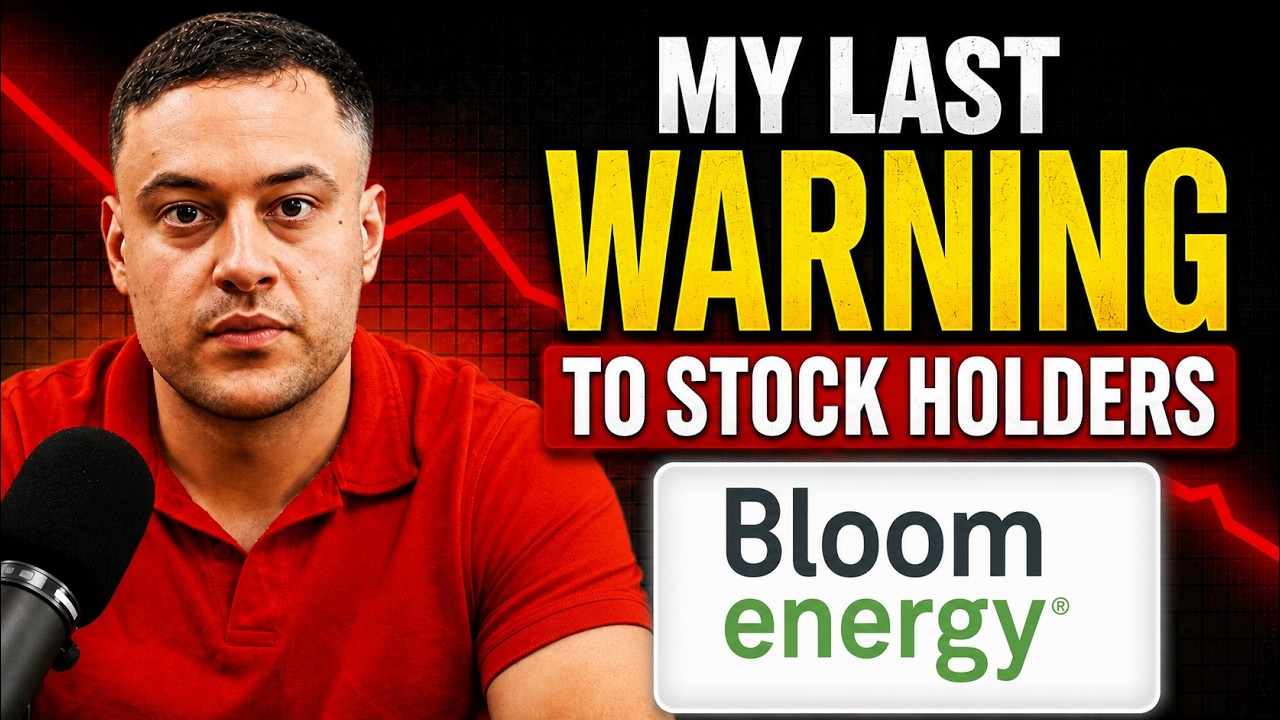
Bloom Energy Stock Could EXPLODE — Here’s My Strategy (BE)
Now Playing
Bloom Energy Stock Could EXPLODE — Here’s My Strategy (BE)
Transcript
407 segments
Guys, we're going to talk about Bloom
Energy. This stock has a lot of implied
volatility, which is the focus of my
video today. I want to give you analysis
on Bloom Energy, and then I want to talk
about this implied volatility and what
we can do from it as option traders. So,
on August 19th, Bloom introduced Power
Connect, and for the past 2 weeks, my
community has been asking me a lot about
this stock, and I've covered it a couple
times on my channel. It's been very
interesting, but now I think this is a
perfect opportunity for investors to run
an option strategy that I'll discuss
later. But first, I want to give you a
breakdown of the technical analysis and
what I think is going to happen with
Bloom Energy next. So, take a look at
the chart right here. You can see that
Bloom Energy has basically spiked to
over $300 per share, and then the stock
has taken, you know, a nose dive all the
way down to under $200. The volatility
has been very intense, and what you see
right now from this fall is actually a
stabilization. So, here we have some
stabilizing activity in all of August
for the past 30 days, and this right
here, these black lines, this is a
Bollinger Band. This is one of the key
technical analysis tools that I teach
within my community. I've been teaching
the Bollinger Band for 6 years now, and
what I like about the Bollinger Band is
that it tells me the range where the
stock is likely to trade. So, what
happened on August 19th is Bloom
introduced Power Connect, which says
they can reduce on-site installation
time by more than 40%, and time is the
most important factor right now because
speed to power is actually the
bottleneck that I see. So, this is
really important because Bloom's biggest
advantage is speed to power already. So,
do you guys realize that speed to power
is Bloom's competitive advantage, but
now is August 19th, Bloom introduced
Power Connect, this actually reduces
their on-site installation time by more
than 40% further. This gives them a
significant competitive advantage, and
this is why I think that Bloom Energy
stock is actually likely to go towards
the higher end here of, you know, next
20 days. I think the next 20 days is
going to be very insightful with Bloom
Energy. I think $2.40 per share is kind
of like my price target, which is pretty
insane because the stock is so volatile,
you know, 240 might not seem like a lot,
but that's a lot. That is a lot, okay?
Because a 10% move in the stock is 20
bucks. So, going up to 240 is over a 10%
move. That's insane, okay? And if I
catch that in my community, which is my
plan going into um as the market opens
up, then we're going to do well. We're
going to make some money. So, Power
Connect is kind of my catalyst here why
I think the stock can go up. But just
generally speaking, I'm not a market
predictor in my community. What I'm
doing is I'm actually option selling
because my main goal is income. I think
a lot of people want and need income,
the most important component to how we
live our lives. So, that's what I've
been focusing on for the last 6 years as
a coach is producing income. And that's
really through option selling. So, when
I used to work at Goldman Sachs, I read
tons of research and everything pointed
me to option selling. That's why I
prefer to sell options. So, I'm going to
show you kind of what strategy that I'm
looking at, but I wanted to summarize my
video real quick just in case you don't
have time. So, Bloom isn't just trying
to produce cheaper electricity. They're
trying to sell something AI companies
may value right now way more than
anything else, which is really time,
okay? That's what I think Bloom Energy's
advantage is. And that's the point of my
video of why I am pretty bullish on
Bloom Energy and I think $2.40 per share
could happen in the next 20 to 30 days
and the option strategy that I'm going
to discuss is going to be the wheel and
I'm going to show you what strike prices
I'm going to pick. So, that's basically
everything I'm going to cover in this
video. All right, so let's kind of dive
in a little bit deeper now. So, I'm
going to go to Trade BE Options. It's
really conveniently at $200 per share
right now and we can see that the market
cap is at a $60 billion market cap. I
think, you know, I'm not going to say
it's a $100 billion company, and I don't
even need to say that. All I'm trying to
do is, with the wheel strategy, I just
want to collect a ton of premium. That's
my goal. I just want to make hand over
fist, bicep over tricep, premium.
Premium cash flow. That's That's it.
That's all I want, right? I'm not trying
to hold this stock into the future. I
don't think this is the next Nvidia or
anything like that. Although their
numbers are getting pretty crazy, like
in Q2, Bloom, their strongest quarter
ever was over a billion dollars in
revenue. So, it was 1.065 billion. And
when you look at the revenue growth as a
percentage, boy, oh boy, that percentage
is wild. 166%
year over year. Honestly, like when I
look at their partnerships, it's it's
looking good. So, one main partnership
that they have is a Bloom and
Brookfield, which actually ended up
expanding their AI infrastructure
financing partnership from 5 billion to
25 billion in June. So, you know, that
was like 3 months ago, right? We're in
September. But, what's interesting is I
do see that playing out in their like in
their money. In their money, money,
money. Their money's looking great.
Investors that are looking to make
money, I think Bloom Energy is a good
position in a portfolio. It's volatile,
and it's not cheap, but hey, if you got
some money, if you have a portfolio
that's, you know, in the five figures,
multiple five figures, man, there's a
lot of money we can make off of options
There there is, honestly, genuinely a
lot. So, their relationship with
Brookfield's financing increased by 5x
from 5 billion to 25 billion in June,
and
you know, I think that's going to
continue to lead them into high revenue
growth. So, that's why I like this. I
think Bloom doesn't only need customers,
they they need partnerships, okay? They
need to really tackle this as fast as
possible, because in AI, things are
changing so fast. They they got to make
quick money. They have to scale fast,
make fast money cuz who knows what
competition's going to look like. There
is risks to competition, for sure. So,
when I look at Bloom Energy, I think
they're bringing the power right now in
technology. So, let me go to trade Bloom
Energy BE stock and I want to show you
what I'm looking at. So, I just want to
go back here to the technical analysis.
If I'm running the wheel strategy,
right, you can see here that there's
kind of mindset that you should have,
okay? Yes, I'm bullish, but we also have
to look at risk management. That's what
sets me apart from every other my
competitors and YouTube coaches that
came after me on YouTube that have some
of them have grown bigger than me is
they talk about hype. They talk about
this, buy this and do this, but often
times I see people coming from their
programs into my programs and having
better experiences with me. Why is that?
Because a lot of beginners, they're
chasing hype, okay? And it's all fun and
games and it's really exciting to make a
bunch of money and, you know, other
channels and and all these other picks
that you guys are seeing online, they
work in good markets. But what happens
when, you know, kind of the roof caves
in? What happens when the weather is
bad? What happens when implied
volatility is high? How do you protect?
How do you guard against, you know,
losses, right? That's the most
important. That is the missing piece
that YouTubers can't really cover
because they're not financial experts.
They don't have degrees in finance or
experience on Wall Street, like, you
know, your boy Uncle Henry here has.
This is not to brag, I'm just saying
risk management is the most important
piece that you need to understand and
one simple way, one of the ways that I
assess risk, is I look at the Bollinger
Band. So, what is the bottom of the
Bollinger Band? How low could this stock
potentially go next 20 days,
technically, right? I look at it
fundamentally as well, that's beyond
this video. Technically though, 194.
That's it, okay? 194 here, the moving
average.
I'm going to zoom in here to the moving
average a little bit. We can't really
see it, but the moving average is
looks like it's around 240, 238. So, we
see that the stock is below the moving
average. It's a little cheaper than the
last average 50 days. That's actually a
good sign. It's a little bit better of a
value. So, if we bridge this gap, we got
$35 to go or so. And on the bottom end,
I don't see the stock falling, you know,
below 194 in next 20 days. It would be
unusual. It can happen, but it would be
unusual. So, we have about, you know,
$20 on on the downside for protection.
So, look, if I'm going to run the wheel
strategy, okay, I love the wheel, been
teaching the wheel all the time weekly
for seven, six years. It's been a long
time. And I like the wheel specifically
on high implied volatility stocks.
That's why DE is good because BE high
implied volatility. Let me show you. So,
if I go for next 20 days out, let's say
I I want shorter-term income, okay,
that's my goal here. Then, I'm going to
go down here. I'm going to I'm going to
expand the 190. We're going to take a
look at it. You can see the implied
volatility is about 80, okay? Typically,
stocks are 30, 35, 40. Above 50, that's
high implied volatility. It's high.
That's good because as an option seller
who's running the wheel strategy, um it
is more profitable to sell options when
the implied volatility is high, okay?
So, again, our bottom is about 194. So,
you know, if I wanted to be safer, if I
wanted to generate income and and be um
safer in producing income, then I want
to go below, you know, where I think the
support level is. 190, I would say, is a
mini support. I'm not going to call it a
strong support because the fact is AI
stocks are super volatile. So, I'm
trying to optimize here, okay? My goal
is to optimize. If I want to produce
money, if I want to produce fat stacks
of cash, just cash, I'm trying to build,
trying to get bicep over tricep results.
If I want that type of scale, I must not
only be safe because I don't want to
blow up my portfolio, I must also look
for high implied volatility. Biggest
lesson, biggest takeaway. So, with BE,
the delta here is 0.28, which is pretty
good. That means there's a 20% chance
of, you know, BE going to 190 or below
based off of the delta. Okay, the delta
is a great metric. It's one of the most
important metrics that I look at all the
time. Delta is incredibly, incredibly
important. Okay, the bid-ask spread here
is pretty tight. 697 15 is good. That's
tight bid-ask spread. So, simply to
start the wheel strategy, you just sell
puts. Okay, it's it's a pretty simple
process overall. So, if I sell a put
here, um it's about $700, okay, which is
you know, pretty decent. It's definitely
not uh anything crazy. So, if I wanted
to increase this, I would just go closer
to the money. So, I would go 195 right
here. Let's expand this option. Now,
this one does have implied volatility
exactly 80. The delta here would be a
bit higher. So, right here I would
collect $880.
And, you know, this is very attractive
because it's only in a 2-week period.
Now, what's more attractive is the
second portion of the wheel strategy,
which is once you get assigned, right?
You're basically selling a put with the
risk and danger of getting assigned.
That's not a bad thing. You know, let's
say that we got assigned last week or
what or right? And Bloom Energy's at 201
and we got assigned at 202, 203, right?
So, we're under the water uh a bit,
[clears throat] right? So, what we what
would we do, right? Once you get
assigned in the wheel strategy, we just
sell calls. Just keep it going. Keep the
cash flow going. Keep that, you know,
money coming in. How do you do that?
Sell calls. As soon as you sell puts,
once you get assigned, you will get
assigned. Your risk is pretty high
because, you know, the delta's around
30. Three out of 10 times you'll get
assigned. And then what? You got paid
$880. Okay, now what? Well, now you sell
calls. So, if your average cost is 202,
yes, in the wheel strategy the way I
teach it is you want to sell covered
calls above your average cost because
otherwise if you sell a call a covered
call on the shares that you have and
it's below your average cost, well,
you're not you know, you can still make
money depending on your average cost,
but ideally we want to be above our
average
cost per share. Okay? So, let's go for
an option that is going to be above our
theoretical 202 average cost, which is
205. We don't have to go too much
higher, although I'll tell you I do
think BE can be 240 and because I do see
a short-term run, I probably would give
myself a bit more room. Let's go for
let's say 215 here, okay? Now, this is
really interesting because
you have upside up to 215. You have nice
premium $1,100. You can actually you can
actually see here it seems like the
options are skewed towards calls. You
can see that I'm going out of the money
by a lot and the premium is still really
really high. So, it seems like
um there's a skew where call pricing
right now is more, which also is a
pretty bullish indicator. Okay,
investors seem to be placing more
volatility and more skew. You can see a
little bit higher on the implied
volatility. We can see a little bit of a
skew for the calls. Okay, so that's a
pretty decent indicator that there could
be a bullish move and option traders are
potentially also thinking that that
could be the case. So, 215 here, premium
is actually nice. Very very very nice.
So, yeah, once you get assigned in the
wheel strategy, you have shares, right?
Each contract is 100 shares and you just
sell out of the money covered calls on
the shares. So, you still have your
shares, you sell 215 covered call.
Premium here is $11.20,
which actually effectively makes your
break even $226
per share. So, when I look at
like as a company what Bloom Energy is
doing, they're solving the time problem.
This might be more important than the
fuel cell technology itself. Okay, so I
think that timing is really important.
Investors realize that. You know, this
is a big part of the AI bottleneck.
Also, all the hyper scalers are also
using BE. So, yeah, I'm pretty bullish
on it. I don't even think we need to go
to 240 for investors to see, you know,
great cash flow, great premium
collection from option selling, which
is, you know, what I'm known for, what
I've been doing for I've been personally
doing it for 11 12 years thereabouts.
And I've grown my portfolio to seven
figures. A lot of it from option
selling. But in the earlier days, I was
also option buying. I think Bloom Energy
has lots of opportunities for option
buyers. If you want some of my option
buying strategies and what I'd be doing
with BE, I'm going to be discussing that
live in my Discord community. So, I
welcome you to to apply and find out
more information in my description if
that's something that might be
interesting to you, might be a fit for
both of us to work together. But either
way, this is something I want to share
here on YouTube. If you appreciate this
content, make sure to subscribe and
yeah, I'll catch you in the next video.
Interactive Summary
Ask follow-up questions or revisit key timestamps.
The video provides a detailed analysis of Bloom Energy (BE) stock, highlighting the company's recent 'Power Connect' launch as a major catalyst for potential growth by reducing on-site installation times. The speaker, an experienced investor and coach, shares his bullish outlook on the stock, setting a price target of $240 in the near term, while emphasizing his focus on income generation through the 'wheel' option trading strategy. He discusses the technical aspects of the stock using tools like Bollinger Bands, explains the importance of risk management, and demonstrates how to collect premiums by selling put and call options on this high-volatility stock.
Suggested questions
3 ready-made promptsRecently Distilled
Videos recently processed by our community