Is OpenAI the Achilles’ Heel of the US Economy? | The Weekly Wrap
Now Playing
Is OpenAI the Achilles’ Heel of the US Economy? | The Weekly Wrap
Transcript
575 segments
The 10-year yield almost brushed against
4.8% and there is no question that at
some level of interest rates the market
will correct. The entire US economy
hinges on the success of AI. The amount
being spent is just so large that were
it to stop, the economy would go into a
recession almost immediately. I think
that open AI is potentially in trouble.
Things are not moving in the right
direction. So, I'm starting to think
that the demise of open AI could push
the US into an almost immediate
recession. It's not too early to think
about the ramifications of open AI
failing. So, let's think about it.
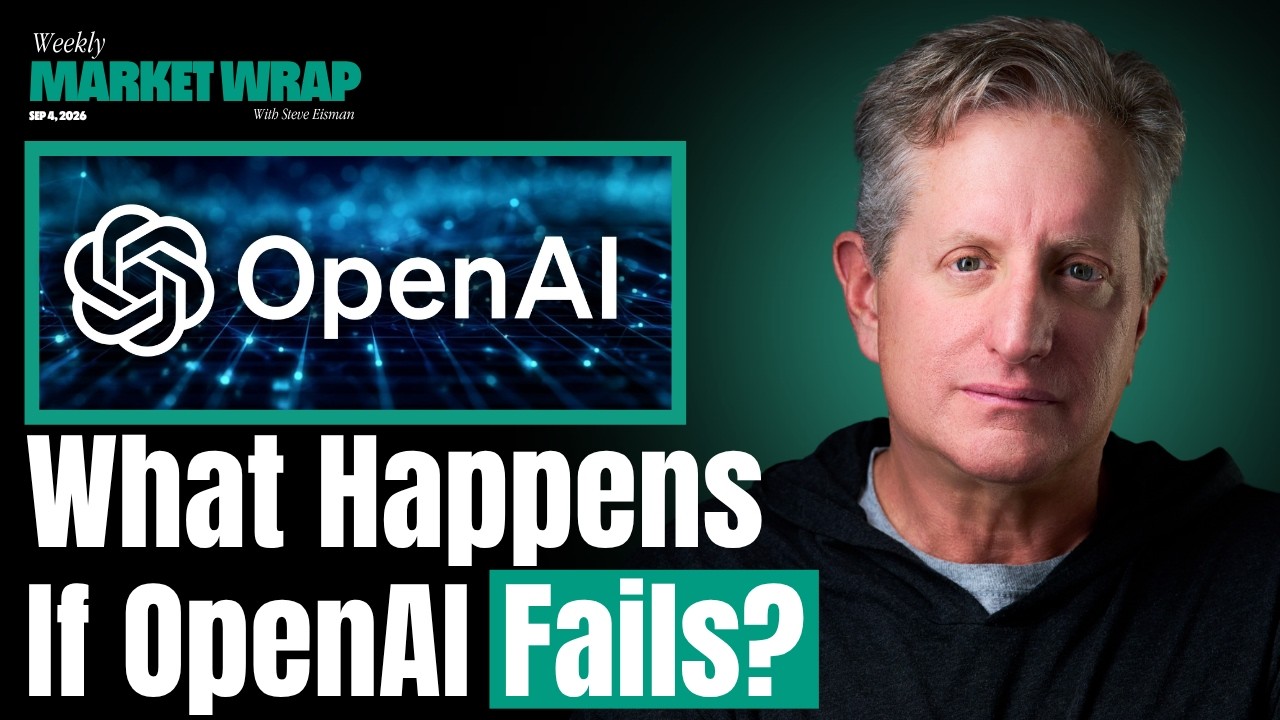
Hi, this is Steve Eisman. Welcome to the
weekly rap. This is for the week ending
Friday, September 4, but recorded
Thursday night, September 3. First, I
will take a moment to thank everyone who
has joined me on Substack and subscribe
to both free and premium. We'll be
increasing our premium prices on
September 7th at midnight to $20 per
month and $200 per year. If you want to
get the old pricing, subscribe now
before Labor Day. Existing subscribers,
your rates will not change if you stay
subscribed. Thinking about switching to
annual? Now is the time to lock in the
price at $107.99 per year for as long as
you stay subscribed. If you're
interested in being a premium subscriber
and receiving daily comments on the
market and economy, being part of a
thriving community, receiving an extra
weekly episode, including a two-part
master class on analyzing banks, which
drops soon, and accessing all free
episodes, ad free, consider subscribing
before we raise the price on September
7th. Over the past several months, we've
gotten several requests from subscribers
to interview Ed Zitron, the Substack
newsletter writer, who is one of the
most famous critics of the entire AI
story. So, I'm pleased to announce that
this coming Wednesday, September 9, on
premium, we will post an interview with
Ed Zitron. Open AAI and Anthropic to
account for 48% of all of Google Cloud's
revenues next year, which is
>> that's huge,
>> bonkers. That's crazy. That means that
Google Cloud's growth is based on
whether these companies will pay them.
>> We had an incredible conversation and
covered every aspect of the AI story,
its strengths, weaknesses, the financial
shenanigans, and where and how it could
fail. So, please tune in. In this weekly
rap, I will discuss one, war, oil, and
interest rate news. Two, the
increasingly insatiable need for
commentators to predict a dystopian
ending to the AI bubble. Three, why I'm
not there yet. Four, AI's insatiable
need for capex is the major driver of
GDP growth. Five, is open AI the
potential catalyst for a recession? And
six, some recent events. So, let's get
started. This week, the war heated back
up and oil prices spiked, thereby
driving fears of mounting inflation. The
10-year yield almost brushed against
4.8%. And there is no question that at
some level of interest rates the market
will correct. What that level is, no one
really knows. I thought that 4.5% was
the Rubicon and I was wrong. Is it 4.8%
or even higher? I don't really know, but
we are certainly getting closer. I'd
also point out that part of the problem
is the enormous amount of AI debt being
issued. This supply is putting pressure
on rates. And I'd also point out that
Treasury Secretary Besson's recent
attempt to reduce long-term rates
appears to have already failed. One more
point, higher rates put pressure on any
company issuing debt. However, higher
rates are good for consumers who save
and put their money in the bank or in a
money market fund. Before we get to some
of this week's events, I am going to
spend some time discussing the desire by
many commentators to call for the end of
the world and what it would actually
take to cause a recession. Now, one of
the last great sitcoms on network TV was
The Big Bang Theory. For those of you
who never watched the show, it was about
a group of friends who were science
nerds. In the show, there was a minor
character called Stewart. Stuart owned a
comic book store that the main
characters like to hang out at as they
all loved comic books. Now, recently,
Chuck Lori, the creator of The Big Bang
Theory, created a new show on HBO called
Stuart Fails to Save the Universe. In
this new show, a catastrophe has
enveloped the world, and humanity now
lives in a horrible dystopia. Stuart
finds a machine that allows him and his
friends to travel to alternative
universes, constantly searching for a
better place to live. Thus far on the
show, every universe Steuart jumps to is
just another form of dystopia. Show is
quite funny, but captures something
essential. There is something about
imagining a dystopian future that people
find captivating. I've noticed that over
the years since the GFC, whenever I am
interviewed, the interviewer is almost
begging me to predict the end of the
world. How do I feel about that? Well, I
predicted the end of the world once, and
believe me, it was no fun. I am in no
rush to predict to the end of the world
again, unless I am really convinced that
it's going to happen. But I'm not going
to make such a prediction just because
it will get a lot of press. There is no
question in my mind that the entire US
economy hinges on the success of AI. The
amount being spent is just so large that
were it to stop, the economy would go
into a recession almost immediately.
There are several commentators who are
making exactly that prediction. They
could be right, but right now the data
does not support the end of the AI
story, at least not yet. So let me point
out where the points of weakness reside
because it's time to consider how the
unwind could could occur, what the
catalysts are and what the impact could
could be. Now there is no question that
the large tech companies have
transformed the dynamics of their
businesses. They used to run businesses
that threw off so much cash they didn't
know what to do with it. But because of
the hundreds of billions they are each
spending on AI capex, their cash flow
has evaporated and in some cases they
are raising both debt and equity to fund
that capex. This is a topic of great
concern. It gets a lot of press, but it
is not necessarily the deathnell of the
AI story. After all, if and it's a big
if, AI generates new businesses and
large returns on this capex investment,
then the hyperscalers will be okay. Now,
there is also a great deal of circular
financing going on, mostly led by
Nvidia, and these transactions are very
complicated and convoluted, but
essentially Nvidia is either lending
money or making equity investments. The
companies then take that cash and buy
more Nvidia chips. Now I'm
oversimplifying but that is essentially
what is going on. Nvidia's potential
investment in perplexity and the recent
investment in poolside are only the most
recent examples of such transactions.
This financing circularity is also a
topic of great concern. However, here
too if AI succeeds then these financing
techniques will probably turn out to be
okay. So where is the Achilles heel? I
think that it resides with anthropic and
open AI because they are so central to
the entire AI food chain. According to
reports from various Wall Street firms,
something like 70% of hyperscaler AI
revenue comes from anthropic and open
AI. 70% equates to around 25 to 35% of
total hyperscaler cloud revenue. I can't
confirm those statistics, but they sound
right given what we actually know about
Oracle. Oracle has a backlog of around
600 billion and we know because the
information is public that around 50%
50% of that backlog is from open AI
alone and by the way open AI accounts
for over 20% of coreweave's total
contracted order book hyperscalers are
spending about 700 billion in capex this
year and even more next year and that
spend accounts for around half of the 2%
% GDP growth projected for 2026.
So one must conclude that the health of
the US economy is extremely dependent on
hyperscaler capex and hyperscaler capex
x is highly dependent on the health of
anthropic and open aai. That's the
chain. Now between the two openai is the
weaker entity. It has lost several key
senior employees. Let's list them
because the list is kind of
illuminating. One, Denise Dresser, chief
revenue officer, resigned in August 2026
after only eight months on the job. That
probably means she gave up all her stock
options as those usually don't vest for
at least a year. That's a big data point
for her. I guess moving on was perhaps
worth the loss options and maybe she
never thought they would vest because
going public is being pushed further out
on the timeline. Two, Brad Lcap, former
COO, resigned in August 2026 after eight
years with the company. Three, Caitlyn
Kalinowski, head of robotics and
consumer hardware, resigned in March
2026 over governance concerns regarding
an agreement with the Pentagon. Four,
Kate Rouch, chief marketing officer, and
Kevin Wild, science research overseer,
both departed in April 2026. The most
concerning departures are the ones that
took place this August. Denise Dresser
and Brad Lcap. Supposedly, OpenAI is
getting closer to an IPO. That's the big
payday for employees because it means
that eventually they can sell some of
their shares. That two such senior
employees would leave now is an
important data point. More importantly,
OpenAI's financials look tepid. The Wall
Street Journal reported that OpenAI's
June quarter revenue reached 6.7
billion, up only only 18% versus the
March quarter. Compare that to
Anthropic's revenue of 11 billion plus
in the June quarter, which was up over
100% versus the March quarter. What's
even worse than the relatively weak
revenue growth is the explosion in
costs. Again, according to the Wall
Street Journal, OpenAI's costs reached
12.3 billion, up 3 billion versus the
March quarter. So, in 3 months, revenue
increased 1 billion, but costs surged 3
billion. Things are not moving in the
right direction. Now, you might ask,
what is the problem at OpenAI? Part of
the problem, I think, is that OpenAI
made a strategic mistake. It chose to
chase the business to consumer market, B
TOC. It did so by giving its product
away or underpricing it with the hope
that later on it could raise prices.
That strategy proved to be flawed and
now OpenAI is chasing the businessto
business market B2B. The problem is that
it's late and playing catch-up with
anthropic which chose the B2B market at
the outset. Again, I think that OpenAI
is potentially in trouble and this bears
continuous monitoring. According to Ed
Zitron, our guest in a week, to survive,
Open AI will have to raise hundred
billion dollars per year for the next
several years. Now, when you lose
billions upon billions, appearances
matter a lot. Open AI is completely
dependent on the kindness of strangers
funding its cash flow needs. When a
company is growing and very profitable,
appearances don't matter nearly as much.
Such a company can survive quite well.
But when a company is not profitable and
has an insatiable need for capital,
appearances matter more than anything
because if the narrative turns negative,
raising capital becomes much more
difficult. Now, this is just me reading
the tea leaves, but Open AI's press is
no longer all positive. The press is
actually focused on the high level of
departures and on the weak numbers I
just described. That's why, as Ed Zitron
wrote recently, it's not too early to
think about the ramifications of Open AI
failing. So, let's think about it. First
of all, I want to emphasize I'm not
predicting, at least not yet, that Open
AI will fail. I still think it's too
early to make that prediction, but it's
not too early to think about it. If Open
AI fails, Oracle is in immediate trouble
because of the large increase in
Oracle's debt levels. Oracle's debt
rating is barely above junk. Oracle's
S&P credit rating is tripleB minus,
which is quite weak. Like I said before,
it has a $600 billion backlog, and half
of that backlog is from OpenAI. Now,
what would happen to Oracle stock price
if Open AAI failed? Well, we've already
had something of a preview. Last year
when Oracle reported its backlog for the
August quarter of 2025,
what it calls remaining performance
obligations, RPO, it showed an RPO
explosion to 455 billion. It's now 600
billion. Now, in that quarter, the RPO
was up over 300 billion in just three
months. People were blown away. Prior to
the earnings report, stock was $230 a
share. In just a few days, it jumped to
$330 a share. Then analysts started
publishing reports pointing out that 50%
of the RPO was from Open AI, and the
stock gave back all of its gains plus in
a few months. Today, the stock is around
145, well below where it stood before it
reported the August 2025 quarter
results. From the peak, the stock is
down over 50%. That decline is because
the market perceives an over reliance on
Open AI. Imagine what the market would
do to Oracle stock if Open AI fails. The
ramifications of an OpenAI failure
extend far beyond just Oracle. Remember
I said that AI capex accounts for 50% of
US GDP growth. While the other
hyperscalers are not quite as dependent
on entropic and open AAI as Oracle, they
are dependent enough. If OpenAI failed,
the hyperscalers I am sure would cut
back on their capex. So I'm starting to
think that the demise of Open AI could
push the US into an almost immediate
recession. So what would happen to
particular stocks and sectors? Well,
first the hyperscalers would go down. A
failure of Open AI would mean they would
pull back on capex. cloud revenue growth
would slow and these stocks Amazon,
Google, Microsoft and Oracle, Nvidia,
I'm sure as well would all correct.
Also, the whole tech sector would
correct. But the ramifications are even
much broader than just that. Investment
banks and large banks, these stocks are
at peak valuations. Also, the investment
banking cycle is super strong right now,
partially because of the financing needs
of AI. Should those needs lessen, the
investment banking cycle would weaken
and these stocks would correct from
their peak valuations. Industrials.
There is a subset of industrial
companies that are major beneficiaries
of AI. They are in the power space like
GE Vernova and Quanta or they are in the
electrification or automation spaces
like Eaton and Rockwell. These stocks
will decline as well. So what will do
well? This is not a stockpicking
question but a reallocation question.
Investors will reallocate to safety
sectors and subsectors. In the safety
sector category, think about healthcare
and consumer staples. I'd also point out
that within almost every sector, there
exists safety subsectors. For example,
within financials, the property and
casualty sector is considered the safety
subsector. Since we are talking about
capital reallocation and not stock
picking, let me flag three safety ETFs.
One, LVHD,
the Franklin US low volatility high
dividend index ETF. SPLV,
the Invesco S&P 500 low volatility ETF.
And finally, the KBWP,
which is the Invesco KBW Property and
Casualty Insurance ETF. It's still early
and I want to emphasize that I am not
making a major call. Not yet. I'm just
preparing. Last week, Nvidia reported
and the results in many ways support
what I'm saying about the AI story that
it continues but is displaying potential
weakness. Both apparently contradictory
ideas can be true. What do I mean by
that? On the one hand, Nvidia's results
show that the AI story continues. How
could it be otherwise? The hyperscalers
continue to increase their capex and
that means they are buying more chips
from Nvidia. Nvidia's July 2026 quarter
results showed revenue growth in excess
of 100%. 100%. Think about it. The
largest company by market cap on planet
Earth just posted revenue growth in
excess of 100%. And that is an
acceleration from the 85% revenue growth
in the April 2026 quarter. That shows
that the AI story continues. However,
beneath the surface, there are
weaknesses. In note 7 of Nvidia's 10Q,
it states, quote, "Five direct customers
accounted for 22%, 14%, 13%, 11%, and
10% of our accounts receivable balance
as of July 26, 2026." End quote. That
adds up to 70%. So yes, Nvidia's revenue
growth is explosive, but it is dependent
largely on only five companies. Who are
those companies? They must be the
hyperscalers who therefore account for
most of Nvidia's revenue. And the AI
revenue of the hyperscalers, as we've
just discussed, is dependent largely on
entropic and open AI. Once again, it
looks like the entire AI ecosystem is
dependent on the future health and
success of two companies that currently
lose billions. Again, if Anthropic or
OpenAI ever get into trouble, the whole
AI ecosystem will slow to a crawl. There
was also news from OpenAI that at first
looked positive, but which I think was
actually quite negative. Open AAI
announced that its advertising business
reached 1 billion in an annualized
revenue run rate, ARR. Now, I have no
idea what ARR means in this context.
What exactly is being annualized? Is it
revenue for a day, week, month, or
quarter? OpenAI won't say. But leaving
aside the definition of ARR, what was
interesting was that this news was
lauded by the business press. Not so
fast. First of all, in the June quarter,
OpenAI had 6.7 billion in revenue and
12.3 billion in costs. So 1 billion in
advertising ARR hardly cuts those losses
by much. More importantly, much more
importantly, earlier this year, OpenAI
projected 2.4 billion in advertising
revenue for all of 2026.
1 billion ARR now means that it won't be
even close to that 2.4 billion
projection. In other important news,
Meta reached a legal settlement with
several state attorneys general.
California-based lawsuit alleged that
Meta harmed young adults and children
via its algorithms. The size of the
settlement was not large, 17 plus
billion. More importantly, Meta agreed
to change its conduct and alter its
algorithms. Now, on June 17th, we posted
an interview on our premium Substack
service with law professor Ben Zaperski.
In the interview, Professor Zaperski
outlined the legal theories behind these
social media lawsuits. Our problem is
with your algorithms, not with the
content that the algorithms get users
to, but with how much they use it and
how addicted to it they are.
>> I reached out to him and asked him what
he thought of the settlement, and this
was his response. Quote, I think the
state AG should be pleased to have
extracted from Meta a commitment to
change the way they do things to
children and teens. The draft consent
agreement is quite detailed. And my
current instinct is that it could really
make a difference to kids, assuming they
were mainly users of Meta's platforms,
not other platforms. I also think Meta
is in some ways the biggest fish here,
and it really does put pressure on the
other defendants, for example, Tik Tok
and Snap in related lawsuits. I think
Meta was smart to do this. The verdict
could have been much bigger. Equally
important, they may avoid legislation
and regulation from many different
states and they will get to play a key
role on what sorts of rules they will
have to abide by. And it is possible
that this show of cooperiveness may have
an impact on some of the other cases
that lie ahead. I.e. judges including
the federal judge in the Northern
District of California who still
presides over a massive number of live
cases against Meta may be more favorably
inclined on close calls moving forward.
Finally, and not insignificantly, one of
the big problems for defendants in mass
tort cases is that with regard to
individual tort plaintiffs, one worries
that the stream of cases will never dry
up. By changing their practices now in a
way that state ages approve of, they
will make September of 2026 or whenever
they really change a kind of line in the
sand moving forward. To illustrate, 10
year olds now who try to bring claims in
2036 for their psychiatric problems as
20 year olds will probably lose out of
the gate. And no doubt Meta will try to
use this fact far more aggressively than
that. Most of all, I do think the result
is good in the sense that public health
may benefit and less money may get spent
on litigation. Thank you, Professor
Zaperski, for your response. Several
weeks ago, I recommended a whole bunch
of books. I also said that I love
historical fiction and in honor of the
new movie the Odyssey I recommended a
trilogy by David Gmel with the first
book called Lord of the Silver Bow. The
trilogy is an incredible reimagining of
the Iliad. One viewer wrote to me that
based on my recommendation, he read the
trilogy and loved it and asked for
another historical fiction
recommendation. Here's one. It's a four
book series that begins with Mistress of
Rome by Kate Quinn. The series starts
with the reign of Emperor Demission in
Rome and ends with the reign of Hadrien.
It's amazing. This coming Monday,
September 7, we will post an interview
with Ryan Tunis, a property and casualty
insurance analyst at Caner. This is a
very timely interview. Investors are
looking for ways to diversify away from
the AI tech trade. I would point out
that there are safety sectors and within
every sector there are safety subsectors
and the property and casualty insurance
subsector is the safety sub- sector
within financials. So if you're looking
for some low volatility safety stocks,
this interview is timely. The best way
to support the realizing playbook is to
subscribe to Substack. Subscriptions are
free and we appreciate your support. And
that's the wrap.
This podcast is forformational purposes
only and does not constitute investment
advice. The hosts and guests may hold
positions in stocks discussed. Opinions
expressed on their own and not
recommendations. Please do your own due
diligence and consult a licensed
financial adviser before making any
investment decisions.
Interactive Summary
Ask follow-up questions or revisit key timestamps.
In this weekly wrap, Steve Eisman explores the precarious state of the US economy, highlighting its significant dependence on AI capital expenditure. He details the potential risks posed by the financial health of key AI companies like OpenAI and Anthropic, arguing that their potential failure could trigger a broader market correction and even a recession. The discussion covers the circular nature of current AI financing, the tech sector's vulnerability, and potential defensive investment strategies during these uncertain times.
Suggested questions
3 ready-made promptsRecently Distilled
Videos recently processed by our community