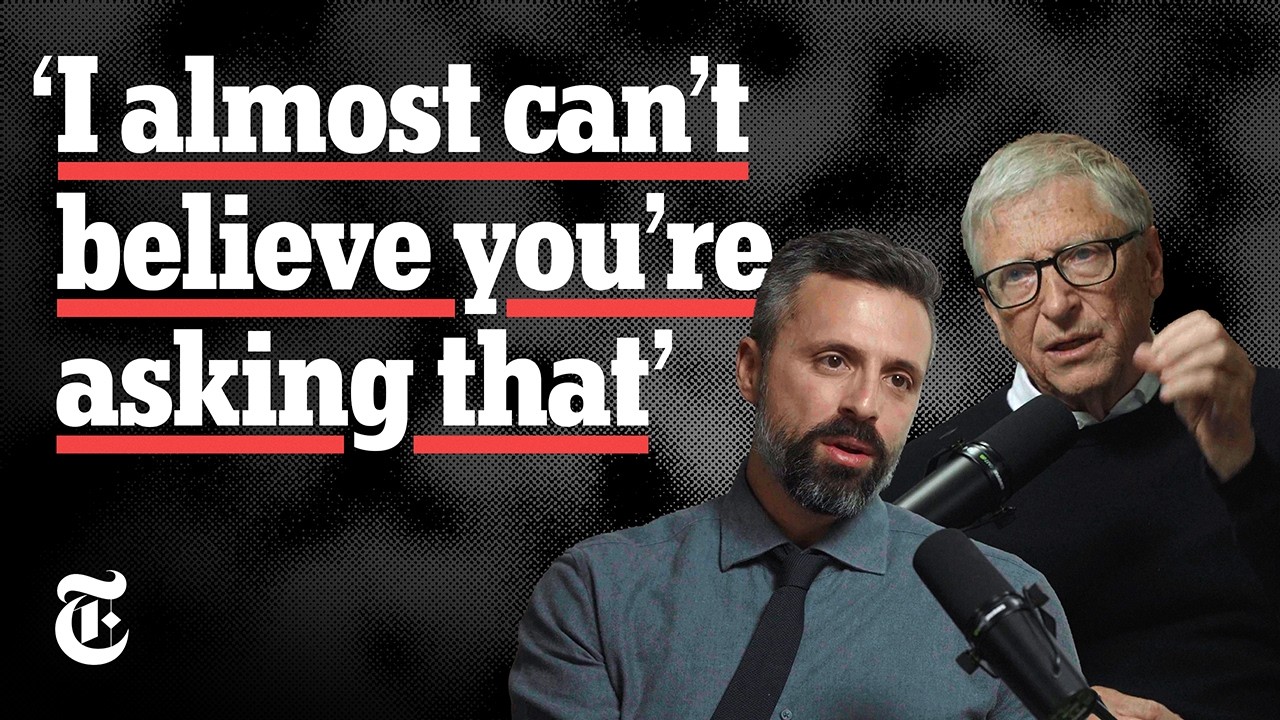
Legendary Investor Outlines His AI Thesis in 14 Minutes — Bill Gurley
Now Playing
Legendary Investor Outlines His AI Thesis in 14 Minutes — Bill Gurley
Transcript
370 segments
AI bubble or not? [laughter]
[snorts]
And if so, what does that mean?
>> Yeah. So, I think this is super
interesting. My my partner Peter
reminded me of a book that we had seen a
a while ago by Carla Perez. It has
[clears throat] this very benign title,
Technological Revolutions and Financial
Capital. It was written in like 2002.
And what Perez
kind of simplifies and notices, which I
just find perfect for trying to
understand whether there's a bubble or
not, is that every time there's been a
technology wave that leads to wealth
creation, especially fast wealth
creation, that will inherently invite
speculators, carpet baggers, interlopers
that want to come take advantage of it.
think of the gold rush, you know, and so
people want to make it a debate. Do you
believe in AI or is it a bubble? And if
you say you think it's a bubble, they
say, "Oh, you don't believe in AI." Like
this gotcha kind of thing. And if you
study Perez, and I I think this is
absolutely correct. If the wave is real,
then you're going to have bubble-like
behavior. like they come together as a
pair precisely because anytime there's
very quick wealth creation, you're going
to get a lot of people that want to come
try and take advantage of that or
participate in it. So, you get a flood
of those types of people coming at it.
And so, it's odd. There's a real
technology wave that's that's
fundamentally changing the world and
there's also massive speculation
simultaneous. Yeah, they come as a pair.
I recall not too long ago, maybe two
weeks ago, saw a short interview with
your friend Jeff Bezos and he
distinguished between financial bubbles
and industrial bubbles and cited and I'm
paraphrasing here, but 2008 as an
example of a bad bubble, right?
financial bubble versus let's just say
the early 2000s like 99 98 99 2000 where
a lot of very important technology was
created that then was durable after the
fact and created new generations of
entrepreneurs and a lot of economic
growth and he believes that AI would
fall into the industrial bubble category
of things. But I suppose given that the
dancing pair you described come
together, how would you [clears throat]
think about investing in private
companies, modern venture capital at
this point in time? And just I suppose
as it's changed since you were most
active,
>> a quick comment on that industrial
bubble thing. You know, one thing that
is surprising to me is that [snorts]
even though I fundamentally believe this
is an important real technology wave,
the big players, even the Max 7 have all
decided to do things from a deal
perspective. You've read about these
circular deals and whatnot.
>> Could you explain what you mean by that?
>> Yeah. I mean, there's a lot of talk out
there, but it all started when Microsoft
invested in OpenAI, OpenAI agreed to buy
services from Microsoft. Yeah.
>> Which is called a circular deal because
you're giving them money they wouldn't
have otherwise.
>> And when Daario was on stage at Dealbook
last week, he said, "Oh, I can explain
this. It's not that hard. Amazon wanted
us to spend money we didn't have, so
they gave us even more money." And I'm
like, well, that's precisely why this is
a questionable behavior. But it's gotten
bigger. You know, Nvidia's handing out
money, and then Nvidia gave Coree money,
but then also agreed to buy any services
they have left over. this stuff's not
ideal. Like if you were to say,
[clears throat] "What's crisp, clean
accounting?" You know, you wouldn't do
these kind of things. And some of them
say, "Well, it's not material." And
which I would say, "Well, then why are
you doing it?" I've asked other people
to try and understand how even big
sophisticated companies might get
speculative using a word from the
previous discussion. And I hear things
like, well, you know, loss aversion
tends to go down when you're winning.
Like if you're on a hot streak in a
casino, you take more risk. Things like
that. But it is surprising to me. When
it comes to retail investors, I mean, I
would be particularly
concerned for them at this stage in the
AI game because there is a plethora of
SPV vehicles. You've heard that phrase,
I'm sure, SPV. This [clears throat] is
where someone has an in on an investment
and they do a oneoff VC fund if you will
>> special purpose vehicle.
>> Yeah. It's a single entity just for that
>> to invest in X. We have an allocation of
however much money and then they can
allow sort of Jane Doe and John Doe
potentially
>> and they take a rake on it and there's
people promoting SPVS in situations
where they don't even actually have the
underlying stock or maybe they hope to
get it. It's the wild wild west and most
of the people on that edge I would put
in the category of interloper carpet
bagger these are people that have come
to this thing and I just think you got
to be quite careful the the investments
that were made that have already had
100x plus returns were made a while ago
you know before this thing started
>> and that's not to say there won't be an
incremental AI investment that makes
money I think there But your odds right
now of of that being the case are really
really low.
>> Yeah, I would add to that and say, and
this this applies to me as much as
anyone else, but your actual risk
tolerance
may differ probably does differ
significantly from your your perceived
risk tolerance if you haven't had a huge
draw down, right? If you haven't
actually ridden a few of those waves and
see how you respond in those
circumstances.
And you should be, I suppose, skeptical
of how you view your own intestinal
fortitude with some of those things or
maybe the losses you can absorb because
I recall, for instance, I've seen this
many, many times, but with these types
of SPVS, people get involved and let's
just say they're not typically an angel
investor, they don't have the experience
of watching 60, 70, 80% of their
investments go to zero or become the
walking dead. and they sign off on all
of the not necessarily waivers, but they
accept accept accept on like the SPV
terms of service, which all say you
could lose all of your investment. This
is incredibly risky.
>> Yeah.
>> But then when it does go to zero, you
know, the financial and psychological
impact is catastrophic.
>> There's a lot there's a lot of people,
and I think this comes from a very good
place. I think they're very
well-intentioned who look at the world
and say, you know, well, first of all,
you know, rising inequality, like why
can't everyone have access to the same
things? And and then companies are
staying private longer. So they say we
need to institutionalize
the generic public's ability to invest
in private companies. And the problem, I
think there's two problems. one you just
hinted at which is most private company
VC backed even go to zero like the
majority which is not something people
really they sense that they want the
lottery ticket they want the the Uber
they want the one that goes to the moon
>> but they don't understand that that
comes along with it
>> they don't want to buy losing lottery
tickets for 12 years
>> right exactly and the second problem is
the information transparency in the
private company game is just low. And I
think the institutional investors have
come to understand that and kind of know
what they're getting into and know how
to evaluate things. But if you come at
it with a public market mindset
thinking, oh, every set of financials
I've been handed is is audited and is
correct and like that's just not the
case. It's it's super loosey goosey. So,
if you were, this may be a difficult
question, but if you were angel
investing
right now, how would you be thinking
about your approach?
>> I'll tell you a funny story. When I
decided to hang up my gloves, if you
will, and stop making institutional
venture capital investments, I had a
whole bunch of ideas about what I wanted
to do next. And one of them was, oh,
I'll do a bunch of angel investing. You
know, Bezos did it on the side. You
know, this would be fantastic.
>> He did pretty well with his angel
investing. I was explaining this to a I
won't say who it is but a a Silicon
Valley CEO very successful and he said
what are you going to do now? I said I
was thinking of doing angel investing.
He goes why would you do that?
[laughter]
He said I got 50 of these things. People
don't return my calls. He goes I
[clears throat] wish I'd never done it.
[laughter]
So there is a unglamorous side to it as
much as there is a glamorous side. And
you've participated in this world
before. What would I say? I think if I
were doing angel investments, I'd try
and find an intersection of people that
are super curious and are playing with
all these AI tools, but bring a
perspective from a particular industry
that gives them an advantage in that
area where they could simultaneously be
maybe the smartest user of AI in their
genre, in their vertical. So despite the
or maybe because of because we talked
about the pair
the AI bubble, you would still be
looking at AI intersected opportunities
if you were angel investing.
>> Yeah, there's a weird reality out there
right now and this could end if ever a
bubble has popped or whatever, but the
institutional investors have zero
interest in non AI deals.
>> Mhm.
>> Zero. It's more black and white than I
could be successful in
>> for people who do not know the term.
Define the institutional investor.
>> People who are paid both a a salary and
a piece of the return to be active
investors of other people's money using
other people's money. But the reason
that kind of matters is if you angel
fund a deal and have any hope of it
raising money in the future, if it's not
AI related right now,
>> could die of neglect.
>> There is no interest. I can't state
clearly enough how there's zero in and I
could I could [snorts] simultaneously
make fun of that reality, but I could
also justify that reality, but it is the
reality right now. And by the way, while
I mention that, I feel obligated for
your audience. Like, I don't care what
field you're in, you should be playing
with this stuff.
>> Like, it has the potential to impact
your role in your career. And the best
way to protect against any risk of your
career being obuscated or eliminated
from AI is to be the most AI enabled
version of yourself you can possibly be.
How would you think about maybe you can
give a hypothetical example of looking
for someone who has very very
sophisticated domain expertise
and experience who's now intersecting
with AI and has a unique because of the
combination perspective on things to
invest in as an angel investor separate
that from something that's just going to
be consumed by the fundamental the kind
of fundamental models and these larger
companies
>> from a career perspective. perspective
or
>> from an angel investment perspective,
how would you pick folks you don't think
are just going to end up working on
something that gets replicated in short
order by the bigger companies?
>> The key is just to stay pretty far away
from the edge of whatever. I mean, you
can go online and see interviews with
people at Anthropic or OpenAI and what
they're working on. Like, if it's the
next thing they're going to do,
>> I don't think you're going to be
protected. But as I think about, you
know, founders and angel investors,
you're talking about a pretty broad
array of things at this point. As I
mentioned earlier, you're not going to
back the next big model company.
Besides, if if you were, you need a
billion dollar angel investment to go
make that happen. Like, it's just really
the game's changed. There's so much
money involved. I think you're going to
want to be off the beaten path anyway.
When I think about these deeper
verticals, I don't think it will make
sense for open AI to go crush every
little vertical
>> waste management.
>> And even if the model's capable of
understanding that subject matter, there
are workflows, there are data sets that
are local to your customer and that
stuff has to be stitched together. Mhm.
>> So I think having an understanding of a
particular industry and and one that's
not going to be on the next thing to do
list at OpenAI would probably be your
best bet.
>> Got it. So is it fair to say if I'm
understanding you correctly that
effectively looking for something that
would not be a high priority for one of
these larger companies and also a
proprietary data set of some type?
proprietary data sets. The more kind of
workflows that exist are are better
because you can build software around
those things.
>> What is a workflow?
>> The thing that popped in my head, I'm on
the board of Zillow. You know, Zillow's
been investing for the past 5 years in
tools that help the realtor do their
day-to-day job.
>> Mhm.
>> They have a tool called Showing Time
that helps you book inerson tours at
houses, as an example. But there's
putting the mortgage together, getting
the sign offs on, like there's just all
these tasks that have to be happen that
can be automated.
>> Tasks that can be automated that can be
integrated with AI. The more of that
stuff you can build into a system, the
better off you're going to be protecting
yourself from a model that just answers
questions, right? Which is why which is
why I brought it up.
Interactive Summary
Ask follow-up questions or revisit key timestamps.
The discussion revolves around the potential AI bubble, drawing parallels to historical technological revolutions and financial speculation. It's argued that bubble-like behavior is a natural consequence of rapid wealth creation, with speculation often accompanying genuine technological advancement. The conversation then shifts to investment strategies, particularly in private companies and venture capital, highlighting the current market's strong focus on AI deals. Concerns are raised about speculative investment vehicles like Special Purpose Vehicles (SPVs), especially for retail investors who may not fully grasp the risks involved. The advice for angel investors is to focus on opportunities that intersect AI with deep, specific industry expertise, proprietary data, and unique workflows, rather than competing directly with large AI model companies. The importance of understanding one's own risk tolerance is also emphasized, especially when investing in high-risk ventures.
Suggested questions
6 ready-made promptsRecently Distilled
Videos recently processed by our community