Stocks Rise as Oil Drop Offsets Europe Debt Worry
Now Playing
Stocks Rise as Oil Drop Offsets Europe Debt Worry
Transcript
128 segments
Well, there's a lot of interest in it. Absolutely.
I mean, I think it's when I think about this personally, it's a double edged
sword because if you rely on it too much, then you get stupid.
And that's like, that's that's something people, you know, we see that too.
Like it's it's embarrassing to get, you know, inbound requests on LinkedIn.
And people clearly just wrote the whole dang thing.
And artificial intelligence, like, you know, respect for yourself.
Gabriela Santos. No, it does not.
No, no, they wouldn't dare. Oh, they would not dare she kill them?
You know, I look at this. Are you guys making radical adjustments
in the greater big bank strategy on the stock market, or are you tweaking it,
given the various traumas that are out there?
I think of this much more as a as a tweak than radical adjustments.
And when I think about the the equity market outlook, given the slew of recent
economic data, given what's going on with oil prices, given the pivot in fed
policy, I actually don't see that much of an adjustment.
Um, you know, I don't see the cyclical parts of the economy being impacted too
much by higher interest rates because these rate changes are very well
telegraphed. They're incremental, they're slow, and I
don't see any adjustments to the secular part of the equity market or the
economy, because the secular part of the equity market is tech.
And I, uh, and there's no brake on I at least not a macro break.
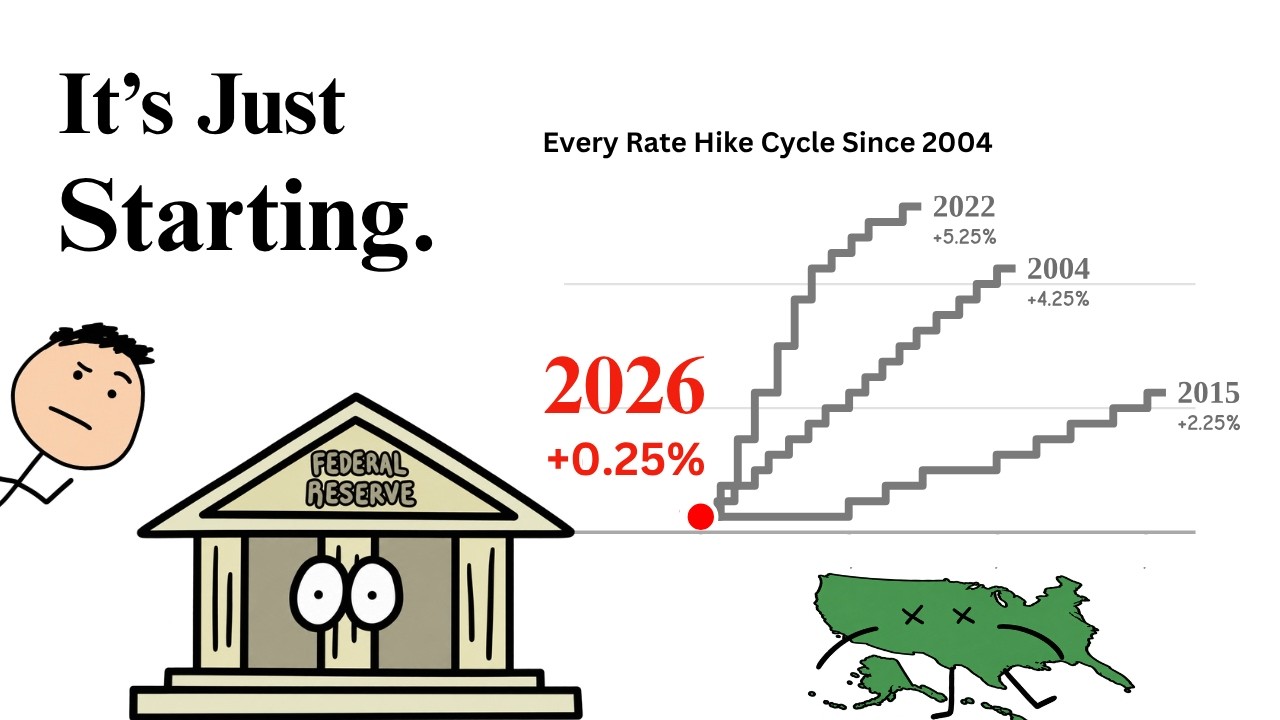
I mean, 25 basis points of incremental borrowing cost is not going to be the
straw that breaks the camel's back. So when I think about equity market
prospects, I don't love small caps. Right now it's a lower quality trade I
think that stays intact. I do like large caps right now.
It's a higher quality play. And, um, I, I think of a lot of the rate
noise is being exactly that. Just just noise.
We should chew through it. All right.
So what about the breadth of the market? Are you happy with what you're seeing
there? Are we still too concentrated in the big
the big names, the big tech names? I would say we are still too
concentrated, but some of that has to do with maybe a bit of skepticism around
artificial intelligence. Like, I, I like it, I can see how it's
useful. And I know, Tom, to your point, that a
lot of people want to use this stuff to get better at what they're doing, but it
costs an awful lot of money to get to this point.
Right. We are talking about companies that are
spending the GDP of Taiwan collectively every year for five, six, seven years.
And there are no multi-trillion dollar problems that are getting getting
solved. When you think about over 50% of the S&P
500 market cap being tied into IE across both growth and value names, you see
private, uh, markets starting to lean more into the artificial intelligence
trade. You're seeing public debt markets
leaning more into the AI trade. There is very deep concentration within
the US. And even if it is a sure thing, do you
really want to put all your eggs in one basket?
It's never been a prudent investing strategy.
I am speaking tomorrow to a group of CFA leaders, and I will announce my essay of
the year at that speech, and I'm going to keep that quiet for now.
But I will say it's about the measurement of growth.
There's good growth. There's bad growth.
How do you discern between growth? It's constructive and growth.
It's overpriced. A lot of the growth that we're seeing
right now, at least from an economic perspective, is based off of spend.
It's based off of the infrastructure build and it's based off of the wealth
effect that has been created through all that infrastructure spend.
What we haven't seen just yet, or at the very least we haven't been able to
measure effectively just yet, is the impact that all this spending is
actually having on productivity. And we can assume that people are more
productive. We can assume that enterprises are more
productive. I think you get that a little bit in
some of the labor numbers. And I think even day to day, how how we
use artificial intelligence at the office to make ourselves incrementally
better at what we do. But, um, the really good, high quality
growth that you're looking for is the actual productivity growth.
And that so far has been, I guess, at least somewhat elusive.
I'm not worried, but but it's the next shoe to drop.
It's the next thing to be paying attention to.
Um, you know, speaking of AI and how people are trying to use it as a tool, I
don't know if either of you caught 60 minutes last night, but the friars in
Saint Francis of Assisi are turning to AI to restore the Basilica of Saint
Francis. Wow.
So you know, AI is out there doing all sorts of things.
Um, but you are a global market strategist.
So I have to ask you about what's happening right now in Europe,
particularly in France, with that, with a bond crisis underway.
Would you call it a crisis? Would you call it a bond crisis in
France right now? I would say it's a crisis.
I mean, yields have exploded right in the and the spread has exploded that the
moves that we're seeing right now are, aren't moves that we've seen in a very
long time. And they are based off of really serious
structural issues that don't seem to have any immediate resolution.
So crisis is a dramatic term, but maybe maybe it's an accident.
What an opportunity. Right, exactly.
I was going to ask, I think if we were talking about something like this,
she was going to ask what I was rooting for was the speech, which is okay.
We tried to rephrase the question of like,
where do investors see opportunity? Uh, okay.
Um, well, you know, if we were talking about a crisis like this happening in
the United States, I would think of it as being something of an opportunity.
Uh, and frankly, I do think of where yields are right now in the States as
being an opportunity. I think the markets got the fed call
wrong. I think inflation is not as bad as what
they're looking for. I think the jobs report from last week
helps to inform this view that the economy's not on fire.
And by the way, the United States continues to be kind of the cradle, the
incubator of innovation at a global level.
In France, the story is not quite as as obvious.
It is obviously, it's clearly a much more, uh, a cyclical economy than a
secular economy like most European economies.
Their political gridlock is far worse than anything that we have here, and
they are more vulnerable to political mishaps than we are in the United
States. That is one of the things that I think
it leaves us in a fortunate position. So I would not necessarily be loading up
on French government debt right now. Not to say not say it's over, you know,
it's underpriced. But like, I just I just don't know.
I had a working weekend and one of the great themes I saw was this a basic idea
for the equity markets revenue in and down the income statement, earnings,
cash flow growth, etc. is endogenous to a big nominal GDP
innovation, American exceptionalism, blah blah blah and all the other noise
is exaggerates. Now Priya misra and JP Morgan going to
tell me I'm nuts. Yield is not exogenous, but to people
with equities in their retirement plans. Are these all distractions outside the
wall? Oh, 100%.
I think these are absolutely right that the Preah daily provisions every
morning. Next time we grab coffee I will I will
let her know the hard truth that. Yeah, this is Preah right now about her
world's exogenous. No, I would say that a lot of these
things are distractions for US based investors, predominantly in US assets.
And you know, Tom, when you mentioned retirement accounts, these are
inherently longer term accounts that you're not supposed to be meddling with.
What matters here is what's going on with GDP growth.
What that matters here is what's going on with borrowing costs on the margin.
And again, I think they will likely move lower over the next 12 to 18 months.
And what matters here, uh, is, is the, the the the spirit, the culture, the
history of innovation that the United States has, has demonstrated for, I
mean, decades now at this point. And the rest is noise.
Interactive Summary
Ask follow-up questions or revisit key timestamps.
The speaker views artificial intelligence as a double-edged sword: a powerful tool for productivity but also a source of over-reliance and market concentration due to high investment costs and unproven solutions. Regarding equity markets, the strategy is one of tweaking rather than radical adjustments, favoring large-cap stocks over small caps, and dismissing current rate discussions as noise. Economic growth is noted to be driven by spending rather than measured productivity. A bond crisis in France, stemming from structural issues and political gridlock, is contrasted with the more favorable investment opportunities in the United States, which is seen as an incubator of innovation. For long-term US investors, key factors are GDP growth, borrowing costs, and American innovation, with much else considered distraction.
Suggested questions
5 ready-made promptsRecently Distilled
Videos recently processed by our community