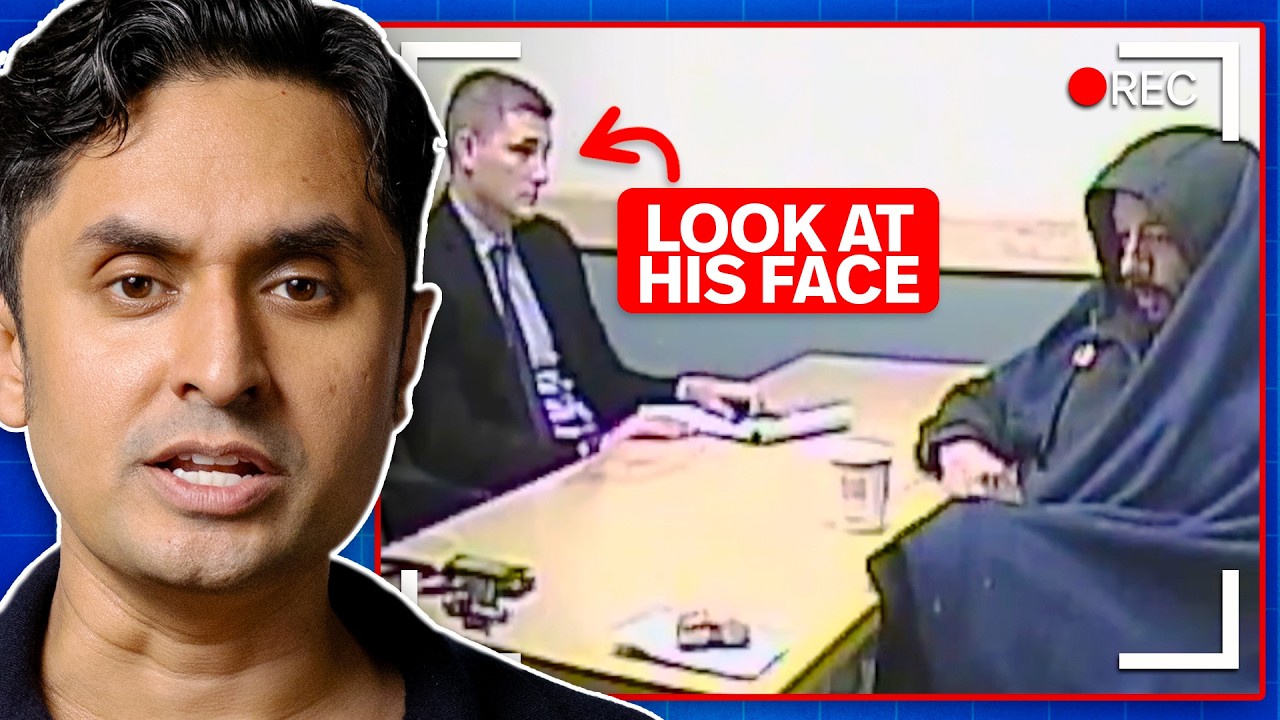
How Cops Use Psychology To Make You Talk
Now Playing
How Cops Use Psychology To Make You Talk
Transcript
1027 segments
Hey all, today we're going to be
analyzing the communication in police
interrogation techniques. I'm Dr. Allo
Kenosha, a Harvard-trained psychiatrist,
and I'll be breaking down which
communication techniques work, which
ones don't, and how they work. So, let's
dive in.
>> Well, this video is incredibly
disturbing to watch. The man being
interrogated is Thomas Perez Jr. He
reported his father missing. Fontana
police accused Thomas of killing his
dad.
>> It was August of 2018. Fontana police
were convinced Perez's father had been
murdered. They thought Perez appeared
suspicious.
>> It's really concerning to me that he
hasn't been back yet.
>> They asked Perez to come to the station,
and that's where they turned a missing
person case into a 17-hour
interrogation.
>> You murdered your dad.
>> No, I didn't.
>> Yes, you did.
>> Yeah, so what's what's kind of scary
about this? There's a couple of like
psychological principles here. So,
what's scary about this from a legal
perspective is they can, you know, ask
him in a 17-hour interrogation. They can
ask him, "Did you murder your dad?" like
500 times, and he can say no 500 times.
And then, the 501st time they ask him,
he says yes, and like that's what gets
cited at trial. That's scary thing
number one. Second thing is I think
people often times underestimate,
grossly underestimate, what
psychological pressure does to you. So,
with like a 17-hour interrogation, your
brain is going to be so fatigued, right?
You're going to be so emotionally raw,
like all of your psychological defense
mechanisms that are healthy won't be
working. And psychological defense
mechanism doesn't mean like you're
you're like a master manipulator. This
just means that at that point, you know,
you're going to feel so raw, you're
going to feel so terrible, like you're
you're kind of trying trying to make
people happy. You're trying to just end
these sorts of things, and then you can
say all all kinds of stuff. One thing
that I think is a a really good example
of this is they did a lot of interesting
psychological studies, I think after
World War II, on some of the behavior of
like Nazis. So, after World War II
during some of these these criminal
trials on the Nazis, people started
designing psychological experiments to
see how hard you could push people
before they start complying. And there's
a really awesome experiment where they
set this this experiment up where
basically you had a subject and the
subject is in one room with a button.
And on and they have a microphone and
they can speak to somebody else that's
on the other side of the wall. And
there's a guy with a clipboard who's
like wearing a lab coat and a clipboard
and he says, "Okay, you've got a button
and every time you hit the button it's
going to administer a shock to the
person on the other side of the wall."
And so basically like they they set the
the shock setting to one and and the guy
with the lab coat instructs the person
to like hit the button. And the guy hits
the button. And then someone on the
other side is like, "Ow." And then the
guy with the lab coat turns it up to two
and they're like, "Hit the button." And
the guy like [clears throat] hits the
button again. So, he's like, "Ow." And
so they slowly start turning up the size
of the electrical shock. It's not a real
shock. There's really no one there.
They're acting. But what's really scary
is at some point the person on the other
side of the wall starts pleading with
the
the subject who's hitting the button.
They tell him, "I have a heart
condition. My heart doesn't feel good. I
think this electrical shock is like
causing me like heart problems." Like
and they're begging them to stop. And
the really scary thing is the person
with the lab coat like turns it up to
eight and he's like, "Hit the button.
Don't worry about what he's saying. Just
hit the button. Your job is to hit the
button." And what's scary about this
experiment is how compliant people are
to like figures of authority. And very
few people, if I remember correctly,
very few people actually like got up or
refused. Most people did what they were
instructed to do because the dude with
the lab coat is like, "This is part of
the experiment. We need to get all the
way to 10. Don't worry about it. Just do
what you're told." People who are under
a lot of authoritative pressure will do
all kinds of things to make the person
in power happy.
>> He just told you we found your dead dad
and you don't give
>> They even brought in Perez's best friend
to try and get a confession.
>> Dude,
they got you on murder, dude.
They got you on murder.
>> Impossible.
>> When that didn't work, detectives
brought in Perez's dog.
>> You killed him.
And he's dead.
And your dog
is sitting here looking at you, knowing
that you
killed your dad.
Did you stab him?
>> I didn't think that I did.
>> Right, so at this point, like your brain
is not functioning correctly. I'm just
curious, you know, you know, if people
told you something was true, and tons of
people came, people that you trusted,
and you just heard over and over and
over and over and over again, right?
They're basically gaslighting here.
That's what this is. Right, at what
point do you crack? At what point do you
start doubting what you think? And as
you get physically fatigued, as you get
mentally exhausted, do you start to
question your own thoughts?
>> Where would you stab him?
>> Might have been the belly.
>> They learned that Tom's father was alive
and well and was at LAX Airport ready to
take a flight to go visit his sister.
>> Steering filed a civil rights lawsuit in
federal court against the city of
Fontana, and the suit was settled for
nearly $900,000.
>> And one of the really interesting things
as a psychiatrist, one of the key things
they teach us is like the value of
silence. So, if you want someone to
start speaking, if you want to make
someone uncomfortable, just be quiet.
Okay, so this guy is
>> So, I get it, right?
>> arms crossed,
right? So, he's he's he's nodding along,
right? So, he's he's trying to signal to
this guy, hey, like I do get that you
get me, but his body language doesn't
really mirror that.
>> Whatever did happen in the apartment
between you and Michelle
that's resulted in her now disappearing.
We'll use that word for lack of a better
term, all right?
>> Um, it's my impression
that
what that was about, what that argument
was about, what that confrontation was
about last weekend, it wasn't about you
wanting to hurt Michelle. It was about
your love for Caden.
And it was about your burden
>> Right. Yeah, I'm
>> about protecting
Caden.
>> So, what I think is actually going on
here is I don't know, I mean, I don't
know what happened here, whether this
guy is guilty or not. See, when people
do things like this, often times what
the mind does is develops a narrative
that is what we call ego-syntonic. So,
ego-syntonic means jives with my idea of
who I am. So, it's not even clear to me
that this guy, before the detective
shares the story, really believes he was
trying to protect Caden. Maybe in that
moment he was just angry and lost
control. He didn't have this conscious,
like, "Oh my god, like, I have to do
this to protect the person I love, even
if it means doing something bad." Right?
These morally framed choices that we see
in movies are not how real life is. But
now the detective is offering him a
hypothesis,
which feels good, fits well with this
dude. Right? You're doing it for love,
not out of anger.
>> protecting
Caden.
>> All right, cuz he wasn't being taken
care of.
>> Exactly.
>> The detective has skillfully employed a
psychological technique known as the
good choice, bad choice method.
This method presents Mark with only two
options, forcing him to make a decision.
On one hand, there is a good choice, his
unwavering love for his son, Caden.
>> I don't know if this really jives.
>> hand, there is the bad choice, harboring
ill intentions towards Michelle.
>> So, the issue here is you don't have to
accept that frame. Right? So, this is
like really important. If you guys want
to learn manipulation resistance 101,
the best thing to do if someone is
boxing you into a yes or no choice,
don't accept the frame. It doesn't have
to be either or. You don't have to
accept if this is good or this is bad.
This is manipulation 101. So, it is a
psychological technique where you're
like, it was this or this. No, it
doesn't have to be either of those
things. I think the best person at doing
this is Jordan Peterson.
>> So, people say to me,
"What do you Do you believe in God?"
And I think, okay, there's a couple of
mysteries in that question.
>> Sorry, I suppose I'll make myself clear
here. I'm only asking for a yes or no.
>> Mark is inclined to favor and gravitate
towards one narrative, typically the one
that paints it in the most innocent
light.
>> It's not even about it innocent. It's
about good. It's we all want to think of
ourselves as good people.
>> telling you I could not
I'm listening to your story, man, and I
almost want to cry for you.
>> Empathic connection?
>> I I I just can't imagine
the stress and
the pressure put on you because of the
love you have for Cayden when you watch
this woman
continually berate him and treat him so
terribly, cuz she's doing the same thing
to you that she's doing to the
three-year-old, and you're an adult.
>> Mark is now in a situation where he
feels cornered.
>> He feels cornered? What?
He doesn't feel cornered.
This is not defensiveness.
>> He has two choices.
>> No, he doesn't.
>> stop talking and ask for a lawyer.
>> He's not cornered, he's connected.
>> She did not walk out of that apartment.
We both know it.
We both know the circumstances under
which
whatever did happen.
>> Now, this is interesting. So, so he he's
he's like pivoting away from rapport
to like, okay, bro, now that we're
together, like let's let's do real talk,
bro. Let's confront this negativity
together. This doesn't feel cornered at
all. This feels the exact opposite. This
feels open to me.
>> So, I want you to be honest with me and
tell me what happened.
>> She got up
and um
I got up
and um
she's getting dressed.
And she's finishing up.
And she's still yelling and Kayden's
hiding. I grabbed her and I broke her
neck.
Told me I was a sorry
and that I would she was going to
control me the rest of my life and I
grabbed her by her neck and she and and
just went threw her on the bed and she
just went
>> This isn't being cornered.
This is opening up. It's the exact
opposite.
That was it.
I mean, I sat there and held it and
So, this is important, too. Look at his
affect, right? Now, he's talking about
murdering someone.
And his response is, "Okay."
Now that he's talking, let's not
interrupt him.
Okay. So, now he's feeling remorse. Um
Give me the death penalty. That's fine.
Now he's ask- This is not cornered. You
guys get this?
This is guilt.
This is warmth. This is not cornered.
Now he's being supportive.
I mean, manipulation I think makes sense
to me here because I think that it's not
clear to me whether the police officer
is being inauthentic. But, this is what
we do in psychiatry, right? Like we try
to authentically connect with people.
The only thing that really strikes me as
manipulative here is we try to connect
with people in order to help them. And
I've worked with people who are I mean,
I've worked in a jail. I've worked with
people who are murderers, you know, like
literally like convicted. And so, we we
authentically connect with them and I
think this is an example of a guy who I
mean, we don't really know what
happened. We don't really know what's in
his mind, but like it sounds like he did
something that he genuinely regrets. And
the officer just created space for him
to share that because I mean, he's even
saying like he feels really guilty,
right? That's not manipulation. I mean,
I guess it's manipulation if you're
planning on using this authenticity to
like throw the book at him. But I mean,
this this felt like a really solid
interview with someone who made a
mistake and then feels guilty about it
and really did do something wrong and
recognizes what they did was really bad.
But maybe the reason that I see it that
way is is why I'm a psychiatrist instead
of a cop. Y'all, if y'all want to learn
a little bit more, by all means watch
another YouTube video. If you guys are
actually interested in finding the
practical tools to change on your own,
that's where memberships comes in. And
if y'all are interested in getting some
help or achieving a particular milestone
4 weeks, 8 weeks, or 12 weeks [music]
from now, check out coaching.
So, if y'all are interested, check out
the link in the description below.
When someone is cornered, they get
defensive. So, like when someone is
cornered, right? Like they're getting
attacked on all sides and they're
retreating. So, when someone's cornered,
they're not going to open up. This is
actually the exact opposite. The police
officer is giving him a lot of space to
step out of the corner and offer his
feelings. Yeah, this was happening and
and like I did feel bad and I was trying
to protect Caden and this is what
happened. He's actually noticed that
that the the the subject of the
interrogation here is not trying to
defend himself. He's actually looking
for absolution. Absolution means opening
up, not closing down.
>> Hey, there.
How are you?
>> Good.
>> I'm Sergeant Leatherman. It's good to
meet you. How are you today? I guess you
had better days.
>> Yeah, sure.
>> Yeah, sure.
>> She does a good job of mirroring, too.
He's like, yeah, sure. Right? So, so he
opens up and she's like, you've had
better days, right? And then he's like,
yeah, sure. And then she's like, yeah,
sure.
>> Have some food. What would you like to
eat?
>> Something that I can eat.
>> Like what? Like a sandwich?
>> This is huge. So, one of the key thing
first things I I learned working in the
emergency department is even when
working with people who are psychotic,
high on cocaine, high on K2, want to
kill me, offering them food is like such
a primal basic human thing that really
like works wonders at calming people
down and building rapport. Feed people
that you care about. It's a great sign
of caring and feed people that you want
to build a relationship with.
>> Good to meet you. Rough day, huh? Want a
sandwich? Need the restroom? It looks
polite, humane, even, but it's not
casual, it's strategic. What you didn't
see is that this man was left alone in
that room for 30 minutes before Sergeant
Terpstra walked in. Think about that.
Nothing but your thoughts, no phone to
distract you, nothing on the walls.
>> Yeah, this is where if you guys want to
prepare yourselves
if you guys want to prepare yourselves,
what you'll need to do is check out our
staring at a wall for an hour exercise.
There's a really good video that Kabir
actually uploaded of a time lapse of him
doing it. It's really funny.
>> Your mind starts racing and then relief
walks in. Calm voice, soft tone, even a
handshake. Your nervous system begins to
shift. You now associate with the
sergeant comfort, but that's not
kindness, that's conditioning. Watch
what she does next.
>> And I appreciate how pleasant you've
been and you know,
>> [snorts]
>> it makes it a lot nicer for me.
>> Is he crying?
>> have to come and talk to somebody and
they're not um
a beast about it, you know.
>> More conditioning. She says, "When you
cooperate, this stays comfortable. When
you engage, I approve. You want this
interaction to avoid conflict and to
stay positive." But that is exactly what
the cop
>> So, this is where I get a bit confused.
I think there's like a bit too much
extrapolation here. So, demonstrating
kindness is on some level like
behavioral conditioning. I don't know
that I quite get the stick that this guy
is talking about here. That that like
things are about to turn. I think she's
just expressing appreciation. It's
absolutely a rapport building, but I
just call it expressing appreciation.
>> They don't want you guarded. They
certainly don't want you silent. And
they never want you asking for a lawyer.
But they do want you to be comfortable
because comfortable people talk.
Suddenly you feel like you have to fill
the silence. You start clarifying things
they didn't ask you to clarify. From
here they only tighten the noose.
>> But even if you resist all of these
tricks, you'd be amazed at how effective
it is when cops start dripping evidence
on you and demanding something back. For
hours Sergeant Terpstra slowly reveals
evidence. Just pieces. A hat, gloves,
fingerprints.
>> This is a ball cap.
>> Mhm.
>> Have you ever seen that before?
>> Maybe.
>> Tell me about it.
>> I don't know.
>> I mean, do you own that hat?
>> It's a ball cap.
>> Yeah, it is a ball cap.
>> What's really interesting about this is
how unsatisfied she is with his answers.
Man, this feels like how to resist
manipulation 101. Number one way that
people manipulate you is by asking you
questions over and over and over again
that you have already answered. Do you
want to go on a date? No.
Why not?
No is a complete answer. I don't know is
a complete answer. You don't need to say
anything else after that, right? And if
people are manipulating you, what
they'll do is they'll keep asking
questions until they find a [ __ ] in the
armor and then they'll widen the crack.
So he's already said, I don't know. He
doesn't have to defend himself. He
doesn't have to provide her with an
explanation.
>> thing she can anchor on camera and look
back and say, "Look, that's the look of
a guilty man." Because think about it,
if she just dropped all the evidence on
the table at one time and he reacted,
she wouldn't know what he was reacting
to and what he was flinching about.
>> Let's understand conditioning, okay? So
conditioning is something that is a
behavioral thing that is done over time.
Conditioning is is things like you know,
like Pavlov's dogs is the classical
conditioning argument where over a long
period of time, we are training a dog to
when the bell rings, the dog starts to
salivate. So, conditioning is is
actually about learning and
reinforcement. Usually does not happen
over a very short window of time. It's
something that happens over a longer
window of time. And this is kind of a
random joke, but one of my mentors is a
very skilled psychiatrist once told me
that psychoanalysis is something that
very intelligent psychiatrists developed
to help people who with really boring
problems. So, boring stuff is not
exciting to think about. So, we develop
all these complex theories. The simple
thing that I see in all of these clips
is wearing people down, wearing people
down, wearing people down. This isn't
conditioning, this is exhaustion. I want
you guys to think about the worst
layover that you've ever had where
you're sitting at the airport and then
the plane gets delayed 2 hours and then
it gets delayed 4 hours and then it gets
delayed 8 hours and then you're like
you're you board the plane and then you
get off the plane. Think about your
mental state. How fried you would be.
And remember, their goal here their this
this other interrogation that we saw
lasted 17 hours. Can you imagine being
hammered for 17 hours? How would your
mind be functioning? This isn't
conditioning. You're not learning
anything. There's no permanent learning
here. This is just wearing you down
until your brain starts misfiring. And
then you misspeak a little bit here, you
get a little bit emotional over there.
And the really scary thing about this is
that what I see from these interrogation
tactics is they get to throw as many
darts as they want. And what they're
looking for is one that hits. This is
like the opposite of gambling. In
gambling, every pull of the slot
machine, you lose something, it costs
you something. But every time one of
these cops ask question, they don't lose
anything. They just get to throw as many
as they want and once one hits, right?
You get as many pulls of the slot
machine as you want. You just need one
to hit, and that's what's going to be
what puts you away.
>> Yeah, what time of day was that do you
think?
>> Midday.
>> You said she called you supposed called
yourself?
>> Before before noon.
>> Very detailed rant.
>> just one morning and I decided to stop
in and
>> This guy does think that he can offer a
story that will work to accomplish
whatever he thinks it's going to
accomplish.
>> Walking down the road and he was mowing
his lawn around here somewhere.
And we walked in and we're talking and
I met his dog.
>> I walked over to pet his dog.
>> So, all these details, these details
wreak of something called confabulation,
which is something that we see in people
who are like pathological liars, where
people with pathological liars will
offer lots and lots and lots of details
that are just made up. I don't know if
that's the case with him or not, but
it's really interesting. It maps onto
that. Because details are what makes a
story true. So, the more details I
offer, the more believable my story is.
>> I don't know. He's got chairs here.
We sat down here. It was a hot day. We
came back outside.
>> So, the other thing is most memories
don't work like this, right? We don't
remember all these details most of the
time. This level of resolution is
usually not the way our memory works.
Like I want y'all to just think about
the last time you went to someone's
house. Do you remember what the
temperature was? Do you remember where
you walked? Do you remember you had a
cold beer? Do you remember you walked up
and you did this and you did this? Like
you don't actually have all those
memories. Memories of details only
happen when something is emotionally
significant.
>> I do have a bicycle. I do know this
much.
>> Okay.
>> And I've
>> Is it a 10-speed with the handlebars
from that era?
>> No.
>> Okay, what type of bike is it?
>> It's uh
>> [sighs]
>> eight by three I mean four speed.
>> Okay. So, you said you had a bike,
right? Okay, tell me what kind of bike.
I appreciate you being honest.
>> Well, cuz it just
>> [laughter]
>> Oh, oh, I want you I appreciate you
being honest. And look at how frustrated
he is.
>> I don't get how many look at I
appreciate you being honest.
>> Well, cuz it just
>> You guys can catch that tone of voice?
Well, it's just because
So, he's actually emotionally not in a
good place right now. So, his mind is
scrambling if I had to guess. But what
what I see this kind of thing when when
you see a lot of mental activity, but
you you hear that pivot in tone of
voice, that speaks to the his emotions.
It's emotionally active for him. As for
all the stuff about, you know, locking
in contracts, I think memory is like
remarkably unreliable, so I'm not
surprised that people wind up with
contradictions. I think if if I
interrogated you about what happened 3
months ago, we'd find contradictions.
Doesn't mean that you're lying.
>> I don't want to say that.
You were brain dead at the time.
>> I don't know.
>> What type of tobacco or was it what No,
it was still
>> So, so, so this is something I think
that this speaks to me of artificial
relaxation. So, I want you guys to like
notice how open he is. This this really
reeks. I'm trying to figure out what
about this feels artificial, right?
Maybe it's it's the way he's leaning.
Something about this is like artificial.
His facial expression is not relaxed.
His facial expression is concentrated,
but his posture is relaxed. But it's not
really. Like if you look at this, does
this guy truly look relaxed to you? I
think there's something about the
squaring of the shoulders maybe, maybe
he's leaning against something, I'm not
sure what. What this is giving for me is
someone who has artificially decided to
show authentic emotion. And let's see if
that tracks for y'all. Look at this.
>> I told you it was white. Did that screw
you up?
>> Yeah, I don't know.
>> Right? So, he's trying to be honest.
He's like, "Okay, I have to be Yeah,
this is honest but obfuscating. Honest
sneakiness. Right? There's no way that
he can't say no. So, he's displaying a
lot of emotion. He's displaying
authenticity.
>> You said you didn't say you never met
the little boy.
>> Never met the little boy either.
>> Did he want you to meet the little boy?
>> Yeah, so look at his face. So, look at
his breathing pattern. Breathing is
deep, right? And then like look at his
face. He's like there no animation in
it. It's locked. That's what it is. So
when someone is truly relaxed, there's
going to be variability in their
movement. That's what it is. This is a
locked posture. So if you think about
like if I'm relaxed and I'm chatting
with you like I'm going to move my
hands. I'm going to go like this. I'm
going to go like this. My face is going
to do this. I'm going to smile. I'm
going to do this. There's going to be
variability, right? I'm loose. I'm going
to be moving. He's really locked in.
>> Stops. Tears rolled down his cheeks. The
first real crack in his composed facade.
The weight of the interrogation was
clearly taking its toll.
>> Once again, wearing people down. That's
the number one technique here.
>> Did you bring your coffee?
When he gets back in here, I'll go get
you one, all right? Do you want Do you
actually want coffee though?
>> Yes.
>> Okay, I'll get you one in a minute.
>> Now he's saying sir. Interesting.
>> back in here.
Where would you like to start?
>> Oh, this is so interesting, okay? So
before he was squarely but open. Now
he's defended but surrendered. The
game's over. GG'd out. Where would you
like to start, sir?
>> Things were going good at first.
Things were going fine the whole time.
>> Uh-huh.
>> Until
>> It happened.
>> It happened.
>> Okay.
>> Sugar and ice?
Cream?
Just cream?
>> I like this a lot. This is really
interesting. One way that you can make
something I don't know even know how to
explain this seem normal is to interrupt
it, right? So there's a really
interesting thing which is like if
someone is like confessing and you're
like oh hey like let me do this little
minor thing. Like let me interrupt you
and then we'll kind of go back to it.
Makes it seem like there's no climax to
the story, which is which is a really
interesting kind of like thing that they
consistently do. Is if he's like if
people are confessing or talking or
whatever, they're they're happy to
interrupt them. They're almost like
signaling subconsciously that okay like
this is just business as usual and we
can just like oh what what page were we
on? We were on page 62. Like let's pick
it up on page 63. There there there's a
lot of really neutral affect. It's not
that big of a deal. They're not adding
emotional weight. This is the exact
opposite of what you see in like crime
shows, right? Where it's like oh like do
do you do you
do you want the truth? You can't handle
the truth.
It's the exact opposite. It's like oh
like you want cream and sugar in your
coffee?
>> When did it turn from everything going
all fine to not so much?
>> That's a good question. When questions
are good when you're talking to people.
>> something to you? Did he
>> I
>> That that that was not good. So that's a
close-ended question, right? Did he say
something to you? So yes or no? See
you give him a no. If you want people to
talk, don't give them yes or no
questions. Like this is a really useful
question that I use a lot. You know, if
someone's like oh I'm I'm depressed. I'm
really depressed. How long you've been
I've been depressed my whole life. When
was the last time that you felt good?
And then you ask what was going on at
that time? And then what changed? So
when questions are really good to help
people discover transitions. If you're
trying to figure out what direction you
want to go in, ask yourself when was the
last time you felt that way and what
happened after that? Because that is
going to be the moment that there was
the fork in the road of your life.
>> What happened?
>> What happened?
>> what happened.
>> I'd like to hear it from you. I have
theories, but I'd like to
>> So this is actually really good, right?
So he's like he this is playful. He's
like grinning. He's like hey man,
we both know what happened, but I'd like
to hear it from you, bro. He already
knows, right? There's like connection
here. This is good.
>> I'd like to hear your side of the thing.
I know what happened. I want to see if
>> He even admits it.
>> So I can tell you what happened.
I killed him.
>> You killed Jeff.
And how did you do that?
>> With a knife.
>> Okay. And where did you get the knife?
>> It was mine.
>> Could there was a bayonet type knife?
>> Large.
>> Large knife. And that's the one you keep
sharpening all the time.
Right? That was your That you brought
that with you cuz you always wear it.
>> I didn't know you knew that much. Yeah.
>> What do you all think is the
significance of I I didn't know you knew
that much? What is the point of
admitting his ignorance? This is him
actually like bowing down and admitting
that he has been outsmarted by the cops.
So, this is an interesting psychological
thing, right? When when someone Does
that kind of make sense? It's like early
on he's like, "I'm going to outsmart
you." And this is basically him saying,
"You've outsmarted me." Which is kind of
what I read from it.
>> How many times did you stab him, do you
think?
>> Those are questions I don't know the
answer to.
>> Are you saying one or 100? I mean, the
>> Multiple.
>> Multiple times?
>> Okay.
>> Obviously more than one.
I didn't want it to be a prolonged
thing, though. I wanted it to be as
quick as possible. And unfortunately,
I mean, wasn't long, but it's not like
television.
>> It's
>> different from what you expect.
>> Yeah, so what's so interesting here is
now he's like slipping into the role of
almost expert. Like this seems really
relaxed to me.
>> And I'm not even much of a TV watcher.
And obviously, I
have enough intellect to know that it
wouldn't be like television.
>> That was really interesting, right? And
then he's like, "I have enough intellect
to know, Russ." But anyway, I mean, this
is this feels interesting, but also I
don't know. I mean, I it really makes me
feel for a lot of these people. Like,
you know, we look at these things and
they're and they're so villainized. And
and I think people should absolutely pay
for what they've done. And also having
worked with this population like
it makes me wonder, you know, what was
this what was this person's history
like? I'm not getting any sense of like
motive or rational motive from this,
which really is kind of scary on the one
hand. It also like sad on the other
because is it is he is Is just wired to
kind of function in this way? Which
doesn't mean that he shouldn't pay for
his his his actions, but really just
tragic to see this kind of thing and
that this is the world that we live in.
>> She could tell stories like no one I've
ever known. They were so convincing. You
would ask her a question and she would
just be so fluid in her answers. And of
course she's describing something that
was taking place in Germany. So it's not
something that we could go and check on
the next day. And she led us on for
about a year. The only thing that we can
do to protect ourselves from deception
is what is being said and what is the
proof. You begin to make an inquiry, the
story begins to fall apart or it causes
a cognitive load. You know, oh so you
you went to to Mexico. Which airport did
you land at?
Um I you know, and then they struggle to
come out with with an answer. Simple
questions should evoke simple answers.
And when they create a cognitive load
>> Okay, so so this is where like this may
be a virtue of the populations that we
deal with, right? So simple questions
should evoke simple answers, completely
agree. But very few human beings have
detailed memories about simple things
from time a long time ago. So I don't
know what frame of time he's talking
about, but it's like if you asked me
like what airport did I fly into a year
ago, my answer isn't going to be that I
remember the airport. My answer is going
to be I remember which airport people
fly into. So if you ask me like you
know, which airport did you fly into in
Tokyo? I'm going to say Narita because I
forgot that Haneda exists, even if I
flew into Haneda. So this is where
there's some stuff that I think is is
kind of weird about this. The other
thing is in terms of detecting
deception, respectfully I think this
could also be the the populations that
we've got in in the evidence that we've
got. But in psychiatry, we don't have
any evidence. We function without
evidence. So, there's a lot of ways that
you can detect deception. Here's like
top three. First is incongruent affect.
So, when once when someone is talking
about something that does not match
their facial expressions. So, they're
talking about something really bad
happening to them and they're smiling
about it or they're, you know, talking
about something really good happening to
them, but they have a really neutral
affect. It doesn't necessarily indicate
deception. It indicates a discrepancy
and deception is one of the
possibilities in that discrepancy. The
other thing is is kind of like
incongruent uh like internally
inconsistent incongruent affect. So,
this is where things get complicated,
but basically we kind of have this like
[ __ ] meter, which I've shared with
y'all before that it's like, "Okay, this
person is trying too hard." So, you
know, it doesn't feel natural or they're
trying really hard to convince you of
something. Another sign of deception is
actually like explaining yourself in a
superfluous way. So, Shakespeare noticed
this many years ago when he said, "Me
doth think that they protest protesteth
too much." or something like that. So,
when someone verbally explains or
defends themselves, that's a sign that's
a potential sign of deception, okay? The
last thing the last really interesting
version of deception is actually
projection. So, people who are cheating
in a relationship are more likely to
accuse their partner of cheating. I
don't know if that's like evidence-based
or not, but we absolutely have all of
these like psychological mechanisms and
projection is one of them. When I'm
suppressing something from myself and
literally what projection means is I
have something inside me that I am
avoiding in some way either
intentionally or unintentionally that
then I put on top of you. So, I'm the
cheater, but I accuse you of cheating.
So, I think there's a lot of techniques
that we have to detect deception or
tools. The key thing to remember is that
none of these are one-to-one. They're
not definitive for deception. They are
definitive for a discrepancy, and
deception could be one explanation in
that discrepancy. If you all like some
of the stuff about how to become
resistant to manipulation, how to pay
attention to facial expressions, what to
say, what not to say, definitely check
out communication 101 over on the
membership side. This is my
psychiatrist's
take on the foundational principles to
become an effective communicator. You
all can check out the link in the
description below, start your free
trial, and hopefully you'll become a
better communicator.
Interactive Summary
Ask follow-up questions or revisit key timestamps.
Loading summary...
Recently Distilled
Videos recently processed by our community