What Comedians Get Right About Mental Health Trauma
Now Playing
What Comedians Get Right About Mental Health Trauma
Transcript
1062 segments
Hey y'all. I'm Dr. Alo Kenoja, a Harvard
trained psychiatrist, and today we're
going to watch some comedians joking
about mental illness. Hopefully, we'll
laugh. But what I really want to do is
explain the mechanisms behind the joke.
So, let's dive in.
>> Self diagnosed with a dissociative
identity disorder.
>> Dissociative identity disorder.
>> It's dissociative.
>> It wasn't me cheating on you. [laughter]
>> Self-dagnosed. Important.
>> What does that mean, though?
>> What that mean? That's what used to be
known as m multiple personality
disorder. It's a controversial
diagnosis. I'm not getting into it.
>> Yeah,
>> you can. Just so you know, like you can
totally
>> You get to walk off stage after this. I
got to meet these people in the parking
lot.
>> When you say these people, do you just
mean one?
>> Okay. So, let's get into multiple
personality disorders and why it's a
controversial diagnosis. So I once asked
one of my mentors, professor of
psychiatry at Harvard Medical School,
hey are multiple personalities real? And
he said,"I believe in multiple
personalities in the same way that I
believe in aliens, which is like
statistically yes. There is probably
something out there called multiple
personalities or people do really have
multiple personalities, but I never
believe anyone who says they've seen
one." It was, you know, it was it
happened within literally 24 hours and
it was like here's my two other
personalities and their names and I was
like,
>> can I ask and I don't mean to be rude,
but remember this is all fake. Uh,
[laughter]
>> we'll talk. Okay, so is it fake? We'll
get to the fakeness later. [laughter]
>> We we'll we'll talk about is it fake?
>> Can I ask?
>> We'll explain what it is.
>> Can you like tell me like when when they
introduced the other people, was it like
Actually,
yes.
>> Or was it or was it like they're back
here
>> to tell you what they're saying?
>> Both. Okay. So, this is really
interesting. Let's understand what
multiple personalities are first of all.
So, normally you have your mind, right?
And your mind is connected and you adopt
different roles. So, like if I'm, you
know, deeply in love with someone in a
secure relationship, I may start talking
to them in like a baby voice. Oh, baby,
I love you so much. Oh my god, you're so
amazing. I love you. And then when I'm
like when I go into work, right, I may
adopt a different personality. So I'
I've worked with patients, for example,
who are executives at highpowered
companies. And one of the really
interesting things about media, which is
somewhat correct, is sometimes people
who are in an very dominant positions
will engage in like submissive sexual
fetishization. Okay? So we have all
these different hats that we put on in
our personality. But the thing is our
personality is all connected. So, I want
you guys to think about like your
personality is a crystal that has lots
of different facets. What happens in
multiple personality disorder is that
there's a psychological trauma that
basically imagine taking a hammer to the
crystal and then all the pieces shatter.
So, in multiple personality disorder,
there's a great um text about it where
they talk about how trauma causes the
personality to shatter along fault
lines. So in the way that there's like a
weakness in like a certain like let's
say piece of stone or a tectonic plate
and then it cracks along those lines,
that's what happens in multiple
personalities. So whereas all of the
different hats that you put on are all
still connected, when someone has
dissociative identity disorder, their
hats are no longer connected. So I don't
know if this kind of makes sense, but
all the hats that they put on aren't
just hats. They sort of become different
people. And this is where things get
kind of interesting because they're all
still connected though, right? because
it's like one brain. So sometimes they
do have different mannerisms, sometimes
they have amnesia from each other
because one alter like won't let another
altar know what's going on. And then the
other thing is also true where since
they're all connected by one physical
organ which is the brain, they can
actually communicate with each other as
well. So when you're doing like
psychotherapy with some of these
patients, what you can do is ask them,
hey, can you let soand so come forward?
And then I I know this, you know, that
there's that move and stuff like that,
but what's really interesting is you'll
see changes in tone of voice. You'll see
changes in like accent, mannerisms, even
body language, posture, stuff like that.
I thought I was on an anti-depressant.
It turns out I'm not. It turns out I'm
actually on a mood stabilizer that they
use as an anti-depressant. Fun fact
about prescription drugs, everything
they prescribe, they actually use for
like four different things.
>> This is correct. know what your deal is
until you find a combo that works and
then Google all your pills by yourself.
>> So here's what's we got to understand
why we do this in psychiatry. This comes
down to pharmaceutical company and FDA
shenanigans. So in order for a drug to
be approved by the FDA and to a certain
degree the European Union as well. You
have to show efficacy. So if you're a
pharmaceutical company, you have to show
that it works really well. So often
times what pharmaceutical companies will
do is they will design a medication that
is shows a large effect for a very
specific condition and once they get it
approved you are allowed to do something
called off label use. So I am as a as a
medical doctor can prescribe something
for a condition once the drug gets
approved that means it's generally
speaking safe and and stuff like that.
So then I can prescribe it for any
condition that I want to. And we see
this right now with nothing more than
the ozic, right? The pick. You're on a
bit of the pick, which is actually like
approved for like obesity and like, you
know, severe obesity and things like
that. But everyone's getting
prescriptions for it out of pocket.
Insurance isn't covering it if they're
like normal weight and just want to like
lose some weight and be prettier. So,
this happens all the time where a drug
company will get something approved and
then what they'll actually market it to
is a completely different way more
common condition. So, after years of
trial and error, I finally found a
combination of things that worked for
me. And 6 months ago, I decided to
Google it cuz what the hell? And it
turns out that everything I'm taking is
primarily used for bipolar disorder,
which is what mood went back to my
psychiatrist and I was like, "Hey,
[laughter]
>> do we think?"
And she was like, "Oh, yeah."
>> Yeah. This is sad but unfortunately
true.
[applause]
And I was like, "Is this how you
TELL PEOPLE?"
>> Often times we don't tell people.
>> No, of course not. We didn't know. I'm
glad we figured it out. And I was like,
"We?" [laughter]
>> I said, "You really didn't know that I
was bipolar." And she goes, "No, of
course not. We thought we were treating
anxiety and depression." And I said,
"Okay, cuz this kind of feels like a
putting your dog's medication in cheese
situation." [laughter]
>> Yes.
This is sad. We'll explain all this.
And I was like, I don't know how I feel
about this diagnosis. And she goes,
well, if it makes you feel better, you
don't have to say I am bipolar. You can
say I have bipolar. Which feels a lot
like someone going, I said you were
being A
Not that you are a Okay. So,
here's why a psychiatrist may give you a
mood stabilizer if you're depressed. So,
basic thing to understand, in
depression, we have low mood. But
bipolar disorder is different. It is low
mood plus elevated mood at times. So if
we look at an anti-depressant
medication, it elevates mood. If we look
at a mood stabilizer, it elevates mood
and it brings down excessively high
mood. So a psychiatrist may prescribe a
mood stabilizer to a depressed patient
because it actually elevates mood. And
sometimes what happens in people with
depression is we just don't know if
they're bipolar yet because they've
never had their manic episode. So, we
start with an SSRI or an anti-depressant
medication, maybe doesn't work great. We
try another one, maybe doesn't work
great. But us as psychiatrists, what we
do is, okay, let's try a mood stabilizer
because some patients are more
responsive to mood stabilizers than they
are to anti-depressants. So, we give
them a mood stabilizer, their mood gets
a little bit better. Now, here's the
tricky thing. At that point, are they
bipolar? And the answer is really scary.
We don't know. Because the way that we
diagnose bipolar disorder is you have
depressive episode, depressive episode,
depressive episode, and then at that
point you've got MDD, but the moment
that you become manic, that's when you
get the diagnosis. So imagine someone
has bipolar disorder, depressive episode
number one. Number two, they haven't
become manic yet. So they may truly be
bipolar but we don't have information
that tells us definitively that they are
bipolar at that point which is how we
end up with this ridiculous situation.
One of the upsides of co might be I hope
>> is uh empathy for mental health stuff
right
>> everybody was isolated
>> and human beings don't do well with
isolation
>> this is true
>> we still got cave brains right so we
think if we're isolated
>> that the tribe is rejecting us
>> and that and then we start picking away
at ourselves and finding fault that
aren't there and
>> basically our mental health declines
right so I hope in the future that
People have empathy when someone else
someone says like I'm depressed or
anxious. They'll go like oh yeah I I I
remember that.
>> Let's talk about isolation because this
is a really good point. Human beings
evolved in social tribes. And so the key
thing to understand is that since human
beings are tribal in nature like we are
not great at hunting on our own. We're
like pack hunters. We have division of
labor. Isolation meant death. So if you
were exiled from the tribe, right? And
this is something that I don't know if
you guys have ever wondered about. Like
exile doesn't seem like that bad of a
punishment to me. Like if someone sent
me to a different city, like I would
like not that big of a deal. But exile
used to be basically a slow and painful
death. That's what the sentence was. So
when a tribe pushes us away, we become
isolated. We our risk of dying increases
and our brain tries to protect us from
that. And the way that our brain
protects us from isolation is actually
shame. So let's understand this. If a
lot of people at school are making fun
of me, they're like pushing me away from
the group. I feel ashamed. And what does
the emotion of shame try to get you to
do, right? So, if people make fun of me
because I don't have a particular pair
of shoes, what would a teenager want to
do? I want those pair of shoes. Shame
induces a behavioral change that leads
us to acceptance by the tribe. Okay?
Now, it's abused and stuff like that all
the time, but here's the key thing to
understand. When we feel ashamed, we are
isolated. That's how it kind of evolved.
So if you artificially isolate someone,
they will start to feel a lot of shame.
And this is where things get really
messed up because generally speaking,
isolation and shame and ostracization,
all of those things go hand in hand. If
I use the wrong language, everyone gets
upset with me. They stop getting sending
inviting me to parties, things like
that. Okay, let's just keep going.
[laughter]
>> No, I'm all right. I got a therapist
recently. Nice. Yeah.
>> Let's go.
>> Yeah. [cheering]
>> Yeah.
>> Audience is on board.
>> You have to, guys. You You do like
>> Well, like if you're going to complain,
as much as I complain, [laughter]
unfortunately, you do have to get one.
Like, um, yeah,
>> this is actually a really good point.
So, people will say like, "Hey, everyone
needs to be in therapy. Is that true?" I
think no. But if you have a lot to
complain about in life, therapy is a
great place to start. If you have a lot
to complain about and you are not
mentally ill, coaching is a great place
to start. Hey, if y'all want to learn a
little bit more, by all means, watch
another YouTube video. If you guys are
actually interested in finding the
practical tools to change on your own,
that's where memberships comes in. And
if y'all are interested in getting some
help or achieving a particular milestone
4 weeks, 8 weeks, or 12 weeks from now,
check out coaching. So, if y'all are
interested, check out the link in the
description below.
>> Like my friends were starting to be
like, "You should pay someone to do what
you expect of us." I was like, "Oh,
okay. I found this therapist." And and
>> so, one quick point about that. So, what
is the limit of being a friend and when
should you see a therapist? Really
simple reciprocity. So, if you are
emotionally supporting someone and on
balance, they're emotionally supporting
you in the same ballpark. You helped me
through a breakup. I help you through a
breakup. That's what friendship is. When
things become lopsided is when you
should consider working with a
therapist.
>> Really smart and uh we zoom and uh he
said something interesting where he said
remember you are not the feeling like
sure you feel consumed by the feeling
but you are not the you and within
[snorts] everyone there's like a very
still neutral internal self and and you
know you experience the feelings but
you're you're not consumed by them. And
he said rather than identifying so much
with the feel like I'm anxious, I'm
this. He said you don't be consumed by
the feeling, just observe the feelings
as they come with curiosity.
>> Yeah, this doesn't work. This is
correct, but it doesn't work.
>> Apparently, that's the
>> So, I think you're just be like, huh?
[laughter]
>> This presumes a certain intensity of
feeling
>> experiencing
rage.
See, we as therapists
>> curious.
>> Okay, this is fascinating. So, let's
talk about this. This person says,
"There is a place of stillness within
you." I call it shunya. Just don't
identify WITH THE FEELING. OH, I didn't
think about that. Oh my god. I Oh, and
now that you've told me there's this
eternal place of peace within me, now
that I know it's there, I can access it
immediately. Not how it works. So, let's
understand a couple of things. People
who say just be curious about the
feeling. This is something that blew my
mind that I learned after finishing
residency. Okay, so I'd been a
psychiatrist for three years or
something and then I finally realized
this. People's emotional experience, you
can rate it from 1 to 10, but one
person's 10 is not another person's 10.
If we look at research on people who are
highly sensitive persons, if we look at
research on conditions like borderline
personality disorder, even if we look at
I suspect conditions like major
depressive disorder, what what's really
confusing for a lot of people is that
when I say I'm 10 out of 10 sad today,
that may actually be half as sad as
somebody else's sad. The volume on all
of our emotions is not the same. And so
this idea of being curious about your
emotion is absolutely effective. But
generally speaking works better when you
have less emotion because when we have
very very strong emotions just this is
how it works in our brain. Our amygdala
and the lyic system are so powerful they
shut off the part of our brain that is
capable of curiosity. So, one of the
things that really frustrates me is like
a lot of people will say like, "Hey, do
this thing." And another good example of
this is like, "Hey, are you feeling
lonely? Just put yourself out there.
Just put yourself out there, bro." But
these people are assuming a certain
degree of lack of social anxiety.
they're assuming a certain like their
experience of putting themselves out
there is not like filled with anxiety
and terror whereas somebody else's
experience is filled with anxiety and
terror. So I think this like just being
curious about a feeling absolutely does
work but let's be clear that it is way
easier for some people to do than it is
for other people to do. And this is
where we get to I think one of the the
kind of like modern weaknesses of
therapy which gets better with every
year is there are the some of these
concepts right like you have this
eternal place of stillness inside you.
You can observe a feeling with
curiosity. Both of these are true but
they require skill to do. We don't do
them naturally. In fact that's not how
our brain naturally works. You have to
level up the ability to do it. For me I
had a ton of emotions that took control
of me. I had an ego that took control of
me. I was crippled with with fear of
failing out of Spanish and crippled with
lust that was unrequited and feeling in
love and falling in love with all kinds
of people and it wasn't working out and
I literally like had to go sit in an
ashram for three ashram for 3 months in
India to train in these skills and
that's where I discovered things like
shunya meditation which I teach on the
channel absolutely love it is the skill
building of finding that emptiness
inside you and once you learn how to do
that you can like put negative feelings
ings into that and they disappear into
the void. It's really weird. But when I
work with my patients, I teach them very
specific meditation practices that they
learn over the course of 4 weeks, 8
weeks, 12 weeks, 16 weeks, 20 weeks, and
that's really when it starts to work.
So, I think that there are a lot of
therapists out there who will utilize
this truth, but sometimes are not
trained as well in terms of teaching
this skill to people who have very
intense emotions.
>> I meet so many people, okay? I meet way
more people than you. Um, it's not even
close. So,
here's the thing. People usually say
nice things to me, you know? They're
like, "Oh, thanks for coming. I had a
good time." Conversations naturally will
turn and I'll ask somebody, "Oh, what do
you do?" Do you know what I hear like
98% of the time? They'll be like, "It
sucks. I hate it." And then I
go, "Oh, why don't you do something
else?" And they'll go, "It's too late.
My life's It's good to meet you,
man." And they walk away. H Yeah, that
sits in my head. So, I think about it,
but I have advice. And this is this is
the advice that I hope you leave with.
All right, this is it. You just need to
learn to do one thing really well, and
it's this. You need to learn to manage
your expectations. It's not an innate
thing you're born with. It's a skill. If
you work at it, you'll get good at it.
And the more you manage your
expectations, you'll feel, less
depressed, happier overall.
>> I'll share with you my life's greatest
disappointment, which in retrospect is
my fault. I didn't know it at the time.
I do now. We'll talk about this.
>> And I'm going to tell you, it's going to
be upsetting to some people, but
hopefully we can use it as a learning
tool. So,
>> let's try.
>> Here's what it is. All right.
[sighs and gasps]
I think that 69ing is overrated and it
sucks. [cheering]
[applause]
>> Yeah. Yeah. You see that? Some people
clap and some people are like, "Arest
this man." But listen, [laughter]
the story of why is more important. Do
you remember when you first heard about
it? I do. I was in third grade and
that's too young. All right.
One of the older kids told me and I was
like, "What?"
>> Prepubertal exposure to sexual activity
and pornography is one of the highest
risks risk factors for pornography
addiction. Seeing pornography or being
exposed to sexual material before your
brain knows how to react to it in an
appropriate manner can really end up
with this is what your brain does. He
does such a good This is why it gets
messed up and that's how you end up as a
professional comedian.
>> Every birthday, every Christmas, my dad,
I go, "What do you want?" I go, "I want
69." He goes, "Shut up and stop saying
that." And I was like, "No." Defiant.
No. 69. 69. It's going to be the best.
Be the best. Be the best. Be the best.
Be the best. 69. It's going to be like
smoking meth out of God's dick. I want
to do it. I want to do it. I want to do
it. [laughter and applause]
And I built it up. And I built it up.
And I built it up. And when I finally
got to do it, I finally got to do it.
You know what the first thing I said
was? Get off me. All right.
>> So, I want you guys to understand what's
happening here is that some part of his
brain has latched on to the idea of
something that has really high value,
but he doesn't understand what it is. He
doesn't have context around it. So, then
what he starts to do is builds up a
fantasy or an idea or an expectation
around what it is, right? But that's not
based in reality. Let's talk about
expectations for a second. One of the
key teachings of the contemplative
traditions is that expectations are a
huge source of our suffering. Let's
understand why. So I want you all to
think about how happy a surprise is.
Like a good surprise, right? So if you
have like a surprise birthday party or
you're not expecting something and you
receive something good, it's not even a
surprise birthday. If someone just for
no reason whatsoever is like, "Hey, I
baked you cookies because you're an
awesome person and I care about you."
All that is is like straight joy.
Whereas y'all may have heard of take
your favorite video game or movie that
has been hyped up. And the more that
something is hyped up, the more prone to
disappointment that you are. So
generally speaking, what the eastern
contemplative meditative traditions
teach us is that there is a skill of
sitting at neutral and the less we
expect, the less we will be
disappointed. Right? Because you cannot
be disappointed unless you have an
expectation. Something can still be bad.
So if I was expecting a really good
burger and I get a bad burger, this
negative loss is this big. But if I was
never expecting a bad burger and I get a
bad burger, then I just experience this
loss. So literally like expectations
when it comes to one's happiness are not
really good to have. Now we should make
predictions about the future. I'm not
saying don't make predictions about the
future. The key thing is what is the
difference between an expectation and a
prediction? An expectation is the idea
of a certain result. It is a presumption
of a certain result. And a prediction is
a possibility of a result or a
probability of a result. Okay? So, by
all means, make predictions. Don't
ignore the future, but don't presume a
result. Don't count your chickens before
they hatch.
>> What about persistent genital arousal
disorder?
>> Uh-oh. That is a fancy way of saying
never not coming.
>> No, it isn't.
>> These are people that have orgasms every
90 seconds and they can't have jobs. Why
can't they have jobs, Tom? Cuz they're
coming all the time.
>> This is correct.
>> Not appropriate
>> for you to be like, "Can I try on this
shirt?" And the guy's like,
>> "Let's talk about persistent genital
arousal disorder." actually is is quite
damaging. So, first thing about
persistent genital arousal disorder is
it is not orgasming all the time. It is
just being aroused all the time. And the
really scary thing about this is that
often times people with persistent
genital arousal disorder in order to
make the arousal go away. They have to
orgasm sometimes multiple times to
complete the cycle. So, persistent
genital arousal disorder isn't
orgasming. It's being aroused. sexually
aroused, being erect, having vaginal
lubrication at really inappropriate
times. And here's why this is actually
so damaging. So, the first is sometimes
it's like really hard to give yourself
multiple orgasms or for somebody else to
give you multiple orgasms, including
men, and there's a refractory period and
all that kind of stuff. So, it's
actually quite debilitating to be like
aroused all the time, especially when
you're trying to concentrate, trying to
do work at a funeral. The other thing
that I think is even more subtle and
psychologically so damaging is that it
destroys your association between
arousal and pleasure. So for most human
beings when we get aroused that is like
something that we covet, we look forward
to or that ends well. And it's like a
really basic part of human happiness and
fulfillment. Like getting aroused,
getting laid, cuddling afterward.
There's so many good things that come
with that. With persistent genital
arousal disorder, the problem is that it
happens at all of these inappropriate
times. We start to loathe it. It causes
us problems. Can cause us physical
suffering. If you have a prolonged
direction for a long period of time, if
you're trying to focus on your work, if
you're trying to take a test and you
have sexual thoughts all the time, you
can't do anything. It creates all these
really negative associations. And in my
opinion, the most psychological damaging
thing is it takes sex and arousal
outside of the column of things that you
enjoy in life. So it's kind of like the
best example analogy that I can give you
all is imagine that you really love
eating hamburgers, but you're allergic
to them and you vomit every time you eat
a hamburger. Now you can no longer enjoy
hamburgers, right? But the good news, if
you like of a gluten sensitivity, is
there's still lots of other foods that
you can enjoy. Imagine, I have some
patients who have have things like
cyclic vomiting syndrome and stuff like
that where it's like all food makes you
vomit. And then imagine for a moment
what your life is like if you can no
longer enjoy food. That's what's scary
about persistent genital arousal
disorder.
>> I'm somebody who has it, but I got to
tell you about it in case you have it.
>> Can I just say I hate hard-coded
subtitles, especially in comedy. It
ruins the punchline. It's like this is
so bad.
>> I want you to know it's okay to have it.
I'm having a great week. I'm on day
seven right now of uh anti-depressants.
So,
if you don't laugh, [laughter]
no,
we'll see. No, just No, I wouldn't I
wouldn't do it here, but I I don't
[laughter]
It's too tough to get a hearse through
the city. Um, so
come on.
>> It's actually scary how many people
consider convenience and not
inconveniencing their loved ones when
they're considering ending their life.
It's it's like shocking how important
that is. The other really interesting
thing is it blows my mind how many
people the most powerful protective
factor against ending your life or
suicide is actually who's going to take
care of my pets. Really common for so
many of my patients. Anti-depressants
are fickle because everybody says you're
supposed to give them about 4 weeks
before you feel anything, which is
strange. Feels like if you're depressed,
the last thing you have is time.
[laughter]
>> This is one of the problems with anti.
>> That's why it's a hotline,
[laughter] not a PO box.
I got hooked up with this drug dealer
over at the pharmacy and [laughter]
she was the one who told me, she was
like, "Just so you know, when you're on
anti-depressants, uh uh it takes about 4
weeks for you to feel anything." I was
like, "Um,
>> two to four weeks."
>> Well, do you have a same day option?
>> Yes, we do now. It's called
>> I am depressed right now. [laughter]
>> That's why it's so I'm more depressed
since you told me this. We are we are
headed in the wrong direction right now.
[laughter]
She was like unfortunately nasal spray
too.
>> Your brain needs time to become
desensitized to the drug about 4 weeks.
That way it won't notice the change.
And I was like, "So to be clear,
[clears throat]
>> I am to wait a month before I feel
anything, at which point I will be so
used to the drug that I will not feel
anything." [laughter]
>> That's actually somewhat correct. Let's
talk about this for a second.
Anti-depressant medication, specifically
SSRIs. Problem number one is that
benefits take 2 to 4 weeks. It's not
going to take you 2 to four weeks to
feel anything. It's going to take you 2
to 4 weeks to feel good things. Side
effects happen early. This is one of the
hardest things about anti-depressants is
that often times people will feel the
negative side effects of
anti-depressants within a day or days
after starting them, but they don't see
the benefits for weeks. Now, the reason
for this is because of the way that
anti-depressants work. Probably what
they they do is they don't have a direct
chemical effect. They're not like
caffeine where they turn on our cells.
What anti-depressants probably do is
create more machinery for for ourselves.
So, this is kind of like, you know, when
you see one of these ads about some
product on TV and they're like, "Allow 3
to 5 weeks for delivery." And the reason
is because they don't have the product.
They get all the orders and then they
send the order to the factory and the
factory produces it and then sends it
your way. So, that's how
anti-depressants work. They don't turn
on your cells, which is what cocaine
does or caffeine does or benzoazipines,
alcohol, marijuana, take your pick. What
they do is change what machinery your
cells have. So your cells starts
building more serotonin transporters or
whatever. Okay? So the problem with
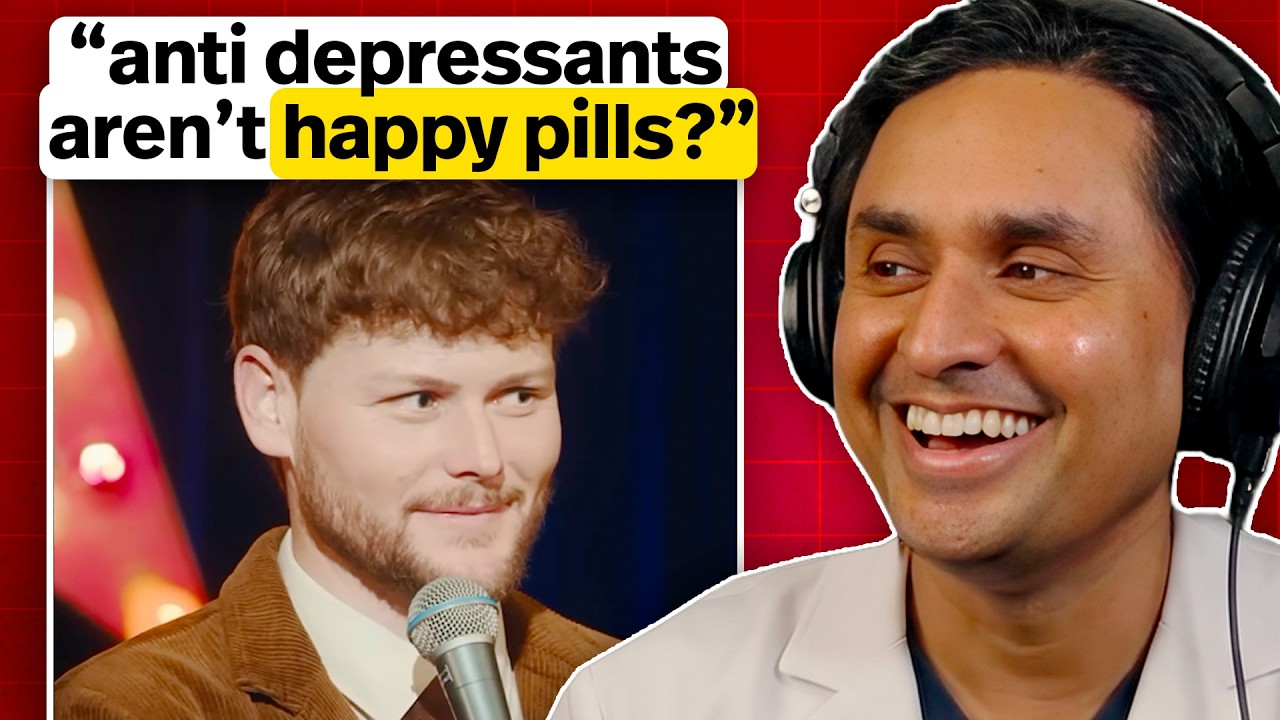
anti-depressants is that when they are
working, we feel normal. We don't feel
great. They're not happy pills. We just
remove the depression. And they work so
gradually and sometimes we'll see an
effect size of like 30 to 50% for an
anti-depressant. So it doesn't do take
it all away. So it happens so gradually
and what it does is makes you feel
normal and then people are still
experiencing the side effects and they
look at their anti-depressant and
they're like I feel fine. I don't need
this anymore. And then they stop the
medication and then the depression will
start percolating back. But it doesn't
happen within a day. Doesn't happen
within 2 days. Remember this is cellular
machinery that we're talking about. So
after a while the cellular machinery
eventually gets broken down and then
weeks later the depression can emerge.
So one of the key things that I do with
my patients is if I start them on an
anti-depressant I try to have them stay
on it for about a year which is the
natural course of a depressive episode
and then we can try to take it off. that
if you feel normal and you feel like the
anti-depressant isn't really doing
anything, that could actually be a sign
that it's working because it's restoring
you to normality.
>> She was buming me out. She was like,
"Just so you know, when you're on
anti-depressants, you can't drink." I
was like, "You can't drink. [laughter]
You don't know about me. I have
unlimited potential. You have no idea
what I could do on anti-depressants."
She's like, "I mean it. if you drink on
this medication, you will have internal
bleeding.
And I was like, well, if there's no
mess, [laughter]
I'll keep it to myself. You know what I
mean? I'll I'll keep it in. [laughter]
She's like, I think keeping things in is
what got you here in the first place.
I was like, you're actually pretty good
at this, son. I'm not going to lie.
[laughter]
Then I had her ring me up for a
six-pack. I got the out of there. You
know what I mean? [laughter]
Oh yeah, you can check.
>> Okay, let's talk about anti-depressants
and drinking. So there are some
medications that we prescribe that are
like really really bad to drink with
because they act synergistically can put
you in a coma. Top of the list is
something like a benzoazipene or an
opioid. The most common problem that I
see clinically with anti-depressants and
people who drink is not that they can't
drink, which is you still shouldn't, but
it's that there are many patients I've
worked with that feel like
anti-depressants don't work. And what
drinking does, the most common effect
that I've seen clinically is that
alcohol cancels or prevents the benefit
of an anti-depressant. And even very
small quantities of alcohol can do this.
So, you really shouldn't drink on an
anti-depressant. But it's kind of like
the real problem is like, okay, I'm
dieting. I'm I'm on keto and I'm doing
intermittent fasting and in between my
intermittent fasting, I'm just going to
eat a bag of chips when I feel like it.
And it's like that defeats the purpose.
That's really the most common clinical
impact that I've seen. As for the
bleeding risk, absolutely true. He must
be talking about SSRIs because not all
anti-depressants are the same. SSRIs and
do increase bleeding risk. So should be
used with a lot of care with other kinds
of things like if you've got
anti-coagulation or warin or whatever
things like that. If you have a history
of bleeding things like that then you
have to be careful with
anti-depressants. That's correct dude.
Um I'm jealous today. Like they got the
internet to shame their parents into
paying attention to them.
Yeah. Something we didn't have. I
realized this a couple years ago when I
was having anxiety attacks. I'm at the
doctor's office and she goes, "All
right." All right. She goes, "Before I
[clears throat] give you any
medication," she goes, "I want to know
what do you take for your ADHD."
I was like, "Uh, this is the first time
anyone's ever told me that I have that."
[laughter]
She like, "Wow, anxiety and ADHD. You
had me bouncing off the walls when you
were a kid. How did your parents handle
that?" I'm like, "They hit me."
>> Unfortunately, really common,
>> which I do not condone hitting kids.
Don't tell. But ADHD and anxiety, like I
could not stand still, right? Like what
are you going to do? A timeout? I can't
stand still now. I got to go stand in
the corner and look at a wall for an
hour, [laughter]
right? Forget that. Timeouts can be
absolute torture for kids with ADHD. So,
this is what's kind of scary about it is
like we'll give them punishments, but we
don't understand if you're neurotypical,
you don't understand the subjective
experience of the punishment on the kid
with ADHD. Second thing here is that you
know physical corporal punishment
yelling a lot is also really really
common in kids children with ADHD and
there's a really scary mechanism about
around this. People don't usually hit
their kids as much as they used to but
people will yell at their kids. Here's
why parents end up yelling at their
kids. So when you have ADHD you need a
large stimulus. If you're hyperfocused
on something you need a large stimulus
to break through your attentional focus.
So if your parents call your name you
don't hear it. They call a bit louder,
you don't hear it. Then you have to yell
to snap their attention. So in order to
get their attention, you have to use a
very high volume. The problem with ADHD
is that even though you need a high
volume to get attention, the effect of
the yelling on the other parts of your
physiology are not reduced. So you need
to yell in order to basically get their
attention. But when you yell, their
cortisol still spikes, their stress
hormones spike, their heart rate
elevates, they are startled by the yell
because the yell still startles them.
And then you create a really scary
scenario because every time I need my
kids attention, I have to scare them.
That's the only way that I know how to
get it. There are ways around that. So
one of the things that I do with my kids
is I actually train one of my daughters
is neuroatypical and so one of the
things that I do is I train her with an
attention word. So, we play this really
fun game where there's a word that we'll
use moose juice, goose juice. For
example, what I'll do is like when I
want her attention, I'll be like, "Okay,
when I say and I did this when she was
like five. I'd say like moose juice,
goose juice, look at me when you hear
moose juice, goose juice." Okay? So, I'd
say moose juice. She looks at me and
then we we turn it into a game where I I
will start to say it quietly. I'll sneak
into the room and I'll whisper it and
over time she wants to win the game. And
once you orient her towards trying to
pay attention, then something really
cool happens where she's like now she
knows the game, she likes to win, she
gets a prize, whatever becomes fun,
right? I'll sneak up behind her, I'll
hide behind the couch, I'll say moose
juice, goose juice, and then I'll
whisper it something like that. And then
she learns to she trains her mind to
actually pay attention to it. And then
when I need her intention, instead of
yelling, I will say moose juice, goose
juice.
>> Smack me. Let me go run around in a
yard. This is [laughter] true. Right.
Trying to fix ADHD and anxiety with a
timeout would be like trying to stop
someone's asthma attack by having them
do jumping jacks. [laughter]
>> That can work. Okay. So, let's talk
about one other thing, ADHD and anxiety.
So, one of the features, one of the new
features that we've understood about
ADHD is that emotional dysregulation is
a core component. So, when someone says,
"I have ADHD and anxiety." Now, as a
psychiatrist, what I think about is if
they have ADHD, I assume that their
negative emotions are more intense than
baseline. So, they may have a separate
anxiety disorder, but these kids tend to
be prone to more anxiety, more
depression, more shame because the part
of their brain that restrains their
impulses, the part of their brain that
controls the other parts of their brain
is a little bit weaker. which means the
part of your brain that controls your
negative emotion is also weaker. Which
means unfortunately these kids often
times have a lot of intense emotion. The
real problem with that is that since
they've got intense emotion and they
have difficulty shifting their focus
once they start to have an intense
emotion, it becomes really easier to get
hyperfocused on it for that intense
emotion to spiral in their mind and only
intensify over time, which is what makes
them prone to dopamineergic sources,
drugs, devices, video games, etc.
because that's the tool that they use to
get rid of their negative thinking. It's
fine to laugh about some of this stuff,
like trying to clean your living room
and ending up with more of a mess, but
then the question is like, what do you
do about it? So, we actually have a
great video on developing skills with
ADHD that you guys can find in our
membership. Check out the link in the
description below and start your free
trial
Interactive Summary
Ask follow-up questions or revisit key timestamps.
Loading summary...
Recently Distilled
Videos recently processed by our community