HydroGym: A Reinforcement Learning Platform for Fluid Dynamics
Now Playing
HydroGym: A Reinforcement Learning Platform for Fluid Dynamics
Transcript
654 segments
Welcome back. So, I am extremely excited
today to tell you about a new project,
HydroGym, that just appeared in nature.
So, this is a huge collaborative effort
to build a benchmark platform for the
reinforcement learning control of fluid
flows. I want to give a special
shout-out to Christian Lagemann, who is
the lead architect and the first author
on this paper. Christian started off as
a postdoc in my lab
when this was just a niche project with
a few environments, and he really grew
this into the massive international
collaboration and success story that it
is today. So, huge huge credit to
Christian. We have an amazing team of
co-authors, brilliant brilliant minds
from across the world. I'll show you
some of their work in a little bit. And
also, I'd like to acknowledge Boeing and
the National Science Foundation for
funding this effort over the years.
There will be links in the description
to the paper, to the GitHub repository,
but I really want to jump in to what we
actually are doing here in HydroGym.
Okay? So, reinforcement learning
is the idea that if there is some
complex system, like a fluid flow, this
is the flow past a cavity. Reinforcement
learning essentially learns how to
interact with and manipulate this
environment for some kind of engineering
objective. So, we've seen the success of
reinforcement learning in other fields,
like AlphaFold for protein folding, that
was a Nobel Prize in Chemistry.
Reinforcement learning is able to now
control fusion reactors. It can beat
humans at chess and Go and many many
games. So, reinforcement learning is
this extremely powerful machine learning
framework for learning how to interact
with and control the real world. Now,
fluid flows are particularly important
for many many trillion-dollar
industries. If you think about health
care, transportation, energy, defense,
we live and work inside of a living
fluid, and so do almost all of our
machines. So, the ability to model and
predict and control fluid flows even a
little bit better could have an enormous
economic and ecological impact in the
world around us. Hugely important
problem, very, very challenging. So,
controlling fluid flows
requires simulating them, which is
itself very expensive. But, you don't
just simulate the fluid flow once in
reinforcement learning. You have to
simulate it thousands or millions of
times interacting with this environment
to learn by trial and error how to
control that system. So, that's the
basic idea is instead of making it so
that you have to have all of the the
simulation capabilities and all of the
reinforcement learning control
capabilities to participate, we wanted
to abstract this and create a community
benchmark platform that has the leading
fluid flow environments and the leading
reinforcement learning agents
pre-programmed, built in. So, that if
you have a new fluid flow or a new
reinforcement learning algorithm, you
can test it out much more easily and we
can move the field forward faster
together. Again, to solve those huge
societal scale problems, um making
better uh wind turbines and more
fuel-efficient vehicles [clears throat]
and better artificial hearts and things
like that.
And so, things I'll tell you about in
this uh short intro video and that we
talk about in the paper, uh I'll tell
you about some of the environments we
have. We have, you know, dozens, over 50
two-dimensional and three-dimensional
fluid flow environments that you can
play around with and try different
control algorithms in.
Uh we have transfer learning, so you can
try a controller in 2D and see how it
works in 3D. Or, you can try it at low
flow velocities and see how it works
when you crank up the speed uh of the
flow. Then, we also have some advanced
reinforcement learning uh capabilities
built in. So, multi-agent RL is really,
really powerful for very complex kind of
uh turbulent control. And, we also have
several differentiable environments in
differentiable languages like JAX where
you can get gradients for free and do
better gradient enhanced reinforcement
learning. So, we'll talk about that um
in this video just very briefly.
Now, again, I want to call out just the
incredible list of co-authors uh on this
work, especially Christian Lagemann and
been uh foundational through the entire
development, uh, of this this modern
hydro gym.
Um, and I'll only have time to give you
little vignettes into subsets of their
work, okay? Um,
so a little bit of history, this
actually started off with a project by
Jared Callahan. I think he actually came
up with the name hydro gym, maybe five
or six years ago, where we only had a
couple niche environments, you know,
two-dimensional flow environments, but
the really cool idea,
um, Ludger Paehler kept it alive, uh,
after Jared uh, graduated. And then when
we got Christian to join our lab as a
post-doc, it really flourished and, you
know, almost every kind of major advance
we're going to talk about today was
really because of, uh, Christian's hard
work.
So again, I'm just going to highlight,
you know, some of the work of my lab.
These are folks who were in my lab at
some point in time. I'm also going to
highlight, uh, the work of Ricardo
Vinuesa's group, who came in with one of
the most impressive results in this
entire hydro gym paper. Basically
showing that you could train a
reinforcement learning,
uh, agent on a simplified canonical
hydro gym fluid flow,
and then transfer that over to a much
more complicated aircraft wing and get
very, very impressive drag reduction. So
I'll highlight some of these results.
Again, there's a much longer, uh,
co-author list, many more cool results I
don't have time to talk about in this
video. Please read the paper, um, and
and give credit to their work as well.
Okay. So, um, you know, in the five or
six years since we've been developing
this, there's been this large diversity
of flow environments that we've created
in hydro gym, from 2D to 3D, low
Reynolds number to high Reynolds number,
means, you know, higher flow velocity,
more turbulence. Uh, we have a lot of
flows where there's a 2D and a 3D
analog, so you can test an algorithm in
one, you know, debug it in the cheap
kind of laptop version, and then scale
it up to the supercomputer version.
Um, Christian and his collaborators, his
team, you know, ran many of the leading
reinforcement learning algorithms on all
of these flows. This is, you know,
hundreds of thousands or millions of of,
uh, you know, hours of of compute time
that you don't have to run, you know, if
you have an algorithm, you only have to
test your algorithm on the flows of
interest, and you can compare it against
all of the other pre-computed, pre-run
flows.
So, HydroGym at its core
is a set of fluid flow simulations that
are very, very bomb-proof. They've been,
you know, tuned and calibrated to be
extremely robust to different flow
conditions, to different control
scenarios, so that it's very unlikely
you're going to break these flows, and
they're very reliable and validated. So,
the results are reliable.
Importantly, HydroGym is not programmed
in one
simulation language or one programming
language. We have environments from many
different programming languages, JAX,
C++, and so on and so forth.
And so, the solver diversity is actually
one of the strengths. If you have a
solver for a fluid flow that is
interesting or relevant, you can almost
certainly wrap it into HydroGym. So, we
have FireDrake environments, finite
element method. We have Maya code. This
is lattice Boltzmann method. We have
Maya unstructured finite volume,
Nek5000, JAX for for differentiable
flows. And so, all of these kind of
different back-ends and different
simulation environments can be wrapped
into HydroGym.
And we use the standard kind of Gym API
that you're used to from, you know, the
OpenAI Gym that you would use to train
reinforcement learning agents on much
simpler systems like the pendulum swing
up and things like that. Okay? So,
solver diversity is a huge deal. And
again, we have a ton of environments in
2D and 3D with these various
characteristics.
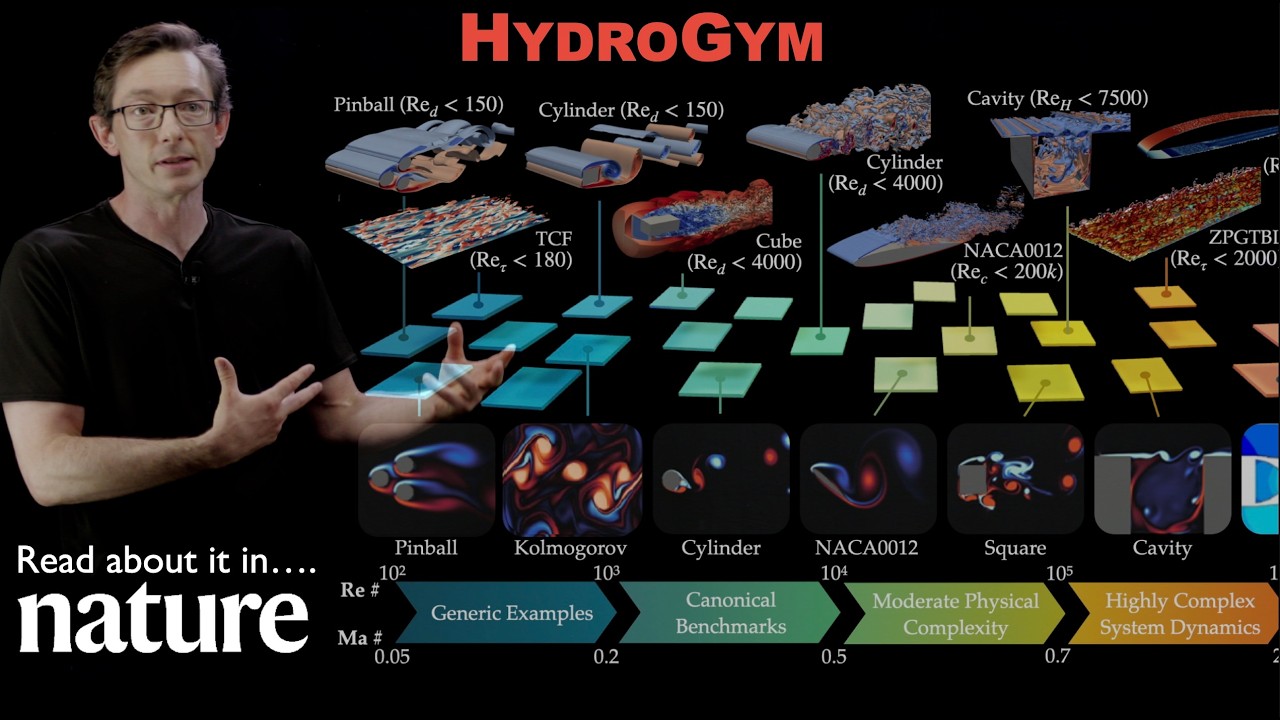
And so, this is a diagram that Christian
made that I really, really love, and it
kind of gives an idea of how these are
organized in terms of complexity.
So, on this kind of bottom axis here,
you see this increasing complexity from
generic examples to canonical benchmark
flows all the way up to really
complicated real-world dynamics, you
know, full-scale aircraft, very
complicated jets, and, you know, jet
noise, and multi-physics scenarios.
For all of these cases, we have 2D
two-dimensional kind of cheap
inexpensive toy systems and then we have
their three-dimensional analogs at
increasing kind of Reynolds numbers and
complexity. So some of these are
extremely high Reynolds number complex
fluid flow simulations. These require
supercomputers running hours and hours
to simulate and to train these agents.
But again, Christian and his team
already ran you know the leading
algorithms and benchmark them so that
that leaderboard exists so you don't
have to reproduce those the results you
know with with another million hours of
compute.
Okay.
You'll notice on the very very end here
future extensions. Those are kind of the
aspirational next steps. We see HydroGym
as not being a single static environment
a single paper but a community effort
that will grow in time. We will have
regular releases with new environments
new control algorithms and and you know
new new team members. So we want you to
join and and try stuff as well.
But this is kind of the big organizing
diagram. I really go back to this one
and use this one to kind of understand
where is the next opportunity? If I was
going to try my reduced order modeling
my Cindy methods you know to to
accelerate reinforcement learning where
would I start? Would I start with the
cylinder and then go to 3D? Would I
start with an airfoil? You know how
would you actually interact with this
environment and kind of build in
complexity without just trying to you
know tackle the whole thing all at once.
Okay. So that's kind of the overview of
this um
of this environment. Let's see if
my clicker actually works. Good.
So now I want to kind of highlight this
really impressive kind of flagship
result that Ricardo and his team brought
in to HydroGym in in the last year or
so. So this is work coming out of
Ricardo's lab. I'm going to highlight it
here because it's so impressive and it
really highlights what you can do with
this kind of community benchmark
reinforcement learning platform.
So the idea here is how do we use
HydroGym or how do they use HydroGym to
train a reinforcement learning agent
that can be applied to an extremely
complicated flow like the flow over a
real scale aircraft wing, okay?
So the idea here is that you can train a
reinforcement learning agent in a much
simpler canonical hydrogen environment.
On the left you see this
this you know periodic channel flow easy
to simulate relatively fast relatively
simple to actually write that code and
train algorithms and models here.
And what Ricardo and his team showed is
that you can take that agent that
reinforcement learning controller and
zero shot transfer that on to an actual
wing simulation a very complicated wing
simulation. If you match certain local
boundary conditions and again details
are in the paper and and they have
follow-up work really flushing this out
and going into the physics and the
algorithms beautiful work.
And so this is kind of the schematic
here again you train on this hydrogen
channel at an RE tau of of 206 a pretty
turbulent channel. And you can zero shot
transfer that to this real NACA 0012
airfoil with a chord wise Reynolds
number of 200,000 so very turbulent very
sophisticated wing simulation.
And without any modification just just
transferring this controller over to
this scenario they were able to achieve
a skin friction reduction of 38% that's
a 38% reduction in the turbulent drag
the turbulent skin friction drag on this
airfoil.
So that's the kind of power we envision
hydrogen bringing to the community is
you can train on these kind of canonical
building block flows and start to
transfer those over to much more
industrially relevant industrial scale
flows again that start to move the
needle on some of these societal
problems
fuel reduction more efficient transport
you know better mixing all kinds of
applications that could be accelerated
with better control of fluid flows.
Okay, good.
And again really grateful to collaborate
with Ricardo, uh been fantastic working
with their team.
So, a couple of uh just kind of
summaries of things I mentioned earlier.
These are three kind of advanced
capabilities that we explored in this
paper that we think you can really uh
dig into with HydroGym. The first one is
differentiable environments. So, if you
write your fluid flow simulator in a
differentiable computer programming
language, essentially where automatic
differentiation is enabled, so think
about how you train a neural network
using backpropagation, that's using
automatic differentiation. If you write
your flow solver in an environment like
that, like JAX, then you can use that
same automatic differentiation to get
gradients of outputs with respect to
inputs, and you can do gradient enhanced
reinforcement learning. So, here you can
see this uh this GPPO, this is gradient
enhanced PPO, uh proximal policy
optimization, and this pink curve learns
faster and better solutions than
standard kind of industry standard um
PPO. So, gradients help, they accelerate
uh and get better performance solutions.
This is um largely work by Sigita
Mackwell, who's a a PhD student in my
lab, and her whole thesis is on
differentiable flow environments and
what you can kind of accelerate and do
better when you have that gradient
information.
Multi-agent reinforcement learning, as I
mentioned, is a huge accelerator. If you
have a big flow, big complicated flow
like a wing or like this uh this long
span cylinder,
you can break it up into sections and
have different agents in different
sections share information. So, you can
train much, much faster, much smaller uh
agents that share information better,
and again, uh you get great um kind of
training and uh and control results.
And then the third row here talks about
transfer learning, which is a really,
really big idea. If we have this generic
platform, then we would hope that
controllers learned in some scenarios
transfer to more complicated scenarios,
like what we showed you uh with that
zero-shot transfer to the wing.
And so, here's just kind of a a little
bit more of a textbook kind of example
where we take a two-dimensional flow
past a cylinder, really simple, and we
take that controller and transfer it to
a three-dimensional cylinder, and then
do some retraining on that that in the
3D environment.
So, importantly, it's much faster to
train a controller in a two-dimensional
environment than a three-dimensional
environment. And so if I can train my 2D
controller and then transfer it to 3D, I
can save dramatically on training costs.
And that's essentially what we're seeing
here. This blue curve learns much much
quicker
a good solution. That is the transferred
controller from 2D to 3D. So we get a
much much faster learning,
much fewer interactions in this
expensive environment. You save a lot in
compute and you get your solution much
faster with transfer learning.
Okay, great.
And these are just, you know, some more
results showing kind of the training
reward. Again, what I really want to
highlight here is that Christian and his
team,
the larger collaborative team, have
implemented many of the leading
reinforcement learning algorithms, PPO,
DDPG, TD3, on, you know, nearly all of
these environments. So that baseline
performance is logged and cataloged for
all of these flows.
You don't have to repeat PPO
on all of these three-dimensional
environments. That baseline is
established. So if you have a better
idea, you can just test that and see how
it compares to a well-trained
well-tuned PPO.
And again, this is designed to be as
easy to use as possible in the standard
kind of gym API. So really easy to
initialize, you know, import hydrogym,
you can go to the GitHub and download
all the code
and import this this environment. You
set up your environment. This case I
think is a cavity in Maya, Reynolds
number 7,500.
You can pick, you know, what your
sensors and what your actuators are. So
different flows have different sensors
and different actuators that you can
affect. And then you, you know,
initialize this flow environment.
Next, um, interact with it is also very
simple. This is standard kind of API.
Um, you know, you set up a loop and you
basically, uh, do the reinforcement
learning, um, iteration to interact with
this environment.
And that gives you these kind of, you
know, training, uh, and roll out curves,
um, for the various flows for different
controllers. So, very, very standard. If
you train reinforcement learning, if
you're a reinforcement learning person,
you can interact with this rich variety
of fluid flows basically in the same way
you would interact with any other system
in robotics or in dynamical systems. If
you're a fluids person, you can put your
environment into HydroGym and you can
get the whole range of reinforcement
learning solutions on your problem from
the community, from other people who
have that expertise. So, that's really
what we're trying to do is abstract the
expertise so we can all move the field
field forward faster.
Okay, um, and this is kind of a cool
example I like to talk about of just a
really short vignette of what you can do
with this environment. So, this is
fantastic work by Nick Zolman, uh, who
is a PhD student in my lab, uh, in
collaboration with Christian and Urban,
where essentially Nick wanted to test
this idea that you could use Cindy, the
sparse identification of nonlinear
dynamics, to accelerate, uh,
reinforcement learning training. So,
again, I said that it's really expensive
to train these agents in these very
expensive fluid simulator environments.
And often times, you know, this will
involve thousands or millions of of
simulation calls to these expensive
simulators. So, Nick's idea is to take
this data,
train a really lightweight Cindy model,
and then do reinforcement learning, as
much reinforcement learning on that
surrogate Cindy model, as possible
because it's super, super fast. So, can
you bypass the expensive environment
with a cheap Cindy surrogate model? Very
simple idea.
But again, because HydroGym exists, um,
and this was, you know, in development
when he wrote this paper, he was able to
test his algorithm on three major
environments of increasing complexity
from the cylinder flow to the fluidic
pinball, to a full three-dimensional
turbulent airfoil, in addition to the
standard gym environments that you would
normally test your algorithms on.
So, this allows you to test much more
sophisticated systems if you have a new
idea, a new algorithm.
And just kind of cool here, shout out to
to Nick's work, um this does in fact
show that Cindy RL in blue can learn
much, much faster and sometimes much
better solutions than a baseline
reinforcement learning algorithm. So, it
does dramatically accelerate the
training and reduces the number of
interactions with the expensive
environment. That's what's on the the
x-axis in a log scale.
Um and the fact that HydroGym has this
range of Reynolds numbers and flow
conditions also means we can test things
like how does your controller
generalize? So, this is a controller
Nick trained at Reynolds number 100,
kind of a slow flow velocity, and when
he rolls it out to a higher Reynolds
number, Reynolds number 350, much more
turbulent, his controller still works.
So, that's a really powerful thing
that's sometimes hard to do uh unless
you have, you know, uh
a ball proof code where you can actually
crank up the Reynolds number is to test
this generalization. And so, that's a
hallmark feature of HydroGym is that you
can test the sweep across Reynolds
numbers and flow conditions and flow
complexities.
Okay, good.
So, where is this going? Um I want to uh
also mention, you know, I I gave the uh
the the funding acknowledgements earlier
that this has been funded by uh by
Boeing and by the National Science
Foundation. And in particular, the
National Science Foundation has
supported our AI Institute in dynamic
systems where these benchmark
environments are one of our central uh
focus points.
And so, we've just been selected for a
renewal for another 5 years of this AI
Institute, and HydroGym is going to
remain one of the central uh emphasis
points of our uh our AI Institute. So,
we're going to have funding and research
and time and effort to continue to build
HydroGym, to continue to make this a
community resource, and to continue to
support and grow towards these
increasingly uh challenging
applications.
So, for example, things like a full
aircraft model. We really want to scale
this up. Um Ricardo's group's result is
just the tip of the iceberg. We want to
go to full complexity, corner flows,
much more sophisticated flows, higher
Reynolds number, multi-physics.
Um
Again, with community support, uh with
all of you, we can actually do this and
we can drive better design, better
vehicles, better engineering faster with
uh this technology.
And not just aircraft, of course, um you
know, wind turbines, artificial hearts,
you know, trains, planes, automobiles,
everything uh that involves a working
fluid, we can model and control better
um if we have the best algorithms and
the best simulation environments working
together.
So, another area I'm very passionate
about is again design optimization of
aerodynamic uh shapes and surfaces. In
this case, you know, some kind of a
vehicle you want to design.
In reality,
we don't just have simulation data of
low and high fidelity. We also have
laboratory tests, wind tunnel tests,
field tests, sometimes you actually have
to build it and fly it.
All of this data contributes um you
know, to a surrogate model, whether this
is an AI model or some kind of
statistical model, you know, there's
lots of options for how to build this
model. But, we want to eventually start
doing our design optimization again on
this less expensive surrogate model.
Uh and that surrogate model can be
informed by hydrogen environments. We
can start including cyber-physical
systems and and actual laboratory data
into these hydrogen environments. So, I
think moving also uh
from control to the broader problem of
design optimization is a really great
opportunity for all of us.
Okay. Um that's the thumbnail sketch.
Really again, this is just a teaser for
a much deeper effort with a lot of
brilliant uh collaborators. And so, I
just want to end here. I want to thank
you for uh paying attention, for getting
involved. If you have flow environments,
physics problems, hard engineering
problems, please work with us to wrap
them into hydrogen. You'll get people
working on your problem uh if you can
get it in this environment. If you're a
machine learning or a controls expert
and you have a new algorithm, you want
to test it on the hardest problems there
are, try your algorithms in our hydrogen
environments. Again, huge shout out to
Christian Lagaman and the whole team,
brilliant researchers from across the
the globe. Truly a pleasure to work with
all of all of you.
Thanks to Boeing and the NSF and thanks
to all of you. Thank you.
Interactive Summary
Ask follow-up questions or revisit key timestamps.
This video introduces HydroGym, a collaborative benchmark platform designed for the reinforcement learning control of fluid flows. HydroGym simplifies the interaction between complex fluid simulations and reinforcement learning by providing a standardized, community-driven interface. It allows researchers to test control algorithms across various environments, ranging from 2D toy systems to high-fidelity 3D industrial scenarios, such as aircraft wing drag reduction. The project emphasizes scalability, transfer learning, and simulation diversity, aiming to accelerate advancements in engineering applications like fuel efficiency, wind turbines, and medical technology.
Suggested questions
4 ready-made promptsRecently Distilled
Videos recently processed by our community