Convex Sets
Now Playing
Convex Sets
Transcript
340 segments
Welcome back. So we're talking about
convexity and in particular convex sets
today. So convexity is a key concept in
optimization theory. If we have a convex
optimization problem then there are a
huge wealth of techniques to solve those
problems and they're much much much
easier to solve than non-convex
optimization problems. And so there are
two ingredients to a convex optimization
problem. There's the objective function
and then there is the set of constraints
that determines a feasible set where the
optimum solution has to live. And so
today we're going to talk about what
makes a set convex or non-convex. So
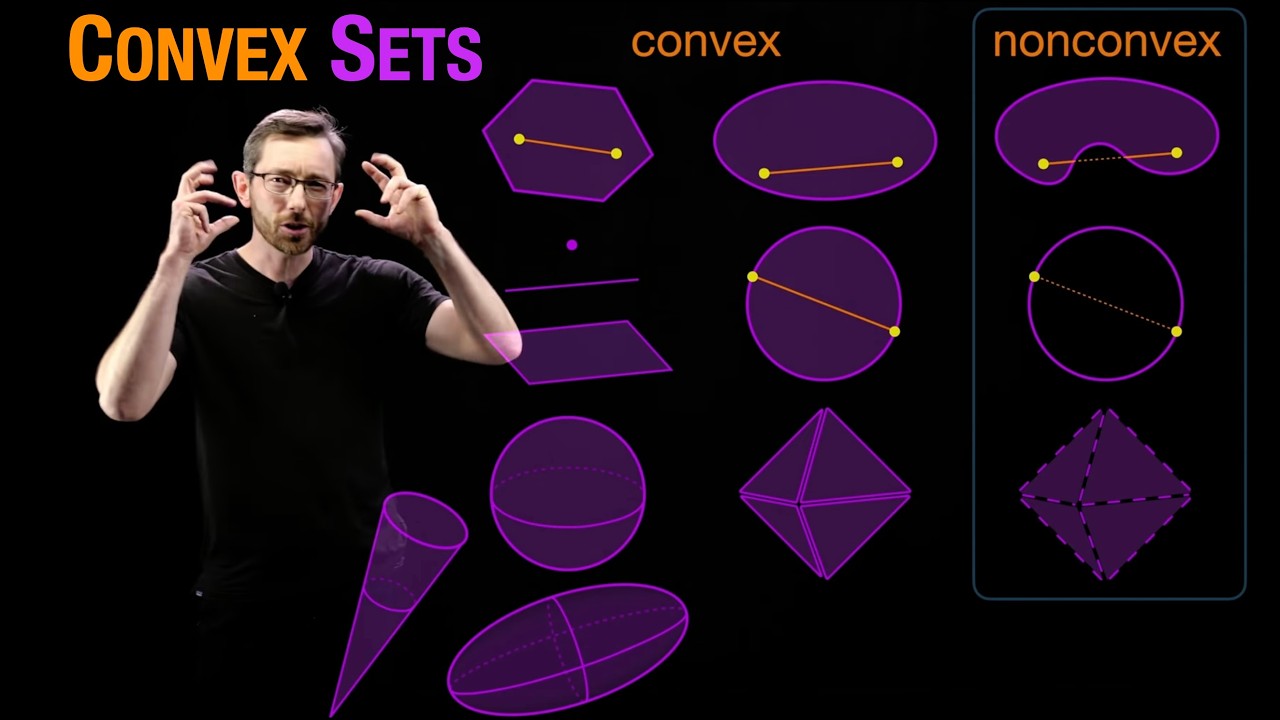
here are two examples of convex sets um
a little hexagon and an oval. And we're
going to illustrate what is we're going
to define what it is to be a convex set
and then give a bunch of examples and
properties.
So the definition of a convex set is the
following. A set C like this hexagon or
this oval is convex if for every two
points inside of this set for every x
and y point uh pair of points inside of
this set the line segment connecting
those two points is also in the set. If
that's true for every pair of points, if
every pair of points has a line segment
connecting them that is also in the set,
then we would say that that set C is
convex. If that's not true, then the set
is not convex. Okay? So here uh I'm
going to illustrate it on this oval
example. So we have our set uh our set
here and we have these two points X and
Y. They're just arbitrary points. And
you can parameterize the line segment
between those points, this orange line
segment with this alpha parameter. So
when alpha is zero, we are entirely at
the point y. And when alpha is one, we
are entirely at the point x. And for an
alpha between 0 and one, I slide along
this line segment. So for every single
alpha between 0 and one, for every point
on this line segment, that point has to
be in this set in this purple region for
the set to be convex. And that has to be
true for every single pair of points I
could pick in this set. For every pair
of points I can pick, uh, in this case,
including on the boundaries, the line
segment connecting them has to be in the
set. So that's clearly true for this
oval. You can kind of verify that just
intuitively in your mind. It's also true
for this hexagon. Any two points, the
line segment connecting them is also in
the
set. This is an example of a non-convex
set because there is this uh we call
this here a concavity, this little bump
that's taken out. And if I take two
points uh x and y that are kind of
around that concavity, the line segment
connecting them, there are points that
are not inside the set. These points
here are not in the set. And that means
that that set is not convex. It's a not
it's not a convex set. Okay. So really
really important definition and actually
really simple and easy to understand.
This is kind of all there is to convex
set theory. A set is convex if and only
if for every two points in that set, the
line segment connecting those points is
also in the set. Okay? And this idea
generalizes to much higher dimensional
spaces and much kind of weirder shapes
and geometries. Okay, so this is a a
really simple definition, but this will
encapsulate a huge array of
shapes. Good. So let's look at another
example. If I have this uh this this
circular disc and the interior of that
disc is also part of the set. So this is
a shaded disc. This is a hollow circle.
The shaded disc is a convex set because
any two points the line segment
connecting them is in that shaded disc.
Whereas the ring the hollow circle or
the hollow ring is not convex because if
I take two points on the boundary the
line segment connecting them is interior
and the interior is not in the set. So
all of these dashed orange points are
not in this hollow ring set. So the
filled disc is convex but the hollow
ring is
non-convex. Um polyhedra in higher
dimensions in three dimensions, four
dimensions, n dimensions are generally
uh convex if they have this kind of this
this property. Um, but if they have
weird boundaries where some of the
boundaries are included and some of them
are not included, you might have them be
uh kind of degenerately non-convex
because if I took a point uh at this
corner and a point at this corner, there
would be points along the line
connecting them that are not in the set.
So, I've drawn this as kind of a dashed
boundary here. But usually if you do
common sense things like include the
boundaries uh or disregard all of the
boundaries then your set will be convex.
And there's a lot of pretty hairy deep
mathematical theory in set theory and
topology uh related to convex set
theory. I'm going to gloss over most of
that and just give you the intuitive
kind of common sense notions of these
things and maybe later I'll have some
more kind of deep dive math lectures on
convexity. Good. So these are some
examples. Um other good examples are a
point is convex. Um kind of trivially
convex. Uh a line segment or an infinite
line those are both convex. A section of
a plane or an entire plane or a half
plane those are also convex. Uh and
these generalize to higher and higher
dimensions. So for example a you know a
positive quadrant of a three-dimensional
space that would be convex or the entire
three space is also convex or the
positive half space where x is greater
than or equal to zero that would be
convex. So these are all building
blocks. And what we're going to see very
soon is that I can get kind of more
exotic shapes by taking the
intersections of these and I can build
these little convex sets out of these
building block pieces. So other useful
uh convex sets that are going to come up
a lot are things like spheres,
ellipsoids, and cones. And as long as
the cross-section of this cone is
convex, then if I extrude it out either
in a cylinder or a cone, that will also
be a convex set. Okay, so these are
really, really useful. And we're going
to see these all the time in
optimization theory. And remember, a lot
of our optimization problems are going
to be very highdimensional. we're going
to be trying to train a neural network
with a million parameters or doing a le
squares problem where we're fitting you
know a hundred or a thousand unknown
variables. So our notion of a convex set
is going to be in a very highdimensional
space. So we need to be able to take
these building blocks these these kind
of concepts and abstract them. An nphere
is convex. An n-dimensional ellipoid is
convex. An n- dimensional hyper plane is
also convex. Things like
that. Good. Uh so this is the notion of
kind of convex and
non-convex. One kind of other point is
if you had a non-convex shape like this
kidney beam, there's something called
the convex hole. H u ll. This is like
the hole of a ship, the the kind of body
frame of the of a of a vessel, a naval
vessel. And you would get this convex
hole by taking the smallest set that is
convex that contains that non-convex
kidney bean. And in this case, it's
really kind of intuitive how to do this.
You just kind of take those two uh edge
points and connect them and fill it in.
Um you basically fill in this concavity
here and you get a convex set called the
convex hole. So you can take non
non-convex sets and convexify them by
adding in the points that are missing
essentially. Good. Okay. So that's the
notion of convexity. Um I want to show
you how you can take inequality
constraints which are going to come up
all over the place in optimization
theory and build convex sets using these
inequality constraints. So um if I have
something like the inequality constraint
that my x variable has to be greater
than or equal to zero that sets up a
feasible region in my optimization
problem that is the right half plane
where x is greater than or equal to
zero. It also establishes what's known
as an infeasible region. The complement
of that is the set x less than zero.
Notice that if this is x is greater than
or equal to then this is x strictly less
than. The boundary has to you know be
either feasible or not feasible. It
can't be both. Okay. And so this
feasible region in this case is a convex
set. The infeasible region is also a
convex set. So this inequality
constraint in my optimization problem
establishes a feasible region that is
convex. And so that means that all of my
powerful convex optimization techniques
are going to apply when I have simple
equality and inequality
constraints. Now I can have more complex
constraints like um the radius of my x
and y point has to be less than or equal
to one and that would also establish a
convex feasible region this unit circle
here. And it would establish a nonconvex
infeasible region which is everything
outside of that circle. So what I'm
trying to get at here is that you know
in our optimization problem our
constraints are generally going to be
written as either linear or nonlinear
inequality constraints and those are
going to establish feasible regions
which may or may not be convex. I could
easily write down an equation where the
feasible region is weird and
nonconvex. Uh but in these cases our
feasible region is in fact convex. So
that's kind of where we, you know,
inequality constraints often give you
convex sets. Linear inequalities will
always give you convex sets. Nonlinear
inequality equations may or may not give
you convex sets. Good. And the
intersection of two convex sets is also
convex. This is always true. Um, I'm
going to prove this in another video.
It's actually a really simple proof, so
I'm just going to like do it because
it's good for you to see it. If I have
two sets C1 and C2, the intersection
this C1 and that should be a C2. C1 and
C2 uh is this intersection of the two
sets. We call it C. And that means that
any point in this middle region has to
belong to both C1 and to C2 to be in
this intersection. And you can prove
pretty easily that if C1 is convex and
if C2 is convex then this kind of
intersection region in the middle has to
be convex. It has that property that
every line segment connecting any two
points lies entirely in that set. Okay.
And if this is true for two sets it's
true for three or for four or for n. I
can take the intersection of as many
sets as I want and I still if they're
convex the resulting set is still
convex. So this is huge. This is how
we're going to build convex feasible
regions with our constraint equations in
optimization. So for example, if I have
this matrix system of inequality
constraints, a bunch of inequality
constraints that can determine a convex
feasible set C uh like this kind of
quadrilateral here. So for example, I
might have two um inequality constraints
that y has to be greater than or equal
to zero and x has to be greater than or
equal to zero. Those are these kind of
very lightly shaded purple half planes.
Those are convex. And so their
intersection, the positive quadrant up
here is also
convex. And then I might add two more
constraints that y has to be less than
or equal to 2/3 and x + y has to be less
than or equal to 1. Again, the
intersection of these four constraint
equations, these four convex sets gives
me this feasible convex set here in the
middle. And this is where my optimum
value, my the solution of my
optimization problem has to live in this
convex feasible set given by these
inequality constraints. So super super
useful. The property that the
intersection of two convex sets is also
convex is what allows us to build these
convex feasible regions in optimization
problems. Super powerful, really
fundamental. And I'm going to show you a
proof of this in a future
video. Good. Um, and this again, like I
said, this establishes the feasible sets
that we're going to use for every linear
programming problem and for every
quadratic programming problem. the
constraints are going to be of this form
and so we're going to get these convex
feasible sets. So that's that's one of
the nice things about linear programming
and quadratic programming is that
they're convex optimization problems
that have really uh good generic
solution
techniques. Okay, so that's kind of all
I wanted to tell you at the beginning
with convex sets. Um, it's really just
defined by this simple definition that a
set is convex if for every two points X
and Y in the set, the line segment
connecting those two points is also in
the set. So these are examples of convex
sets. This set is nonconvex because it
does not satisfy that property. And this
is one of the most useful uh ideas in
set theory and in
optimization. So soon we're going to
talk about what it means to make a
function convex. So we can have convex
sets and also convex optim uh objective
functions. And so we'll talk about what
it means for a function to be convex
soon. All right. Thank you.
Interactive Summary
Ask follow-up questions or revisit key timestamps.
This video provides an introduction to the concept of convex sets, which are foundational to optimization theory. The speaker defines a set as convex if, for any two points within it, the line segment connecting them also lies entirely within that set. The video covers examples of convex versus non-convex shapes, discusses the importance of the convex hull, and explains how inequality constraints and the intersection of convex sets are used to define feasible regions in optimization problems.
Suggested questions
3 ready-made promptsRecently Distilled
Videos recently processed by our community