Fable vs GPT-5.6 Wasn’t Even Close
Now Playing
Fable vs GPT-5.6 Wasn’t Even Close
Transcript
410 segments
In my previous video, I had Fable build
a completely polished system, a game of
spades, that went all the way from a
very clear design document to a
completely polished deliverable
application. That video really goes
through how I did all of that. Once I
got there and it was so good, I thought,
"Why I wonder if Soul can do the same
thing?" So, this video is kind of an
investigation into can the GPT-5 6 Soul
model do almost the exact same steps
with a different application to be fair,
but very, very similar. And actually,
the finding that I came up with was
entirely surprising to me. This is not
what I thought the outcome would be, so
it's worth taking a look. But, what
you'll really find here is should you
use Fable? Should you use Soul? Are they
completely interoperable with one
another? Are they kind of hot swappable
and it doesn't matter? Or does it
really, really matter? And let me tell
you, to me, it really, really matters.
So, let's dive in and I'll show you
exactly what we're going to go through.
Okay, wait a second. One very quick note
here before we dive in. I want to make
this very clear up front. One
application that we built was spades.
The next one that we built was
Parcheesi. If you don't know the
Parcheesi game, you'll be introduced to
it very quickly here. It's a little bit
more complicated. It is not 10 times
more complicated. It is not two times
more complicated to build, but it is a
bit more complicated. There's some more
moving parts to it. So, that exists and
what we asked Soul to do was, quite
frankly, more difficult than what we
asked Fable to do and we would
anticipate the results would match that.
They do match that, but they kind of
over match that. You'll see in a second.
I just wanted to call that out. Okay, as
I mentioned, I have a previous video
that goes through all of the how here.
So, if you're looking for exactly how I
got to the results that we're showing
here, go watch that other video. But,
what I'll show you here is I used Claude
design and you can see here this is just
claude.ai/design.
You can use this with your subscription.
Um if we look back at the designed game
for what we did with Fable, this was a
spades game. Here's the design, a bunch
of different screens and how they work,
some of the animations, that kind of
stuff. So, that was for one of the
applications. What we did for the Soul
model was give it a version of basically
ask it to design a version of something
like a Parcheesi game. So, if you've
ever played Parcheesi, there's four
players around a board, they have to
move through a certain series of of
squares as you roll dice and move pawns
between those. What we did with this is
very much like the last time, we shared
this, we download the zip, this zip file
is going into Codex. I'll show you
exactly how I did that next, but first,
I need to show you an intermediate file.
This is the design. This is what it
looks like. This is not what it is, and
I want to make that very clear. So, I
then described what it is in the next
file. Okay, next step, really simply,
this is the application. This folder was
empty when I started. What we just
downloaded from Claude design, I would
have created the docs folder and created
the design folder, and then I dropped
that file right here. So, that was the
zip that we would have just downloaded,
right? That's the first thing. This
information comes out of here once it
explodes, but we asked Codex to do that.
The only other file is this request
file, and this file is something that I
basically I'm telling the building
agent, you're building a system that is
going to be multi-user, you need to use
uh kind of peer-to-peer solutions to
pull this off to kind of uh create that
paired relationship. It's also a video
game, it's mobile first, you definitely
need to take into consideration mobile
experiences, but it should also work on
these other platforms, et cetera, et
cetera. This is the exact same kind of
information. This file, in fact,
essentially came from the one that we
gave Fable with Spades. So, it's
basically the same thing. And from here,
the only thing that I did was came out
to Codex and I said, "Set up a goal. Use
the game build request file that we just
dropped into that folder there." Um and
build until complete because all of the
instructions are in there, including the
information about the handoff design
file. So, it was all in that one place.
This is also the same basic prompt that
I gave to to Claude code previously to
get the build done when I was building
with Fable. That's it. They are
otherwise really the same. Okay, and
from here, let's take a look at what
they came out with. I want to point out
though at this moment, this is not
necessarily where that first build got
us. I have pushed back into these a
little bit after that, and I'll describe
that in a second because it's kind of
the most important thing about what
we're talking about here, but I did want
to show you this is the Spades game. If
you come in and play this Spades game,
like any other Spades game, you get to
bid, you get to
play your cards.
Hey, I even get to take one. Fantastic.
So, it's a normal Spades game. You can
come in here if I leave the table and
host my own game, it allows me to
connect with a code. Normal kind of
stuff that you might expect from a
Spades game. The other side is what we
just built with GPT-56 Soul. So, this is
Dash. It renamed it Dash really in in
fact, the design step renamed it Dash
instead of Parcheesi, but if we play
here, then we can come in, play a game,
pick the different uh characters that we
want to play against,
pick the character that we're interested
in,
and then play the game. And so, we're
down here in the left, and we get to
roll first,
of course.
And we have to get a five to get out.
So, you'll see the different turns for
the different players. He rolled a five,
he gets one of his pieces out. So, this
is the way it works. You work around the
board. There's different cards for
different power-ups, those kinds of
things in the game.
There's a lot of moving parts here. Now,
again, this is not the finished version
of the game or this wasn't that first
build. This is closer to where the
multiple push-ins got us, but
it was very close to this. It was It was
reasonably close to this experience. And
so, from this is what I kind of want to
describe. What happened after we got
that first return? And what How long did
it take to get just to that? Okay, so
it's worth saying both of these took
about an hour and a half to complete.
So, they took about the same amount of
time.
Remembering, of course, that the Soul
job was particularly more difficult than
Spades. Now, Spades is not a very, very
simple thing to build, but at the same
time, it's relatively static. As you saw
all the movement in in the the Parcheesi
board that we have. So, if they both
took an hour and a half, what did I end
up with? Okay.
The pass that I got back from Spades was
excellent. And what I did from there is
I started playing the game. And I did
this for both of these products, quite
frankly. Started playing the game. I
opened a microphone. And every time I
saw something I didn't like, I took a
screenshot and put it into a folder. And
so, then I had the ability of just
saying, "Here's the 12 screenshots or
whatever it was." And while I was
playing through the game, I was speaking
out the things that I didn't quite like
or I didn't understand or maybe could
use a little bit of adjustment. So,
there was basically one intent file and
10 or 12 screenshots in a folder. That
folder, of course, was inside of the
project folder itself for Spades. And I
could go back to the agent at that
point, it was Fable, and say, "Look, go
take a look at my notes and the
screenshots that I need fixed. Create a
goal around doing this work and making
sure that it's that it's correct."
Again, you can see that I'm using goal
to do this kind of objective level work
that I'm not describing each particular
element. And I'm being very high-level
about the things that I'm looking for.
I'm not being extremely particular
unless something really particular
needed to be fixed. I did this for both.
I want to make sure that I make that
very clear. Both of them got this second
run. So, they gave me all the work back
in an hour and a half. I said, "Here's
the 10 things that I noticed that I
really just kind of don't like." And
then it got to work for another hour,
hour and a half on each one of them at
least, something like that. And so, they
both had a big first round update. And
after that, I only had a few adjustments
for Spades, and that was where I was.
And what you saw is relatively close to
that. I have pushed in a few more times,
but not enough to really talk about.
The other one, however, the one we're
talking about now, Saul,
that's the question. And so, just saying
both of these, how did they turn out a
single version of this build?
Brilliant, fantastic, great work, both
of them. I want to make that very, very
clear. But, I will say what I got back
from Saul, there were things that didn't
quite really work. So, things were
overlapping one another. Um there were
some rules that flat out were invented,
and I had to ask about where these rules
came from, and it said, "Well, it just
decided that this would be a good rule,
basically. It'll revert it back to the
traditional rules." That became a little
more expensive than I wanted. But, on
top of that, it also had like user
experience problems. Like characters or
messages or information was over the top
of the board in a way that while I was
trying to take my turn, I couldn't click
on the squares that I needed to click on
to move my pawns around. And that's
devastating, right? That to me is a
complete failure in understanding how
the game itself operates rather than
technically does it operate. And it's
kind of that that I think separates
these two models. So, I want to talk
about the investment that it took
for me using both these systems, giving
them this remit with a good design and
kind of that that instruction file of
doing a multiplayer game, this kind of
stuff. That worked really well, and
getting to the 1 and 1/2 hour mark
worked really, really well. In fact,
getting to about the 3-hour mark, maybe
3 and 1/2 hour mark, when we had pushed
in all of those extra things inside of
the folder that are the screenshots and
the big thoughts that we had. That
actually worked quite well.
But, not well enough. So, at that point,
I had done the initial request, I had
done that secondary larger request uh uh
or update request for Fable, and then I
did about two more, maybe a few more
than that. That's about it. So, I would
say maybe up to six, seven requests,
something like that, to get all of Fable
built, all of Spades built.
Okay.
At that point, though, it got to really
roughly what you just saw.
The other one, however, I did the same
exact kind of work. 3 and 1/2 hours in,
it got to a pretty completed state, but
still had huge amounts of little pieces
that I needed to go and clean up and
find myself. And what happened at that
point was very different. And this is
the big problem that I wanted to point
out. All right. So, this is pretty
simple to describe. As mentioned, we had
done a certain amount of work, put some
some requests in that were similar,
gotten to about the 3-hour mark, and
both of these were working extremely
well. In fact, getting to that 3-hour
mark is really roughly what you saw with
the Fable build, with Spades. It is
basically that now. I did ask for a few
more things, but that's it.
The other one, however, got to a place
to where there were quite a few things
that I still needed to push on. And
things that I couldn't avoid, as I
mentioned before. We just had to get
those cleaned up, or it was not a
completed product. It was still
excellent, but it wasn't complete. And
that started a round of kind of vibe
coding with it. I would put in kind of
generalized messages saying, "Here's the
kinds of things I need you to worry
about. I need you to take a look at
making sure that this is uh performative
on touch hardware. Right now, the
touches aren't capable because of XYZ.
So, I was being kind of directive, but
at the same time allowing it to work at
the goal level, and it would solve that
problem, and then it would solve the
next problem, and the next problem, but
never tack them together and kind of do
a reinvestigation. Now, it did hours and
hours of work and testing on some of
these to make sure it got it right. So,
it works exceptionally well,
but it just doesn't tack it together,
and it really needed me. What's
important to understand here is the
whole crux of what I'm talking about.
The first one,
working with Fable, I did basically six
or seven messages all told. I told it
six or seven things, and you saw how
small some of those requests were. They
really were not that big.
The second one, though, working with
with Soul and GPT-56,
I did 65 plus messages. And the first
three or four you've already seen. And
then I had to sit there for hours and
work with it, then it would go away and
work for several hours and come back. In
the end, the run time was incredible.
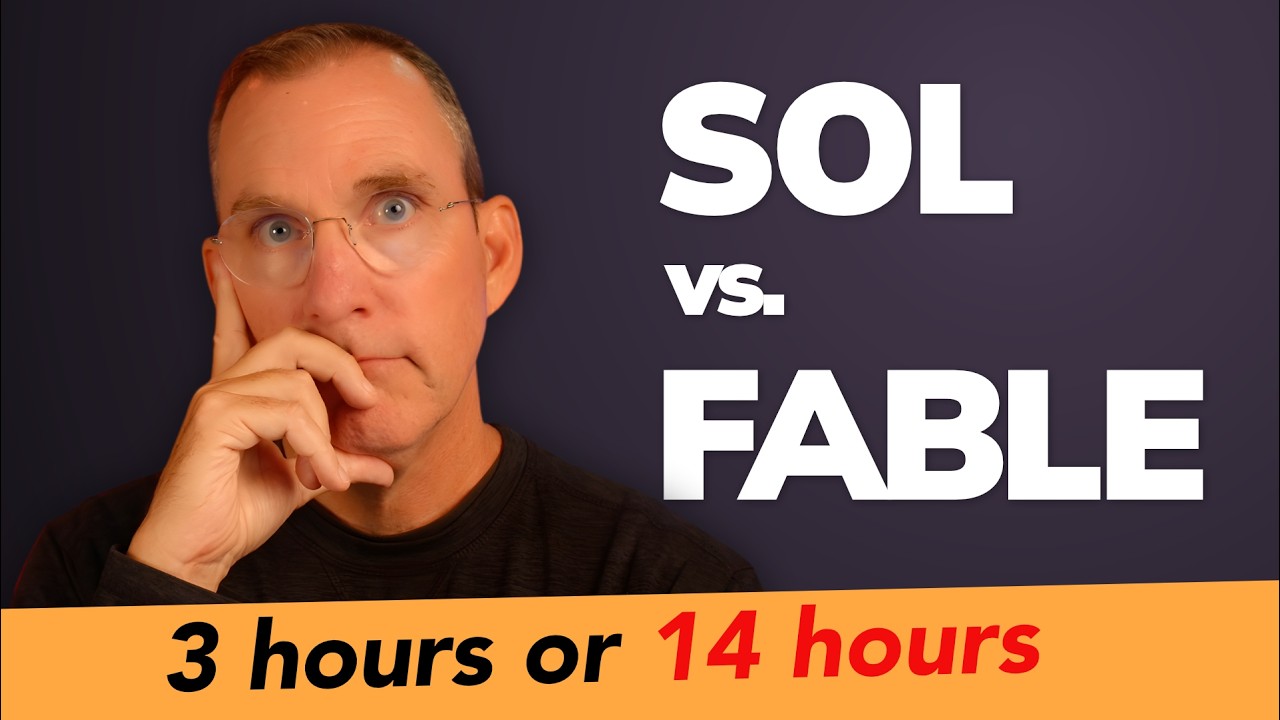
So, the first one was done in about 3
and 1/2 hours, and the next one was done
in about 14 hours. And this is work
time. The So, we're removing all of the
wait time or delay time for when it took
me time to get back, and it was asking
me questions. So, this essentially took
me several days to build, which is crazy
comparatively. So, all I can say is did
the the Soul model solve the problem?
Absolutely. Had I told it about all of
those considerations up front and been
very predictive about, "Oh, you you need
to make sure that you handle all of the
controls for touch controls, and you
need to make sure that when you make
communications between multiple players,
these kinds of things happens a lot lot
lot You know, these If I told it all of
that, I have no doubt it would have
worked." That's back to the kind of the
PRD days. Make sure you mention
everything that you needed it to know
about that it needs to address,
but that is not where we are today. The
Fable model did not require that. So,
what I would say is working in this
space is kind of a user-facing
application and this happened to be a
game, but basically a user-facing
application,
the Soul model needed me. I had to be
there. I could not get it off of my
back. The other one, Fable, more than
happy to run off, make some decisions,
and push forward, and turned out
excellent product. That's all there is
to it. If I was doing another project
similar to this, I would hands down,
without question, choose Fable right
now. Maybe GPT has another one coming or
there's some changes in their next dot
release. We're still at 4.6, not really
five for them, so maybe that's the big
change, but right now, I would say for
this kind of project, honestly, it's not
close. The fidelity in the end is
definitely close,
but it took so much of my work to get
there that
boy, I wouldn't say they're even at all.
I hope you found some value out of this.
Thanks for coming along for the ride on
this one, and I'll see you in the next
one.
Interactive Summary
Ask follow-up questions or revisit key timestamps.
The video provides a comparative analysis of using Fable and the Soul (GPT-4.6) models for building a full-stack game application. While both models were successful in producing functional deliverables, the author highlights a significant discrepancy in the development process: Fable required minimal input (6-7 messages) to achieve a polished result, while the Soul model necessitated intensive manual oversight, requiring over 65 messages and significantly more development time (14 hours versus 3.5 hours) to reach the same level of quality.
Suggested questions
3 ready-made promptsRecently Distilled
Videos recently processed by our community