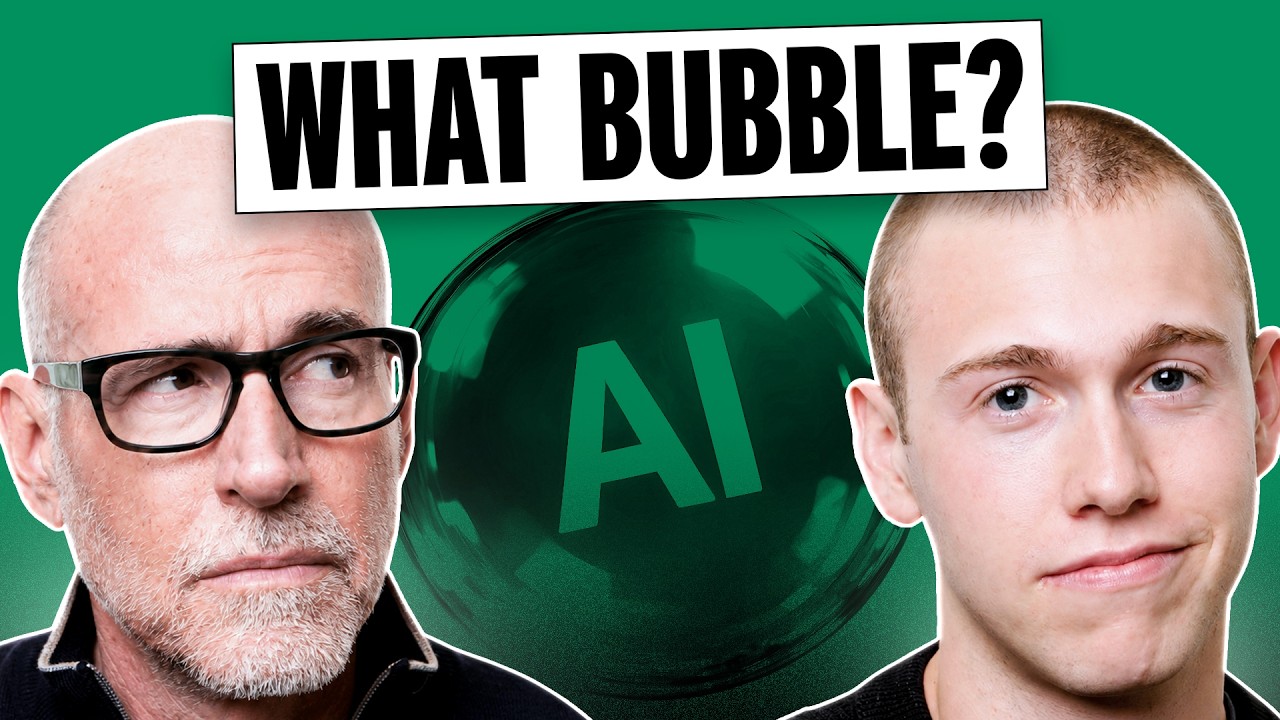
SoftBank's OpenAI Jackpot Has a Familiar Stench (Remember WeWork?)
Now Playing
SoftBank's OpenAI Jackpot Has a Familiar Stench (Remember WeWork?)
Transcript
173 segments
SoftBank just announced their earnings
this morning that they made $20 billion
off of OpenAI, at least on paper, and
now they want to invest 30 billion more.
This company, by the way, SoftBank, is
the same one that lost 16 billion on
Weiwork. Same CEO, same playbook, and
nobody is talking about it. They hit 1.6
billion net, which is a miss based on
what the analysts were expecting. But
they also reported a 19.8 cumulative
gain on OpenAI despite the fact that
this is just on paper. of that they
argue that $4.2 billion of the gain was
just this quarter which offsets their
losses on Qang DD and bite dance. They
own 11% of OpenAI, a company which by
the way was as we've said before here on
the channel does not make money. They
are not a profitable company. And the
CFO of Soft Bank, Yoshimitsuguto
said that 60% of the company's assets
are now quote ASI oriented investments.
And by ASI he means artificial super
intelligence. what Sam Alman is selling
us the dream of but has yet to
materialize. To free up this cash,
SoftBank has been making some troubling
moves. They actually sold their entire
stake in Nvidia for 5.83 billion and
then sold 12.73 billion worth of
T-Mobile stock. So, they are
centralizing around these ASI plays and
specifically around investments in
OpenAI, a company that does not make any
money. And it actually gets juicier than
that. They're actually taking out loans
against ARM Holdings to help finance
this. This is like your buddy who is
always losing money on gambling. Never
wins. Has gone from middle class salary
to pretty much destitute over the past
year. Frittering away all of his money
on gambling. And he comes to you and
he's just like, "Hey man, can I borrow
10 bucks? I got some inside information.
Can I just borrow 10 bucks?" That's
exactly what SoftBank is doing here.
They're buying from all their other
investments. They're getting loans and
they're funneling it all into ASI plays,
which we know based on their balance
sheet is primarily open AI investment, a
company that does not make money. And
maybe it's already a sunk cost fallacy
at this point. SoftBank has already put
30 billion into OpenAI. As I mentioned,
SoftBank is OpenAI's largest private
backer. So, why not throw some more cash
at it? OpenAI, as you know, if you've
been watching the channel, is working on
a $100 billion funding round, and
SoftBank is considering funding 30
billion of that. By the way, that
funding round would value Open AI at
between 830 and 850 billion. And you
know, we like to contextualize stuff on
this show. That's about the same GDP as
Argentina, which is like not a super
rich country, but at the same time, this
is a company in the US led by a guy that
has never had a real job and is not an
engineer. So, he's doing pretty well for
himself. And what's more concerning is
the CEO of the same company, Masayoshi,
says that we are 10 years from
artificial super intelligence that is
10,000 times smarter than humans. So,
they're betting the entire company on a
hypothesis that by the CEO's own
admission is not coming anytime soon.
And if you don't take my word for it,
take Sam Alman's cuz he's a super
credible guy, right? That always
delivers on what he says in a reasonable
time frame. By their own projections,
they're expecting 14 billion in losses
in this year alone. Just setting 14
billion on fire R&D. Maybe the model
gets a little bit better. Who knows?
That would make for 44 billion
cumulative losses through 2028. Which
means, as we've said many time on this
channel before, they will not be
profitable at soonest if they survive
until 2030. They're raking in money
handover fist. They made 20 billion in
2025, but their burn rate is 57% of
their revenue, which you might say it's
a new type of company. We don't really
know how to value them. And that's fine.
That's a good claim. It's a good
thought. But when we look at Anthropic,
their burn rate is expected to drop to
about 9% by 2027. OpenAI says, "No, full
boore. We're going to keep it at 57%.
We're going to go until the wheels fall
off." The company is obviously in
trouble. You'll remember that they
declared a code red in December where at
that point and continuously, Google
Gemini was beating them on benchmarks
and Anthropic took 40% of enterprise
share, which was a huge shakeup, a huge
upset. So, SoftBank is making a $30
billion bet on a company that apparently
the leadership does not even think will
pay off for the next decade as soonest.
A company that is burning money faster
than investors can get them the money
and is led by somebody who is not an
engineer and has never had a real job.
By the way, if you like the hat, it's by
abandonware. The link is down there in
the bio. And actually, this is related
in caret 95. You know, it makes me
nostalgic. The other thing that makes me
nostalgic is what's going on between
SoftBank and OpenAI because I start to
wonder, I think I've actually seen this
before. And hey, wasn't it with Weiwork
that the last time something like this
went down? And in fact, you'd be right.
This is the same bank that made the
ridiculous Wei work play. It is not only
structurally the same, it is the same in
the features. Adam Nyman, who founded
Weiwork, was a hu, a charlatan, a fraud,
just like Sam Alman is. They have an
incredible number of things in common.
So you have a visionary founder, a
massive out of proportion valuation,
dreams of boiling the oceans and
SoftBank is right there to write the
check. And the CEO of SoftBank,
Masayoshi, he has been called the quote
billion dollar loser since 2020. So he
cannot live this down even the numbers
on that were less severe, but still of
the same magnitude. In 2023, SoftBank
posted a $5.2 billion quarterly loss
because of wei work. So same guy saying,
"Trust me, different this time.
give me those 10 bucks so I can go bet.
SoftBank made $20 billion on paper,
which is not money. It's paper. And
anyone who held stocks in 1999 will tell
you the exact same thing. The question
isn't is OpenAI a real company that's
providing value. It is that's
established at this point. These AI
tools to at least some degree are
extraordinarily helpful. The question is
whether the juice is worth the squeeze
and whether SoftBank and other investors
are making an extremely poor bet based
on hype here. That's what history says.
So, with the Weiwork scheme and
SoftBank's involvement in that, and that
is what I say as the AI bubble begins to
pop. Thanks for watching. Please
subscribe and hit the mailing list down
there below.
Interactive Summary
Ask follow-up questions or revisit key timestamps.
SoftBank announced earnings revealing a $20 billion paper gain from OpenAI, yet they missed net income expectations and intend to invest an additional $30 billion. Despite OpenAI being unprofitable and forecasting substantial losses for years, SoftBank is aggressively shifting 60% of its assets into "artificial super intelligence" investments, primarily OpenAI. To finance this, they sold stakes in Nvidia and T-Mobile and took loans against ARM Holdings. This strategy, led by CEO Masayoshi Son (dubbed a "billion dollar loser"), is heavily scrutinized and compared to the company's past disastrous WeWork investment, citing similar patterns of a "visionary founder," an "out of proportion valuation," and a company rapidly burning cash.
Suggested questions
5 ready-made promptsRecently Distilled
Videos recently processed by our community